

A short definition
The CMA is the UK's competition regulator. Under the Enterprise Act 2002, as amended by the Digital Markets, Competition and Consumers Act 2024, it can review any merger that meets its jurisdiction tests. Its question is whether the deal results, or may be expected to result, in a substantial lessening of competition in a UK market.
Unlike the US and EU systems, the UK regime is voluntary and non-suspensory. Parties do not have to notify and can legally close without clearance. In practice the CMA watches deal announcements, can open its own investigation, and can impose orders that stop the parties combining their businesses while it reviews, so notification is common for deals with real UK overlap.
Real examples
| Deal | Year | What happened at the CMA |
|---|---|---|
| Meta / Giphy | 2021 to 2023 | CMA ordered Meta to sell Giphy after completion; Meta sold it in 2023 |
| Microsoft / Activision Blizzard | 2023 | Blocked in April; a restructured deal, with cloud streaming rights outside the EEA sold to Ubisoft, was cleared in October |
| Adobe / Figma | 2023 | Abandoned in December after the CMA's provisional findings and European Commission concerns |
| Vodafone / Three UK | 2024 | Cleared in December after Phase 2 with binding network investment commitments |
These cases show the range of outcomes. The CMA can unwind a closed deal, block a global deal others cleared, push parties to abandon, or accept behavioral commitments, which it historically used rarely.
Jurisdiction: which deals the CMA can review
Since January 1, 2025, a merger qualifies if any of these tests is met:
| Test | Threshold |
|---|---|
| Turnover test | Target's UK turnover above 100 million pounds |
| Share of supply test | Merged firm supplies 25% or more of goods or services of a description in the UK, and the deal increases that share |
| Hybrid test | One party has at least a 33% share of supply and UK turnover above 350 million pounds, and the other has a UK nexus |
| Small merger safe harbor | Exempt if each party's UK turnover is below 10 million pounds |
The share of supply test is flexible. The CMA chooses the description of goods or services, which lets it reach deals with small UK revenue. The hybrid test was added for acquisitions of small or early-stage firms by large incumbents.
The timeline, step by step
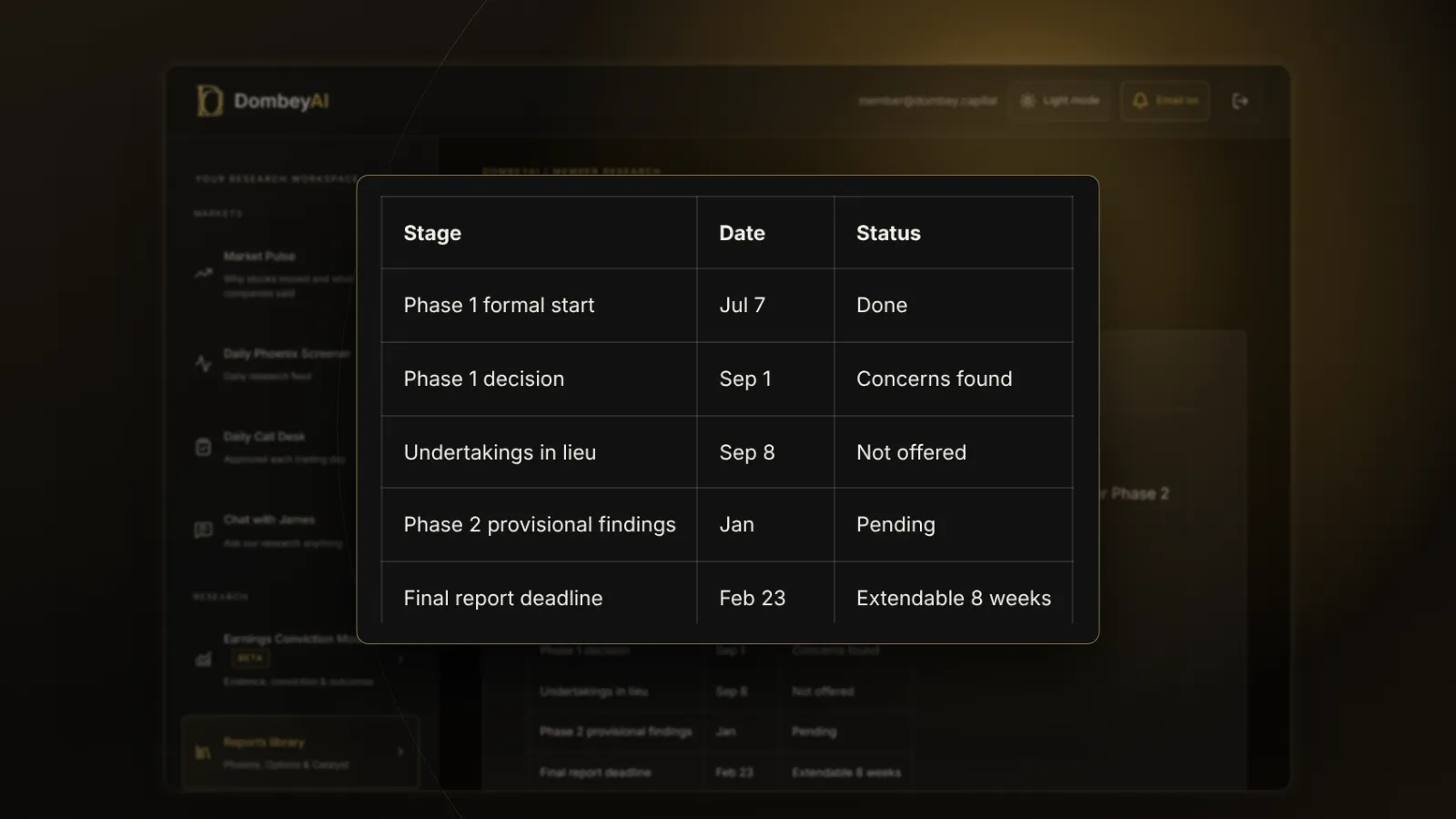
| Stage | Statutory time | What to watch |
|---|---|---|
| Pre-notification | No limit | Draft merger notice and CMA questions; can take weeks or months |
| Phase 1 formal start | Day 1 | CMA announces the case and an invitation to comment |
| Phase 1 decision | 40 working days | Clearance, or a finding that the deal may lessen competition |
| Undertakings in lieu | Short window after the decision | Parties offer a remedy, usually a divestiture, to avoid Phase 2 |
| Phase 2 reference | If no remedy accepted | Independent panel takes the case |
| Phase 2 issues statement and hearings | Early weeks | The theories of harm the panel will test |
| Provisional findings | Usually around mid-review | The first strong signal of the likely outcome |
| Final report | 24 weeks, extendable by up to 8 | Clear, clear with remedies, or prohibit |
| Remedy implementation | 12 weeks, extendable by 6 | Final undertakings or an order |
Parties can also ask to fast-track a case to Phase 2 when they accept that concerns exist, which skips part of the Phase 1 process. Since 2025 the CMA has said it is aiming to move faster on straightforward cases and to favor remedies over blocks where they can work.
How the CMA judges a deal
The legal test is whether the merger results, or may be expected to result, in a substantial lessening of competition. At Phase 1 the bar is a realistic prospect of that outcome, which is why many deals with any meaningful overlap draw questions. At Phase 2 the panel must decide on the balance of probabilities.
The CMA usually looks at three kinds of harm:
- Horizontal overlaps. The parties compete today, and combining them removes a rival. The CMA looks at shares, closeness of competition and whether other suppliers would constrain prices.
- Vertical effects. One party supplies an input the other's rivals need, so the merged firm could raise their costs or cut them off.
- Loss of future competition. A large firm buys a smaller one that could have become a serious rival. This theory drove the Meta and Adobe cases.
Remedies follow the harm. Structural remedies, usually the sale of a business that removes the overlap, remain the CMA's preferred fix. Behavioral commitments, such as supply or investment promises, are used where a sale would not work, as in Vodafone and Three.
What it means for merger arbitrage
A UK overlap adds a separate regulatory clock to a deal. Each milestone can move the spread:
- If the CMA clears at Phase 1 with no remedy, the UK risk falls away and the spread usually narrows.
- If the CMA finds concerns and the parties offer a clean divestiture, the market weighs whether the remedy is enough and whether a buyer exists.
- If the deal goes to Phase 2, expect the spread to widen on the longer timeline and higher block risk, then move sharply on the provisional findings.
- If the outside date in the merger agreement falls before the likely Phase 2 end, check the extension terms and any reverse termination fee.
The CMA's process runs alongside other reviews. The HSR waiting period covers the US process, EU merger control the European one and SAMR approval China's. How to track a merger through approval shows how to keep all the clocks in one calendar, and merger remedies covers how divestitures are judged. For recent deal moves, see the market coverage.
Dombey's published research sets out the regulatory calendar for each deal it covers; see the research archive.
Where this goes wrong
- Treating voluntary as optional. Parties that close without notifying can face an investigation after completion and an order to sell. Meta's sale of Giphy is the standard case.
- Ignoring pre-notification. The 40 working day clock starts only when the CMA formally accepts the notice. Pre-notification can take longer than Phase 1 itself.
- Assuming global alignment. The CMA, the European Commission and US agencies can reach different conclusions on the same deal, as in 2023. Model each regulator separately.
- Reading the issues statement as a verdict. Early Phase 2 documents list theories of harm to test. Many are dropped by the provisional findings.
- Missing the remedy timeline. Clearance with remedies is not the end. Agreeing and implementing a divestiture can add months before closing.
The bottom line
The CMA reviews mergers that meet its turnover, share of supply or hybrid tests, in a 40 working day Phase 1 and, where needed, a 24 week Phase 2 that can run up to 32 weeks. Notification is voluntary, but the CMA's power to call in and unwind deals makes early engagement the norm. For event-driven investors, the formal Phase 1 start, the Phase 1 decision, the provisional findings and the final report are the dates that move spreads. Read each against the merger agreement's outside date and termination fees.