

A short definition
Under the FDA's regulations, a review ends in one of two actions: an approval letter or a complete response letter. The CRL replaced the older "approvable" and "not approvable" letters in 2008. It reflects a complete review of the data submitted, and the FDA's rules say it will describe all the deficiencies the agency has identified.
After a CRL, the sponsor has three options:
- Resubmit the application with the information that addresses the deficiencies.
- Withdraw the application.
- Request an opportunity for a hearing on whether there are grounds to deny approval.
If the sponsor does none of these within a year, the FDA may treat the application as withdrawn, though extensions can be requested.
Real examples
These well-known letters show how different the requests in a CRL can be.
| Sponsor and product | Year | What the FDA asked for |
|---|---|---|
| Intercept Pharmaceuticals, obeticholic acid for NASH | 2020 | The FDA concluded the predicted benefit based on a surrogate endpoint was uncertain and did not outweigh the risks; it recommended submitting more interim data |
| Lykos Therapeutics, MDMA-assisted therapy for PTSD | 2024 | The company said the FDA asked for an additional Phase 3 study |
| Outlook Therapeutics, ONS-5010 for wet AMD | 2023 | The company said the letter cited manufacturing issues, open inspection observations and a lack of substantial evidence |
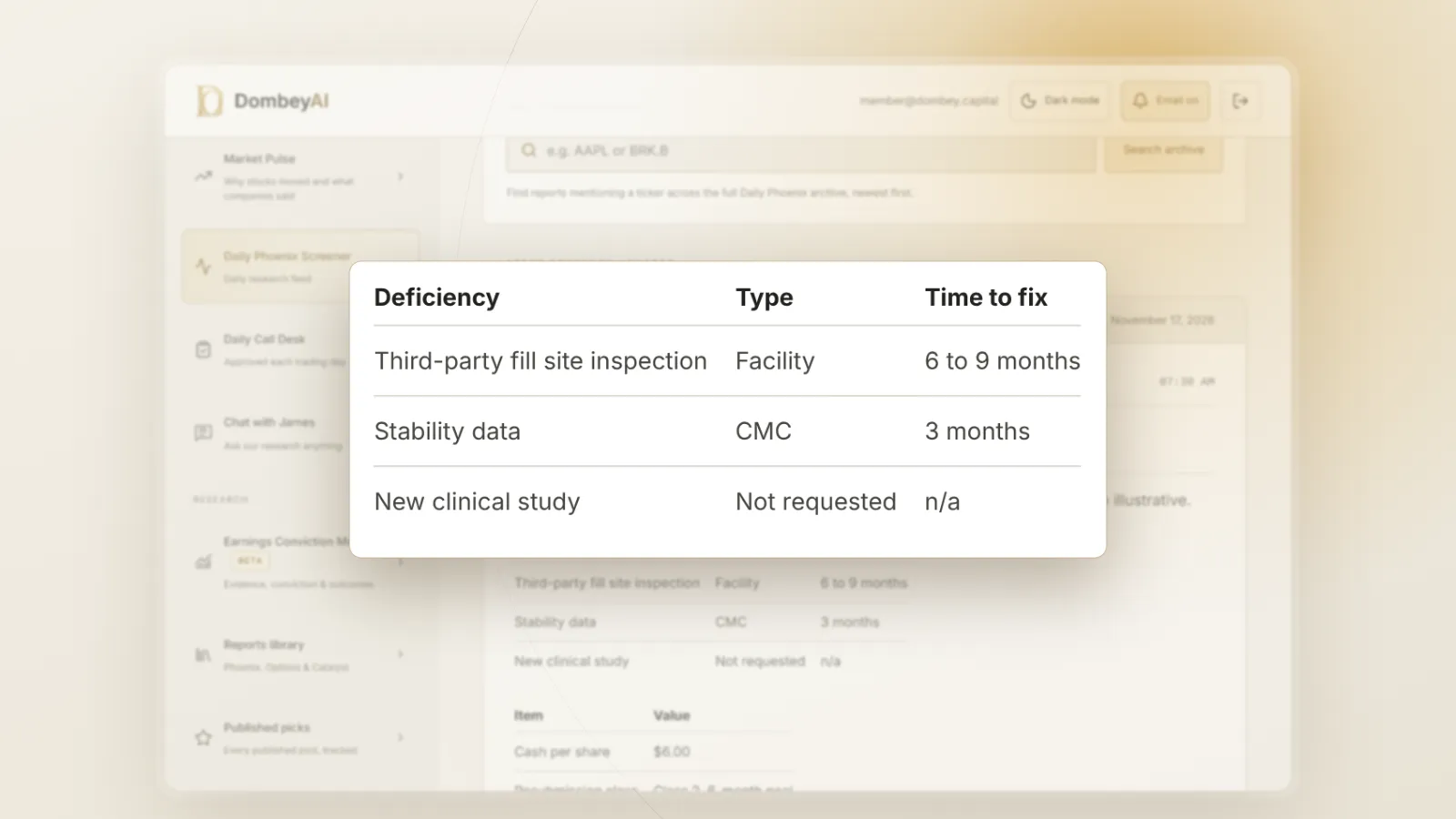
The pattern to notice: a request for a new trial is a multi-year delay, while a manufacturing or inspection issue can sometimes be resolved within a year. The company's description of the letter is a summary, and since 2025 the FDA's own published letters let investors check it.
Where a CRL sits in the review timeline
A CRL arrives on or before the PDUFA goal date, the target date set under the Prescription Drug User Fee Act. For a new molecular entity under "the Program," the goal is 10 months from the 60-day filing date for a standard review and 6 months for a priority review. The mechanics are covered in how PDUFA decision dates work.
| Stage | Typical timing | What investors see |
|---|---|---|
| Submission | Day 0 | Company announcement |
| Filing decision | By day 60 | Acceptance, or a refuse-to-file letter |
| Mid-cycle and late-cycle meetings | During review | Sometimes disclosed, often not |
| Advisory committee | If scheduled, before the goal date | Briefing documents and a public vote |
| Action | By the PDUFA date | Approval or CRL |
| Resubmission review | 2 or 6 months | New goal date |
A CRL can also arrive early. The goal date is a deadline for the FDA, not a promise of the day of decision.
What a complete response letter covers
Most letters fall into a few categories, and the category drives the delay.
- Clinical efficacy. The trials did not show substantial evidence of effectiveness. The fix is usually another trial, which means years and new funding.
- Safety. The FDA wants more patients exposed, longer follow-up or a risk management plan. The fix ranges from added data to a new study.
- Chemistry, manufacturing and controls (CMC). Problems with how the product is made, tested or kept stable. Often fixable in months.
- Facility inspections. The FDA could not complete or was not satisfied with an inspection, sometimes at a contract manufacturer the sponsor does not control.
- Labeling and other items. Minor issues, often listed alongside the main ones.
Class 1 and Class 2 resubmissions
When the sponsor resubmits, the FDA classifies the resubmission:
- Class 1 covers minor items such as labeling, safety updates or minor clarifications. The review goal is two months.
- Class 2 covers everything else, including new clinical data, a new inspection or a new safety analysis. The review goal is six months.
So a CMC-only CRL that is fixed in four months and resubmitted as Class 2 could lead to a new decision about ten months after the letter. A CRL that asks for a new trial puts the next decision years away.
How to read a CRL and the company's response
When a CRL arrives, the company usually issues a press release the same day. Since 2025, the FDA's published letters allow a comparison. A short checklist:
| Step | What to check | Where to find it |
|---|---|---|
| 1 | Every deficiency the FDA lists, in its order | The published letter, when available |
| 2 | Whether the company's release mentions each one | The press release or 8-K |
| 3 | Whether the FDA recommends a new study | The letter's clinical section |
| 4 | Any inspection or third-party manufacturer issue | The letter's facility section |
| 5 | The company's stated plan and timing | The release and the next earnings call |
| 6 | Cash and burn against that timing | The latest 10-Q |
Companies often say they will request a meeting with the FDA. A Type A meeting, the type used to discuss a CRL, is generally scheduled within 30 days of the request under the FDA's meeting guidance. The minutes of that meeting are not usually published, so the company's account of it is the main source. Treat a statement that the path forward is "clear" with care until the company names what it will submit and when.
The 8-K that announces the letter is worth reading in full, because risk factor updates and financing plans sometimes appear there first.
How the market reacts
| Scenario after the CRL | What it implies | Value per share |
|---|---|---|
| Labeling or CMC fix, resubmit in six months | A delay of about a year, little extra cash | Close to the pre-CRL value, discounted for time |
| New Phase 3 trial needed | Two to four years and a raise | Cash, minus burn, plus a heavily discounted option on the drug |
| Program abandoned | Wind-down or pivot | Cash minus liabilities and wind-down costs |
The first reaction often prices the second scenario before anyone has read the letter. When the letter turns out to be about manufacturing, the gap between the price and a probability-weighted value can be wide. When it asks for a trial, the cash position and cash runway decide whether the company can fund it without heavy dilution.
Dombey's coverage of dated catalysts, including regulatory decisions, is on the market page.
Where this goes wrong
- Trusting the press release alone. Companies summarize their own letters. Some summaries leave out deficiencies. Read the published letter when it is available.
- Ignoring third-party manufacturers. An inspection problem at a contract site can delay several unrelated drugs, and the sponsor may not control the fix.
- Assuming the goal date is the decision date. Letters can come early, and goal dates can be extended by three months after a major amendment.
- Underestimating cash needs. A new trial costs money the company may need to raise at a low price.
- Treating the CRL as the end. Many products are approved after a CRL. Others are never resubmitted. The letter's content, not its existence, tells you which path is more likely.
The bottom line
A complete response letter means the FDA cannot approve an application as submitted, and it lists why. It is a delay, not a final answer, but the length of the delay depends entirely on what the letter asks for. Read the deficiencies, sort them by the time each takes to fix, and compare that timeline with the company's cash. The stock's first move often prices the worst case before the letter is read.