

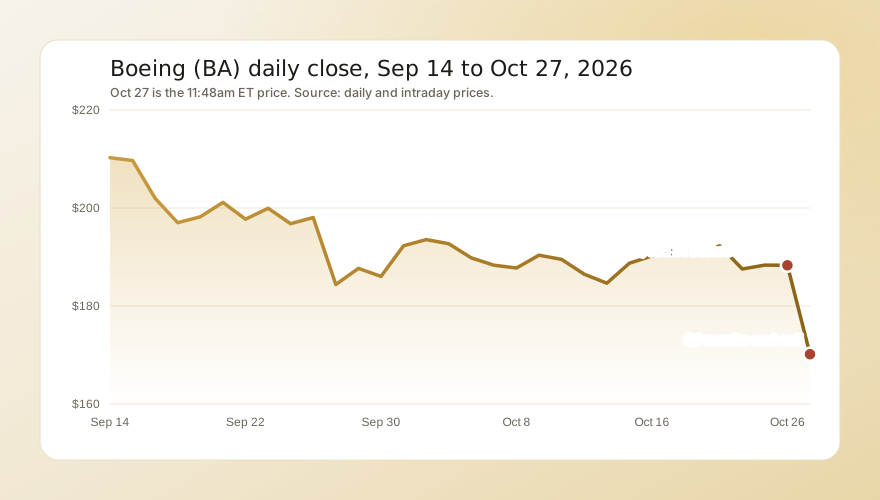
Oct 27, 2026: flat on the release, down 10% on the call
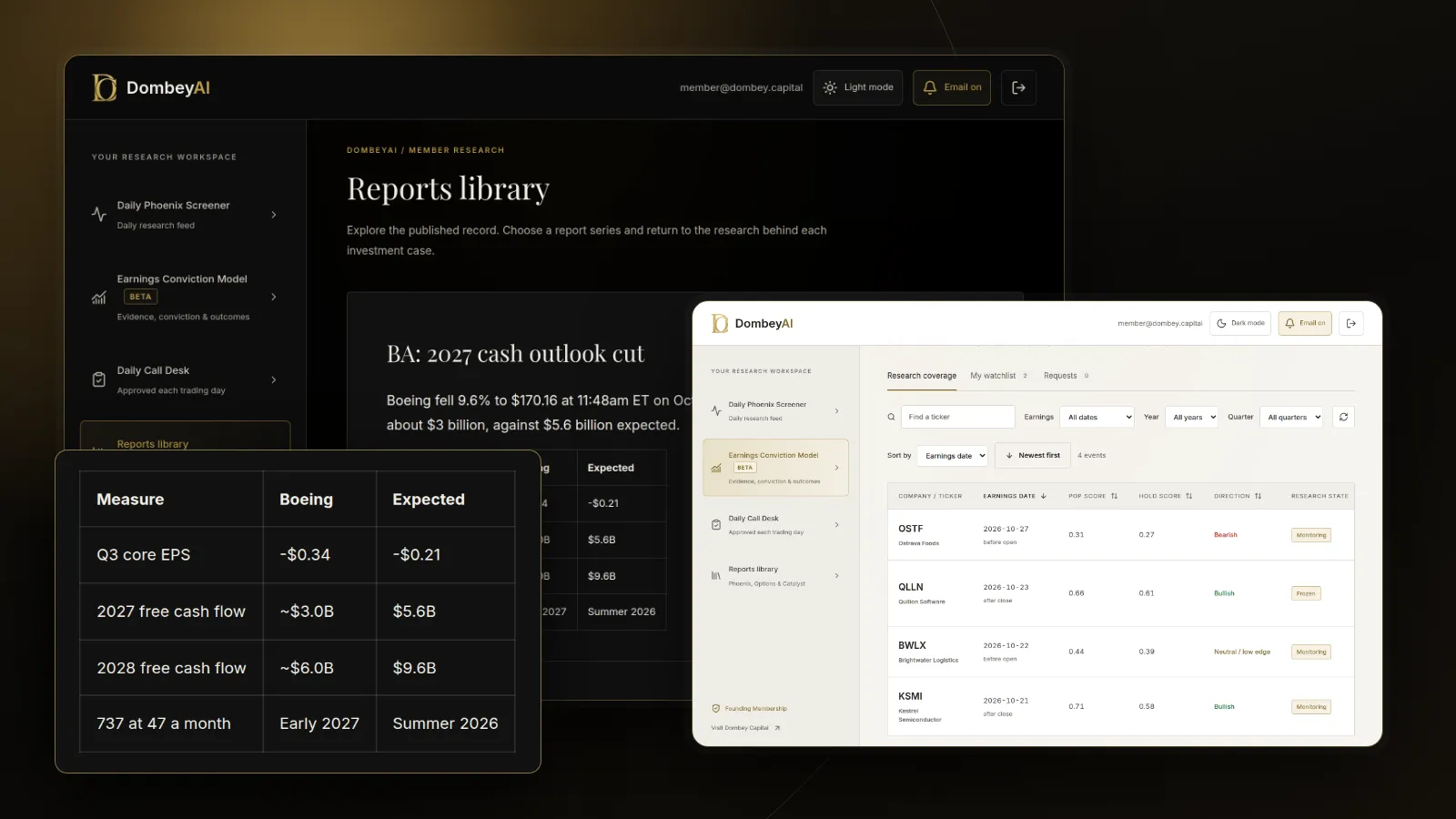
Boeing released results at 7:30am. The stock traded as high as $191.00 in the minutes after, then drifted to about $182.50 by 8:40am. It opened at $183.50, touched $187.86 in the first minutes and spent the first hour between about $183.50 and $186.50. At 10:16am it was down about 1.6%. The selling started around the 10:30am start of the call: $178.15 by 10:30am, $174.55 at 10:35am, $171.29 at 10:45am and a low of $168.42 at about 11:05am. Reuters noted the shares reached their lowest level since April 2025. By 11:48am the stock was $170.16, down $18.15, on 21.3 million shares, and the company had lost about $14 billion of market value.
What Boeing reported and said:
- Earnings. A core loss of $0.34 a share, against the $0.21 loss analysts expected. The GAAP loss was $0.26 a share, or $116 million, against a $5.34 billion loss a year earlier.
- Revenue. Up 4% to $24.19 billion, with defense up 15% and commercial down 3%.
- Cash. Operating cash flow of $1.5 billion and free cash flow of $464 million, after about $0.7 billion of Justice Department settlement payments. Nine-month free cash flow was negative $359 million.
- The 737. 124 deliveries in the quarter, about 41 a month. Ortberg said the line will take "into early next year" to reach 47, Reuters reported.
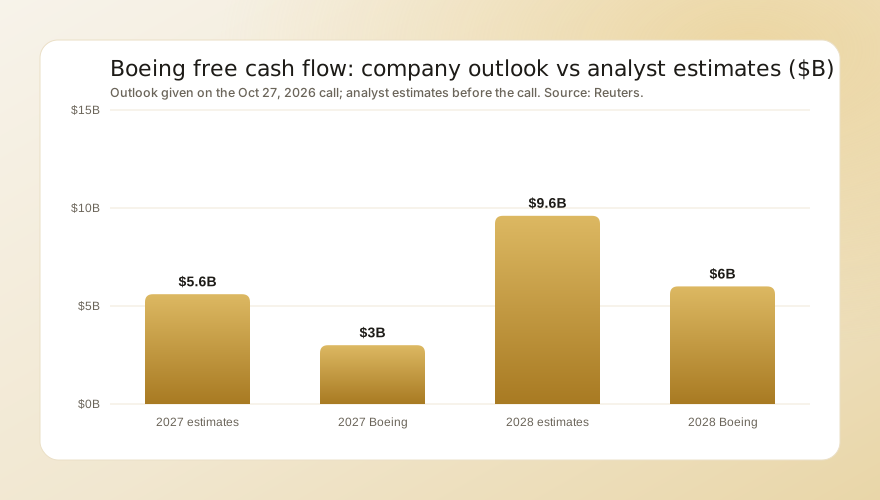
- The outlook. About $3 billion of free cash flow in 2027 and $6 billion in 2028, against analyst estimates of $5.6 billion and $9.6 billion, according to Reuters.
After the drop, RSI(14) stood at 26, the shares sat 14.5% below their 50-day average and 21.9% below their 200-day average, volume was already 2.8 times its 20-day average for a full day, and the stock was 33.0% below its 52-week high of $254.35. More of the day's big moves are in today's biggest stock moves.
The numbers behind the move
| Segment | Q3 2026 revenue | Q3 2025 revenue | Q3 2026 margin | Q3 2025 margin |
|---|---|---|---|---|
| Commercial Airplanes | $10.72B | $11.09B | -6.5% | -48.3% |
| Defense, Space & Security | $7.94B | $6.90B | 6.2% | 1.7% |
| Global Services | $5.57B | $5.37B | 18.3% | 17.5% |
| Total | $24.19B | $23.27B | 1.5% | -20.5% |
The year-ago comparison flatters the quarter, because the third quarter of 2025 carried a large 777X charge. Against this year's own run rate the commercial business went backward: the first-half margin was negative 4.2%. Boeing blamed a less favorable delivery mix, higher projected costs tied to future production rate changes and higher supply chain costs. Total deliveries were 161, one more than a year ago, with 22 787s against 24.
The defense margin also had help. It included a $252 million gain on the sale of HRL Laboratories; without it, the unit earned about 3.0%. Global Services earned about $1.02 billion, more than enough to cover the jetliner loss. Our guide on how to read an earnings release covers how to strip one-time gains like this one from segment margins.
The balance sheet held steady. Cash and marketable securities were $20.7 billion, up from $20.0 billion in June, against $45.9 billion of debt, unchanged, and $10 billion of undrawn credit lines. Net debt was $25.2 billion, down from $25.9 billion in June.
Why the call mattered more than the release
The release did not include a multi-year cash outlook. The call did, and that is where the move came from. Our explainer on why guidance changes move stocks covers the pattern: a forward number well below what the market had priced matters more than a quarter that is roughly in line.
Three points set the 2027 figure apart:
- It is a large gap. $3 billion against $5.6 billion is a 46% shortfall, and the 2028 figure trails by $3.6 billion.
- It follows a pattern. Ortberg had already said in September that the wings could not be built fast enough, and the 47-a-month rate was first meant for this summer. Each slip moves cash further out.
- It changes the math on valuation. At a market value of about $134.5 billion, $3 billion is a free cash flow yield of about 2.2%. Our page on free cash flow yield explains why that ratio carries weight for a company whose story rests on a cash recovery.
The bull case
- The cash beat was real. $464 million against forecasts of $238 million, after a $0.7 billion legal payment. Three of the last four quarters were positive.
- Demand is not the problem. The backlog rose to a record $745.4 billion from $682.2 billion at the end of 2025, and Boeing booked 300 net commercial orders in the quarter.
- The product line is filling in. The FAA certified the 737-7 in the quarter and the 737-10 in October, and the 777X remains on track for first delivery in 2027.
- Defense has turned. Revenue up 15%, a positive margin and the Navy's F/A-XX award give Boeing a second leg while the jet business recovers.
The risks
- Estimate cuts. Analysts' 2027 earnings estimate of $3.56 a share was set before the cash outlook. Our explainer on earnings estimate revisions covers why the weeks after a guide like this can weigh on a stock.
- The fourth quarter. Hitting the 2026 range needs $1.4 billion to $3.4 billion in one quarter, more than double Boeing's best recent quarter.
- Supply. Engine deliveries and wing output have slowed both the 737 and the 787, which is stuck at 8 a month.
- Customers. Oil prices are up nearly 60% since late June, which strains the airlines that buy Boeing's jets.
What comes next
- Monthly orders and deliveries reports in November and December. The 737 count is the cleanest read on whether 47 a month arrives in early 2027 as promised. Our guide on how to build a catalyst calendar shows how to track dates like these.
- Fourth-quarter results, expected in late January 2027. Watch fourth-quarter free cash flow against the $1 billion to $3 billion full-year range, and any change to the 2027 figure.
- 777X certification ahead of first delivery, which Boeing still targets for 2027. A slip there would hit 2027 deliveries and cash again. Our guide on how to analyze an earnings call transcript covers how to read management's timeline language.