

Oct 21, 2026: Abbott's diabetes outlook pulls Dexcom down
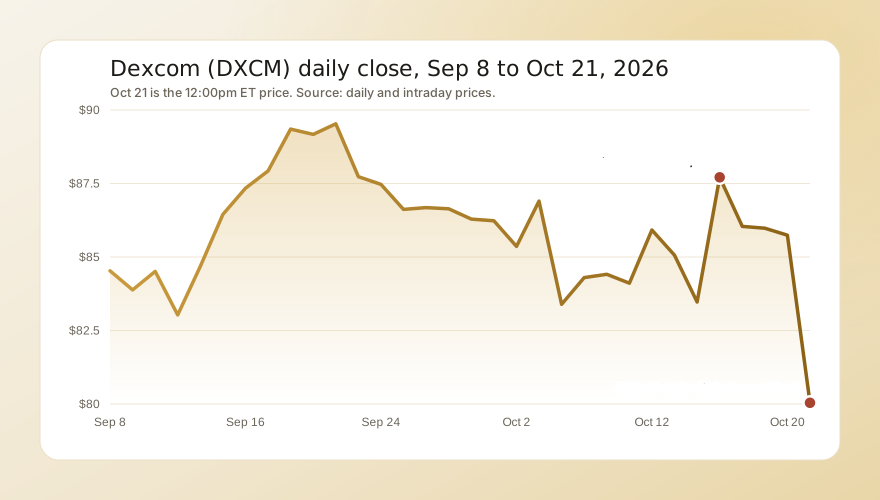
Dexcom first traded before the bell at $84.95 at about 8:20am, down 0.9%, and was $84.05 at 9:25am. It opened the regular session at $83.75, down 2.3%, and bounced to $86.17 by 9:40am, above the Oct 20 close. The bounce did not last. As Abbott's call went on, the stock fell in a steady line, with no single drop: $83.13 at 10am, $81.86 at 11am, and a low of $79.92 at about 11:45am. At noon it was $80.04.
What pushed it down:
- Abbott cut its diabetes growth outlook. Abbott's third-quarter Diabetes Care sales were $2.19 billion, up 6.2% reported and 6.7% on a comparable basis. U.S. sales rose 9.4% to $872 million and international sales rose 4.9% comparable to $1.31 billion. Glucose monitor sales grew 7.7% comparable. Investing.com reported that Abbott now expects low-to-mid single-digit diabetes growth in the fourth quarter and probably for the next few quarters.
- Overseas pricing. "I actually expected to be a little bit more price pressure internationally, a little bit earlier," Ford said. "I think it would be a strategic mistake for us to lose market share based on price in these international markets." He said Abbott will make some pricing adjustments, lock in longer-term contracts, and offset the margin impact with cost programs.
- Type 2 coverage. Ford said the glucose monitor market "had not seen a significant new reimbursement expansion for quite some time," and declined to forecast when Medicare will cover type 2 patients who do not take insulin. "I am not going to say that it is embedded in a forecast for next year," he told Citi's Joanne Wuensch.
- Abbott fell too. Abbott traded between $97.67 and $106.35 and was $98.33 at noon, down 4.0%. It also cut its full-year comparable sales growth outlook to about 6%, citing electrophysiology as well as diabetes, and announced a plan to spin off its nutrition business by the end of 2027.
What held it up:
- A beat elsewhere in the report. Abbott's total sales rose 7.0% on a comparable basis to $13.01 billion and adjusted earnings were $1.42 a share. It narrowed its full-year adjusted earnings range to $5.50 to $5.55.
- Ford expects a rebound. He said a payer formulary change in Abbott's favor takes effect on January 1, 2027, that the Libre Duo glucose and ketone sensor launches in the U.S. in December, and that it "would not surprise me at all" if diabetes growth comes in much better than the new range next year.
At 12:00pm, from the Oct 20 close:
| Stock or fund | Oct 20 close | Oct 21, 12:00pm | Change |
|---|---|---|---|
| Dexcom (DXCM) | $85.74 | $80.04 | -6.7% |
| Abbott (ABT) | $102.45 | $98.33 | -4.0% |
| iShares medical devices ETF (IHI) | $54.27 | $53.21 | -2.0% |
| Medtronic (MDT) | $94.63 | $93.29 | -1.4% |
| Insulet (PODD) | $142.64 | $141.24 | -1.0% |
| Health Care Select Sector SPDR (XLV) | $179.82 | $178.18 | -0.9% |
| Tandem Diabetes Care (TNDM) | $16.52 | $16.55 | +0.2% |
| MiniMed (MMED) | $17.49 | $17.78 | +1.6% |
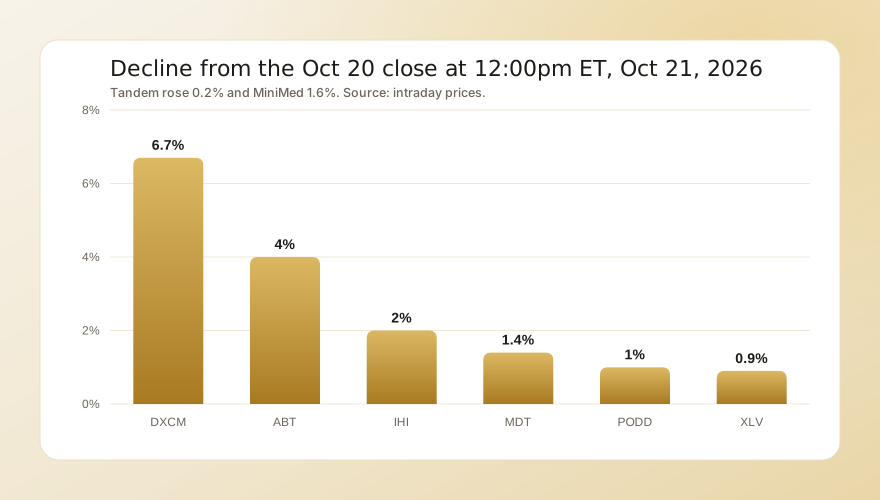
Dexcom fell further than Abbott, the company that actually reported. The insulin pump makers, Insulet, Tandem and MiniMed, barely moved, so the selling was aimed at glucose sensor pricing, not at diabetes devices as a group. That is a read-through trade: Dexcom is being priced on a competitor's comments about a market they share, which is why Abbott's call is worth reading line by line; our guide on how to analyze an earnings call transcript covers how. For more on how a change in outlook moves a stock, see our explainer on why guidance changes move stocks, and for other big names moving today, see today's biggest stock moves.
After the drop, RSI(14) stood at 36, the shares sat 8.3% below their 50-day average and 7.9% above their 200-day average, volume of 2.4 million shares by noon ran 0.8 times its 20-day average of 3.2 million, and the stock was 13.5% below its 52-week high of $92.59.
The numbers: Abbott's slowdown against Dexcom's last quarter
Dexcom last reported on July 30. Second-quarter revenue rose 13% to $1.308 billion. U.S. revenue grew 11% to $933.4 million and international revenue grew 19% reported, or 16% organically, to $375.0 million. Non-GAAP gross margin rose four points to 64.1%, and non-GAAP operating margin rose 5.9 points to 25.1%. Dexcom raised the midpoint of its 2026 revenue range to $5.18 billion to $5.25 billion, 11% to 13% growth, and ended June with $1.95 billion of cash and marketable securities.
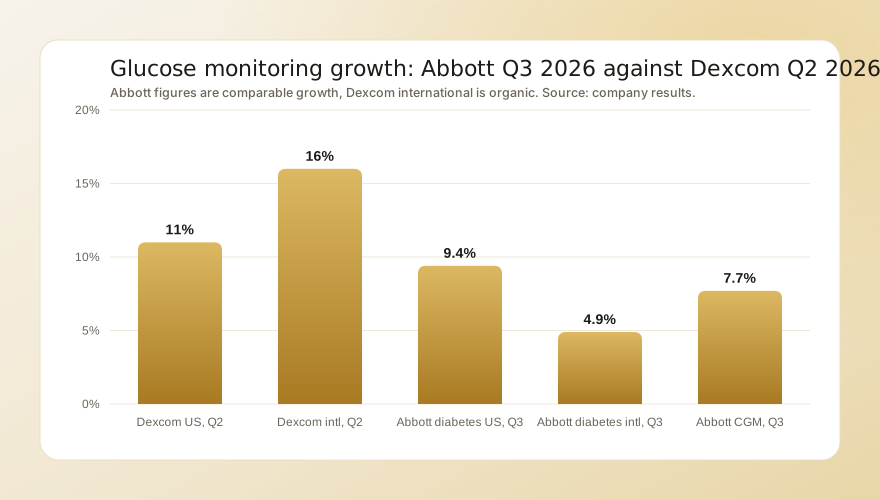
The comparison is not exact: the quarters differ by three months and Abbott's Diabetes Care line includes more than sensors. But it shows where the pressure sits. Abbott's U.S. business is still growing near 10%. Its international business, which is larger than its U.S. business, grew less than 5%, and that is where Abbott plans to adjust prices. Dexcom's international business is smaller, about 29% of revenue, but it has been growing faster than the U.S. A price move by the market leader there would hit the part of Dexcom that has been carrying growth.
Dexcom's first-half revenue was $2.50 billion, so its full-year range implies $2.68 billion to $2.75 billion in the second half. Analysts expect third-quarter revenue of about $1.33 billion and earnings of about $0.68 a share.
The case for the stock
- Dexcom keeps beating. It topped earnings estimates in each of the last four quarters, with $0.70 a share against $0.61 expected in the second quarter.
- The type 2 evidence just got stronger. On Oct 14, after the close, The New England Journal of Medicine published Dexcom's CONNECT trial, which found that glucose monitoring improved blood sugar control in people with type 2 diabetes who do not take insulin. The stock rose 5.1% on Oct 15. Wider Medicare coverage would open that group to both companies.
- The Street still sees upside. The average analyst target is $96.14, 20% above the noon price, and Mizuho and BTIG both raised targets in the past two weeks.
The risks
- A price fight overseas. If Abbott's adjustments spread from a few contracts into national tenders, Dexcom would have to choose between price and share.
- Medicare timing. Abbott is not counting on type 2 coverage next year. If Dexcom also pushes back its timing, a large part of the long-term growth case moves further out.
- Valuation. At about 31 times trailing earnings, the stock trades on growth holding near the low teens. Our explainer on forward and trailing P/E covers why the multiple can compress faster than earnings fall.
What comes next
- Dexcom's third-quarter report, October 29 after the close. Watch international organic growth, any change to the 2026 revenue range, gross margin against the roughly 64% guided, and what management says about pricing outside the U.S. Our guide to preparing for an earnings report covers what tends to move a stock on the day.
- Any Medicare coverage decision for type 2 patients not on insulin. That is the largest single change either company is waiting on.
- Libre Duo's U.S. launch in December. A new Abbott sensor adds competition in the U.S., where Dexcom earns most of its revenue.