

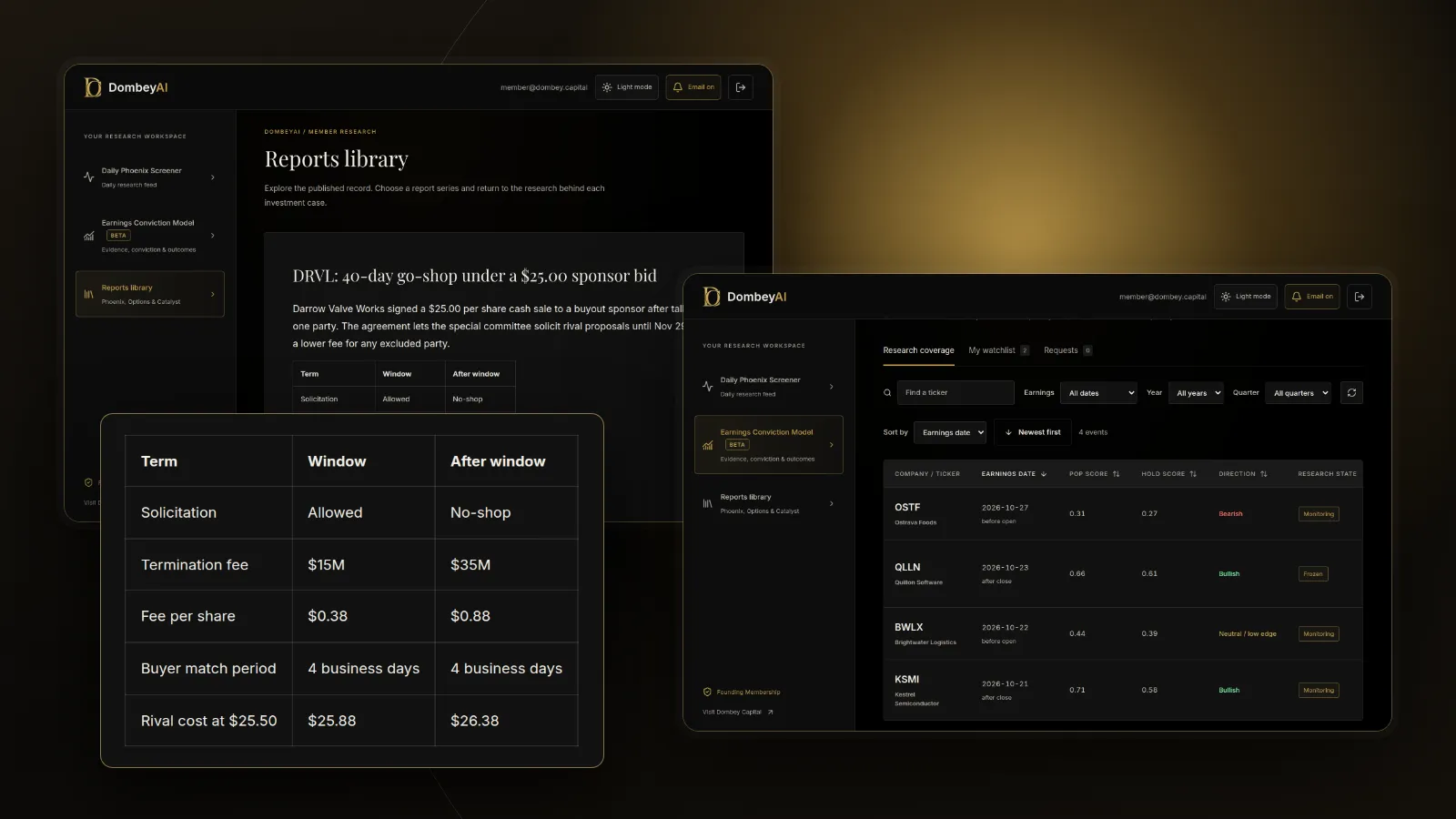
Why go-shops exist
Most public company sales are signed after the target's advisors have contacted some set of potential buyers. Sometimes a board signs with one buyer after little or no market check, often because the buyer asked for exclusivity, because the board feared a leak, or because a private equity sponsor approached the company directly.
When directors are selling the company, they are expected to seek the best value reasonably available. A go-shop gives the board a way to meet that expectation after signing. The deal price is public, every potential buyer knows the number to beat, and the board's advisors spend several weeks calling them.
The first buyer accepts this because it gets a signed deal and protection if it is outbid: matching rights and a termination fee. That trade is why go-shops show up most often in going-private transactions and sponsor-led buyouts, and less often in strategic deals that followed a broad auction.
How a go-shop works, step by step
The mechanics differ by agreement, but the sequence is usually the same:
- Signing and announcement. The parties sign the merger agreement, issue a press release and file an 8-K. The release often states that the agreement includes a go-shop and gives its end date.
- The window opens. The target and its bankers contact potential bidders, share confidential information under confidentiality agreements and invite proposals. The agreement usually requires the target to give the first buyer the same information it gives rivals.
- Proposals arrive, or do not. The board judges any proposal against the standard in the agreement, usually whether it is, or could reasonably be expected to lead to, a superior proposal.
- Excluded parties are named. A bidder that clears that bar by the end of the window typically becomes an "excluded party." The target can keep talking to it after the window closes.
- The window closes. The target becomes subject to a no-shop for everyone else. Many targets announce the result in a press release, sometimes stating how many parties were contacted.
- Matching and termination. If an excluded party makes a superior proposal, the first buyer gets a set number of business days to match. If it does not, the target can terminate and pay the termination fee before signing with the new bidder.
The go-shop usually runs at the same time as the preparation of the proxy statement or tender offer documents, and alongside any antitrust filing. For a cash deal reviewed under the Hart-Scott-Rodino Act, the HSR waiting period can overlap with the window, so a go-shop does not always delay the expected closing date.
Go-shop vs no-shop
| Term | Go-shop | No-shop |
|---|---|---|
| Can the target solicit offers? | Yes, during the window | No |
| Can the board respond to an unsolicited offer? | Yes | Usually yes, if it could lead to a superior proposal |
| Termination fee for a rival found | Often a lower tier during the window or for excluded parties | Full fee |
| Matching rights for the first buyer | Usually yes | Usually yes |
| Typical setting | Going-private and sponsor deals, limited pre-signing market check | Most strategic deals and deals after a full auction |
| What changes at the end | Becomes a no-shop, except for excluded parties | Nothing |
Most agreements with a go-shop have both: a go-shop for the opening weeks and a no-shop afterward.
The terms that decide whether a rival can win
Two go-shops with the same length can be very different in practice. These are the provisions to read:
- Length of the window. Windows of roughly one to two months are common. A short window makes it harder for a new bidder to complete diligence and line up financing.
- The fee tiers. The agreement usually sets a lower termination fee for a deal with an excluded party and a full fee for anyone else. Compare the two amounts with the deal's equity value.
- The excluded party definition. Some agreements require a written proposal by the end of the window; some require the board to have made a determination by then. A tight definition narrows who keeps the lower fee.
- When the lower fee ends. Some agreements give an excluded party the lower fee only if it signs within a set number of days after the window closes.
- Matching rights. The number of business days the first buyer gets to match, and whether it gets a fresh, often shorter, period for each revised proposal.
- Information rights. Whether the target must tell the first buyer the identity of bidders and the terms of their proposals.
- Management and rollover arrangements. If senior managers will invest alongside the first buyer, rival bidders may doubt they will get a fair hearing. Check whether a special committee of independent directors runs the process.
The go-shop language sits in the covenant on solicitation of other proposals. The fees and their triggers sit in the termination article. Read them together.
What a rival actually has to pay
A rival does not just need to beat the signed price. It needs to beat it by enough to cover the termination fee the target owes the first buyer, and by enough again to survive a match.
The example shows why the fee tier matters more than the headline window length. A lower fee during the window reduces the hurdle, but the matching right means a rival can do the work and still lose.
How investors read a go-shop
For holders of the target, the go-shop is a dated event inside the deal timeline. It belongs on a catalyst calendar with the proxy filing, the vote or tender expiration and the regulatory dates.
The common questions while the window runs:
- If the deal was signed without a pre-signing auction, the go-shop is the first real market check, and it is more likely to draw interest than one that follows a broad sale process.
- If the target trades above the deal price, the market is pricing some chance of a higher bid. Ask what evidence supports that, such as a known prior bidder.
- If the target trades below the deal price, that gap is the merger arbitrage spread, and it reflects closing risk, time and financing, not the go-shop. The guide to calculating a merger arbitrage spread shows the arithmetic.
- If insiders are rolling equity into the buyer, read the special committee's role and the background section of the proxy closely.
- If the window ends quietly, the stock usually settles into a normal spread. The go-shop result press release, or an 8-K, is the dated signal.
When a topping bid does arrive, the target typically files the new agreement or a revised one on Form 8-K. The guide to reading an 8-K for catalysts covers what to look for in the item list. Later, the background section of the proxy, covered in the guide to reading a proxy statement, describes how many parties the bankers contacted, how many signed confidentiality agreements and what they said. For recent single-day moves on deal news, see today's biggest stock moves.
Where this goes wrong
- Assuming a go-shop means a higher bid. Many windows end with no competing proposal. Pricing a topping bid into the target because of the clause alone is speculation.
- Ignoring the first buyer's advantage. The original buyer has completed diligence, has financing in place and holds matching rights. Rivals know this, and some will not spend money on a process they expect to lose.
- Reading the headline length and skipping the definitions. A 45-day window with a narrow excluded party definition can offer less than a 30-day window with a loose one.
- Missing the management angle. When executives are partners of the buyer, the process depends on how independent the special committee is.
- Treating the window as a guarantee of fairness. A go-shop that follows a short, private negotiation is a check on the price, not proof that it is the best one. Shareholders still decide in the vote or the tender.
- Forgetting that the deal can still fail. A go-shop does nothing for regulatory, financing or vote risk. The article on what happens when a merger fails covers the other side.
Where to find the terms
The merger agreement is usually filed as Exhibit 2.1 or 10.1 to the 8-K announcing the deal, generally within four business days of signing under Item 1.01. SEC EDGAR full-text search finds go-shop language across filings with a search for "go-shop" or "excluded party". In a tender offer, the offer documents describe the process; the article on how tender offers work covers that timeline. Dombey's published research tracks dated deal milestones like these for the situations it covers; see the research archive.
The bottom line
A go-shop period lets a target that signed a merger look for a better offer for a set time after announcement, usually with a lower termination fee for bidders found in that window. It is common in going-private and sponsor deals where the board did limited shopping before signing. The terms that matter are the fee tiers, the excluded party definition and the first buyer's matching rights, not just the length. Treat the window as a dated event to monitor, and do not price in a higher bid without evidence of real interest.