

How the premium is calculated
The formula is simple:
Premium = (Offer price per share / Unaffected price) - 1
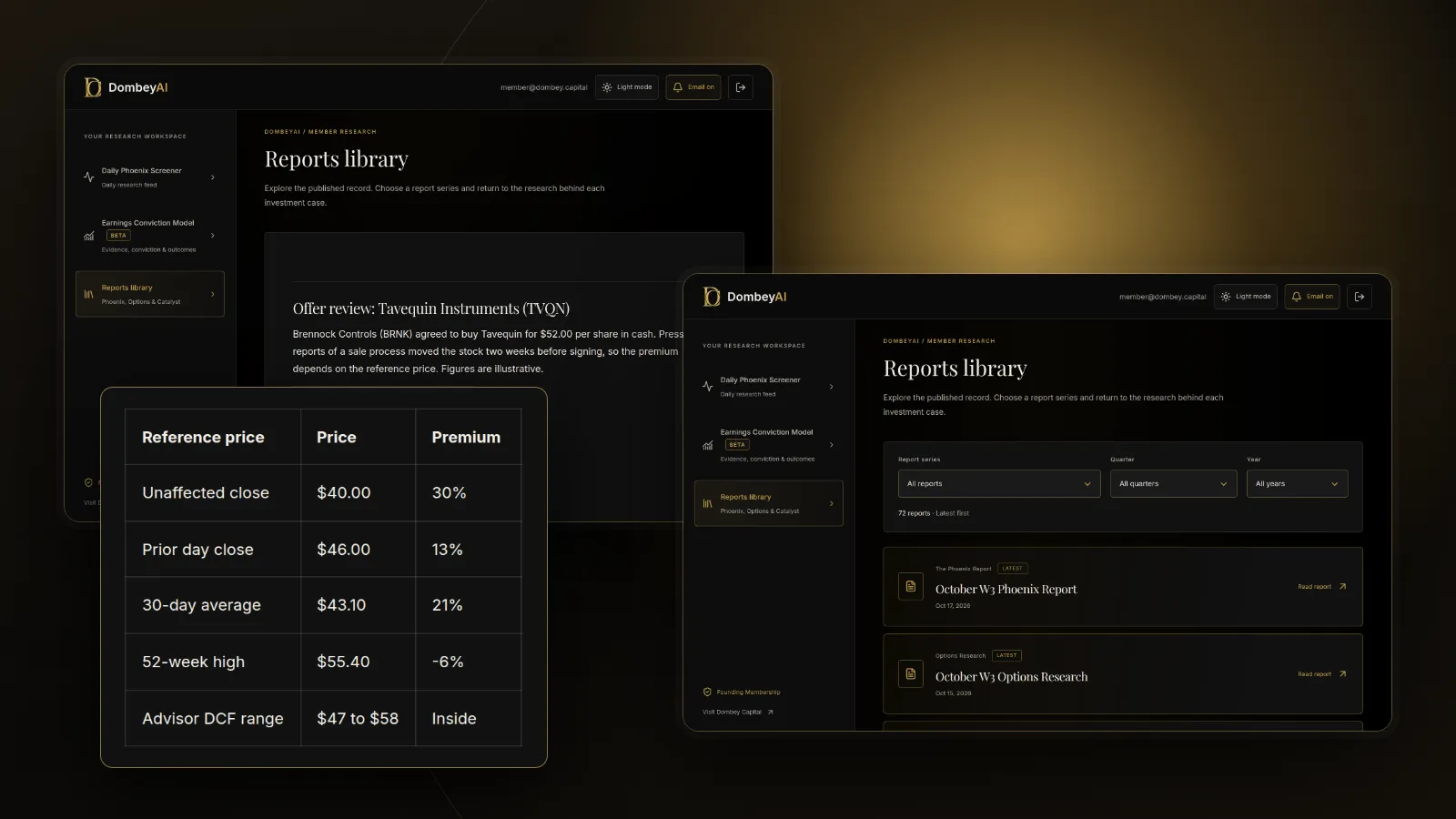
The hard part is the denominator. The unaffected price is meant to be the price the market would set without any knowledge of the deal. In practice there are several candidates, and advisors usually show more than one.
| Reference price | What it captures | When it misleads |
|---|---|---|
| Prior day close | The market price just before the announcement | The stock already rose on a leak or rumor |
| Unaffected date close | The price before the first leak, 13D filing or press report | Choosing the date involves judgment |
| 30-day volume-weighted average | A smoothed recent price | The stock trended sharply in that window |
| 52-week high | The recent peak holders remember | The peak reflected conditions that no longer hold |
| Enterprise value basis | Offer value including net debt, versus market enterprise value | Debt levels changed between dates |
The last row matters for companies with heavy debt or large cash balances. A 30% premium on the equity of a highly indebted company is a much smaller premium on the whole business. Our explainer on what enterprise value is shows the conversion.
Where the premium is disclosed
The buyer and target usually state the premium in the announcement press release, and the company files the merger agreement with a Form 8-K under Item 1.01 within four business days of signing. The more useful detail comes later, in the merger proxy or the tender offer documents.
Schedule 14A, Item 14, requires a merger proxy to describe reports, opinions and appraisals from outside parties that relate to the deal. In practice that section summarizes the financial advisor's fairness opinion and the analyses behind it: comparable companies, precedent transactions, discounted cash flow and, often, the premiums implied by the offer against several reference prices. In going-private deals, Item 1015 of Regulation M-A requires similar disclosure. Our guide on how to read a proxy statement shows where these sections sit.
The "Background of the Merger" section is the other one to read. It tells you how many bidders there were, how many times the price was raised and who started the talks.
What drives the size of the premium
Two separate questions decide the premium. First, how much could the buyer pay and still earn its return? Second, how much of that maximum does the target capture? The first sets a ceiling. The second sets where the price lands under it.
What sets the buyer's ceiling
- Cost savings. A strategic buyer that can close overlapping offices, plants or sales teams expects lower combined costs. The present value of those savings, net of the cost to achieve them, is the largest source of room in many deals.
- Revenue gains. Selling the target's products through the buyer's channels, or the reverse. These are less certain than cost savings, and boards usually give them less weight.
- Control itself. A buyer can change capital allocation, sell assets, cut a costly project or replace management. A financial buyer relies mostly on this and on financing.
- Financing and tax. A private equity buyer funding a deal with debt can pay more when borrowing costs are low and lenders are willing. Tax attributes, such as usable losses, can add value for some buyers.
- Strategic necessity. A buyer that would lose ground if a rival owned the target may pay more than the standalone math suggests.
What decides the target's share
- Competition. A second bidder, or a credible threat of one, is the strongest lever a target has. The background section often shows prices rising in steps as bidders respond to each other.
- A depressed starting price. A stock that has fallen well below its recent range can show a large premium at a price that is still low against the business's value. The reverse also holds: a stock near its high leaves less room for a headline premium.
- The board's position. A board with no pressure to sell can refuse low offers. A company with near-term debt maturities, a weak quarter or an activist pushing for a sale has less leverage.
- Large holders and insiders. A founder or controlling holder who supports the deal makes approval easier and can cap the price. One who opposes it can force a higher bid.
- Deal protections. A large termination fee, matching rights and no-shop clauses can discourage rival bids. Our guide on how to read a merger agreement explains where these terms appear.
Cash, stock and contingent consideration
The form of payment changes what the premium means.
In a cash deal, the premium is fixed at signing. If the deal closes, holders receive the stated amount, and the only open questions are timing and completion risk.
In a stock deal with a fixed exchange ratio, target holders receive a set number of buyer shares. The premium moves every day with the buyer's share price. A 30% premium at signing falls to about 15% if the buyer's stock drops about 12% before closing. Some agreements include a collar, which adjusts the ratio within a range to limit those swings. Target holders also become owners of the combined company, so they share in the savings and the risks.
In a deal with a contingent value right, part of the payment depends on a later event, such as a drug approval or a sales milestone. The headline premium often includes the full CVR value, which overstates what holders can count on. Our explainer on what a CVR is covers how to value one.
How the premium connects to deal trading
Once a deal is announced, the target's stock rarely trades at the full offer price. The gap between the two, the spread, is the market's price for time and completion risk. The premium is still relevant after announcement, for two reasons.
First, a large premium raises the cost of a deal break. If the deal fails, the target's stock may fall back toward its standalone value, and the larger the premium, the larger the potential drop. Our piece on what happens when a merger fails covers that repricing.
Second, a small premium can invite a higher bid or holder opposition. If the target trades above the offer price, the market is pricing an improved offer. Holders in Delaware companies who believe the price is too low may also have appraisal rights under Section 262 of the Delaware General Corporation Law, if they meet its conditions. The court then decides fair value "exclusive of any element of value arising from the accomplishment or expectation of the merger," which means the court does not simply hand the buyer's expected savings back to the holder.
For tender offers, the rules add a timing floor: under Rule 14e-1 an offer must stay open at least 20 business days, and a change in the price or in the percentage of shares sought requires the offer to stay open at least 10 business days after the change is announced. See what a tender offer is for the full timeline.
How to judge a premium yourself
- If the stock moved before the announcement, find the unaffected date in the proxy and recompute the premium from it.
- If the deal is paid in stock, value the offer at the buyer's current price, not the price at signing.
- If the proxy shows only one bidder and no price increases, the board accepted the first number it could get. Read why.
- If the offer is below the 52-week high, ask whether the business has truly weakened or whether the board is selling at a low point.
- If insiders are rolling equity or receiving new contracts from the buyer, read the conflicts section before relying on the premium. Our explainer on going-private transactions covers those cases.
- If the target ran a formal sale process first, the premium reflects a test of the market. Our piece on what a strategic review is explains how those processes run.
Dombey's published research covers announced deals as dated catalysts; see the research archive.
Where this goes wrong
- Trusting the headline number. The press release picks the reference price that flatters the deal. Recompute it from a date you can defend.
- Treating the premium as fairness. A premium measures the price against the market, and the market price may have been low. Compare the offer with your own estimate of value.
- Ignoring the buyer's stock. In a stock deal, the premium is a moving number until closing.
- Counting contingent payments at full value. A CVR or earnout may pay nothing.
- Using averages to predict a bid. A premium reflects one buyer's savings, financing and competition at one moment. Published averages mix very different deals and say little about a specific company.
- Forgetting completion risk. A large premium is worth little if regulators block the deal or financing fails. Read the conditions before treating the offer as money in hand.
The bottom line
A takeover premium is the percentage an acquirer pays above the target's unaffected price. Its size depends on the reference price chosen, on what control is worth to the buyer and on how much of that value the target's board can win through competition and bargaining. The headline figure is a starting point: recompute it from a clean unaffected date, value any stock or contingent consideration at current prices, and read the merger proxy's background and fairness sections to see how the number was set.