


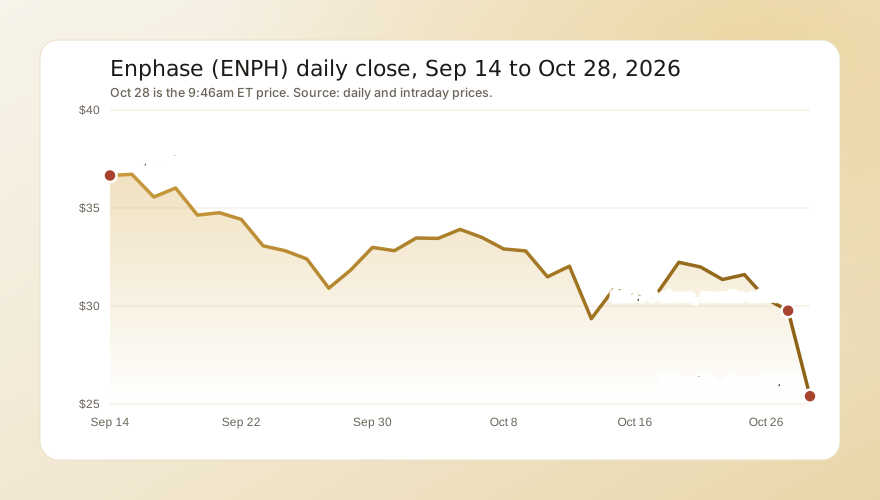
Oct 28, 2026: a new low at the open, then a partial bounce
Enphase fell through the premarket. It traded near $25.45 at 4am, touched $22.87 at its lowest, and stood at $23.84 just before the open. It opened at $23.89, hit its session and 52-week low of $23.83 in the first minute on about 4.2 million shares, then bounced to a high of $25.68 by 9:35am. At 9:46am it was $25.40, down 14.7%, on about 7.6 million shares.
What pushed it down:
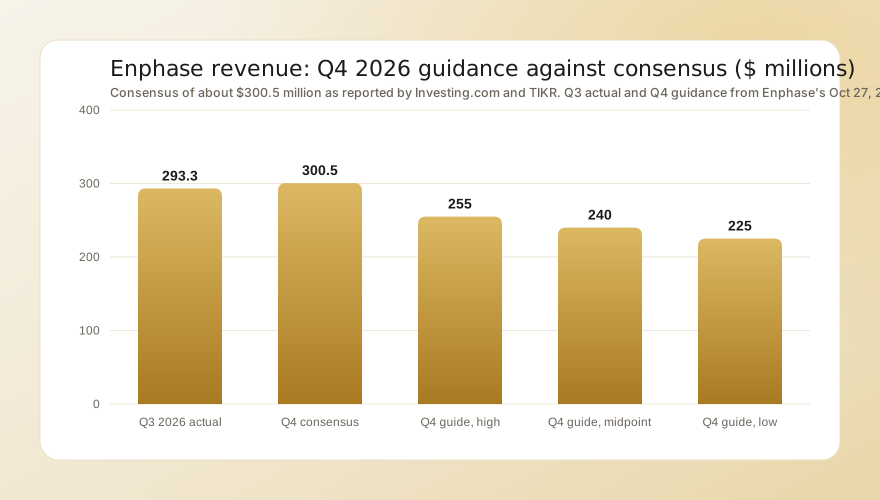
- The fourth-quarter guide. The $240 million midpoint is about 20% below the $300.5 million consensus reported by Investing.com and TIKR, and 18% below the third quarter. Non-GAAP gross margin is guided to 40% to 43%, against 45.7% expected, per Oppenheimer.
- Analyst moves. Oppenheimer's Colin Rusch cut it to Perform from Outperform and dropped his price target. JPMorgan's Mark Strouse cut his target to $29 from $35 and kept Neutral, citing a weakening macro environment, particularly in Europe. TIKR reported that Roth Capital also downgraded the stock.
- A sector read-through. JPMorgan said Enphase's European comments are negative for SolarEdge, which has more European exposure. At 9:46am these stocks and funds were down:
| Stock or fund | Oct 27 close | 9:46am ET | Change |
|---|---|---|---|
| Enphase (ENPH) | $29.76 | $25.40 | -14.7% |
| SolarEdge (SEDG) | $32.16 | $28.70 | -10.8% |
| Sunrun (RUN) | $7.53 | $7.19 | -4.5% |
| Invesco Solar ETF (TAN) | $42.02 | $40.28 | -4.1% |
| Shoals (SHLS) | $7.47 | $7.18 | -3.9% |
| Array (ARRY) | $3.39 | $3.31 | -2.4% |
| First Solar (FSLR) | $175.85 | $171.70 | -2.4% |
| Nextracker (NXT) | $79.44 | $78.18 | -1.6% |
Enphase fell more than three times as much as the solar fund. SolarEdge, its closest rival in home solar equipment, fell 10.8%, while the utility-scale names fell 2% or less. That points to a problem in U.S. and European home solar, which Enphase's own numbers confirm.
After the drop, RSI(14) stood at 25, the shares sat 26% below their 50-day average and 39% below their 200-day average, volume by 9:44am was already 1.4 times its 20-day average, and the stock was 66% below its 52-week high of $73.74.
What the quarter and the guide said
The third quarter was weak but close to the company's own range. The fourth-quarter guide is where the shortfall sits.
| Measure | Q3 2026 | Q2 2026 | Q4 2026 guide |
|---|---|---|---|
| Revenue | $293.3 million | $291.9 million | $225 million to $255 million |
| Safe harbor revenue | $85.0 million | $84.3 million | about $51.2 million |
| Non-GAAP gross margin | 45.0% | 46.8% | 40% to 43% |
| Non-GAAP operating expenses | $78.4 million | $79.8 million | $76 million to $80 million |
| Non-GAAP earnings per share | $0.41 | ||
| IQ Battery shipments | 129.9 MWh | 113.8 MWh | 100 to 120 MWh |
Third-quarter revenue was down 29% from $410.4 million a year earlier. Our arithmetic on the guide: remove safe harbor revenue and the base business goes from $208.3 million in Q3 to about $188.8 million at the midpoint, a 9% drop. Management said global sell-through rose only 1% in the third quarter, against the 10% it had expected, and will fall about 10% in the fourth. It plans to ship about $20 million below sell-through to cut distributor inventory before a slow first quarter, per the call transcript.
Demand was uneven by region. U.S. sell-through rose 5% from the second quarter but was down 35% from a year earlier. Europe fell about 11% from the second quarter, with France the weak spot: battery activations there fell 12% and microinverter activations fell 24%, while Netherlands battery activations rose 23%. About two months before the call, Enphase cut U.S. battery list prices to distributors by roughly 8% to 9%, and management said it was too soon to judge the effect on orders. Oppenheimer pointed to storage price cuts as a new drag on gross margin. For how to read the guidance in a release like this, see our guide to the earnings release and how guidance changes move stocks.
Oppenheimer's new estimates show how far numbers are moving. It cut 2026 revenue to $1.104 billion from $1.203 billion and 2026 earnings to $1.60 from $2.08. For 2027 it cut revenue to $885 million from $1.242 billion and earnings to $1.11 from $2.37. At $25.40 the stock trades near 16 times 2026 and 23 times 2027 on those numbers. The forward P/E of about 15.5 and a consensus price target of $37.53 still reflect estimates from before the report; our piece on estimate revisions explains why those tend to fall after a guide like this, and forward vs trailing P/E covers the multiple.
The case for the stock
- A strong balance sheet. Cash and marketable securities were $931.8 million, about 28% of the $3.3 billion market value, against $573.2 million of non-current debt. See our explainer on net cash per share.
- Margins held in the quarter. Non-GAAP gross margin of 45.0% beat the 44.4% expected, and tariffs cost 1.3 points, down from 2.0 in the second quarter.
- Batteries are growing. Shipments rose to 129.9 MWh, and management expects residential battery volume to grow about 50% in 2027, with the fifth-generation IQ Battery shipping in volume in the first quarter of 2027.
- A crowded short. About 23% of the float is sold short, which can fuel sharp bounces; our guide to short interest and days to cover explains the risk both ways.
- The data center option. The pipeline for its solid-state transformer for AI data centers has more than 50 potential customers. Pilots are planned for 2027 and commercial shipments for 2028, so it adds no revenue in the period that matters for this view.
The risks
- Estimates are still falling. Oppenheimer cut 2027 earnings by 53%, and several firms have yet to publish. A stock is rarely cheap while the denominator is being cut.
- U.S. demand has no floor yet. Sell-through is down 35% from a year ago, the Section 25D credit has expired and rates remain high.
- Price cuts cut both ways. Lower battery prices may lift volume, but Oppenheimer notes the gross margin cost is visible and the demand response is not yet proven.
- Weak cash generation. Operating cash flow was $0.1 million in the quarter and non-GAAP free cash flow was negative $11.4 million.
- Quality of earnings. Third-quarter GAAP net income of $23.4 million included a $27.0 million tax benefit and a $26.6 million investment impairment charge in other expense.
For how to weigh management's tone against the numbers, see our guide to analyzing an earnings call transcript, and more of today's biggest stock moves.
What comes next
- The rest of the analyst reset. More estimate cuts and target changes are likely over the next days. The consensus target of $37.53 is well above JPMorgan's $29.
- Year-end items. Management expects the IRS to refund $108.3 million of 2024 production tax credits by year-end, and expects to validate its transformer demonstration at 34.5 kV in the fourth quarter.
- Fourth-quarter results. The date has not been confirmed. They will show whether sell-through held at the guided 10% decline and whether the inventory drain is done before the seasonally weak first quarter.
- Policy. Analysts on the call asked about tax credit extensions after the midterm elections; none is in place today.
Dombey's published work on earnings reactions is in the research archive.