

Oct 20, 2026: a pulled order and a second outlook cut send the stock to a new low
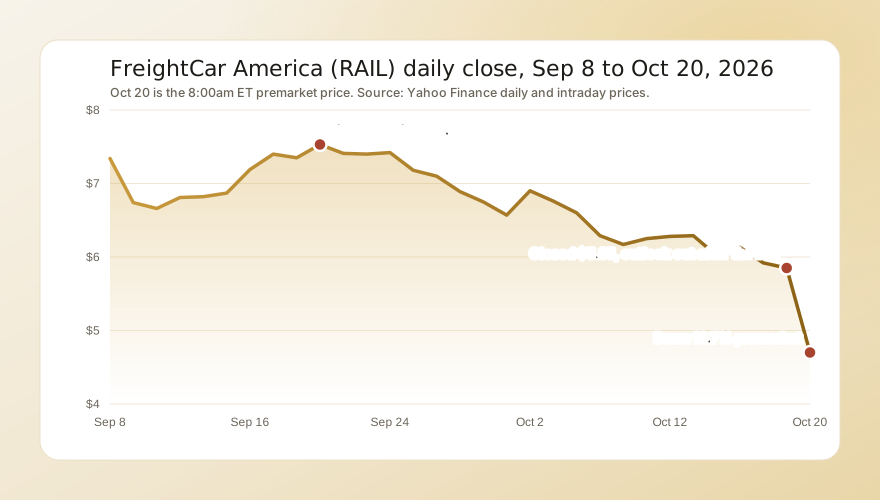
The release crossed after the close on Oct 19, and the stock fell at once in after-hours trading, reaching $4.46 at 5:25pm, down 23.7%. It recovered to $4.74 by 7:45pm. Premarket trading on Oct 20 opened at $4.73 at 4:00am, traded at $4.77 at 7:10am and stood at $4.70 at 8:00am, down 19.7%. Trading was thin: the stock averages about 215,000 shares a day. At $4.70 it sits well below its prior 52-week low of $5.81.
What pushed it down:
- The order is gone. The company removed all 1,285 railcars tied to the retrofit order, which was due for delivery from the second half of 2026 through 2027. CEO Nick Randall said "this adjustment is specific to one customer order," and the company said no other orders in the backlog are affected.
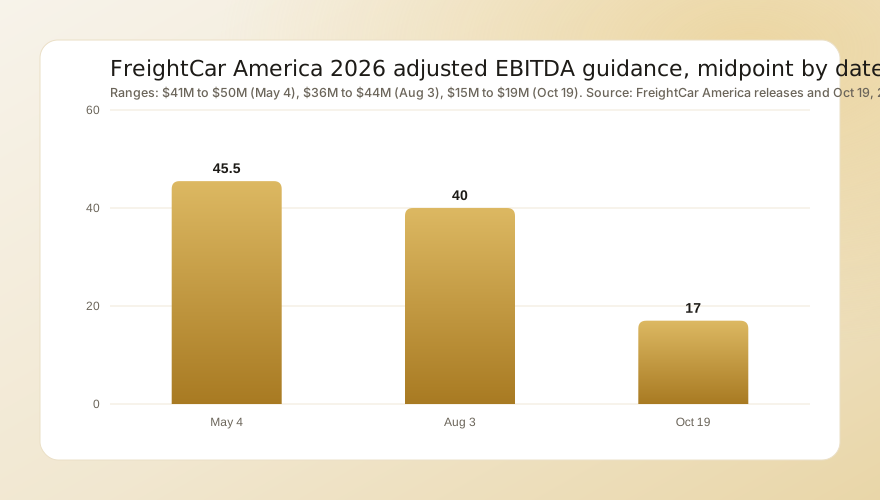
- The outlook fell on every line. The deliveries midpoint dropped 13.5%, the revenue midpoint 10.3% and the adjusted EBITDA midpoint 57.5%.
- The third quarter was weak before the removal. Deliveries of 662 units were about half of the 1,304 a year earlier.
- Credibility. On the August call, CFO Mike Riordan said that cut was "isolated to the timing and mix of new railcar deliveries." Eleven weeks later the problem is a customer that may not pay.
Its peers did not move with it. Greenbrier, Trinity Industries, Wabtec and GATX had not traded in the premarket session by 8:55am, and the iShares Transportation ETF was down 0.1% at 7:26am, so the drop is company news, not a sector move. For more of today's biggest stock moves, see our market page.
Going into the news, RSI(14) stood at 30 after the Oct 19 close; at $4.70 the shares sat 32% below their 50-day average of $6.95, 47% below their 200-day average of $8.90 and 68% below their 52-week high of $14.90.
The numbers
| Measure | Q3 2025 | Q3 2026 (preliminary) |
|---|---|---|
| Railcar deliveries | 1,304 | 662 |
| Revenue | $160.5M | $75M to $77M |
| Adjusted EBITDA | $17.0M | $(0.3)M to $0.3M |
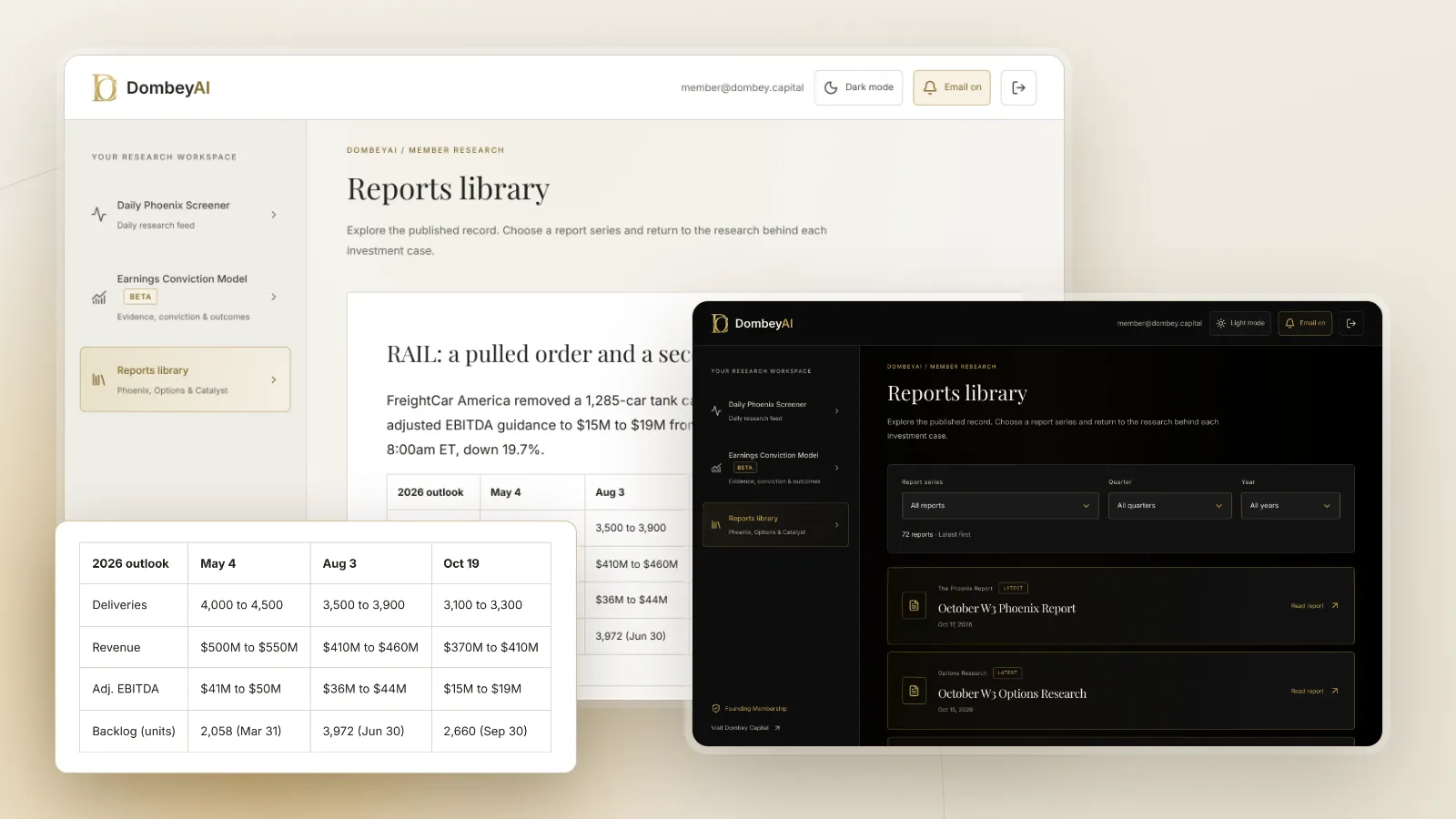
The 2026 outlook has now come down three ways since May:
| Outlook date | Deliveries | Revenue | Adjusted EBITDA |
|---|---|---|---|
| May 4 | 4,000 to 4,500 | $500M to $550M | $41M to $50M |
| Aug 3 | 3,500 to 3,900 | $410M to $460M | $36M to $44M |
| Oct 19 | 3,100 to 3,300 | $370M to $410M | $15M to $19M |
The year to date shows what the fourth quarter has to do. First-quarter deliveries were 577 and second-quarter deliveries 927, so with 662 in the third quarter the company has delivered 2,166 cars. The new range implies 934 to 1,134 deliveries in the fourth quarter. On revenue, $64.3 million in the first quarter, $113.1 million in the second and $75 million to $77 million in the third leave about $116 million to $158 million for the fourth. Adjusted EBITDA was $3.2 million and $1.2 million in the first two quarters, so the fourth quarter needs roughly $10 million to $15 million. That is a large step from a quarter near zero, though still below the $17.0 million of the third quarter of 2025. Our explainer on why guidance changes move stocks covers why a second cut tends to weigh more than the first.
The backlog fell to 2,660 units worth $284.5 million at Sep 30, from 3,972 units worth $344 million at June 30.
The bull case
- The price already assumes a lot. At $4.70 the market value is about $154 million against trailing sales of $464 million. For what a low price-to-sales ratio does and does not tell you, see our explainer.
- The backlog still holds new-car orders. In the second quarter the company booked about 3,000 units, including about 2,600 new railcars, and won a multiyear award for 1,900 railcars with deliveries through 2028. The chief commercial officer, Tonn, said the company took about 45% of all industry new railcar orders in that quarter.
- Cash and costs. The company had $63 million of cash at June 30, generated $11.3 million of free cash flow in the second quarter, and expects about $12 million of annual savings from its Castaños realignment, starting in the third quarter. Riordan said the lower cost base positions the company for stronger results as the backlog turns into 2027 deliveries.
- Retrofits were a fading line anyway. On the August call, Tonn said the industry is at "the tail end of the demand" for converting older DOT-111 tank cars to the DOT-117R standard, so the lost order belongs to a shrinking market.
The risks
- Customer credit. The company did not name the customer or say whether it has any claim under the contract. One failed customer does not mean others will fail, but the market will want proof.
- A thin balance sheet. Stockholders' equity was $36.2 million at June 30, and debt is four times equity. Our guide to what counts as a high debt-to-equity ratio explains why that matters when profits shrink.
- Execution in one quarter. The new range depends on the fourth quarter. Any further slippage into 2027 would push results below it.
- A stock that keeps falling. Shares had already fallen 61% from their 52-week high before the news, and a falling price with falling estimates fits several of the value trap warning signs.
What comes next
- Nov 9 results, Nov 10 call at 11:00am ET. Watch the fourth-quarter delivery schedule, cash at Sep 30, any new orders, and whether the company says more about the customer. Our guide to preparing for an earnings report covers what to check.
- The 10-Q. It should show any write-down tied to the order and any change to the credit facility. For what to look for in the filings themselves, see how to read an 8-K for catalysts.
- Order announcements. New orders before Dec 31 would rebuild the backlog. On the August call, Randall said orders customers place before Dec 31 would push deliveries toward the upper half of the range.