

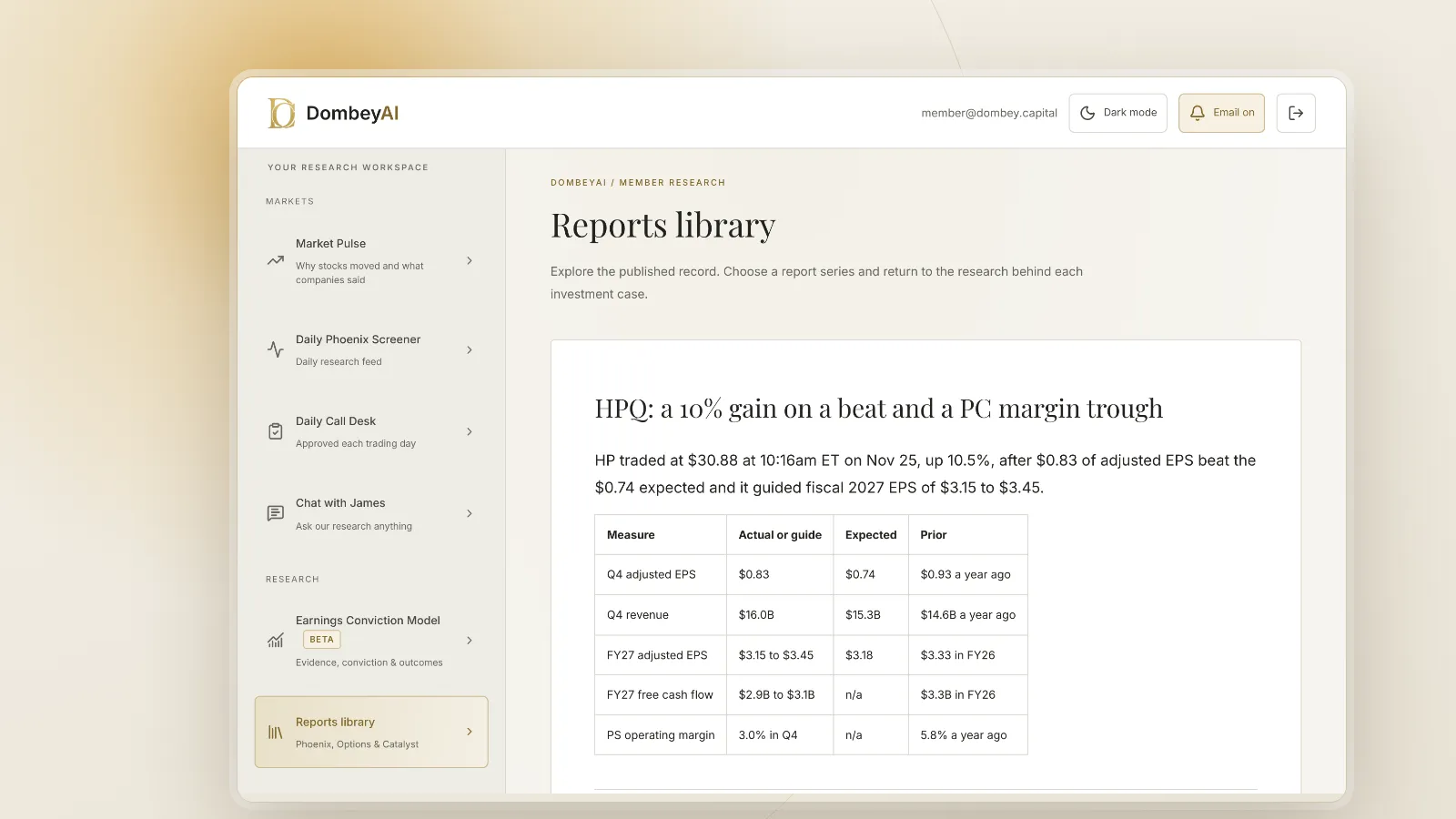
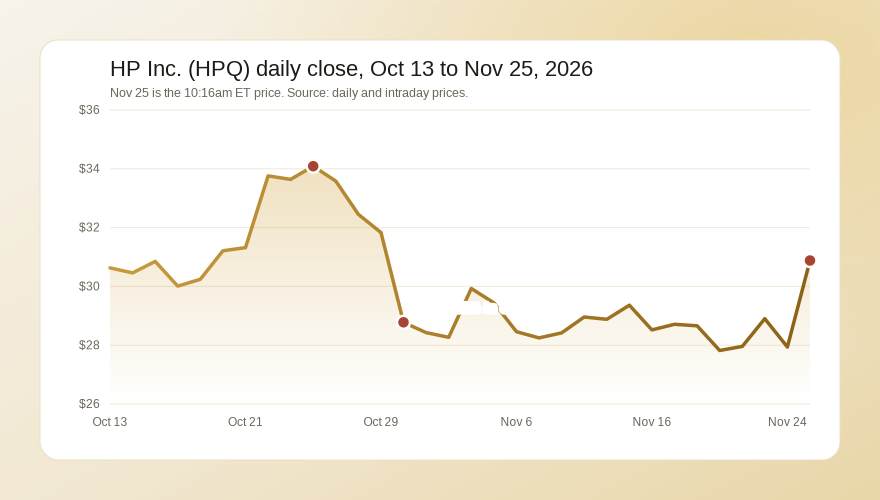
Nov 25, 2026: a 10% gain after a beat, on a day the market fell
HP closed Nov 24 at $27.94, down 3.3% on the day, and released results after the close. The first reaction swung hard. The shares jumped to $32.79 by 4:20pm, 17.4% above the close, then fell to $26.58 by 4:35pm, 4.9% lower, as investors read past the beat to the guide. They ended the evening session at $27.69.
Before Wednesday's open the stock touched $27.43 at 4:50am, then climbed through the morning to $29.60 at 9:00am, up 5.9%. It opened at $29.95, up 7.2%, and hit $32.05 in the first five minutes, 14.7% above Tuesday's close. It slipped to $30.11 at 9:40am, still up 7.8%, and recovered to $30.88 at 10:16am. After the jump, RSI stood at 56, the shares sat 0.6% above their 50-day average and 21.8% above their 200-day average, volume of 9.5 million shares by mid-morning was 0.7 times the full-day 20-day average, and the stock was 14.7% below its 52-week high of $36.23.
The gain was HP's own. At 10:16am Dell was down 7.6%, Micron 10.3%, Hewlett Packard Enterprise 4.3% and Apple 1.6%, against 4.7% for the technology fund XLK, 4.1% for QQQ and 2.6% for the S&P 500 fund SPY. Micron, whose chips are one of HP's largest costs, has now fallen two days running after a broker called for a memory glut from mid-2027. HPE, a separate company since 2015, fell 15% on its own report a day earlier. Short interest is 9.3% of the float, high enough to add to a sharp move, as covered in short interest and squeeze risk. More of today's biggest stock moves are on the market page.
The numbers
Fourth-quarter revenue rose 9.3% to $16.0 billion. Personal Systems revenue rose 14% to $11.8 billion, with commercial up 23% and consumer down 7%, even as total units fell 29%: HP sold fewer PCs at much higher prices. Printing revenue fell 1% to $4.3 billion with a 19.7% operating margin, helped by tariff refunds. Gross margin fell to about 17.5% from about 20.2% a year earlier.
The Personal Systems operating margin was the number the market watched.
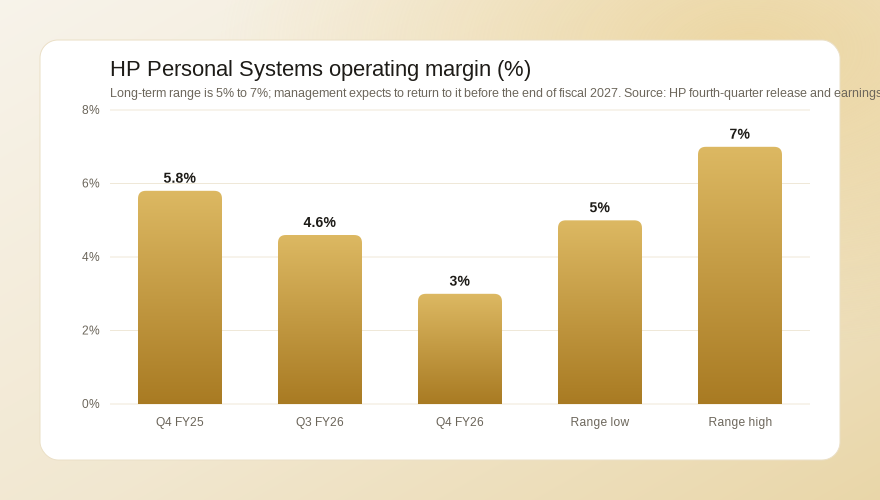
Chief financial officer Karen Parkhill said: "Last quarter, I said that Q4 would be a low point in PS margins and that we would improve from there." She said HP expects "to be back into our long-term range before the end of the year," and that the consumer price cuts that pushed the margin below plan were taken "to address channel health." On costs, she said memory and storage reached "closer to 40% of the bill of materials" by the fourth quarter, from 15% to 18% at the start of the year, and that HP expects them "to continue to increase, but at a lesser rate." Asked about supply, she said: "we are confident that we've got all of the components, including memory and storage, that we need."
Full-year adjusted EPS was $3.33, including $0.26 of tariff refunds, and free cash flow was $3.3 billion, up 13.5%. HP returned $2.3 billion through dividends and buybacks. How a release like this one breaks down is covered in how to read an earnings release.
The guide and the new yardstick
The fiscal 2027 range of $3.15 to $3.45 excludes stock-based compensation, which HP will report as a GAAP-only cost from now on, with a 17% non-GAAP tax rate. HP said the net impact of the change "would be $0.38 per share in fiscal year 2026." Because stock compensation is a cost, leaving it out raises the figure, so on the new basis fiscal 2026 would have been about $3.71 by our math, and the $3.30 midpoint is about 11% below that. The guide also assumes no further tariff refunds, which added $0.26 this year. Whether the expense is real is the subject of is stock-based compensation a real expense, and the reconciliation table that shows it is walked through in how to read a non-GAAP reconciliation.
Parkhill called the outlook prudent "on purpose," citing commodity costs, weaker PC demand, the start of a new year and "a new CEO coming on board." Emma Walmsley starts as chief executive on Jan. 4, 2027, according to a Nov. 4 filing. Analyst questions showed what worried the market: J.P. Morgan's Joseph Cardoso asked whether the 5% to 7% Personal Systems range is reachable in 2027, Bank of America's Wamsi Mohan asked her to bridge the lower free cash flow guide, and Morgan Stanley's Erik Woodring asked how far HP can raise prices before demand falls.
The case for the stock
HP has met or beaten its guide all year and set this one low by its own description. The worst of the memory squeeze may be passing: a cost curve that slows while prices hold would lift margins from a 3.0% base, and a new chief executive often starts with a conservative bar. At $30.88 the forward P/E is 8.8 and price to sales is 0.46. The new $1.24 annual dividend yields about 4.0%, the 11th straight yearly increase, and HP aims to return about 100% of free cash flow over time. AI PCs reached nearly 60% of shipments, and commercial demand is holding up. How outlooks move stocks is covered in why guidance changes move stocks.
The risks
The PC market is shrinking in units. HP aligns with forecasts for a high single to low double digit decline in calendar 2027, and Parkhill said the Windows 11 refresh "is mostly behind us." Consumer channel inventory is high, and clearing it takes promotions that cost margin. First-quarter free cash flow will be negative and the full-year range sits below fiscal 2026. HP guided fiscal 2026 to the low end of its range in February when memory costs jumped, Reuters reported then, and could have to do so again if costs reaccelerate. A new chief executive may also reset priorities, as covered in how management changes move stocks.
What comes next
Walmsley takes over on Jan. 4, 2027, and the quarterly dividend of $0.31 goes to holders of record on Dec. 9, 2026, payable Jan. 6. The real test is the report for the quarter ending Jan. 31, 2027, likely in late February: adjusted EPS against $0.66 to $0.76, a Personal Systems margin above the fourth quarter's 3.0%, and any change to the full-year range. If the margin climbs and the range holds, today's gain has support. If units and cash fall faster than guided, the stock has room to give it back.