


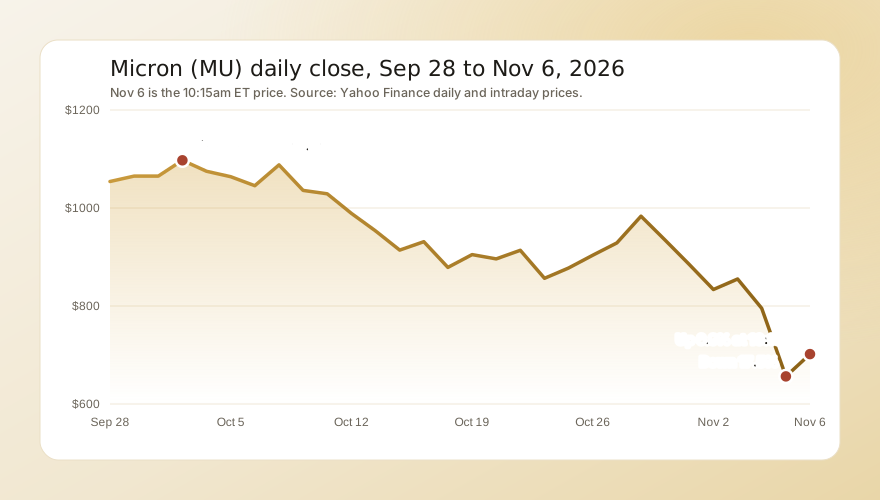
Nov 5, 2026: the memory group cracks
Micron closed Nov 4 at $795.23, already down from $983.23 on Oct 28. Before Thursday's open it slipped to about $754 by 9am as the Taiwan report spread. It opened at $752.69, touched $761.81 in the first minutes, and then fell for most of the day as selling moved from memory to the whole chip group. The low was $650.00 late in the session and the close was $656.39, a fall of $138.84. Volume was 76.7 million shares, about 2.9 times the 26.9 million 20-day average. Trefis noted it was Micron's largest one-day fall in the prior 365 days, and it came at the end of a 39.7% slide over the month.
What pushed it down:
- Data center politics. Yahoo Finance reported that chip stocks fell "amid the threat that stricter regulation could slow data center construction" after Democrats' midterm wins. Goldman Sachs estimated that 45% of planned U.S. data center capacity could face restrictions after newly elected governors pledged to stop or pause construction, 24/7 Wall St. reported.
- The Taiwan plant. Bloomberg reported that Micron paused work on its Fab 11E plant in Taoyuan amid a prolonged labor dispute. Reuters put the budget at $4.5 billion, and production had been due to start in 2028 for HBM and DRAM. Micron did not confirm the halt.
- Chip outlooks. Qualcomm issued a weak profit forecast, citing higher-cost components, and Arm fell 13% after revenue guidance that was slightly above consensus but below what investors had priced in.
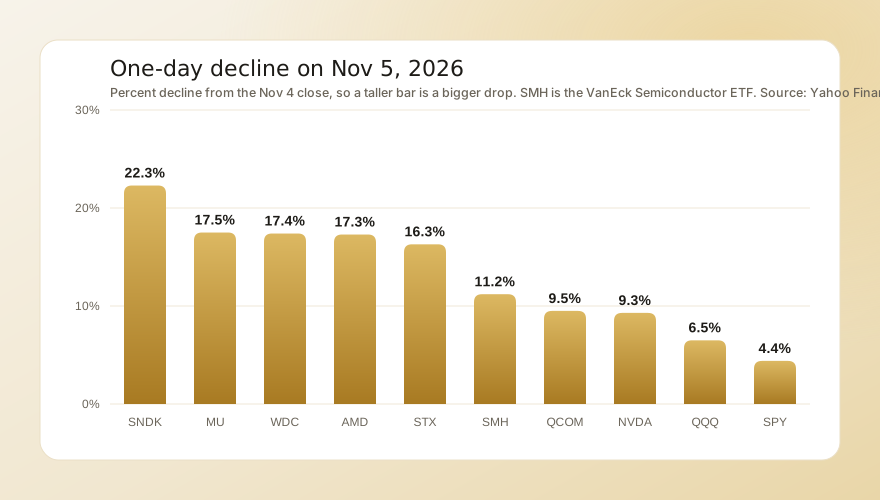
Micron's drop was in line with the memory and storage group, not an outlier. Sandisk fell 22.3%, Western Digital 17.4% and Seagate 16.3%, while AMD lost 17.3%. The VanEck Semiconductor ETF fell 11.2%, the Nasdaq 100 6.5% and the S&P 500 4.4%. We covered the market side of the day in why the VIX jumped.
Nov 6, 2026: a bounce, not yet a turn
Micron traded near $706 at 4am and reached about $720 before 7am, up about 9.7%. It opened at $708.25, dipped to $688.67 in the first minutes and reached $724.80. At 10:15am it was $701.86, up 6.9% on 15.4 million shares. Sandisk was up 6.9%, AMD 10.8% and Nvidia 5.6%, while Western Digital and Seagate were flat, so the bounce is strongest in the names with the most AI exposure.
Two things helped. After Thursday's close, AI cloud provider IREN reported $228 million of revenue, a beat, and a $20.3 billion backlog, which TIKR said eased fears that AI data center spending is slowing; we covered that report in why IREN stock moved. And the October jobs report showed 165,000 new jobs, ahead of forecasts, with unemployment at 4.1%. Not everyone joined in: SK Hynix fell 10.4% in Seoul on Friday, catching up with Thursday's U.S. losses.
After the open, RSI(14) stood at 33, the shares sat 20% below their 20-day average, 27% below their 50-day average and 7% below their 200-day average, and they were 44% below their 52-week high of $1,255.00. Volume was running at about half its 20-day pace, which is thin for a rebound of this size.
What Micron's numbers show
| Item | Fiscal Q4 2026 (to Sept 3) | Year earlier |
|---|---|---|
| Revenue | $54.23 billion | $11.32 billion |
| GAAP gross margin | 86.8% | 44.7% |
| GAAP diluted EPS | $32.87 | |
| Operating cash flow | $43.97 billion | $5.73 billion |
| Next quarter revenue guide | $61.5 billion, plus or minus $1.5 billion |
For fiscal 2026, revenue was $133.19 billion against $37.38 billion in fiscal 2025, and Micron ended the year with $73.48 billion of cash, investments and restricted cash. Its core data center unit made $18.00 billion of revenue in the quarter at a 90% gross margin. On valuation, the forward P/E is 3.3, the trailing P/E is 9.5 and the price-to-sales ratio is 6.0. Short interest is 2.0% of the float, so there is little forced buying to drive a squeeze. The consensus analyst target is $1,631.56. For why forward and trailing multiples can tell such different stories in a cyclical business, see forward P/E vs trailing P/E and what normalized earnings are.
The bull case
The quarter that matters next is already mostly sold. Micron says more than 75% of its 2027 output is committed under its customer agreements, and CEO Sanjay Mehrotra said on Sept 30 that those agreements "provide added confidence in the durability of Micron's financial performance." A policy pause on data centers would take years to show up in orders, and the reported fear is about 2028 capacity. KC Rajkumar of LYNX Equity Strategies told 24/7 Wall St. that his checks found no election-related disruption in Asian memory markets. A slower Taiwan build also cuts new supply in 2028, the same year the demand worry is about. And at a forward P/E of 3.3 the price already assumes a sharp drop in earnings.
The risks
Memory is a cyclical business, and the market has seen low multiples at the top of past cycles. TIKR noted that Micron's multiple is close to where it sat at the 2017 and 2018 peak. If price increases slow, as the CFO said they would, estimates may stop rising even without a demand cut. The Taoyuan union is asking for 15% of operating profit for employees worldwide, and about 60% of Micron's DRAM comes from Taiwan, so a strike would hit output. And if a large state actually passes a construction pause, analysts will start cutting 2028 numbers fast. For how revisions move a stock, see why estimate revisions move stocks.
What comes next
- Nov 12: Applied Materials reports and will say how much memory makers plan to spend in 2027.
- Nov 17: Nvidia reports, the clearest read on data center demand.
- Taoyuan talks: Micron and the Taoyuan union held talks on Nov 6 over profit sharing, with no deal reported yet.
- Dec 16: Micron reports fiscal first-quarter results against its $61.5 billion guide.
We track moves like this one alongside more of today's biggest stock moves, including the earlier slide in Sandisk.