

How stock pay is recorded
Under ASC 718, a company measures each award at its fair value on the grant date and expenses that value over the period the employee must work to earn it, usually the vesting period. Restricted stock units are valued at the share price on the grant date. Options are valued with a pricing model that uses volatility, interest rates and the expected life of the option.
The expense appears in the income statement inside cost of revenue, research and development, sales and marketing, and general and administrative costs, wherever the employees work. The total is disclosed in a footnote and in the cash flow statement.
Three places treat it differently:
| Where | How stock pay is treated | Effect |
|---|---|---|
| GAAP income statement | Expensed at grant-date fair value over vesting | Included in operating costs |
| Adjusted EPS and adjusted EBITDA | Usually added back | Earnings look higher |
| Cash flow statement | Added back to operating cash flow as a non-cash charge | Operating and free cash flow look higher |
| Diluted share count | New shares counted as they are issued or under the treasury stock method | Per-share figures fall over time |
Our explainer on adjusted EBITDA lists stock pay as one of the most common add-backs, and the SEC's guidance on non-GAAP measures, listed in the sources, requires companies to reconcile any adjusted figure to GAAP.
Why it is a real cost
Imagine the company paid the same employees in cash, then sold the same number of new shares to investors to raise that cash. The economic result for existing owners would be identical: more shares outstanding, and the same work done. The only difference is that in the cash version, the expense would hit operating cash flow.
That is why many investors treat stock pay as equivalent to cash. A company that pays its staff partly in stock is financing part of its payroll by issuing equity. If the stock price is high, the equity is expensive to the issuer's employees and cheap for the company; if it falls, the company needs more shares, or more cash, to keep pay level.
How it flatters free cash flow
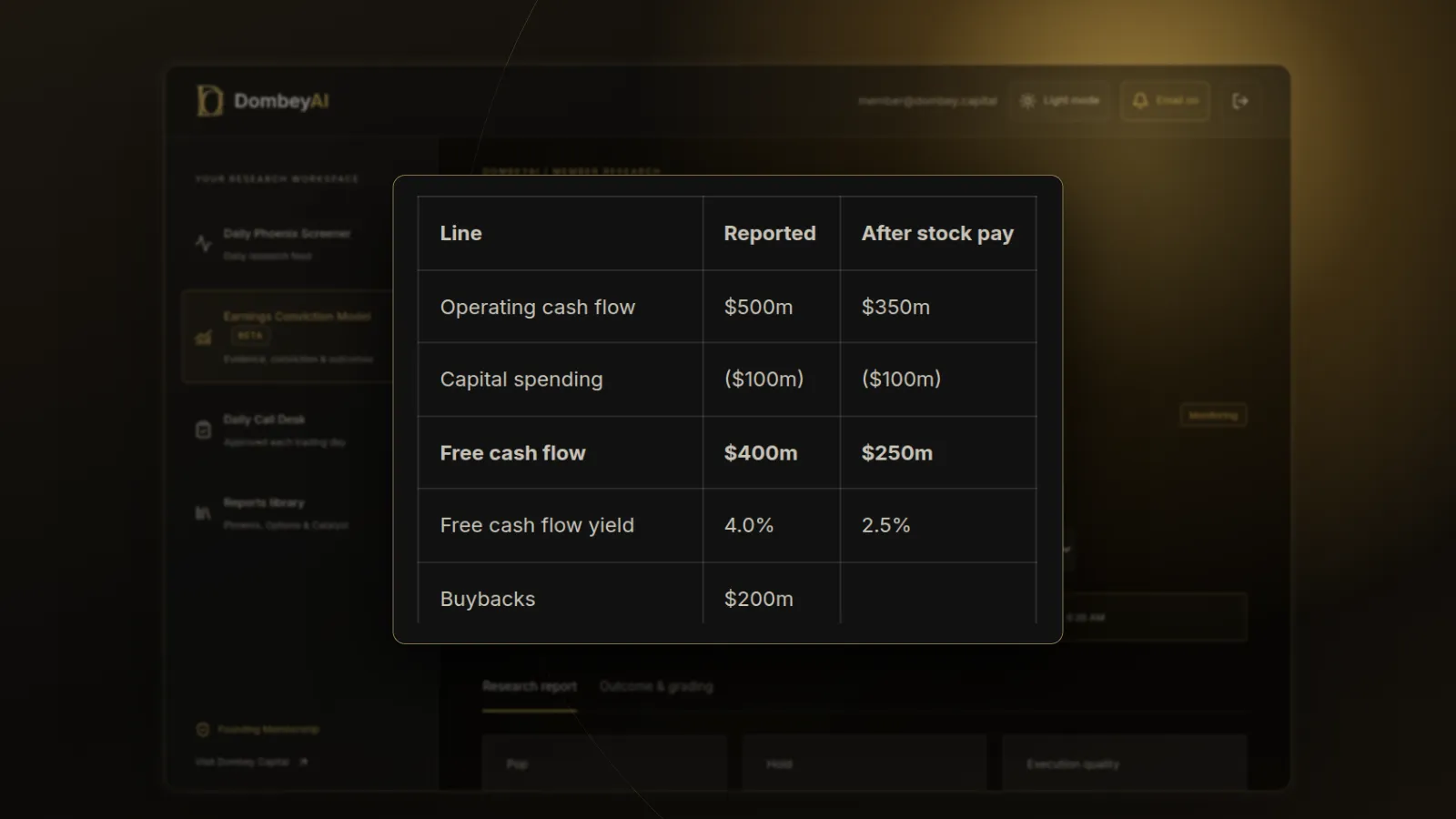
Operating cash flow starts with net income and adds back non-cash charges, including stock pay. Free cash flow, usually operating cash flow minus capital spending, keeps the add-back. So a company can report free cash flow well above GAAP net income partly because it pays staff in shares.
There is a second, quieter effect. When restricted stock units vest, many companies withhold some shares to cover employees' taxes and pay that tax in cash. Those payments are usually reported in financing activities, not operating activities, so they never reduce free cash flow even though they are cash spent because of employee pay. Our guide on how to read a cash flow statement shows where to find that line.
The example shows why a flat share count is not proof that stock pay is free. Here $200 million of cash, half of reported free cash flow, went to keep the share count level. Our explainer on free cash flow yield covers the measure itself.
How to adjust for it
There are two consistent methods. Pick one.
Method 1: treat it as cash. Subtract stock pay from free cash flow (and, if material, the cash paid for net share settlement taxes). Then use the current diluted share count. This is the simpler approach and works well for mature companies with steady grants.
Method 2: count the dilution. Leave stock pay in free cash flow, but forecast the share count growth it will cause and divide future cash flows by the larger share count. This is closer to how the cost actually arrives but needs a forecast of grants and the share price.
What you should not do is add stock pay back to cash flow and also ignore future dilution. That counts the cost zero times. Subtracting it from cash flow and also forecasting dilution counts it twice.
| Approach | Cash flow used | Share count used | Result |
|---|---|---|---|
| Method 1 | Free cash flow minus stock pay | Current diluted shares | Counts the cost once |
| Method 2 | Free cash flow as reported | Forecast diluted shares, rising | Counts the cost once |
| Common mistake | Free cash flow as reported | Current diluted shares | Counts the cost zero times |
| Overcorrection | Free cash flow minus stock pay | Forecast diluted shares, rising | Counts the cost twice |
The same logic applies in a discounted cash flow model and in owner earnings, the measure built to show what an owner could take out of the business.
What to look at in the filings
- The stock compensation footnote. Total expense, unrecognized expense still to come and the average period over which it will be recognized.
- The cash flow statement. The stock pay add-back, buybacks and taxes paid for net share settlement.
- Share count history. Diluted weighted average shares over five or more years. Our explainer on dilution shows how to read the trend.
- The proxy statement. Equity plan proposals, the shares requested and the burn rate. Our guide on how to read a proxy statement covers where these appear.
A useful set of ratios is stock pay as a share of revenue, of operating cash flow and of buybacks, tracked over time and against peers. Many of the platforms in our list of the 12 best stock research tools for individual investors show stock pay and share count history side by side.
Where this goes wrong
- Trusting adjusted figures. Adjusted EPS and EBITDA that exclude stock pay can show steady profits at a company whose owners are being diluted every year.
- Reading buybacks as returns. A buyback that only absorbs new employee shares returns nothing to owners. See buybacks as catalysts for when repurchases do matter.
- Double counting. Subtracting stock pay and forecasting dilution together penalizes the company twice.
- Using grant values from long ago. Expense is fixed at grant date. If the share price has fallen since, future grants will need more shares to deliver the same pay, and dilution can speed up.
- Ignoring the tax line. Net share settlement taxes sit in financing activities and are easy to miss.
Dombey's published research counts stock pay as a cost when it values a business; see the research archive.
The bottom line
Stock-based compensation is a real expense, paid by shareholders through dilution or through the cash spent on buybacks to offset it. GAAP expenses it, but adjusted earnings and free cash flow usually add it back. Adjust once, either by subtracting it from free cash flow or by counting the extra shares it creates, never neither and never both. Track it against revenue, cash flow and buybacks over several years to see how much of the reported cash reaches owners.