

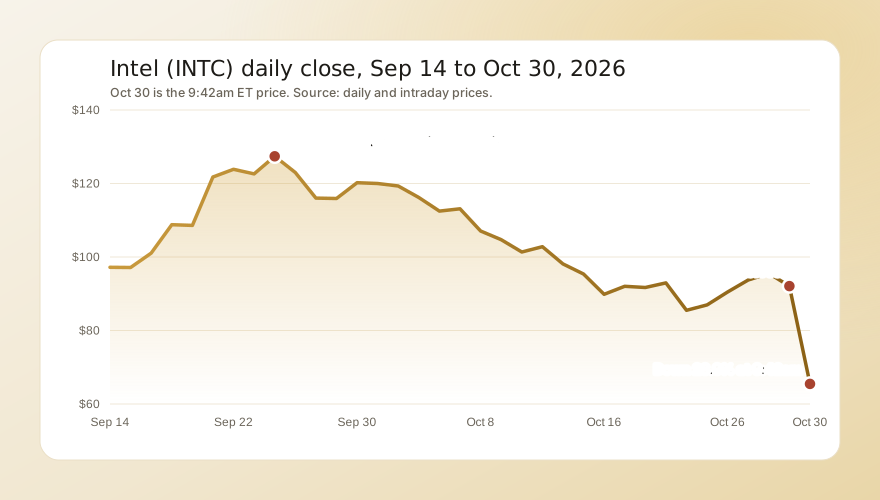
Oct 30, 2026: a 29% gap down on the guide
Intel reported after the close on Oct 29. In premarket trading it was $68.85, down 25%, 24/7 Wall St. reported, and Invezz put the premarket loss at about 26%. It opened at $68.35, traded as low as $64.78 and as high as $68.77, and was $65.47 at 9:42am. After the drop, RSI(14) stood at 25, the shares sat 35% below their 50-day average and 25% below their 200-day average, volume had already reached 0.8 times its 20-day average, and the shares were 54% below their 52-week high of $142.35.
What happened:
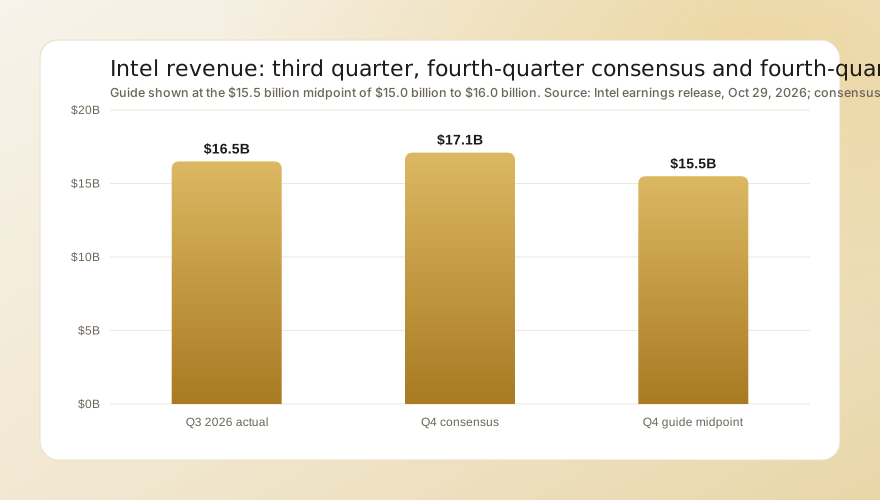
- The guide missed on every line. Revenue of $15.0 billion to $16.0 billion compares with $17.1 billion expected, FactSet data cited by Invezz showed. Non-GAAP gross margin of about 38.0% compares with 44.1% in the third quarter. Non-GAAP earnings of $0.25 compare with about $0.43.
- PCs are the problem. Client Computing and Physical AI revenue fell 5% to $8.1 billion, and Intel expects PC chip revenue to fall at a mid-20% rate in the fourth quarter, Invezz reported. 24/7 Wall St. reported that Intel projects the PC market to shrink 12% in 2026 and 10% in 2027. Intel's release lists "industry-wide substrate and memory shortages" among its supply risks.
- An Israel fab outage adds to it. An accident in early October forced an extended shutdown at a factory in Israel, which Intel expects to cut about $300 million from fourth-quarter revenue, 24/7 Wall St. reported. Invezz put the loss at about $600 million over two quarters.
- Cash flow turns negative. Management does not expect positive free cash flow in 2027, 24/7 Wall St. reported. In the third quarter Intel generated $5.1 billion of operating cash flow but spent $4.2 billion on gross capital expenditures.
Peers fell with it. At 9:42am HP was down 10.4%, Arm 9.9%, AMD 9.5% and Dell 8.5%, against 3.4% for Nvidia, which has little PC exposure. The semiconductor fund SOXX was down 6.7% and the Nasdaq 100 fund QQQ 2.7%. Intel fell far more than any of them, which fits a company-specific guide and not a sector selloff.
The numbers behind the drop
The third quarter was a good one. Revenue was $16.5 billion, up 21% from $13.7 billion a year earlier, non-GAAP gross margin was 44.1%, up 4.1 points, and non-GAAP earnings were $0.52 a share, against about $0.41 expected. The quarter included a $120 million gain on escrowed shares in GAAP results, and the release shows GAAP earnings of $0.60.
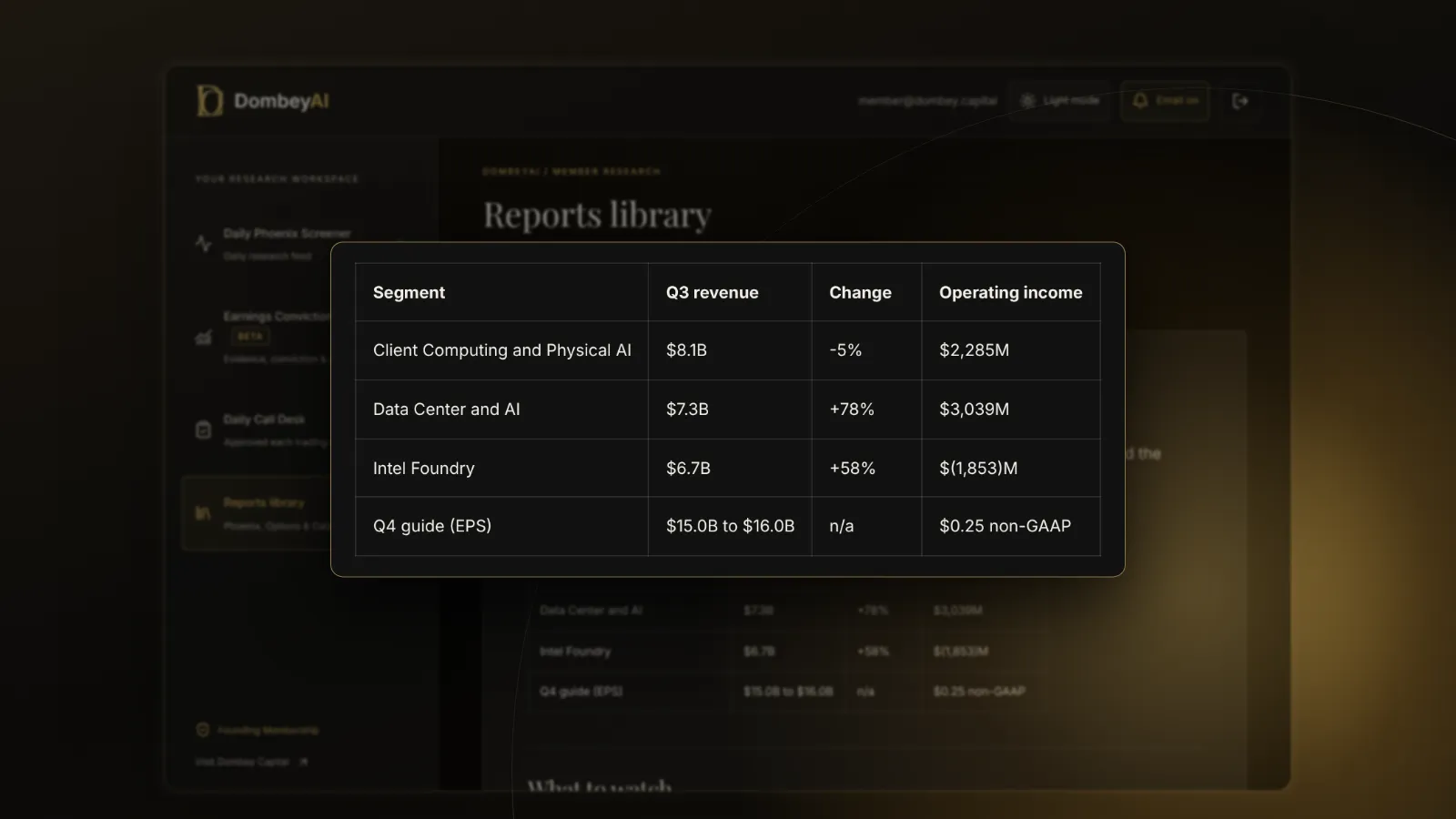
| Segment | Q3 2026 revenue | Change from a year earlier | Operating income |
|---|---|---|---|
| Client Computing and Physical AI | $8.1B | Down 5% | $2,285M |
| Data Center and AI | $7.3B | Up 78% | $3,039M |
| Intel Foundry | $6.7B | Up 58% | $(1,853)M |
CEO Lip-Bu Tan said demand for Intel's CPUs is still strong despite near-term headwinds across the PC industry, and that the "immediate priority is to unlock additional supply to meet extraordinary demand for our Xeon family." Zinsner said Intel will keep "making disciplined investments in capacity and working capital to increase supply." The market heard the other half of the release: a quarter that beat, followed by a guide that takes revenue down about 6% at the midpoint and earnings down by half. For a primer on why a guide often outweighs the quarter, see why outlooks move stocks, and for the release itself see how to read an earnings release.
The bull case
The bulls argue the market is punishing the wrong problem. Jefferies analyst Blayne Curtis said the reset is less concerning because it came from weak PCs and not data center or AI, though he added it is "tough to underwrite the longer-term story even with Foundry/packaging customer announcements," Invezz reported. World Trade Securities kept an Overweight rating and a $130 target, and analyst Nicholas Mugalli said the market is "punishing the right problem with the wrong time horizon." Intel's 18A costs have fallen about 40% since the first quarter, Seeking Alpha reported, and weaker PC demand could free factory capacity for server chips. The average analyst target was $114.57 at 9:45am, 75% above the share price, with a range of $70 to $200. Estimates move after a guide like this, which is why estimate revisions matter more than the target on the day.
The risks
The risks are the ones the guide names. Zinsner said "we see the PC slowdown continuing at least through the first half of next year." Memory prices are rising, which makes PCs dearer and trims budgets, and Intel cannot fix that. BofA moved to Neutral from Buy and cut its target to $100 from $145, saying Intel has not made enough progress winning outside foundry customers and that its products are not yet technically competitive with AMD and ARM-based rivals. Roth Capital also moved to Neutral from Buy, with a $70 target. Morgan Stanley expects Intel to lose share to rivals with lower capital spending. Intel also completed a $23 billion public equity offering, so the share count is already higher, and dilution is part of the arithmetic on any earnings recovery. Negative free cash flow in 2027 means the company relies on its cash pile and outside funding to carry Foundry, a point we cover in free cash flow yield.
What comes next
Intel has not confirmed a date for fourth-quarter results; an earnings calendar lists January 28, 2027. Until then, three things matter: whether PC revenue lands near the mid-20% decline, whether gross margin holds near 38%, and whether Intel can add Xeon supply fast enough to turn data center demand into revenue. Our other work on the setup is in how to prepare for an earnings catalyst, the list of today's biggest stock moves, and the research archive.