

Oct 16, 2026: a third day of neocloud selling
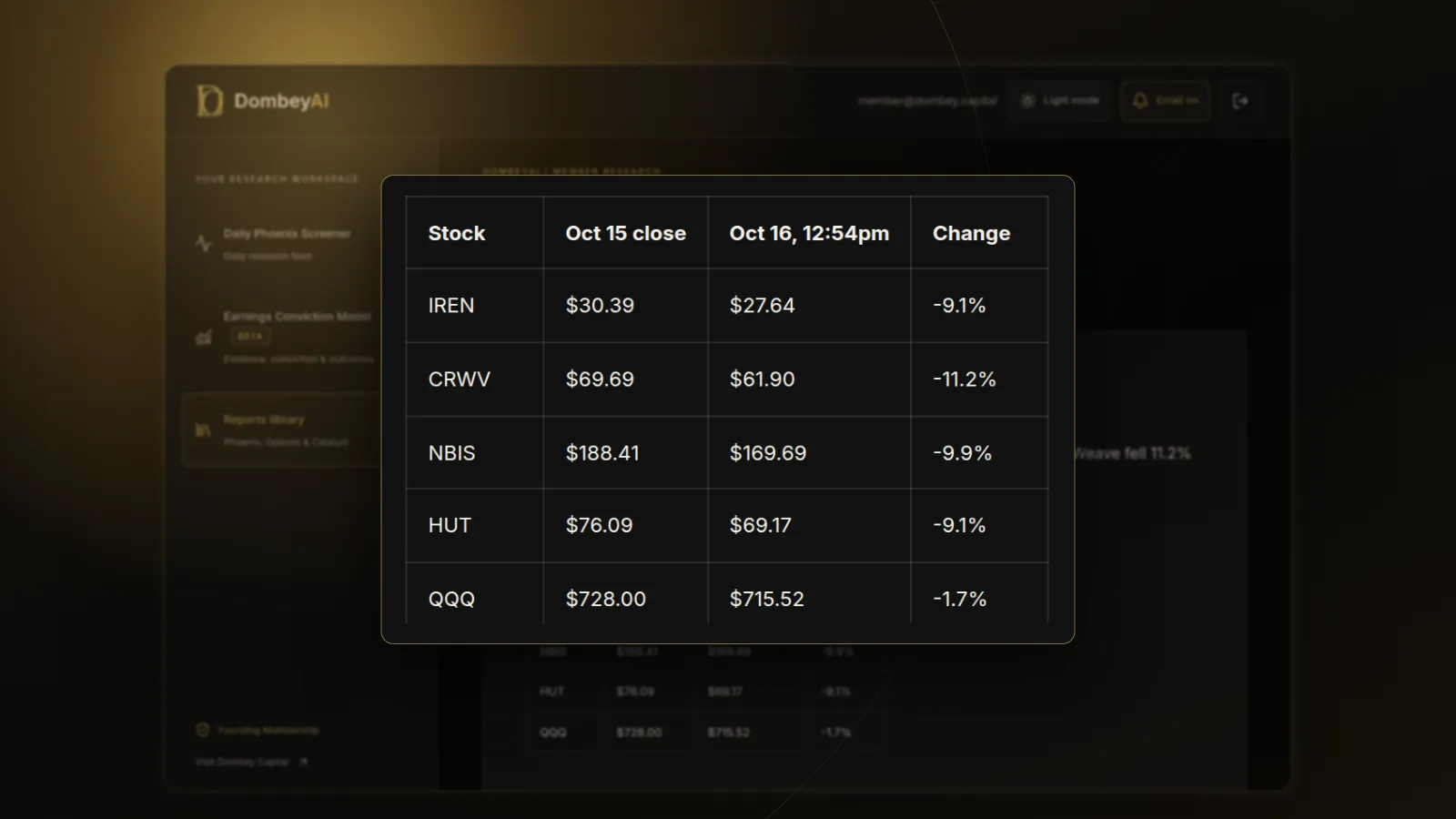
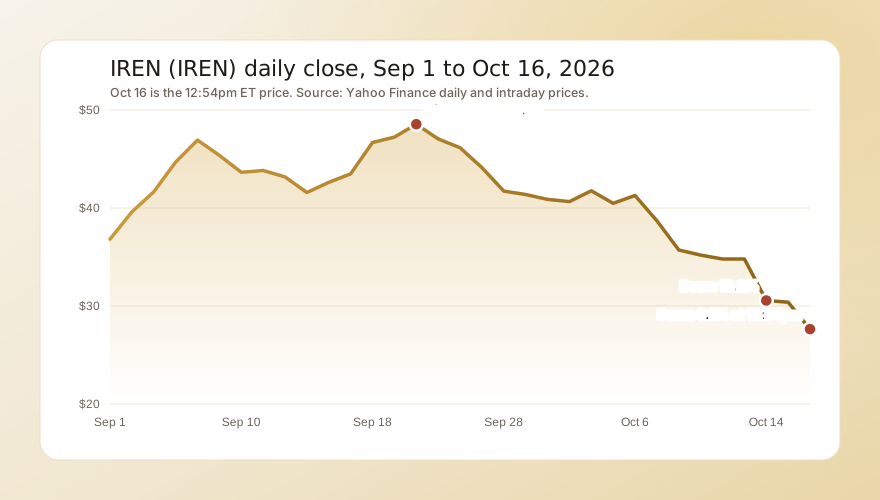
The stock traded at $30.39 when premarket trading opened at 4am, briefly touched $31.05, and drifted lower through the morning to $29.21 just before the bell, down 3.9%. 24/7 Wall St. had it down 4% at $29.30 at 8:41am. It opened at $29.21, managed a high of $29.27 in the first ten minutes, and then slid most of the day. It fell below $28 after 11am and hit $27.52 shortly after noon. At 12:54pm it was $27.64, down 9.1%, on 33.8 million shares.
What pushed it down:
- The CoreWeave credit scare spread again. CoreWeave fell 11.2% as worries about its bonds returned, and investors sold the companies that, like it, rent GPU capacity to AI developers. We covered that move in why CoreWeave stock fell.
- The Gartner warning still hung over the group. Investing.com pointed to Gartner's prediction this week that more than 80% of neocloud GPU-rental providers will stop operating as independent businesses by 2030, citing a "structural mismatch between revenues and capital costs."
- Morningstar trimmed its estimate. Morningstar cut its fair value estimate for IREN to $37 from $43, per The Crypto Basic and ad-hoc-news, warning that neoclouds could face higher financing costs as large technology companies raise capital for their own data centers. It estimated cloud infrastructure investment could top $1.3 trillion in 2027.
- Rates. Investing.com also cited a hotter-than-expected inflation report earlier in the week, which raises borrowing costs for capital-heavy companies.
- No company filing. SEC EDGAR shows nothing from IREN since its proxy statement and annual report to shareholders on Oct 13.
Investing.com also cited a SemiAnalysis report from earlier in October that flagged outages and storage failures at IREN's Prince George and Mackenzie sites in British Columbia, and noted the stock had not recovered since. IREN has not responded in a filing. Wedbush's Dan Ives called the selloff "way overdone," per Investing.com.
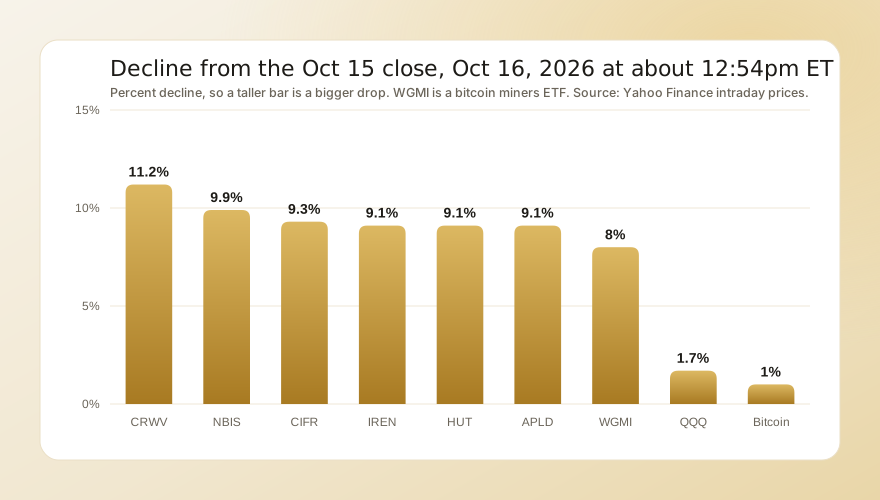
The group moved together, as the peer table shows. At about 12:54pm:
| Stock or fund | Change |
|---|---|
| CoreWeave (CRWV) | -11.2% |
| Nebius (NBIS) | -9.9% |
| Cipher Mining (CIFR) | -9.3% |
| IREN (IREN) | -9.1% |
| Hut 8 (HUT) | -9.1% |
| Applied Digital (APLD) | -9.1% |
| Bitcoin miners ETF (WGMI) | -8.0% |
| Invesco QQQ (QQQ) | -1.7% |
| Bitcoin (BTC-USD) | -1.0% |
After the drop, RSI(14) stood at 23, the shares sat 33% below their 50-day average and 39% below their 200-day average, and midday volume was 0.8 times the 20-day average of 44.6 million shares. The day's low of $27.52 held above the Oct 15 intraday low of $26.60.
IREN fell the same amount as Cipher, Hut 8 and Applied Digital, which points to a sector move rather than new trouble at the company. TeraWulf, which we covered in a separate note, fell less.
How the slide built
IREN fell 12.2% on Oct 14 to $30.56, the day Gartner's warning and the CoreWeave bond chart hit the group. On Oct 15 it fell as low as $26.60, a new 52-week low, before recovering to close at $30.39, down 0.6%, on 106 million shares. Before that, the stock had lost 6.3% on Oct 7 and 7.7% on Oct 8. A report on Oct 12 linking IREN to an unannounced multiyear cloud deal with Anthropic lifted the shares about 5% before the open that day, per Barchart, but they closed 1.1% lower. Neither company has confirmed the deal.
The debt, in numbers
This is where IREN differs most from CoreWeave. Per the 10-K, IREN had $7.71 billion of debt principal at June 30, 2026:
| Debt | Matures | Principal |
|---|---|---|
| 2031 convertible notes, 0% coupon | Jul 2031 | $1.00 billion |
| 2032 convertible notes, 0.25% coupon | Jun 2032 | $1.15 billion |
| 2033 (Jun) convertible notes, 1% coupon | Jun 2033 | $1.15 billion |
| 2033 (Dec) convertible notes, 1% coupon | Dec 2033 | $3.00 billion |
| 2029 and 2030 convertible notes | 2029 to 2030 | $0.45 billion |
| GPU financing for Microsoft, drawn | Dec 2031 | $0.94 billion |
| Other debt | 2027 to 2029 | $0.02 billion |
Contractual interest expense for the whole fiscal year was $37.2 million. Against that, IREN held $5.90 billion of cash and cash equivalents and $1.72 billion of restricted cash. The convertibles carry very little interest, though they can turn into shares, which is a form of dilution. Only $641 million of principal comes due in fiscal 2027 to 2029, so the debt maturity wall is years away.
The pressure is on new money. IREN had $13.81 billion of capital commitments at June 30, up from $368.8 million a year earlier. The Microsoft GPU financing of about $3.6 billion costs about 6%, but the $2.4 billion financing led by Blue Owl and PIMCO that IREN announced in August for non-investment-grade customers carries a 9.0% fixed rate. IREN also sold about $2.5 billion of new shares under its at-the-market program between March 4 and August 14, 2026, and debt stands at 1.87 times equity.
The case for the stock
- A sold-out 2026. In its August results, IREN said it had $4 billion of contracted annualized run-rate revenue for 2026 capacity and $1 billion operating. ARR is a company metric, not GAAP revenue.
- Microsoft is paying in advance. The roughly $9.7 billion Microsoft contract pays 20% of each tranche's value before delivery, and Horizon 1 was delivered and accepted in August.
- Customers are funding part of the build. IREN said recent contracts carry prepayments of 45% to 55% of GPU spending, and that recent three-year contracts earn more than $20 million of revenue per megawatt.
- Analysts still see upside. The analyst consensus target is $81, with a low of $40. JPMorgan analyst Richard Choe moved to Overweight with a $65 target in September, per Barchart.
The risks
- Losses during the switch. Fiscal fourth-quarter revenue was $137.2 million and the net loss was $684.0 million, including $450.4 million of impairments, mostly on retired bitcoin mining machines.
- Delivery deadlines. Horizons 2 to 4 are due in the fourth quarter of 2026. The 10-K says grace periods run from mid-fourth quarter to the start of the second quarter of 2027, and that earlier NVIDIA component shortages delayed Horizon 1.
- Customer concentration. The 10-K says a small number of customers provide a large share of AI cloud revenue.
- A crowded short side. Short sellers held 23.7% of the float, and the price-to-sales ratio was 15.8, so sentiment can swing the stock hard both ways. For how lenders and investors judge a company's borrowing, see what counts as a high debt-to-equity ratio.
What comes next
- The fiscal first-quarter report, expected November 5. The consensus revenue estimate is of about $229.5 million. Watch AI cloud revenue, the status of Horizons 2 to 4, and how the 2027 build will be paid for. Our guide to preparing for an earnings report covers what tends to move a stock on the day.
- New financing terms. The rate on the next GPU or data center financing will show whether lenders are charging IREN more after the CoreWeave scare.
- Any word on Anthropic. A confirmed contract with terms would answer one of the open questions behind the Oct 12 move.
- The CoreWeave bonds. While the group trades together, CoreWeave's credit is the market's daily gauge for all of them.