

Nov 5, 2026: A profit beat and a higher revenue guide lift the stock against a falling market
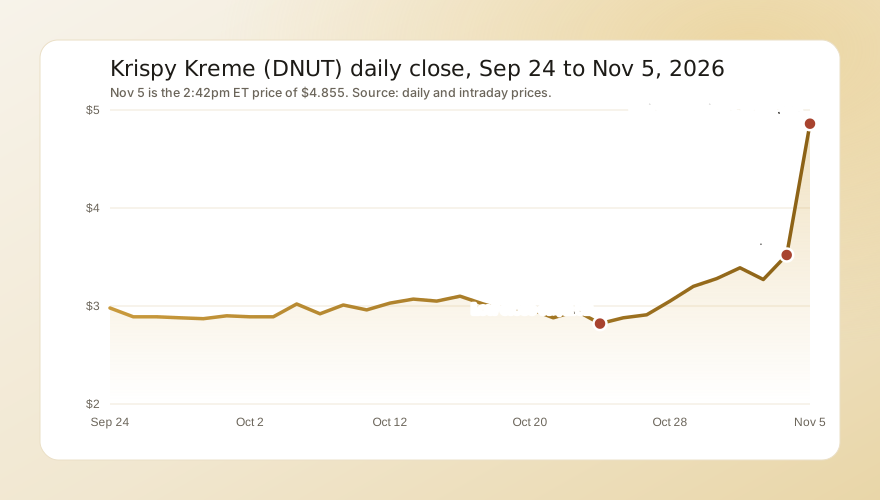
Krispy Kreme closed Nov 4 at $3.52. It released results at 6:45am ET and held its call at 8:00am. Premarket trading stayed between about $3.56 and $3.66, a modest gain. The stock opened at $3.575, made its low of $3.54 in the first minutes, and then climbed most of the day: $4.00 by 9:40am, about $4.70 by 11:00am and a high of $5.03 around 1:30pm, even as the broad market sold off. At 2:42pm it was $4.855 on about 21.1 million shares.
What moved it:
- Profit beat. Adjusted EPS was $0.06, against $0.01 a year earlier and a $0.01 consensus, Investing.com reported. Chief financial officer Raphael Duvivier credited a favorable tax rate, refranchising deals and cost savings.
- Revenue beat and a higher range. Net revenue of $328.8 million beat estimates near $305.7 million, and the 2026 range moved up to $1.35 billion to $1.40 billion.
- Turnaround progress. Franchisees now generate about 42% of systemwide sales, against about 25% in 2025, with a goal of about 50% from 2027. Krispy Kreme signed a 33-shop New York metro deal and, after the quarter, a 120-shop agreement for Pakistan.
- Short covering. Going in, 18.77 million shares were sold short, 19.95% of the float, or about 6.9 days of average volume. Our page on short interest and squeeze risk explains why that matters on a day like this.
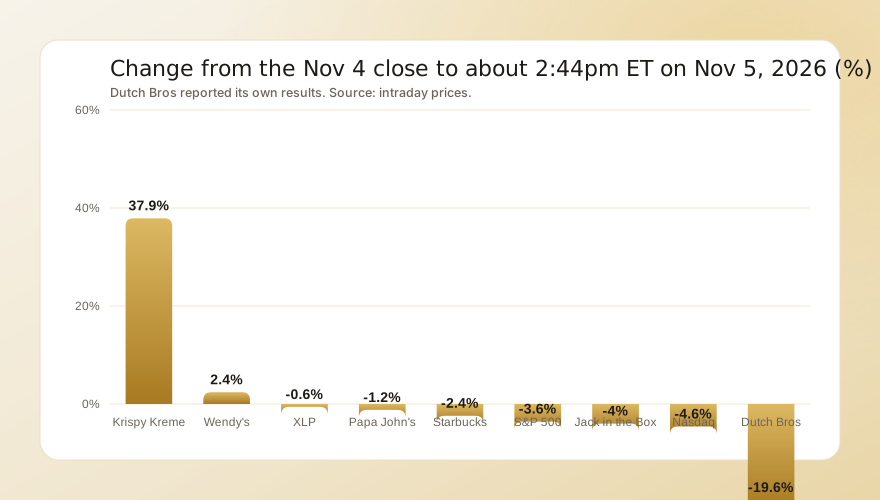
This was company news, not a sector move. Starbucks fell 2.4%, Jack in the Box 4.0%, Papa John's 1.2% and Dutch Bros 19.6%, while Wendy's rose 2.4% and the consumer staples fund XLP slipped 0.6%. More of the session's movers are in today's biggest stock moves.
By 2:42pm RSI(14) stood at 85, the shares sat 55% above their 50-day average and 45% above their 200-day average, volume ran 7.1 times its 20-day average, and the stock was 3.5% below the 52-week high of $5.03 it set earlier in the session.
The numbers
| Measure | Q3 2026 | Change from a year earlier |
|---|---|---|
| Net revenue | $328.8 million | -12.4% |
| Adjusted EBITDA | $35.3 million | -13.1%, or +12.7% excluding the prior-year recovery |
| Adjusted EBITDA margin | 10.7% | 10.8% a year earlier, 8.3% excluding the recovery |
| GAAP net loss | $13.3 million | from a $20.1 million loss |
| Adjusted EPS | $0.06 | from $0.01 |
Organic revenue, which strips out the refranchised businesses, fell 0.1%. By segment, U.S. revenue fell 25.6% to $160.9 million on the western joint venture sale, with organic revenue up 0.9%. International revenue fell 12.0% to $123.5 million, and organic revenue fell 5.4%, mainly in the U.K., where the company restructured its production network in October. Market Development, the franchise segment, rose 135.3% to $44.4 million.
The balance sheet is the constraint. Total long-term debt was $867.9 million, cash $30.3 million and net debt $839.5 million at Sept. 27. Liquidity was $250.5 million, including $220.2 million of undrawn credit. Free cash flow for the first nine months was negative $10.0 million, an improvement of about $82 million. Our page on debt-to-equity ratios covers how to judge leverage like this, and our guide to reading an earnings release covers the adjusted figures that carried this quarter.
The new 2026 outlook calls for net revenue of $1.35 billion to $1.40 billion, systemwide sales growth of 2% to 4% in constant currency, adjusted EBITDA of $140 million to $150 million, capital spending of $40 million to $45 million (from $50 million to $60 million), free cash flow above $15 million and net leverage below 5.5 times. On the call, a Bank of America analyst asked why the higher revenue range did not lift the EBITDA range. Duvivier pointed to cost control and inflation in commodities and fuel, saying edible oil costs had seen "a significant increase since last quarter." He declined to discuss 2027. Our guide to guidance changes explains why the profit line usually matters more than revenue.
The bull case
The turnaround is producing results the market can see. Krispy Kreme exited about 1,500 underperforming fresh delivery doors last year, added 715 net new ones over the past year, and now serves about 7,700 in the U.S. Charlesworth said the company is in "less than half" of Walmart and Target stores, which leaves room to add doors. Leverage fell more than a full turn in nine months, capital spending is down sharply, and 98 new shops have opened this year, nearly all paid for by franchisees.
The company also has a clear path to further debt reduction. Duvivier said it is pursuing at least one more international refranchising deal and wants partners with "capital and a commitment to growth." A sale that brings in cash would cut debt faster than earnings growth alone. And with about a fifth of the float sold short, more covering could carry the stock higher for a time. Our page on post-earnings drift covers how surprises can keep moving a stock for weeks.
The risks
Revenue is still shrinking and the profit range did not move. Refranchising lowers reported revenue by design, but organic revenue was flat and the U.K. is weak. Higher fuel prices are hurting convenience-store traffic, and management is reviewing that footprint. The forward P/E is about 61, and the stock now trades above the average analyst target of $4.18.
The McDonald's history is a reminder of execution risk. The partnership, announced in 2024 with a goal of nationwide distribution by 2026, reached about 2,400 restaurants before it was paused in May 2025 and ended on July 2, 2025, CNBC reported, because Krispy Kreme could not match its costs to demand. The current turnaround plan was introduced after it ended, Nation's Restaurant News reported. At 5.5 times net leverage, the company has limited room for another misstep.
What comes next
The fourth-quarter report is expected around February 25, 2027, with the consensus near $0.07 of adjusted EPS on about $347 million of revenue. Before then, watch for the international refranchising deal management says it is pursuing, any change to the EBITDA range, and whether the stock holds the gap above the $3.52 close of Nov 4 once short covering fades. The fourth quarter is the company's peak season, and year-end net leverage will be the clearest test of the turnaround.