

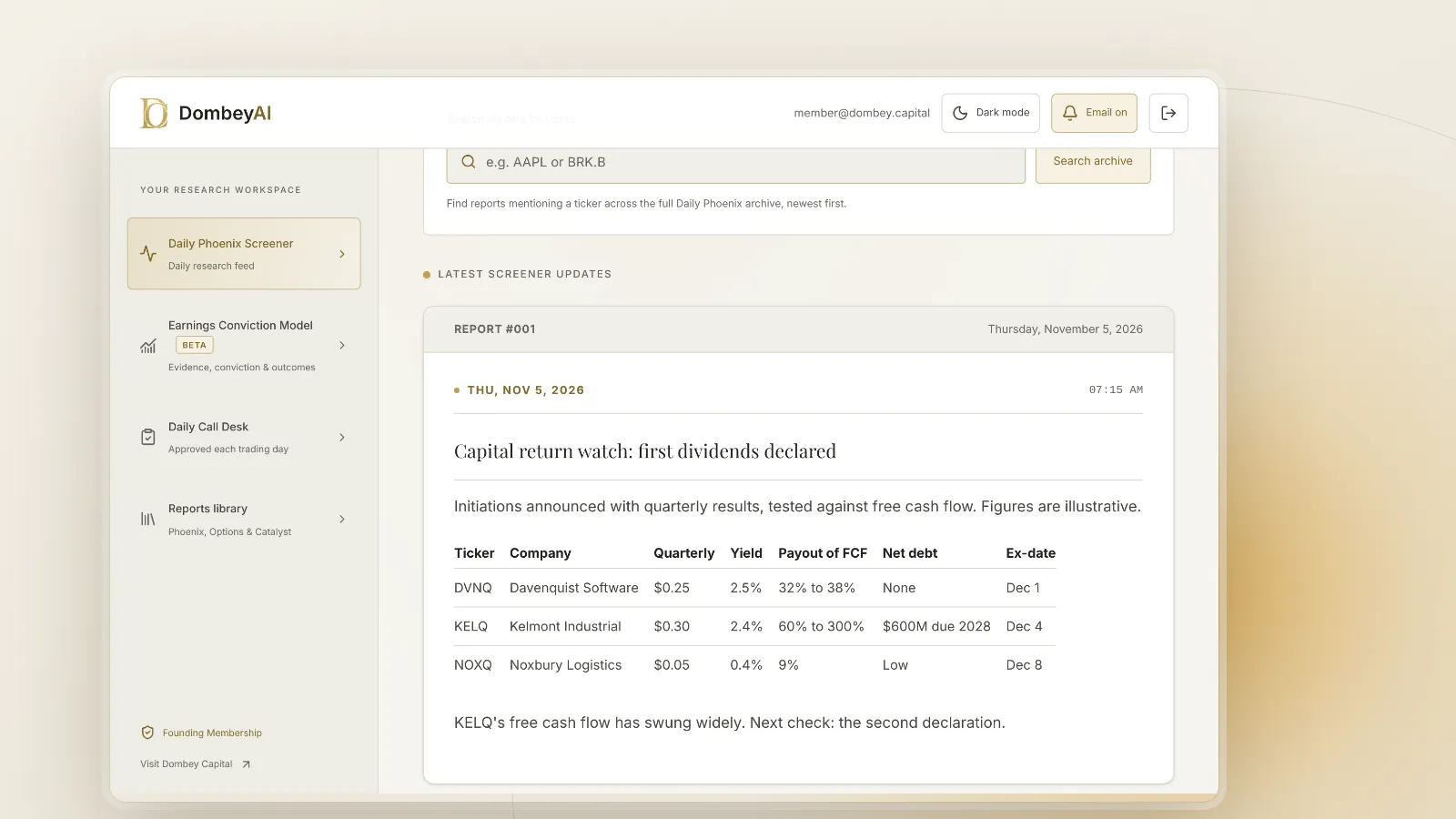
Why a first dividend carries information
Management knows more about the company's future cash flow than outside investors do. Most statements about that future are cheap to make. A dividend is not. Once a company pays a regular dividend, cutting it tends to hurt the stock badly, as our article on dividend cuts explains. A board that starts one is putting its credibility behind the claim that the cash will keep coming.
That is the signaling explanation, and it is why the announcement can matter more than the money. A 1% yield does not change a company's value much on its own. The message that the board is confident enough to commit to it can.
Studies of dividend initiations have generally found positive price reactions at announcement, with large differences between companies. The reaction is a market judgment about one company's cash flow, not a rule.
The four ways a first dividend moves a stock
| Channel | What happens | When it matters most |
|---|---|---|
| Signal | The board commits to a payout it expects to sustain | When the market doubts the durability of earnings |
| New buyers | Income funds and dividend strategies can now own the stock | When the company was large enough but excluded for paying nothing |
| Capital allocation | Cash goes to holders rather than acquisitions or projects | When investors worried about empire building |
| Balance sheet | Cash leaves the company every quarter | When debt maturities or investment needs are large |
The signal
The signal is strongest when the market has doubts. A company emerging from a restructuring, a cyclical business after a long downturn, or a former growth company whose earnings have become steady can all use a first dividend to say the hard part is over. Companies that came out of Chapter 11 sometimes use an initiation to mark that point; see why post-bankruptcy equities often trade cheap.
New buyers
Some investors only hold dividend payers. Income funds, some retirement strategies and dividend-weighted index products can only own the stock once it pays. Index inclusion rules vary and often require a history of payments, so the effect may come later rather than at once.
Capital allocation
Investors sometimes worry that a cash-rich company will spend its cash badly. A dividend removes some of that risk by sending cash out every quarter. Buybacks do the same job with more flexibility, which is why a first dividend sometimes comes alongside a repurchase plan; our article on buybacks as catalysts compares the two.
The balance sheet
The same commitment that makes the signal credible also makes it a cost. A dividend that consumes cash the business needs for investment or debt repayment weakens the company. A debt maturity wall a year or two out makes that tension sharper.
How to read the announcement
Most initiations arrive in a press release, often alongside quarterly results, and are frequently furnished or filed on Form 8-K. Our guide on reading an 8-K for catalysts covers where to find it. The questions to answer:
- How large is it? Work out the annual dividend as a share of earnings and of free cash flow. A payout below half of free cash flow leaves room for bad years.
- What cash flow supports it? Look at free cash flow over a full cycle, not the latest quarter. Free cash flow yield is a useful cross-check against the dividend yield.
- What does it replace? Read the capital allocation section of the release and the latest 10-K or 10-Q. If investment or debt repayment is falling to fund the dividend, ask why.
- What did management say about growth? A dividend framed as "the first step in a balanced return of capital" reads differently from one framed as "we see fewer opportunities to reinvest".
- Was it expected? If management hinted at it on the previous earnings call, much of the effect may already be in the price.
The dates that follow
After the declaration, three dates matter. The record date is the cut-off for holders who receive the payment. With US stock trades now settling one business day after the trade, the ex-dividend date is generally the same as the record date, so you need to own the shares before the ex-dividend date to receive the payment. The payment date is when the cash arrives.
| Date | Event | What to check |
|---|---|---|
| Announcement | Board declares the first dividend | Size, payout ratio, language on future payments |
| Ex-dividend date | Shares trade without the dividend | Price usually falls by about the dividend, other things equal |
| Record date | Holders of record are fixed | Generally the same day as the ex-date under one-day settlement |
| Payment date | Cash paid | Whether the next declaration follows on schedule |
| Next quarter | Second declaration | Confirms the dividend is regular, not one-off |
Worked example
The annual dividend is $1.00 a share, or $100 million. That is about 32% to 38% of free cash flow over the last four years, and the yield at $40 is 2.5%.
The announcement says the company will also continue its $150 million annual buyback and its planned investment in new products. Adding the dividend and the buyback gives $250 million, which sits below the low end of the free cash flow range.
What the analyst would conclude: the dividend looks covered in an ordinary year, and nothing appears to have been cut to fund it. The signal is that management expects free cash flow to stay at or above recent levels. The risk is a weak year in which free cash flow falls toward $250 million and the company must choose between the dividend, the buyback and investment. Whether the stock moves depends on how much of this the market already expected.
Contrast that with Company E, an invented industrial company with the same yield but free cash flow that swung from $40 million to $200 million over the last four years and $600 million of debt due in eighteen months. The same announcement would carry a much weaker signal, because the cash to support it is less certain.
Initiations as a catalyst
A dividend initiation is usually a soft catalyst: there is no fixed date until the board declares it, and the company is not obliged to do it. Some setups make one more likely:
- A company that has recently reached steady positive free cash flow and has net cash.
- A company that has finished a deleveraging plan and said so.
- A company emerging from a restructuring or a spin-off with a stated capital return policy.
- A management team that has said on earnings calls that it is "evaluating a return of capital".
The announcement often lands with earnings, so it can be hard to separate its effect from the results themselves. Some investors also watch for continued price drift after announcements, a pattern discussed in our article on post-earnings announcement drift. Any such pattern depends on the company and the period, and is not a forecast.
Where this goes wrong
The dividend was expected. If management guided toward it, or the market treated it as certain, there may be no surprise left to price.
The dividend is too small to matter. A token dividend with a yield well under 1% sends a weak signal and may not attract income buyers.
It is funded by the balance sheet, not cash flow. A dividend paid from borrowed money or from asset sales is not a sign of durable earning power. Check the cash flow statement for the source.
It replaces investment. If the company is cutting research or capital spending to fund the dividend, the long-term cost can exceed the near-term signal.
The business is cyclical. A dividend started at the top of a cycle may be cut at the bottom. That sequence is worse for the stock than never starting one.
Common mistakes
- Confusing the yield with the return. The dividend is part of the total return, and the ex-dividend price adjustment offsets it on the day.
- Buying just before the ex-date for the payment. The price usually falls by about the dividend, and taxes can make the trade worse. Holding-period rules for qualified dividends also apply.
- Ignoring the second declaration. The first dividend makes a claim. The next one, on schedule and at the same rate or higher, confirms it.
- Reading the headline only. The capital allocation language in the release and the 10-Q says more about what the dividend means than the amount does.
Dombey's published research treats capital return announcements as one input among several before a catalyst; see the research archive. For the events moving stocks this week, see the market coverage.
The bottom line
A first dividend moves a stock mainly because it is a costly signal: a board that starts one is betting that cash flow will be steady enough to keep paying it. It can also bring in income buyers and reassure investors who worried about how cash would be spent. The size of the reaction depends on surprise, on how well cash flow covers the payment and on what the dividend displaces. Read the announcement for those three things, then watch whether the second declaration follows.