

Which deals the Commission reviews
The EU Merger Regulation (Council Regulation No 139/2004) applies to concentrations with an "EU dimension". That is a turnover test, not a market share test.
- The main thresholds. The parties' combined worldwide turnover exceeds 5 billion euros, and at least two of them each have EU turnover above 250 million euros.
- The two-thirds rule. A deal falls outside EU jurisdiction if each party earns more than two-thirds of its EU turnover in one and the same member state. National authorities then review it instead.
- The alternative thresholds. A lower set of thresholds catches some deals whose turnover is spread across at least three member states.
Deals below these thresholds can still face national reviews in individual member states, and the Commission can take on cases by referral in some circumstances. Many large US deals meet the EU thresholds because both parties sell heavily in Europe, even when neither is European.
The timeline at a glance
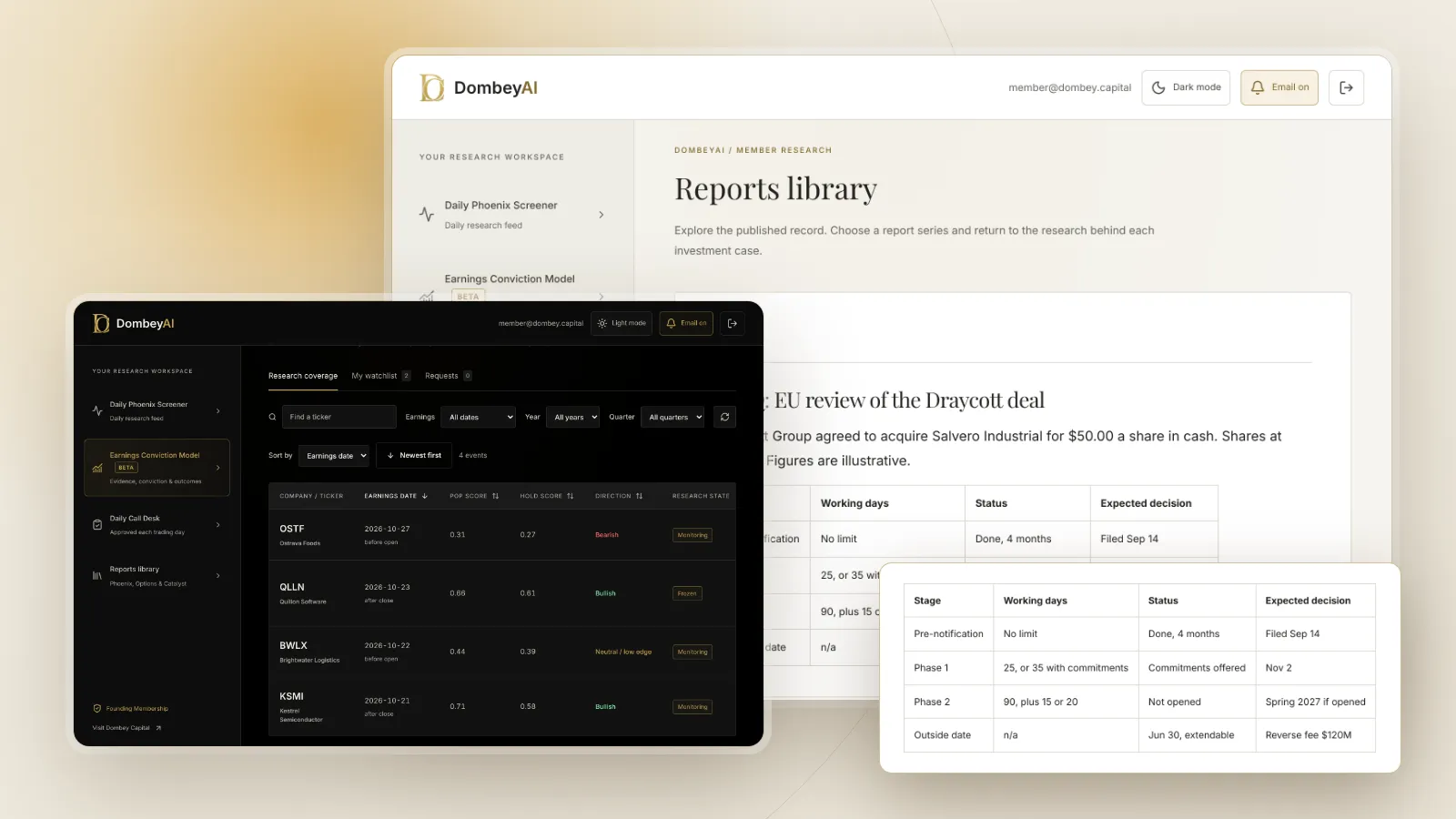
| Stage | Formal length | What can extend it | Possible outcomes |
|---|---|---|---|
| Pre-notification | No fixed limit | Draft filings, information requests | Formal notification (Form CO or short form) |
| Phase 1 | 25 working days | 35 working days if commitments are offered or a member state requests referral | Clearance, clearance with commitments, or opening of Phase 2 |
| Phase 2 | 90 working days from opening | 15 working days if commitments come late; up to 20 working days by request or agreement | Clearance, clearance with remedies, or prohibition |
| Appeal | Years | Court schedule | General Court, then Court of Justice |
Working days exclude weekends and Commission holidays, so 25 working days is about five calendar weeks and 90 working days is roughly four to five months.
Pre-notification: the stage the clock ignores
Before a formal filing, the parties send drafts of the notification to the Commission's case team and answer questions. The Commission encourages this, and for complex deals it can take months. The formal Phase 1 clock does not start until the Commission considers the filing complete.
That is why the signing date of a merger agreement tells you little about when the EU decision will arrive. The useful date is formal notification. The Commission publishes a short notice of each notified case, and the case then appears in its public register with a provisional deadline.
Phase 1: the first review
In Phase 1 the Commission tests the deal with customers, competitors and suppliers through questionnaires, and decides whether the merger raises serious doubts about its compatibility with the internal market.
Phase 1 ends in one of three ways:
- Unconditional clearance. Most notified deals end here. Many go through the simplified procedure, a lighter review for deals with little overlap.
- Clearance with commitments. The parties offer remedies, such as selling an overlapping business, that remove the serious doubts. Offering commitments extends Phase 1 to 35 working days.
- Opening of Phase 2. The Commission decides the doubts are too serious to resolve in Phase 1.
A Phase 1 clearance with commitments is often the outcome the market expects for deals with a few clear overlaps. The commitments themselves can matter to value: a required divestiture may be larger than the buyer suggested at signing.
Phase 2: the in-depth investigation
Phase 2 is the expensive path. The Commission gathers much more evidence, including internal documents, and usually sets out its concerns in a Statement of Objections. The parties get access to the file and can respond in writing and at an oral hearing.
The timeline is 90 working days from the opening decision. It extends by 15 working days if the parties offer commitments on or after working day 55, and by up to 20 working days at the parties' request or with their agreement. The Commission can also stop the clock if the parties fail to provide information it has demanded, which pushes the deadline back.
Phase 2 ends in one of three ways:
- Unconditional clearance.
- Clearance with remedies. Typically a divestiture to an approved buyer, sometimes behavioral commitments.
- Prohibition. The deal cannot proceed as notified. Prohibitions are rare, but the threat of one often leads the parties to abandon the deal before a decision.
Compare this with the US process. The HSR waiting period runs 30 days, but a second request extends review until the parties comply, with no fixed end. The EU has firmer deadlines once the filing is complete, but its pre-notification stage absorbs much of the uncertainty. US agencies also have to go to court to stop a deal, as our explainer on FTC and DOJ merger challenges covers, while the Commission can prohibit one by decision.
What the phases mean for a deal spread
The spread on a pending deal prices two things: the chance the deal closes and the time until it does. EU review affects both.
The calculation behind that move is in our guide to calculating a merger arbitrage spread. Two points from the example are general:
- Time alone widens the spread. Even with no change in the odds, a longer wait lowers the annualized return and so the price holders will pay.
- Remedies can collide with the merger agreement. Many agreements cap the divestitures a buyer must accept. If the Commission's demands exceed that cap, the buyer can walk away. Reading the regulatory efforts clause in the merger agreement tells you where that line sits.
Watch the outside date as well. Many merger agreements set an end date with automatic extensions for pending regulatory approvals. A Phase 2 opening can push the expected decision past the first outside date, which makes the extension terms and any reverse termination fee relevant.
Signals to watch during a review
| Date or event | What to check | Where to find it |
|---|---|---|
| Notification | Formal filing date and provisional deadline | Commission case register and press notice |
| Around working day 20 | Whether commitments were offered | Case register (deadline moves to 35 working days) |
| Phase 1 deadline | Clearance or opening of Phase 2 | Commission press release |
| Statement of Objections | Scope of the Commission's concerns | Company 8-K or press release; Commission statements |
| Remedies offered | Size of divestitures against the agreement's cap | Company filings; market test notices |
| Phase 2 deadline | Final decision | Commission press release |
Company disclosures matter too. US-listed parties usually report regulatory milestones in an 8-K or press release, and the proxy or S-4 describes the regulatory approvals the deal needs and the efforts each side has committed to.
Where this goes wrong
Treating the deadline as fixed. Stop-the-clock decisions, late commitments and extensions all move the end date. A Phase 2 that looks like 90 working days can run much longer in calendar time.
Ignoring other regulators. The Commission is one reviewer among many. UK, Chinese and other national authorities, and in some deals foreign investment reviews such as CFIUS, can set the real critical path.
Reading clearance as the end of the risk. A clearance with remedies may still require an approved buyer for the divested business before closing. Financing, shareholder votes and other conditions also remain.
Assuming a Phase 2 means a block. Many Phase 2 cases end in clearance with remedies. The opening says the Commission has serious doubts, not that it has decided. The reverse is also true: a Phase 2 that leads the parties to abandon the deal never produces a prohibition decision, so prohibition counts understate how often review kills deals. Our explainer on deal breaks covers what usually happens to the target's shares when that happens.
The bottom line
EU merger control gives the European Commission a Phase 1 review of 25 working days and, for deals that raise serious doubts, a Phase 2 investigation of 90 working days plus possible extensions. Pre-notification sits outside both clocks and often takes the longest. For a pending deal, the notification date, any commitments and the Phase 1 decision are the dates that move the spread. For live deals and the moves around them, see the market coverage.