

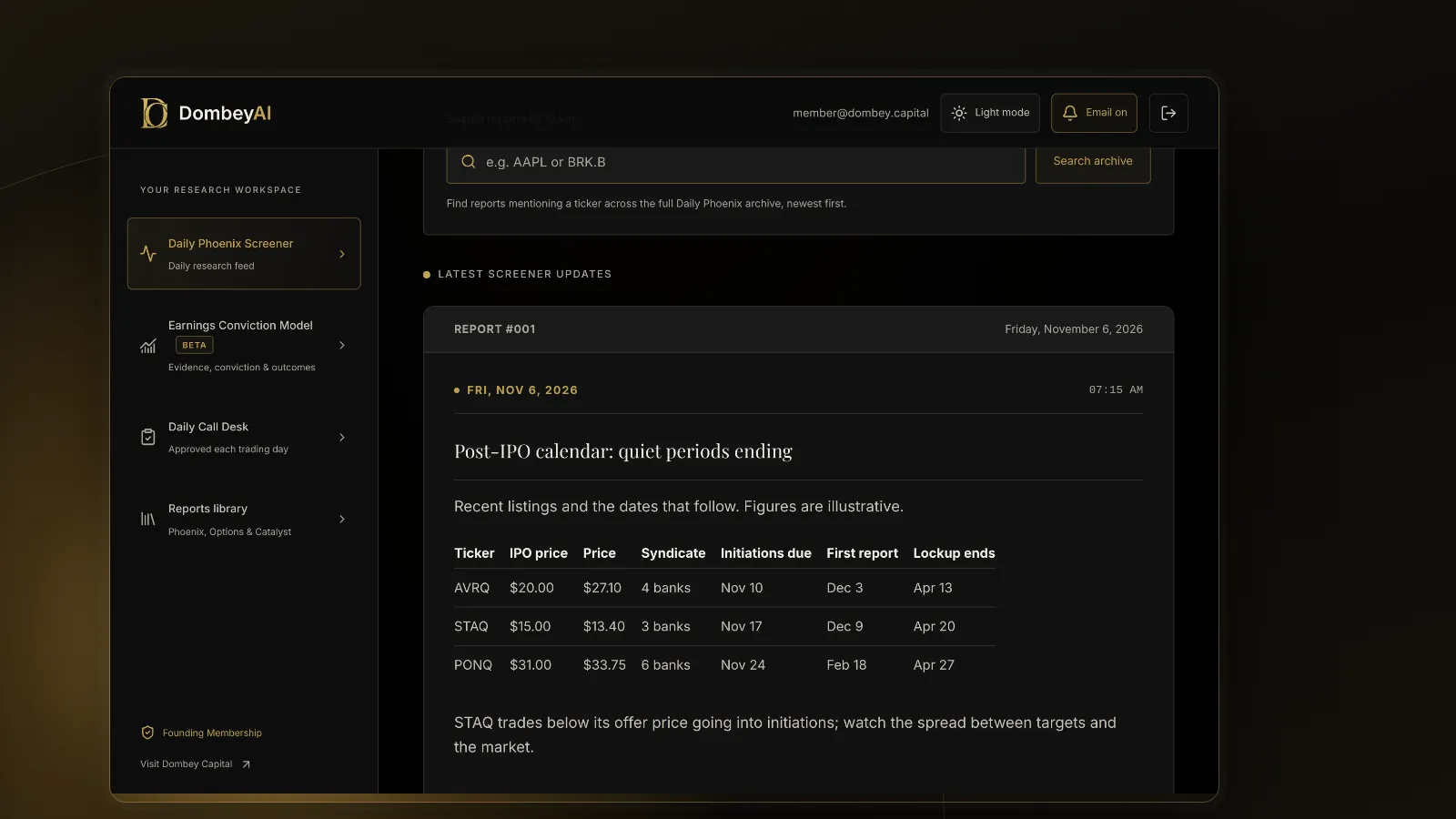
The two quiet periods
The registration quiet period. Under the Securities Act, a company in registration is limited in how it can offer securities outside the prospectus. Statements that look like promotion of the offering can count as an illegal offer, which practitioners call gun-jumping. The SEC has added safe harbors over the years, including test-the-waters meetings with institutional investors, but most companies keep public comment narrow until the deal is done. The S-1 registration statement is the main disclosure document during this period.
The research quiet period. After the IPO prices and trades, FINRA rules limit research by member firms that took part. Rule 2241 requires those firms to set quiet periods during which they do not publish research reports on the issuer and their analysts do not make public appearances about it. The minimums are:
- IPO: at least 10 days after the IPO date, for any member that acted as an underwriter or dealer.
- Secondary offering: at least three days after the offering, for any member that acted as manager or co-manager.
The rule excludes research and public appearances after the IPO or secondary offering of an emerging growth company, a status that covers many newly public companies below a revenue limit. In practice, banks often keep a longer wait for those companies under their own policies. For investors, the useful point is that the timing is set by the underwriters, and the prospectus lists who they are.
Quick reference
| Item | Registration quiet period | Research quiet period |
|---|---|---|
| Who is limited | The issuer and offering participants | Analysts at underwriting and dealing firms |
| Rule source | Securities Act rules on offers | FINRA Rule 2241 |
| When it applies | Before and during registration, through the offering | After the IPO or secondary offering |
| Length | Until the offering is complete | Minimum 10 days after an IPO; 3 days after a secondary |
| Emerging growth companies | Can test the waters with qualified investors | Rule minimum does not apply; banks' policies set timing |
| Event at the end | Company resumes normal communications | Underwriters' analysts initiate coverage |

What happens when it ends
At the end of the research quiet period, the underwriters' analysts typically publish initiation reports, often on the same morning. A large IPO might bring five or more initiations at once, sometimes joined by firms that were not in the syndicate.
Three features shape the market reaction:
- Ratings are usually positive. The banks sold the deal and have ongoing relationships with the issuer. Research rules separate analysts from investment banking, but initiations from the syndicate still tend to be favorable.
- Targets are anchored to the deal. Price targets usually sit above the IPO price. If the stock has already risen well above that level, the targets may look modest.
- The news is expected. Investors know the date and the likely tone. The move depends on how much optimism the price already holds, as with any analyst upgrade or downgrade.
Worked example
| Day | Event | What to check |
|---|---|---|
| 0 | IPO prices at $20 and trades at $27 | Final prospectus: underwriters, lockup terms |
| 1 to 24 | No research from the syndicate | Trading range and volume as the float settles |
| 25 | Four initiations, three positive and one neutral | Price targets against the current price; models' revenue forecasts |
| 25 to 30 | Other firms begin coverage | Whether any target sits below the market |
| About 90 | First earnings report as a public company | Results against the newly published estimates |
| About 180 | Lockup expires | Size of shares eligible for sale |
If the stock trades at $27 and the four targets average $30, the initiations imply limited upside from the current price, and the reaction may be small. If the stock has fallen to $19 and the targets average $28, the reports are more likely to move it, because they disagree with where the price has gone. In both cases the reports also publish the first full set of revenue and earnings forecasts, which set the bar for the first earnings report. Our explainer on earnings estimate revisions covers why those forecasts matter later.
Reading an initiation report
When the reports arrive, most of the useful content is not the rating. A few things deserve more attention:
- The first public model. Until initiation, outside investors have only the prospectus. The initiations publish forecasts for revenue, margins and earnings, often for two or three years. Comparing them shows where the banks agree and where they do not.
- The valuation method. Some reports value the company on a multiple of forward revenue, others on a discounted cash flow. The method tells you which assumption holds the target up.
- Peer choice. The comparable companies chosen for valuation often flatter the new issuer. Our explainer on comparable company analysis covers how peer sets can be stretched.
- Disclosures. Each report states the firm's banking relationship with the issuer. Initiations from banks outside the syndicate, which arrive later, are a useful check.
- Risks section. The prospectus risk factors and the analyst's own list are often similar, but any new risk the analyst adds is worth reading.
Initiations from firms that were not in the syndicate are worth separating out. They have no banking relationship with the deal and sometimes take a more skeptical view, though they also have less access to management. A neutral or negative initiation from an outside firm in the first months can move a new stock more than the syndicate's positive reports, because it is less expected.
The quiet period in the IPO calendar
The research quiet period is one of several dated events after a listing:
- Pricing and first trade. Set by the deal.
- Quiet period expiry. Initiations from the syndicate.
- First earnings report. The first test of the new estimates.
- Lockup expiration. Typically about 180 days, when insiders and early holders can sell. Our explainer on lockup expirations covers the supply effect.
The best IPO and lockup expiration calendars track several of these dates. Adding them to a catalyst calendar on the day of the IPO avoids having to rebuild the timeline later.
Where this goes wrong
Assuming the 10-day rule applies. Many IPOs are emerging growth companies, where the FINRA minimum does not apply. The actual date depends on the underwriters' policies and is often later. Watch for the date to be reported rather than calculating it from the rule.
Treating initiations as independent views. The syndicate's analysts work at the banks that sold the deal. Their reports add data and models, but the ratings say little that the market did not expect.
Ignoring the price before the date. A stock that has run far above the IPO price into the quiet period expiry may have little room to rise on positive coverage. A stock that has fallen may react more.
Confusing the quiet period with the lockup. The quiet period ends within weeks and brings research. The lockup ends months later and brings potential selling. They move the stock through different channels.
Overlooking busted deals. When an IPO trades well below its offer price, coverage can be the first sign of how the banks see the outlook. Our explainer on busted IPOs covers why these can become special situations.
The bottom line
The IPO quiet period is the period after a listing when the underwriters' analysts stay silent, with a FINRA minimum of 10 days that emerging growth companies are exempt from. Its end brings a group of initiations that is usually positive and widely expected, so the stock's reaction depends on what the price already reflects. Treat the date as one item in the post-IPO calendar alongside the first earnings report and the lockup expiration. For dated events moving stocks now, see the market coverage.