

Oct 21, 2026: a quiet session, then a jump on results and the share class
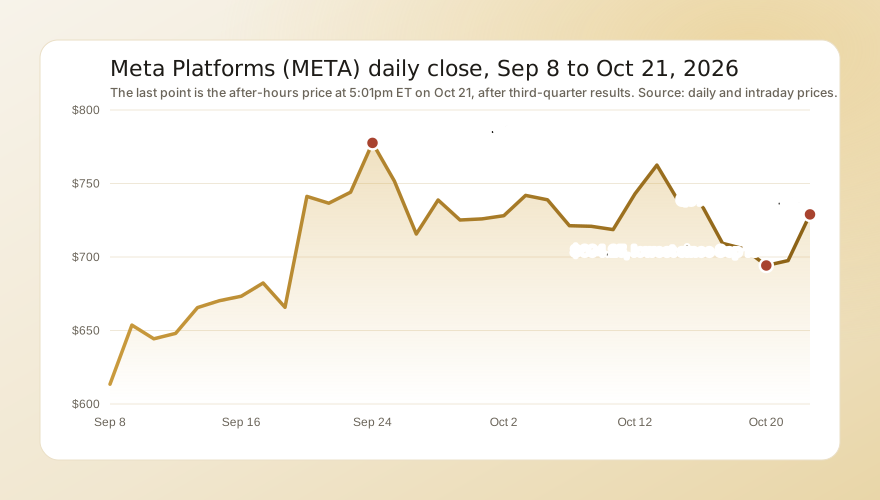
Meta started premarket trading at about $695 at 4am, dipped to $687.78 shortly after 7am, and was $692.49 at 9:20am, below the Oct 20 close. It opened the regular session at $697.74 and climbed to a high of $713.22 at about 12:20pm, up 2.7%. News of the New Mexico penalty broke early in the afternoon; Barron's noted the stock was still up 1.8% after it. The day's low of about $690 came at about 3:15pm, and minutes later Reuters carried a Semafor report that Meta planned non-voting shares and more stock sales to fund AI. It closed at $697.52, up 0.5%, on 23.8 million shares.
The release came out at about 4pm. The stock traded at $730 by 4:03pm and $725.55 at 4:04pm, held near $725 until the call began at 4:30pm, then rose to $748.80 at 4:40pm. By 5:01pm it was $729.00.
What lifted it:
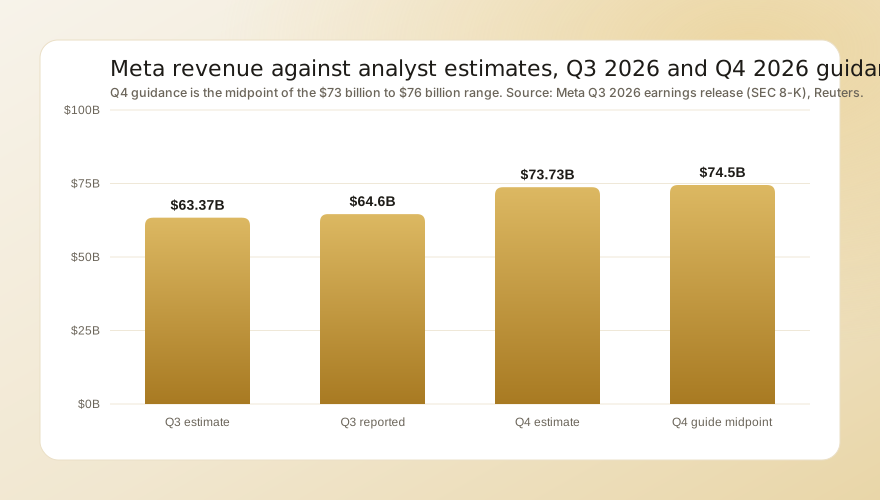
- Revenue and the outlook beat. Revenue of $64.60 billion was 1.9% above estimates, and the fourth-quarter midpoint of $74.5 billion implies growth of about 24%.
- Spending did not run further. The 2026 expense range moved to $175 billion to $179 billion from $165 billion to $169 billion, a rise of about the $9.89 billion charge. Capital spending guidance moved to $135 billion to $145 billion from $130 billion to $145 billion, which Reuters described as a tighter forecast; the top of the range did not move.
- Cash burn was smaller than feared. Operating cash flow was $32.79 billion against $34.91 billion of capital spending.
- A funding source that keeps control. The Class C plan answers how Meta pays for the build without more debt or a loss of founder control.
What held it back during the day:
- The $25 billion penalty. The Wall Street Journal reported Judge Francis Mathew set the penalty weeks after a jury found about 44 million violations of New Mexico's unfair practices law, which allows up to $5,000 each. The state had asked for $35 billion to $40 billion; Meta had argued for $345 million to $3.5 billion. Meta's chief legal officer said the company will appeal.
- A soft sector. Alphabet fell 1.6% and the Communication Services sector ETF 1.1%, while QQQ rose 1.1%.
| Stock or fund | Oct 21 close | Day change | After hours, 4:55pm to 5:01pm |
|---|---|---|---|
| Meta Platforms (META) | $697.52 | +0.5% | +4.5% |
| Alphabet (GOOGL) | $334.76 | -1.6% | +0.2% |
| Amazon (AMZN) | $262.37 | -0.1% | +0.1% |
| Microsoft (MSFT) | $532.95 | +0.2% | -0.1% |
| Snap (SNAP) | $6.35 | -0.5% | +1.7% |
| Pinterest (PINS) | $22.95 | -0.1% | 0.0% |
| Reddit (RDDT) | $153.28 | -1.5% | 0.0% |
| Communication Services ETF (XLC) | $108.97 | -1.1% | +1.6% |
| Invesco QQQ (QQQ) | $725.20 | +1.1% | +0.1% |
Meta held up better than its ad peers in the session, and after hours it moved far more than any of them. The gain is about the report, not the sector.
At the regular close, RSI(14) stood at 47, the shares sat 5.5% above their 50-day average and 10.3% above their 200-day average, volume ran 1.2 times its 20-day average, and the stock was 10.6% below its 52-week high of $779.82. At $729.00 after hours it was 6.5% below that high.
The numbers
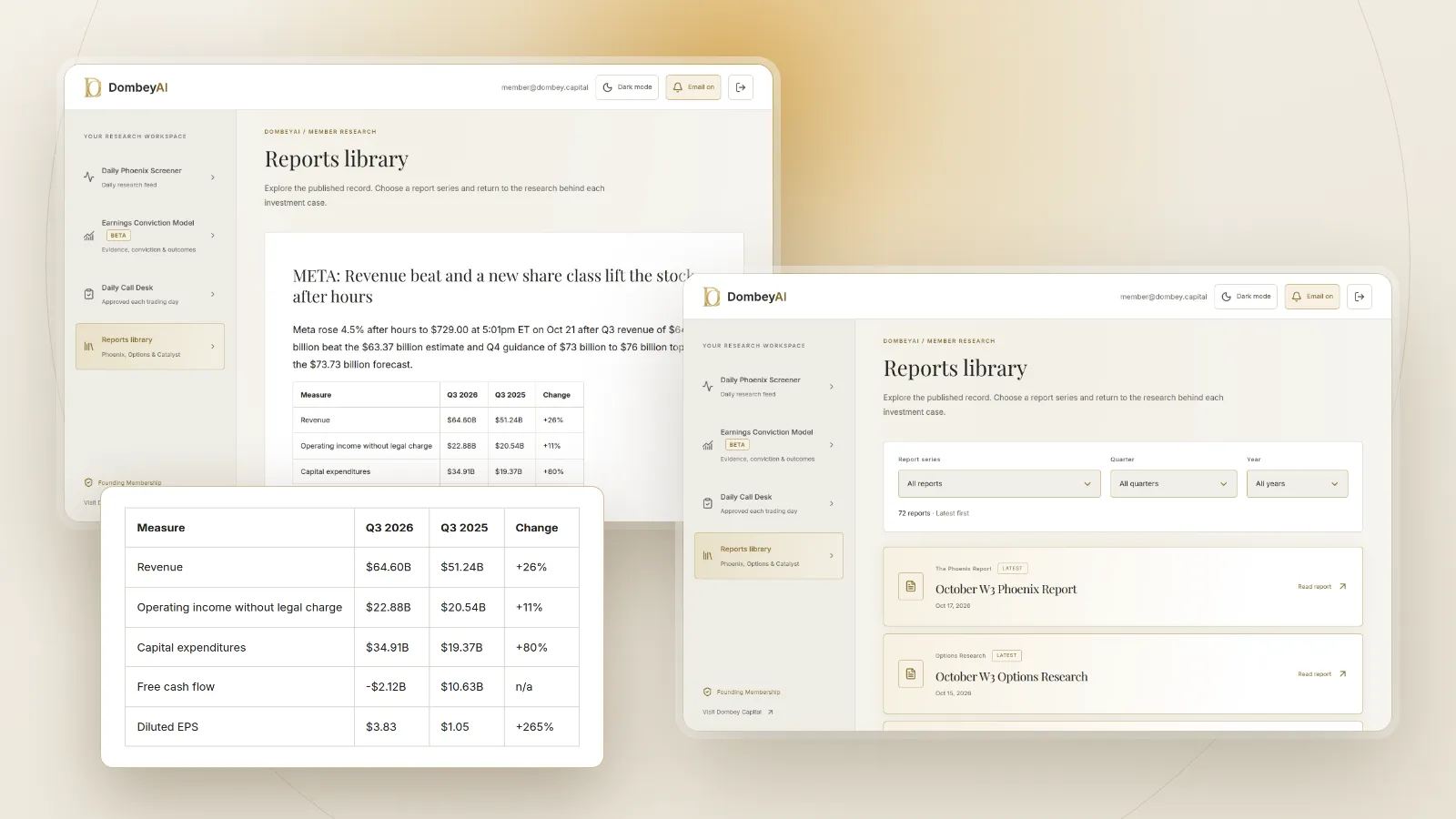
| Measure | Q3 2026 | Q3 2025 | Change |
|---|---|---|---|
| Revenue | $64.60B | $51.24B | +26% |
| Operating income | $12.99B | $20.54B | -37% |
| Operating income without the legal charge | $22.88B | $20.54B | +11% |
| Diluted EPS | $3.83 | $1.05 | +265% |
| Capital expenditures | $34.91B | $19.37B | +80% |
| Free cash flow | -$2.12B | $10.63B | n/a |
Diluted earnings would have been $7.40 a share without the charge, Reuters reported. Family daily active people averaged 3.64 billion in September, up 3%. Headcount fell 15% to 66,775. Reality Labs lost $4.13 billion in the quarter, and Meta expects its full-year loss to fall to $18 billion to $19 billion, then to about $15 billion in 2027 as money moves to AI. Meta bought back no stock in the quarter, after $3.33 billion a year earlier. For why an outlook can matter more than the quarter itself, see our explainer on guidance changes.
The Class C stock
Meta's board declared a one-time dividend of one Class C share for each Class A and Class B share, paid after an amended charter takes effect on January 19, 2027. Meta expects the Class A price to reflect a two-for-one split after that. A special committee of independent directors recommended the change, holders approved it by written consent, and Meta signed a Founder Alignment Agreement with Zuckerberg that covers his sales of Class C shares and his service. Meta plans to list Class C on Nasdaq.
The dividend itself dilutes no one. The point is what comes after: Meta said the stock gives it "the ability to finance its growth," along with paying employees and funding deals. Every Class C share sold later raises the share count, which is how dilution reaches existing holders. Our page on dual-class share structures covers how markets tend to price voting and non-voting lines.
The case for the stock
The ad business keeps beating its own forecasts. Meta had guided the third quarter to $61 billion to $64 billion in July and came in above the top of that range, and revenue rose $3.8 billion from the second quarter's $60.80 billion. Meta still expects 2026 operating income, excluding the charge, to top 2025. The forward P/E is about 21 on the regular close, and the consensus price target is $803.62, about 15% above the regular close. By Oct 20 the stock had fallen 10.7% from its Sep 24 peak close, so the report met a stock that had already given back ground.
The risks
- Legal costs keep coming. The New Mexico penalty is 30% of Meta's $82.45 billion of cash and about 1.4% of its $1.78 trillion market value. The Wall Street Journal reported New Mexico will also ask the court to order changes to Meta's platforms, and Meta flagged several youth-related trials in the coming months. Our guide on how to value a litigation outcome explains how to weigh a judgment that is under appeal.
- Spending with no 2027 number. Meta said it will keep "investing aggressively" next year but gave no figure, and its release says its AI lab investments "will take longer to generate returns than those in our core business."
- Share sales. Once Class C exists, Meta can sell stock to fund capital spending, a new source of supply for the shares.
What comes next
- January 19, 2027. The Class C charter takes effect, and the stock dividend follows. Watch for any sale program filed alongside it.
- The fourth-quarter report, date not yet set, with the first 2027 spending outlook. Our guide to preparing for an earnings report covers what tends to move a stock on the day.
- New Mexico post-trial steps. An appeal, a bond and any order on platform changes.
For other names moving after results today, see today's biggest stock moves.