


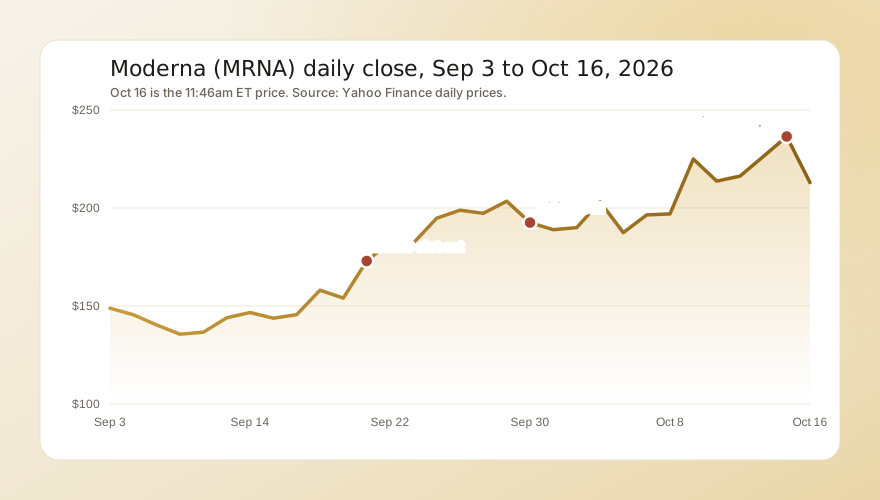
Oct 16, 2026: a 52-week high, then a 10% drop at the open
Moderna traded near $235 to $236 before the open, little changed from Thursday's close. It opened at $234.90, touched $237.96 in the first five minutes, and then fell steadily. By 9:55am it was at $212.84, and it hit the day's low of $208.92 a little after 10:10am. A bounce took it to $217.47 near 11:00am before it slipped to $209.01 around 11:25am and recovered to $212.98 at 11:46am.
What pushed it down:
- Profit-taking after a historic run. The stock closed at $62.96 on Aug 18, rose 177% the next day on the Phase 3 news, and reached $236.50 on Oct 15, up 276% in under two months. FinViz puts the gain this year at 623%. 24/7 Wall St. said the profit-taking "lands hardest on the stock that surged furthest."
- Goldman's note. Goldman Sachs analyst Salveen Richter raised the target to $137 from $120 on Oct 15 and kept a Neutral rating. Investing.com said the note "underscored how far the current share price has stretched beyond Wall Street's fundamental estimates."
- A Form 144. Moderna officer Stephen Hoge filed notice on Oct 15 to sell 39,145 shares, worth about $8.64 million, acquired that day through an option exercise. The filing lists a trading plan adopted June 15, 2026, and four earlier sales by Hoge in the past three months, on Jul 15, Sep 14, Sep 15 and Oct 14. It is a planned sale of about 0.01% of the 399.2 million shares outstanding, so it says little about his view of the data.
- Derisking before ESMO. Investing.com called the move "a classic pre-event derisking dynamic" ahead of a presentation that "could either validate or unwind the cancer vaccine thesis." It also noted that Summit Therapeutics hired two former senior Moderna cancer vaccine scientists.
The sector was weak, but not this weak. At 11:46am BioNTech was down 1.9% at $88.53, Pfizer was up 0.5% at $29.59, and the SPDR S&P Biotech ETF (XBI) was down 2.8% at $145.58. Novavax, another vaccine maker that rallied with Moderna, fell 11.8% to $11.31. Moderna's drop was more than three times the biotech ETF's, which fits a crowded trade unwinding rather than a sector event.
After the drop, RSI(14) stood at 59, the shares sat 38% above their 50-day average and 175% above their 200-day average, volume of 12.5 million shares by late morning was 0.7 times the 20-day full-day average, and the price was 12% below the 52-week high of $242.29, according to Yahoo Finance daily prices.
The valuation, in numbers
Moderna's market value was about $85.1 billion at the late-morning price, according to Financial Modeling Prep. The business behind it is still small and losing money. Second-quarter revenue was $145 million and the net loss was $782 million, per the 10-Q. Cash, cash equivalents and investments were $6.91 billion at June 30, down $1.2 billion in six months. FinViz shows a price-to-sales ratio of 38.2 on $2.23 billion of trailing sales, a price-to-book ratio of 12.6 and no forward P/E, because analysts still expect a loss next year. Our explainer on the price-to-sales ratio covers why a multiple that high depends almost entirely on future products.
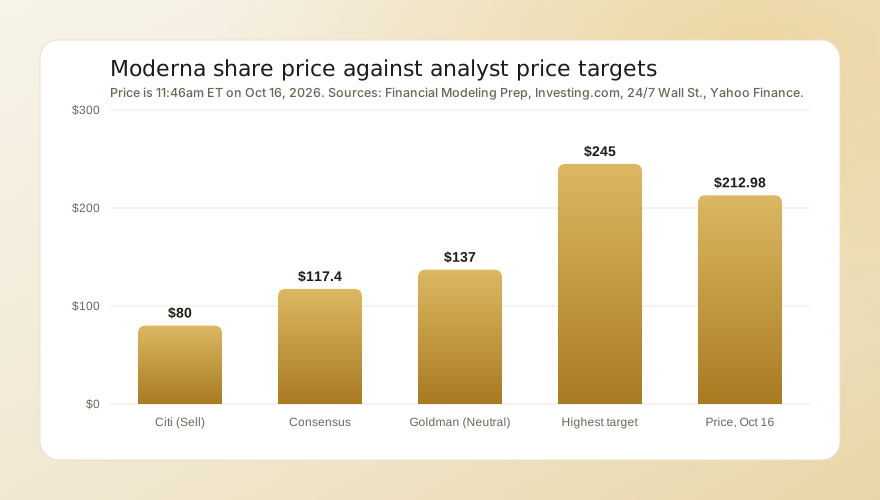
The gap between the price and Wall Street's numbers is the clearest reason for the selling:
| Analyst | Rating | Target | Date |
|---|---|---|---|
| Citi (Geoff Meacham) | Sell | $80 | Sep 30 |
| Rothschild & Co Redburn | Sell | $81 | Sep 3 |
| Barclays | Equal Weight | $125 | Aug 24 |
| Goldman Sachs (Salveen Richter) | Neutral | $137 | Oct 15 |
| UBS | Neutral | $150 | Aug 20 |
| Argus | Buy | $180 | Aug 28 |
The consensus target is $117.40 and the median is $127.50, per Financial Modeling Prep. Only the highest target, $245, sits above the current price. When Citi cut the stock to Sell on Sep 30, Meacham wrote that "the stock price increasingly assumes successful expansion into several additional tumor types," and the shares fell 6% to $191.36 in early trading.
The case for the stock: a first-of-its-kind Phase 3 win
On Aug 19, Merck and Moderna said intismeran autogene, a personalized mRNA therapy built from each patient's tumor, combined with Merck's Keytruda met its primary endpoint of recurrence-free survival against Keytruda alone in INTerpath-001. The trial enrolled 1,137 patients with completely removed stage IIB to IV melanoma, randomized two to one. It also met the key secondary endpoint, distant metastasis-free survival, and showed no new safety signals. The Phase 2b trial's five-year follow-up, presented at ASCO in 2026, showed a hazard ratio of 0.51 for recurrence or death, a 49% risk reduction, and 0.411 for distant metastasis or death.
ESMO gave the result its top slot: abstract LBA1 in the Presidential Symposium. Moderna and Merck are running nine Phase 2 and Phase 3 trials across melanoma, lung, bladder and kidney cancer, per 24/7 Wall St., and Moderna will also show early pancreatic cancer data and a lung cancer trial design at the congress. If the melanoma benefit holds near the Phase 2b level, the bull case is that this becomes a standard of care in a large adjuvant market and the platform carries into other tumors.
The risks
- The size of the benefit is unknown. "Statistically significant and clinically meaningful" covers a wide range. A hazard ratio well above the Phase 2b's 0.51 would still be a win for patients but could disappoint a stock priced for more. Our guide to probability-weighted valuation for binary events shows how a single readout can swing a value this far in both directions.
- Overall survival is still maturing. The companies said it is being evaluated. Regulators and payers will weigh it heavily.
- Melanoma alone may not support the price. Citi's case is that today's value needs success in several more tumor types, and those trials report later.
- Cash burn. The company used $1.2 billion of cash in operations in the first half while its COVID and RSV vaccine sales stay small.
What comes next
- ESMO, Oct 24. The INTerpath-001 presentation is at 4:30pm CEST, or 10:30am ET, on a Saturday, with Moderna's investor webcast at 1:00pm ET. The first full trading reaction comes Monday, Oct 26. Watch the recurrence-free survival hazard ratio, the distant metastasis data, any early overall survival trend and the safety table.
- Regulatory plans. The companies said they will discuss the results with regulators. A filing timeline would set the next dated catalyst; our explainer on FDA decision dates covers how those reviews run.
- Third-quarter results, Nov 6. The call is at 8:00am ET. Watch cash, operating spending and any revenue guidance change. Our guide to preparing for an earnings report explains what tends to move a stock on the day.
- Insider filings. Further Form 144s under the June plan are expected. A sale outside a plan would carry more weight.