

Oct 21, 2026: a profit beat, a guidance cut and a two-year low
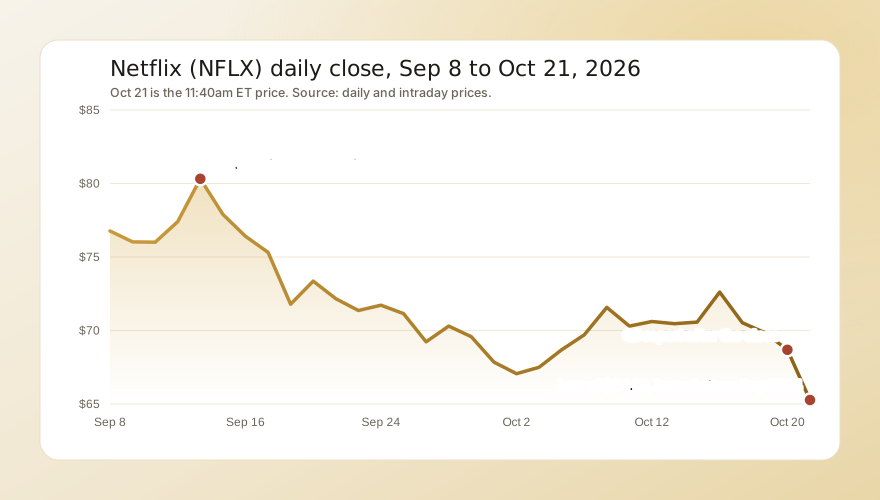
Netflix reported after the 4pm close on Oct 20. The stock traded as low as $63.62 in the first minutes of after-hours trading, then settled near $64.70 by 8pm. Before the open on Oct 21 it drifted lower and hit $63.64 at about 8:25am, down 7.4% from the close. It opened the regular session at $64.13, set a low of $64.10 in the first minutes and bounced to $67.12 by about 9:55am, down 2.3%. The bounce faded, and by 11:40am the stock was $65.27, down 5.0%, on about 49.7 million shares.
What pushed it down:
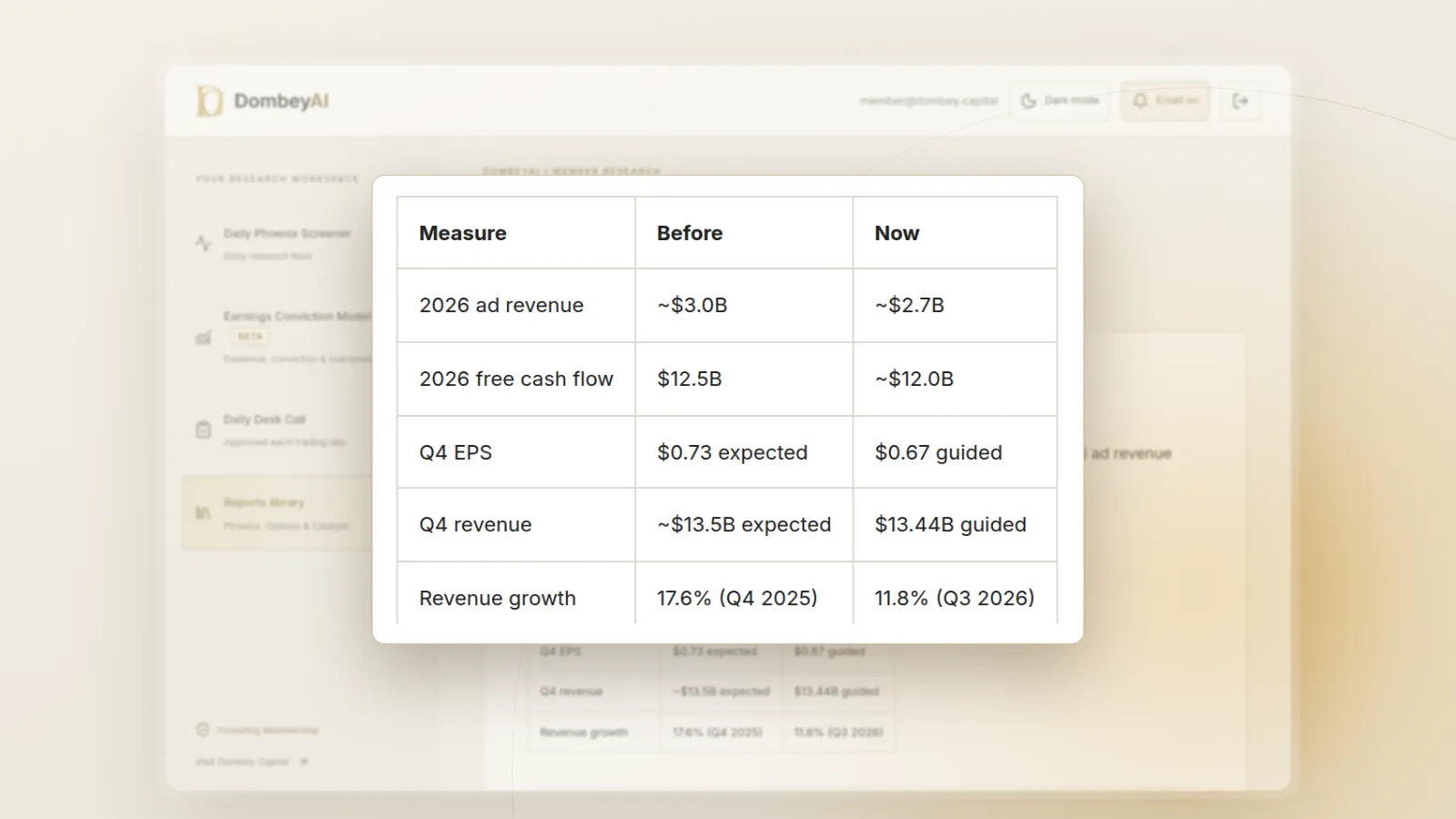
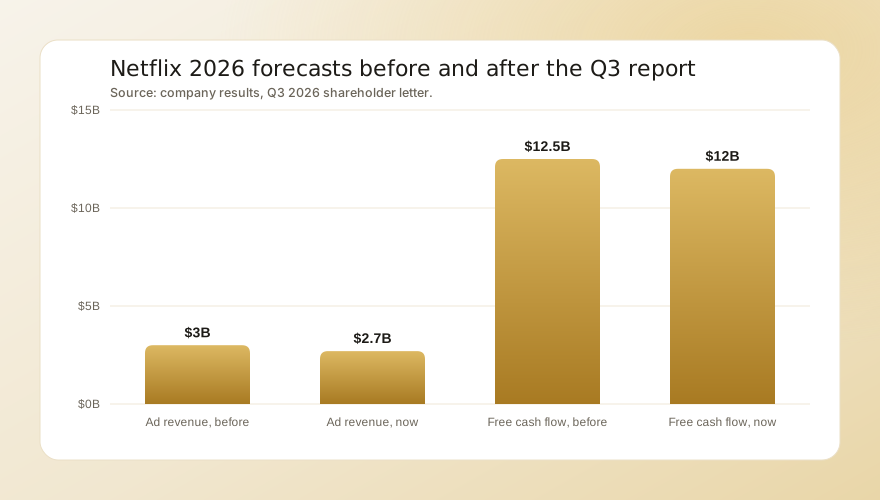
- The ad forecast came down. Netflix now expects about $2.7 billion of ad revenue in 2026, against about $3 billion before, "due to slightly slower than expected rollout of some ad product capabilities," the shareholder letter said. Co-CEO Greg Peters said on the call the ad business is still growing more than 80% this year, "but we are currently a bit behind our aggressive target for the year."
- The fourth quarter looks lighter than expected. Netflix guided to fourth-quarter revenue of $13.44 billion, below the roughly $13.5 billion analysts expected, and earnings of $0.67 a share against a $0.73 consensus, Reuters reported. The forecast operating margin of 26.0% includes about 1.2 percentage points of costs tied to the headcount reductions.
- Free cash flow guidance fell. The 2026 forecast is now about $12.0 billion, down from $12.5 billion, which the company tied mainly to a real estate transaction it expects to close in the fourth quarter.
- Analysts cut targets. Needham downgraded the stock to Hold from Buy. BofA cut its target to $90 from $105, Evercore ISI to $90 from $110, Bernstein to $80 from $95, Canaccord to $110 from $125, UBS to $110 from $115, Morgan Stanley to $77 from $80 and Guggenheim to $78 from $80. Barclays cut its target to $65 from $70 and Rosenblatt to $71 from $75, both with neutral ratings.
The defense came from the same analysts. Deutsche Bank's Bryan Kraft called the reaction "overly punitive, although directionally fair given the guidance cut," and UBS's John Hodulik said "at current levels, we see a compelling risk/reward," TheWrap reported. The average analyst target is $85.83, about 31% above the 11:40am price, with a range of $57 to $141.
The selloff was specific to Netflix. At about 11:45am:
| Stock or fund | Oct 20 close | Oct 21, about 11:45am | Change |
|---|---|---|---|
| Netflix (NFLX) | $68.69 | $65.27 | -5.0% |
| Alphabet (GOOGL) | $340.27 | $333.52 | -2.0% |
| Communication services ETF (XLC) | $110.19 | $109.35 | -0.8% |
| Disney (DIS) | $111.67 | $110.99 | -0.6% |
| Roku (ROKU) | $157.57 | $156.70 | -0.6% |
| Spotify (SPOT) | $526.08 | $525.85 | 0.0% |
| Invesco QQQ (QQQ) | $717.63 | $726.19 | +1.2% |
The broad tech index rose and the other streaming and media names barely moved, so the drop is about Netflix's own outlook. For other names moving today, see today's biggest stock moves.
After the drop, RSI(14) stood at 33, the shares sat 13% below their 50-day average and 21% below their 200-day average, and volume by late morning was already 1.4 times its 20-day average of 36.6 million shares. The stock is down 30% from its 2025 close of $93.76.
The numbers
The quarter itself landed where Netflix said it would.
| Measure | Q3 2025 | Q3 2026 | Change |
|---|---|---|---|
| Revenue | $11.51B | $12.87B | +11.8% |
| Operating income | $3.25B | $4.46B | +37% |
| Operating margin | 28.2% | 34.6% | +6.4 pts |
| Diluted EPS | $0.59 | $0.87 | +49% |
| Free cash flow | $2.66B | $2.88B | +8% |
Operating margin beat the company's own forecast "due primarily to the timing of expenses," the letter said, which means some of that cost lands in the fourth quarter instead. Churn improved from a year earlier, both globally and in the US, and the company said member response to its 2026 price increases matched past increases.
The full-year outlook is now $51.1 billion of revenue, up 13%, which the letter put at 0.2% below the midpoint of the prior range. Subscription revenue did better than planned; ads did worse. The 2026 operating margin forecast is 31.5%, against 29.5% in 2025, after about 0.3 percentage points of headcount costs.
A cut like this tends to weigh on a stock for longer than one session, because it lowers the base for the next year's estimates; our explainer on why guidance changes move stocks covers the pattern.
Growth keeps slowing
Reuters noted that third-quarter revenue growth was the slowest in nearly three years. The trend is steady:
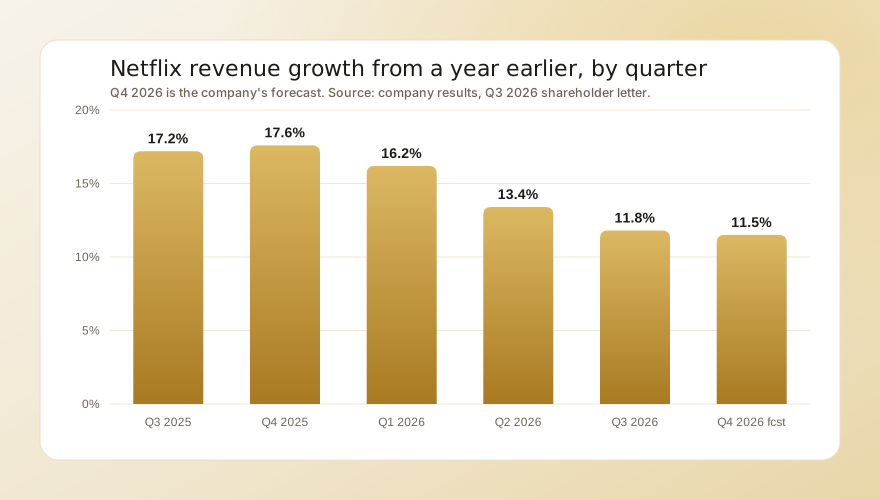
On a currency-neutral basis growth went from 14% in the first quarter to 12% in the second and 11% in the third, Needham noted. Netflix forecasts 11% currency-neutral growth in the fourth quarter. Analysts still expect about $56.7 billion of revenue in 2027, roughly 11% above the 2026 forecast. CFO Spence Neumann said Netflix aims to "sustain double-digit revenue growth" in 2027 but called full-year guidance premature, and JPMorgan's Doug Anmuth asked on the call whether that pace is achievable. Needham expects single-digit growth next year.
The case for the stock
- Cash returns. Netflix bought back 63.9 million shares for $4.8 billion in the quarter, its largest ever, and has $22.3 billion of authorization left. Diluted shares fell 3.3% in a year. It ended the quarter with $15.3 billion of gross debt and $8.2 billion of cash. Our guide to when buybacks act as a catalyst explains when repurchases support a price.
- Profitability. The 2026 margin forecast of 31.5% is two points above 2025, and operating income is on track to grow more than 20% this year.
- Price. At $65.27 the stock trades at about 17 times the $3.78 a share analysts expect for 2027, and about 18.6 times trailing earnings. For how to weigh those two multiples, see forward P/E against trailing P/E.
- The slate. The fourth quarter includes three NFL games on Thanksgiving Eve and Christmas Day and the Tyson Fury against Anthony Joshua fight, Netflix's biggest quarterly live slate.
The risks
- US subscribers. Reuters cited analytics firm Antenna, which reported no US net subscriber additions in any month through September 2026. A Netflix spokesperson called the data "not representative of Netflix's business performance." Co-CEO Ted Sarandos said on the call, "We do need better execution in the U.S."
- Leadership change. Netflix laid off about 1,000 people, roughly 6% of staff, the week before the report, replaced Chief Creative Officer Bela Bajaria, and film chief Dan Lin is leaving, Reuters reported. Needham said it expects fixing the roughly $20 billion content slate to take about two years.
- Ad execution. Peters called the ad shortfall "a modest short-term hit for a better long-term strategic position." If the delayed products slip again, the 2027 ad estimate is the next number at risk.
- Strategy. Netflix lost the bidding for Warner Bros. Discovery to a Skydance-led group, Reuters reported, so growth has to come from its own service.
What comes next
- Fourth-quarter results, expected around January 19, 2027. The 2027 revenue and margin outlook matters more than the quarter. Our guide to preparing for an earnings report covers what moves a stock on the day.
- The holiday live events. The NFL games and the Fury against Joshua fight are the clearest test of ad demand and sign-ups this quarter.
- US subscriber data. Any third-party sign of US net additions after the price increases would ease the main growth worry.
- Buyback pace. At $22.3 billion of remaining authorization, the size of fourth-quarter repurchases will show how much the company leans on its lower price.