

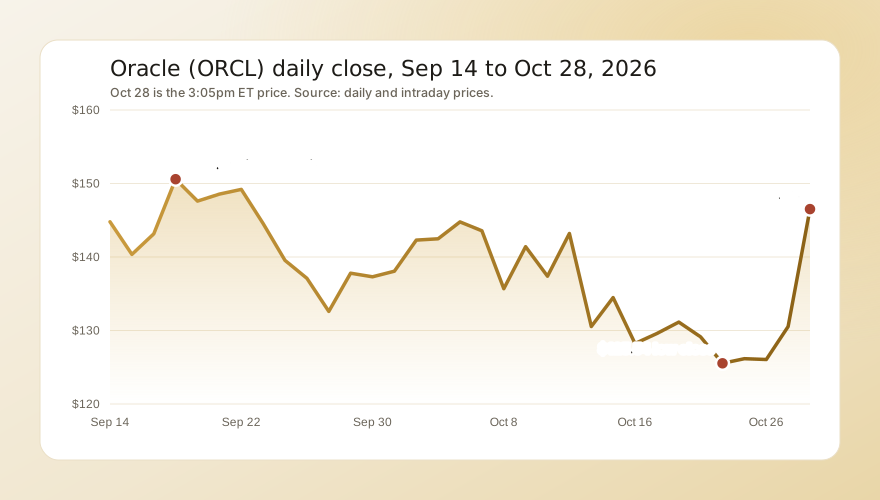
Oct 28, 2026: flat all day, then a 15% swing in an hour
Oracle traded between about $129.60 and $131.80 from the open until 2:15pm, slightly below its $130.53 close. The release crossed at 2:21pm ET. In the 2:20pm five-minute bar the stock dipped to $128.38 and then closed the bar at $138.83; the next bar reached $142.28 on about 28 million shares. It touched $148.47 shortly after 3pm, about 15.6% above the 2:20pm low, and was $146.52 at 3:05pm. Volume by then was about 52 million shares, against a 30-day average near 29.6 million.
What pushed it up:
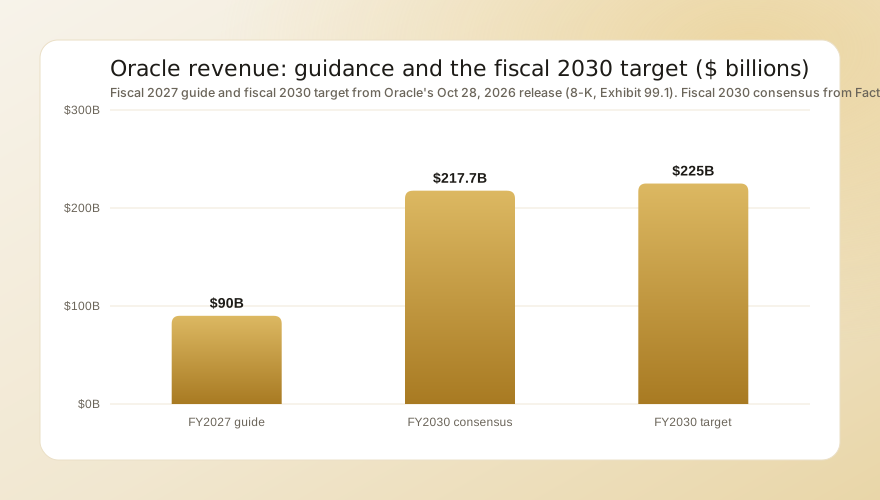
- A revenue target above consensus. Fiscal 2030 revenue of $225 billion or more compares with the $217.7 billion that analysts surveyed by FactSet expected, Barron's reported. Oracle said that means more than 35% compound annual growth from fiscal 2026, with a non-GAAP operating margin of 40% or more and non-GAAP earnings of $21 or more a share.
- A date for free cash flow. Capital spending peaks in fiscal 2027 and 2028 and steps down in fiscal 2029. CFO Hilary Maxson said growth becomes self-funded that year, and Reuters reported it as relief for investors worried about AI outlays.
- A cap on new money. Oracle limited new capital raises for fiscal 2027 through 2030 to $20 billion, about $10 billion of equity and $10 billion of gross debt, excluding refinancing.
- A sector read-through. Seeking Alpha reported that neocloud names rose after the update. At 3:05pm:
| Stock or fund | Oct 27 close | 3:05pm ET | Change |
|---|---|---|---|
| Oracle (ORCL) | $130.53 | $146.52 | +12.3% |
| CoreWeave (CRWV) | $59.57 | $62.97 | +5.7% |
| Nebius (NBIS) | $170.47 | $180.06 | +5.6% |
| AMD (AMD) | $560.26 | $576.93 | +3.0% |
| Alphabet (GOOGL) | $320.58 | $325.75 | +1.6% |
| Amazon (AMZN) | $253.10 | $254.23 | +0.4% |
| Invesco QQQ (QQQ) | $721.25 | $724.38 | +0.4% |
| Microsoft (MSFT) | $531.33 | $529.85 | -0.3% |
| Nvidia (NVDA) | $217.94 | $216.43 | -0.7% |
CoreWeave and Nebius carry the same worry about borrowing to build AI capacity, so a credible funding plan at Oracle helped them most. The large cloud companies with deep cash flow barely moved. We covered that funding pressure in why CoreWeave stock fell and why Nebius stock fell.
Why the funding cap mattered more than the revenue target
Before Investor Day, Evercore said clearer answers on financing were the key to sentiment, GuruFocus reported. Oracle raised $43 billion of debt and $5 billion of equity in fiscal 2026, and earlier this year said it expected to raise about $40 billion in fiscal 2027, including a $20 billion at-the-market stock program. That program was completed in the first quarter of fiscal 2027. Evercore estimated the core software business alone could be worth about $100 a share, which left little value on the cloud infrastructure business at Tuesday's price.
| Measure | Before Oct 28 | Investor Day, Oct 28 |
|---|---|---|
| New capital raises | About $40 billion expected in fiscal 2027, including the $20 billion stock sale | $20 billion more for fiscal 2027 to 2030, after the $20 billion stock sale |
| Free cash flow | Negative $5 billion in Q1 fiscal 2027 | Positive in second half of fiscal 2028; $30 billion or more in fiscal 2029 |
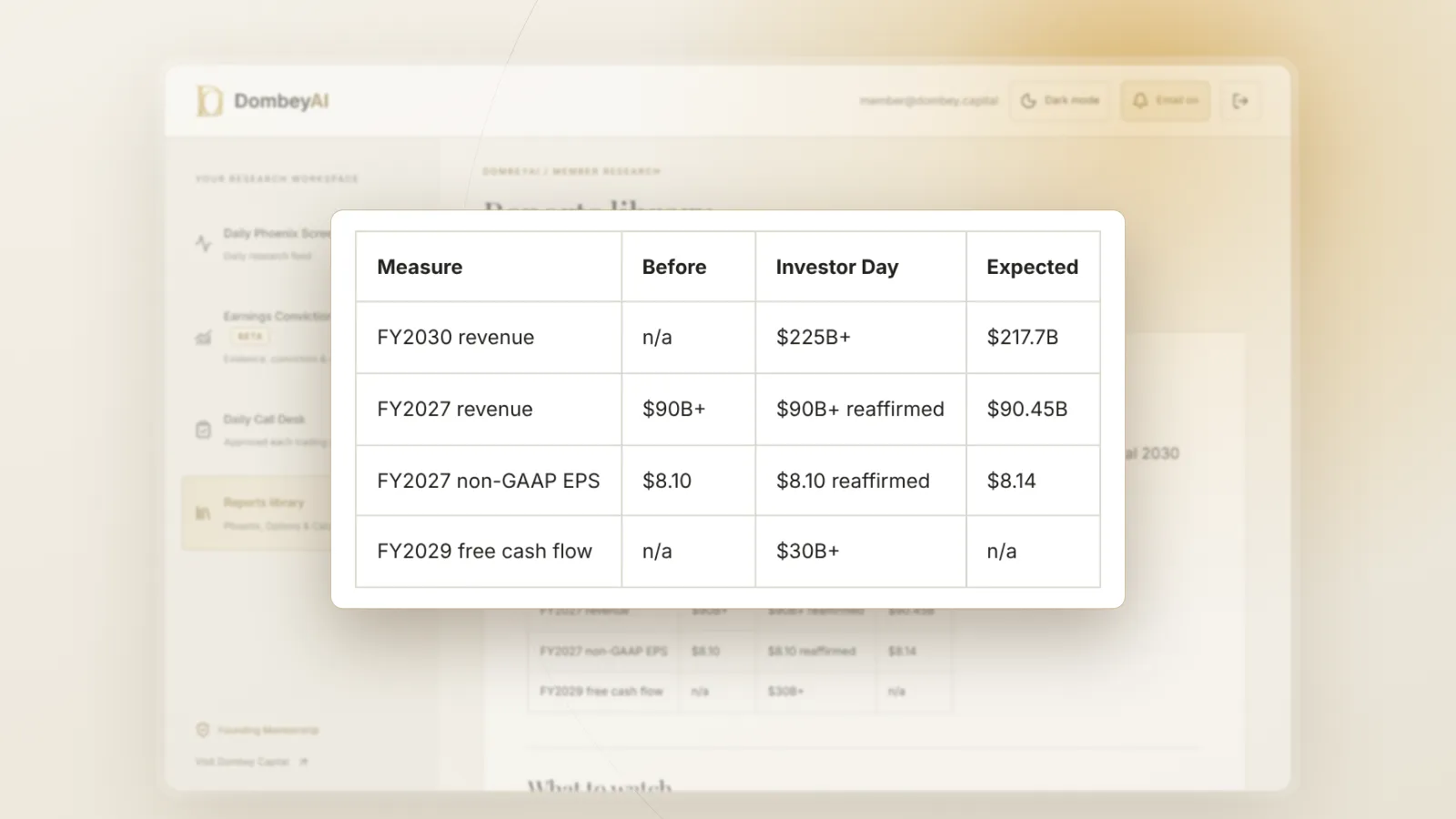
| Fiscal 2027 revenue | At least $90 billion | Reaffirmed at least $90 billion |
| Fiscal 2027 non-GAAP EPS | $8.10 | Reaffirmed $8.10 |
| Fiscal 2030 revenue | $217.7 billion consensus | $225 billion or more |
| Leverage | Debt about 2.5 times equity | Net debt below 3.5 times adjusted EBITDA in fiscal 2029 |
Oracle said vendor financing, customer-provided hardware and customer prepayments will cut its upfront cash needs, which is how a smaller funding need fits with peak spending. Our arithmetic: $30 billion of fiscal 2029 free cash flow is about 6.8% of today's market value of roughly $442 billion. For how to judge a number like that, see free cash flow yield, and for the share-count side, how dilution works.
The day before, Oracle rose 3.5% after announcing that it will offer Google's TPU chips on its cloud from early 2027, add Cerebras inference systems in 2027, expand Nvidia Vera Rubin installations to multiple gigawatts and launch a security product built on OpenAI models. Those deals widened its chip supply; Investor Day addressed what they cost.
The case for the stock
- Demand is contracted. Remaining performance obligations were $664 billion at the end of August, up $209 billion from a year earlier, and Oracle booked more than $30 billion of new AI cloud contracts in the quarter.
- The core is growing fast. First-quarter revenue rose 30% to $19.3 billion, and cloud infrastructure revenue rose 121% to $7.4 billion. Operating cash flow was a record $23 billion.
- The valuation already assumes doubt. The stock is still about half its 52-week high of $285.46. The forward P/E is about 13 and the consensus target is $244.75. On the company's own targets it trades near 7 times fiscal 2030 earnings; see forward vs trailing P/E.
- A near-term check. The fiscal second-quarter report, due before our view ends, will show whether revenue growth holds in the guided 30% to 34% range.
The risks
- Customer concentration. Reuters noted that Oracle relies heavily on OpenAI, which loses money. Any change to those contracts would hit the backlog and the funding plan at once.
- Free cash flow is still negative. Positive free cash flow is at least a year away, and the targets run three to four years out. Long-range targets set at an investor day are easier to miss than a quarterly guide; our guide to guidance changes covers how markets treat them.
- Leverage is high. Debt is about 2.5 times equity; see what counts as a high debt-to-equity ratio. The $20 billion cap excludes refinancing, so maturing debt still has to be rolled.
- More dilution is planned. About $10 billion of the remaining funding is equity, on top of the $20 billion sold in the first quarter.
- Fiscal 2027 was not raised. The $8.10 earnings and $90 billion revenue figures are slightly below the $8.14 and $90.45 billion analysts expected, per Seeking Alpha.
For how to read targets like these against the reported numbers, see our guide to the earnings release, and more of today's biggest stock moves.
What comes next
- Analyst updates. Target and estimate changes are likely over the next days. The consensus target was $244.75 before Investor Day.
- The full presentation. Oracle said the presentations and webcast replay will be posted on its investor site, with segment detail behind the fiscal 2030 targets.
- Fiscal second-quarter results. The date has not been confirmed. Oracle guided revenue growth of 30% to 34% and non-GAAP earnings of $1.85 to $1.93 a share.
- Funding steps. Any debt or equity sale now counts against the $20 billion cap, so the size of the next raise will show whether the plan holds.
Dombey's published work on event-driven moves is in the research archive.