

Oct 16, 2026: software sells off and Palantir follows
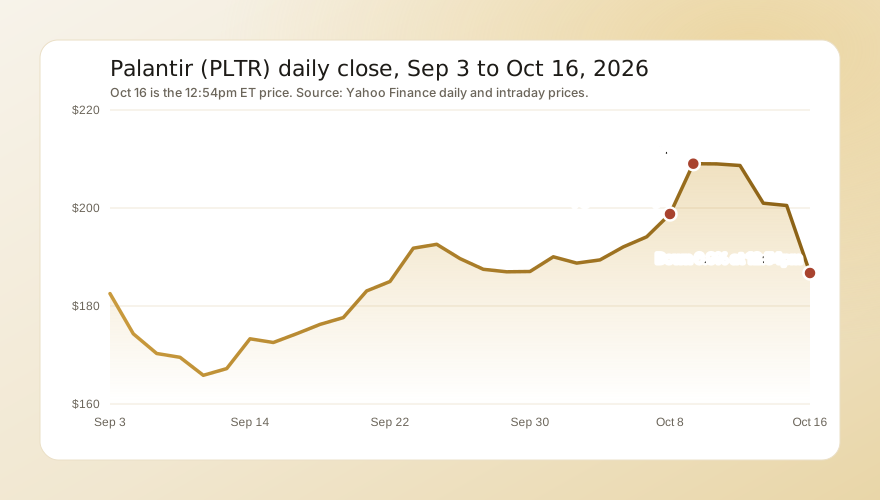
Premarket trading was calm. The stock traded between $200.66 and $202.60 before the bell and sat at $201.85 just before the open. It opened at $202.36, touched its high of $203.55 in the first minutes, and then fell to about $195 within the first half hour.
It held between about $194 and $197 until 11am. Then it broke lower: from $193.05 at 11:00am to $190.11 by 11:05am and $188.27 by 11:15am. That matches the timing in Yahoo Finance's market blog, which reported at 11:17am that software stocks had reversed early gains. By 12:50pm the stock had reached $186.45, its low, and at 12:54pm it was $186.73.
What pushed it down:
- A sector-wide software selloff. Yahoo Finance reported that 41 of the 45 stocks in its software basket were falling, erasing about $130 billion of market value, after 33 of them had traded higher before the open. 24/7 Wall St. tied the selloff to investors who are "skeptical about who actually pays for the AI buildout," and noted that AI-linked software is being sold along with the broader AI trade.
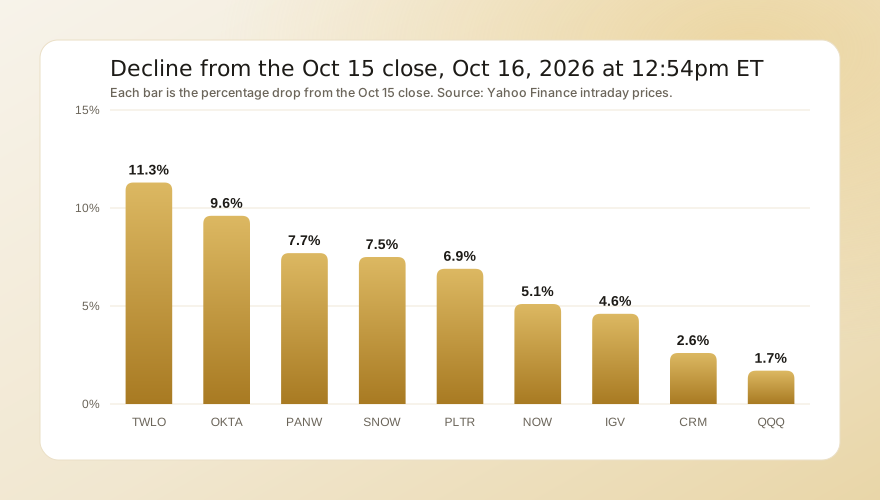
- The whole group fell. At 12:54pm:
| Stock or fund | Change |
|---|---|
| Twilio (TWLO) | -11.3% |
| Okta (OKTA) | -9.6% |
| Palo Alto Networks (PANW) | -7.7% |
| Snowflake (SNOW) | -7.5% |
| Palantir (PLTR) | -6.9% |
| ServiceNow (NOW) | -5.1% |
| iShares software ETF (IGV) | -4.6% |
| Salesforce (CRM) | -2.6% |
| Nasdaq 100 fund (QQQ) | -1.7% |

- No company filing. EDGAR lists only Form 4 and Form 144 insider notices in October. On Oct 15, director Alexander Moore filed a Form 144 to sell 48,000 shares, worth about $9.6 million, under a trading plan adopted on Dec 11, 2025. On Oct 8, executive Ryan Taylor sold 18,000 shares at an average of $201.15 and director Lauren Friedman Stat sold 5,026 shares at $199.00, both under 10b5-1 plans, per MarketBeat. These are routine and were public before today.
- Rates stayed in the background. Fed Chair Kevin Warsh declined to commit to an October rate hike at 10:10am, and bond futures cut the odds of one to about 15%. The 10-year Treasury yield was near 5.07%. That eased pressure a little, but it did not stop the software selling.
At midday, RSI(14) stood at 47, the shares sat 2.2% above their 50-day average of $182.58 and 22.3% above their 200-day average of $152.65, volume of 17.6 million shares ran at 0.8 times its 20-day average, and the stock was 12.3% below its 52-week high of $212.94.
So the drop reads as a sector move. Palantir fell about 1.5 times as much as the IGV, consistent with a beta of 1.60 that MarketBeat reports, and less than Twilio or Okta. Nothing in the day's news changed what the company is expected to report.
The week: from an upgrade to a pullback
The stock had run hard into this week. On Oct 8, Goldman Sachs upgraded Palantir to Buy from Neutral with a $230 target, citing sovereign AI demand, custom applications and its industry-focused sales model, per TIKR. The shares closed at $198.78 that day and $209.05 on Oct 9.
Since then it has given that back. It fell 3.7% to $200.97 on Oct 14, a day MarketBeat linked to the insider sales, slipped to $200.50 on Oct 15, and fell again today. From the Oct 9 close, the stock is down 10.7%. It is still above where it traded before the upgrade, and 2.2% above its 50-day average.
The numbers behind the stock
Second-quarter results, released Aug 3, were strong across the board:
| Measure | Q2 2026 |
|---|---|
| Revenue | $1.935 billion, up 93% |
| U.S. commercial revenue | $764 million, up 149% |
| U.S. government revenue | $809 million, up 90% |
| Adjusted operating margin | 62% |
| Total contract value | $3.373 billion |
For the third quarter, Palantir guided revenue of $2.160 billion to $2.164 billion and adjusted income from operations of $1.292 billion to $1.296 billion. For 2026 it guided revenue of $8.150 billion to $8.158 billion, U.S. commercial revenue above $3.424 billion, and adjusted free cash flow of $4.5 billion to $4.7 billion.
The valuation is where the risk sits. The forward P/E was 81.3, a price-to-sales ratio of 72.9 and a price-to-book ratio of 45.9 on Oct 16. Our explainers on forward and trailing P/E and the price-to-sales ratio cover why multiples this high leave a stock sensitive to small changes in sentiment. Short sellers held only 2.5% of the float, so a squeeze is not part of the story either way.
The bull case
- Growth is fast. Revenue growth of 93% in the second quarter was the fastest the company has reported, per TIKR, and U.S. commercial revenue more than doubled.
- Margins are high. A 62% adjusted operating margin and full-year free cash flow guidance of up to $4.7 billion mean the growth is not being bought with losses.
- Analysts still lean positive. Goldman's $230 target sits well above today's price, and the analyst consensus ranges up to $265.
The risks
- The multiple. At about 81 times forward earnings, the stock needs results well ahead of guidance to hold its price. A beat in line with past quarters may not be enough.
- The sector trade. Today showed that Palantir moves with software and AI sentiment, whatever its own results. If doubts about AI spending keep spreading, the stock can fall without any company news.
- Targets are near the price. The analyst consensus target was $198, with a median of $207.50 and a low of $80. That is only about 6% above the midday price, a sign that much of the good news is already counted.
- Insider selling is steady. It is pre-planned and modest, but it has continued through the rally.
What comes next
- Third-quarter results on November 2, after the close. Palantir confirmed the date on Oct 12 and will hold a webcast at 5:00pm ET. Watch revenue against the $2.164 billion top of the guide, U.S. commercial growth against the second quarter's 149%, and whether the 2026 forecast rises. Our guide to preparing for an earnings report explains what usually moves a stock on the day.
- The software group. The IGV is the best daily read on whether today was a one-day selloff or the start of a longer slide.
- Options pricing into the report. The implied move will show how much the market expects. Our explainer on implied volatility covers how to read it.
- Further Form 144 notices. They show up on EDGAR before insider sales and are worth tracking into the report.