

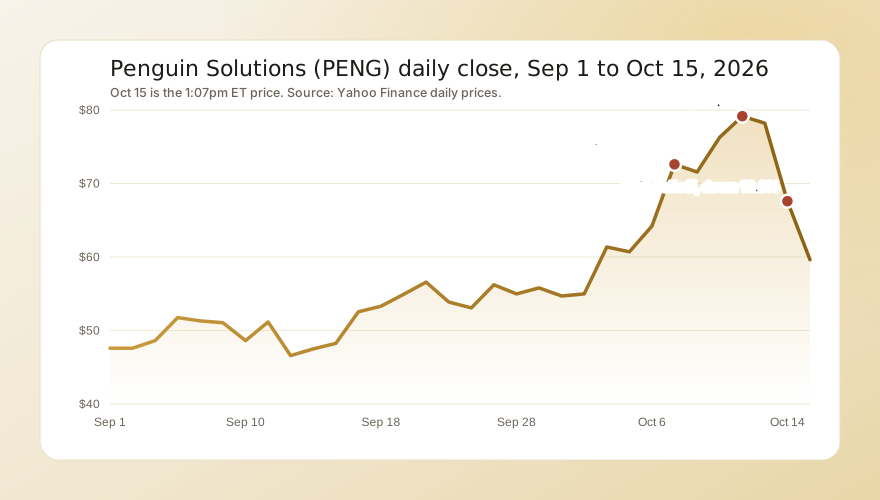
Oct 15, 2026: a lower open, a brief bounce, then new lows
The selling started before the bell. Penguin's first premarket trade was $65.34, already 3.3% below Wednesday's close, and it reached $64.04 by 9:25am ET, down 5.3%. It opened at $61.92, down 8.4%.
Buyers tried early. The stock rose to $64.33 in the first five minutes, which was the high of the day. It did not hold. Sellers pushed it down through the morning to a low of $59.35 at about 12:25pm ET, down 12.2%, and it sat near $59.63 at 1:07pm. About 3.3 million shares had traded by 12:31pm, already 21% above a full day's average, according to ad-hoc-news data.
What pushed it down:
- Memory stocks kept falling. Micron was down 4.2% before the open, according to Investing.com, as the memory selloff that began on Oct 13 entered its third day. SK Hynix fell sharply in Seoul. Super Micro Computer, another AI server name, was down about 5% by midday.
- The CXMT report. China's CXMT plans to unveil server-grade DDR5 memory modules built on a denser 4F² cell design before year-end. That is the market Penguin's memory business sells into. Investors read it as cheaper competition and lower memory prices ahead.
- Rates. September consumer prices rose 3.7% from a year earlier, above the 3.6% forecast, and core prices rose 2.6% against 2.5% expected. Traders briefly priced even odds of a Fed hike before settling near a 71% chance of a hold on Oct 28. A stock with a beta near 2.9, as MarketBeat lists Penguin's, tends to fall harder when rate fears return.
What did not help: Bank of America's Buy rating and $100 target from Oct 9. Analyst support from a week earlier did not stop the selling.
Oct 14, 2026: the first big drop
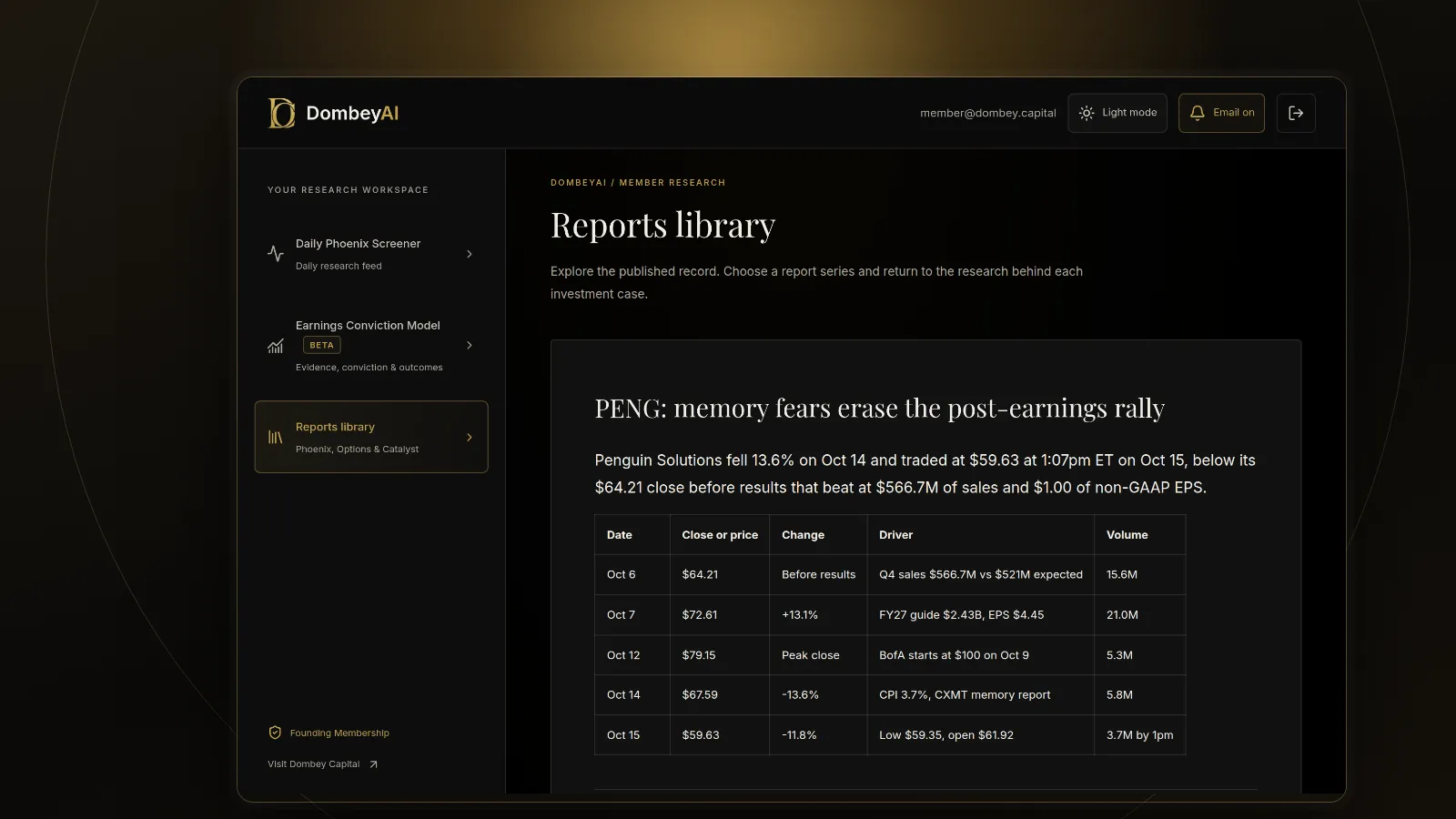
Penguin fell 8.1% to about $71.86 by midday on Wednesday, per MarketBeat, and closed down 13.6% at $67.59 on 5.8 million shares, more than twice its usual volume. That was the day the September inflation report came out, and the second day of heavy selling in memory stocks after the CXMT report.
The chip selloff had started on Oct 13. Reuters reported that day that the Philadelphia chip index fell 1.5% for its fifth straight decline, with Micron down 4.5%, Samsung down more than 7% and SK Hynix down more than 10% in Seoul after the CXMT report. Dakota Wealth's Robert Pavlik described the rush to take profits after a big run: "all the sheep run to the door at the same time." Penguin slipped 1.2% that day. It fell much harder the next two.
Oct 6, 2026: the results the stock has now given back
Penguin reported after the close on Oct 6. StockUnlock reported the stock up about 15% the next morning, and it closed Oct 7 at $72.61, up 13%. By Oct 12 it had reached $79.15, 30% above its Oct 5 close.
| Measure | Q4 fiscal 2026 | Q3 fiscal 2026 | Q4 fiscal 2025 |
|---|---|---|---|
| Net sales | $566.7 million | $478.7 million | $337.9 million |
| Integrated Memory | $340.8 million | $275.1 million | $132.2 million |
| Advanced Computing | $154.0 million | $137.6 million | $138.3 million |
| Optimized LED | $71.9 million | $66.1 million | $67.4 million |
GAAP gross margin was 27.5%, and non-GAAP diluted EPS was $1.00.
Analysts had expected about $520 million of sales and $0.77 of non-GAAP earnings per share. Sales rose 68% from a year earlier, GAAP operating income was $69.5 million, and the company added six AI infrastructure data center customers in the quarter, four of them neocloud providers.
The bigger news was the outlook. Penguin guided fiscal 2027 sales to about $2.43 billion at the midpoint, 40% growth, plus or minus 10 points. It guided non-GAAP diluted EPS to $4.45, plus or minus $0.70. Analysts had expected about $2.21 billion of sales and $3.38 of EPS. For why a raised outlook usually moves a stock more than the quarter itself, see how guidance changes move stocks.
Why memory fears hit Penguin so hard
Penguin used to be described mainly as an AI infrastructure and computing company. Its sales mix has moved toward memory over the past year.
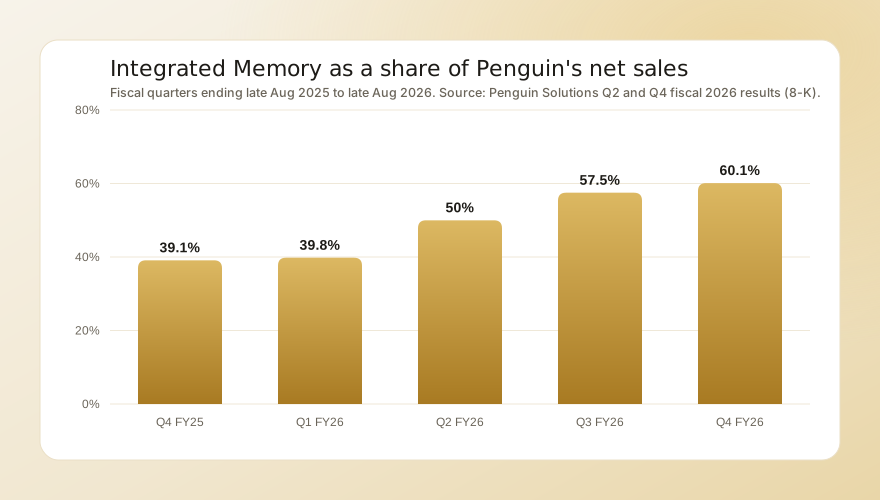
Integrated Memory sales went from $136.5 million in the first quarter of fiscal 2026 to $171.6 million in the second, $275.1 million in the third and $340.8 million in the fourth. For the full year the segment brought in $924.0 million, about double the $464.2 million of fiscal 2025. In the fourth-quarter release, CEO Kash Shaikh said the memory business "remains strong," and the company said it had set up a new supply arrangement with a leading memory supplier for AI data center demand.
That growth is why the CXMT report landed here. When investors expect memory prices to fall, they sell the companies whose sales depend on memory, and Penguin now fits that group.
The case for the stock
- The guidance is fresh. The fiscal 2027 outlook is nine days old and sits 10% above prior sales estimates and 32% above prior EPS estimates, per StockUnlock. Nothing the company has said since points the other way.
- The price has reset. At $59.63 the stock trades at about 13 times the midpoint of guided non-GAAP EPS. Our explainer on forward and trailing P/E covers why a forward multiple on guidance needs a discount for execution risk, but the discount here is now large.
- Analysts stayed positive. Bank of America's $100 target, set on Oct 9, is about 68% above the midday price. Rosenblatt is also at $100, and Goldman Sachs, Stifel and Needham are at $85.
- The balance sheet is not the issue. Penguin ended the year with $647.2 million of cash against $788.9 million of debt, a modest net debt figure for a company guiding to $2.43 billion of sales.
The risks
- Memory prices drive much of the growth. A business that is 60% memory rises and falls with memory pricing. If DRAM prices turn down, sales could fall short of the guidance even if unit demand holds.
- CXMT may deliver. The year-end launch target is only a plan today, but if CXMT ships competitive server DDR5 at lower prices, the pressure on memory prices would be real rather than expected.
- Rates. Another Fed hike would raise the cost of building data centers, which is the spending Penguin's AI customers depend on.
- A wide guidance range. Plus or minus 10 points of growth is a wide band. The low end, 30% growth, would still be strong, but it is well below the midpoint the stock rallied on.
- Not everyone agrees. Barclays rates the stock Underweight with a $60 target, about where it trades now.
What comes next
- The Fed decision on Oct 28. A hold would ease the rate fear that hit the whole chip group on Oct 14. A hike would likely extend the selloff.
- Memory pricing updates. Comments from Micron, Samsung or SK Hynix on DRAM contract prices are the clearest test of the CXMT fear.
- The fiscal 2026 annual report. Penguin has not yet filed its 10-K. It will show customer concentration and more detail on the memory supply arrangement. Our guide to what a 10-K contains shows where to look.
- The next quarterly report. The first fiscal 2027 quarter is the first check on the $2.43 billion outlook. Our guide to preparing for an earnings report covers what to watch.