

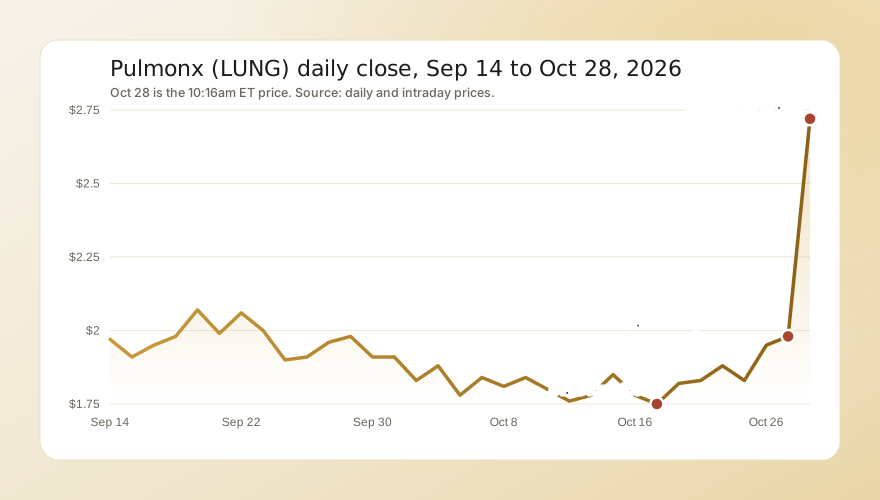
Oct 28, 2026: up 38% on the first growth quarter in over a year
Pulmonx reported at 4:07pm ET on Oct 27. The stock closed the after-hours session at $2.21, traded at $2.13 at 4am on Oct 28 and stood at $2.37 just before the open. It opened at $2.37, touched its session low of $2.31 in the first minute, and climbed steadily to a high of $2.77. At 10:16am it was $2.72, up 37.6%, on 2.6 million shares, already about 8.6 times its 20-day average daily volume.
What pushed it up:
- Growth returned. Revenue of $22.8 million was up 6% on both a reported and constant currency basis. U.S. revenue rose 7% to $14.9 million, after a 4% decline in the second quarter. CFO Derrick Sung called it "our first return to global year-over-year growth since Glen and I rejoined the company last year."
- A beat on both lines. Revenue was about $0.9 million above the $21.9 million consensus, and the $0.19 loss per share was 7 cents better than expected.
- Lower costs and burn. Operating expenses fell to $24.9 million from $30.4 million, and the full-year expense guide moved down to $108 million to $109 million.
Other medical device stocks did not move with it. At 10:15am the iShares U.S. Medical Devices ETF (IHI) was up 0.6%, Inspire Medical, which also treats a breathing disorder with an implant, was up 0.4%, and Penumbra was down 1.8%. The move is Pulmonx's own, much like Axogen's 22% gain today on its own beat.
After the jump, RSI(14) stood at 79, the shares sat 44% above their 20-day average, 34% above their 50-day average and 65% above their 200-day average, and the stock was 6% below its 52-week high of $2.89.
What the quarter and the guide said
| Measure | Q3 2026 | Q3 2025 | Change |
|---|---|---|---|
| Revenue | $22.8 million | $21.5 million | +6% |
| U.S. revenue | $14.9 million | $14.0 million | +7% |
| International revenue | $7.9 million | $7.5 million | +5% |
| Gross margin | 76% | 75% | +1 point |
| Operating expenses | $24.9 million | $30.4 million | -18% |
| Net loss | $8.4 million | $14.0 million | -40% |
| Adjusted EBITDA loss | $3.5 million | $8.2 million | -57% |
The guidance changes all point the same way. Gross margin moved up to about 77% from about 76%. Operating expenses moved down by $1 million to $2 million, including about $14 million of stock-based compensation, down from $15 million. The expected decline in cash, cash equivalents and marketable securities for the year moved to about $22 million from about $23 million. Cash fell $17.1 million in the first nine months, so the guide implies about $4.9 million of burn in the fourth quarter, below the $5.7 million nine-month average. Our guide on estimating cash runway walks through the same arithmetic.
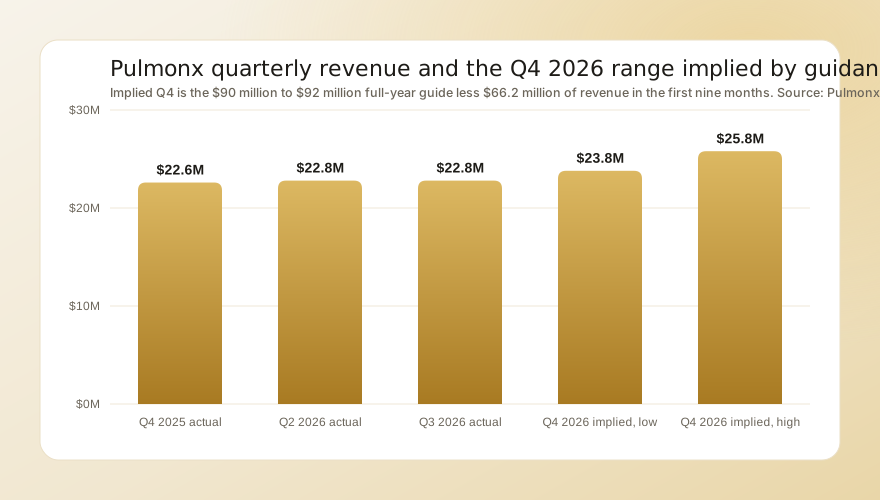
The fourth quarter is the test. Revenue for the first nine months was $66.2 million, so the $90 million to $92 million range leaves $23.8 million to $25.8 million for the last quarter. The midpoint, $24.8 million, would be about 10% growth over the $22.6 million a year earlier and the highest quarterly revenue of the year. For how to pull the implied quarter out of an annual guide, see our guide to reading an earnings release.
China is a swing factor in both directions. Pulmonx had no sales to its Chinese distributor in the quarter while it restarts activity under a renewed registration certificate; China contributed $4.0 million in the first nine months of 2025 and nothing this year. Excluding China, international revenue grew 9%. CEO Glen French said on the call that China "is a distributor market, so it is not quite as predictable."
The case for the stock
- Growth is turning. U.S. revenue went from a 4% decline in the second quarter to 7% growth in the third, and the guide implies faster growth in the fourth.
- Operating leverage. Selling, general and administrative expenses fell 22% to $20.0 million while revenue rose. The adjusted EBITDA loss has more than halved, and Sung told analysts the company has "a very clear pathway to get to cash flow breakeven."
- A low valuation for the margin. At $2.72 the market value is about $117 million. After $52.7 million of cash and $37.7 million of debt, the enterprise value is about $102 million, roughly 1.1 times the guided revenue midpoint, for a 76% gross margin product. Our price-to-sales explainer covers when a low sales multiple means something.
- A pipeline catalyst. French said enrollment in the CONVERT II trial is on track to finish in the second half of 2027.
The risks
- Still losing money. The net loss was $8.4 million in the quarter and $32.1 million in nine months, and interest expense rose to $1.2 million from $0.8 million.
- Debt against a shrinking cash pile. Long-term debt of $37.7 million is 72% of the $52.7 million of cash. More borrowing under the credit facility would change the picture; our piece on debt maturity walls explains why the schedule matters.
- A young sales force. Sung said the average tenure of the U.S. sales team is "a little bit on the junior side," which can slow productivity gains.
- No 2027 guide. Analysts asked whether this is a high single digit or low double digit growth business, and management gave no timeline for double-digit growth.
- Revenue is flat from the second quarter. Revenue was $22.8 million in both the second and third quarters; the year-over-year gain comes partly from a weak comparison.
What comes next
- Fourth-quarter revenue. The quarter ends Dec 31 and must land between $23.8 million and $25.8 million for the guide to hold. The report date is not yet set.
- China orders. Any restart of distributor sales would add to the fourth quarter on top of the guide.
- Analyst updates. The consensus target is $3.70, above today's price; target changes after the beat will show whether estimates move up.
- CONVERT II enrollment. Completion is expected in the second half of 2027.
For how to judge management's tone on calls like this one, see our guide to analyzing an earnings call transcript, and more of today's biggest stock moves.