

Nov 9, 2026: a rebound on the brokerage notes
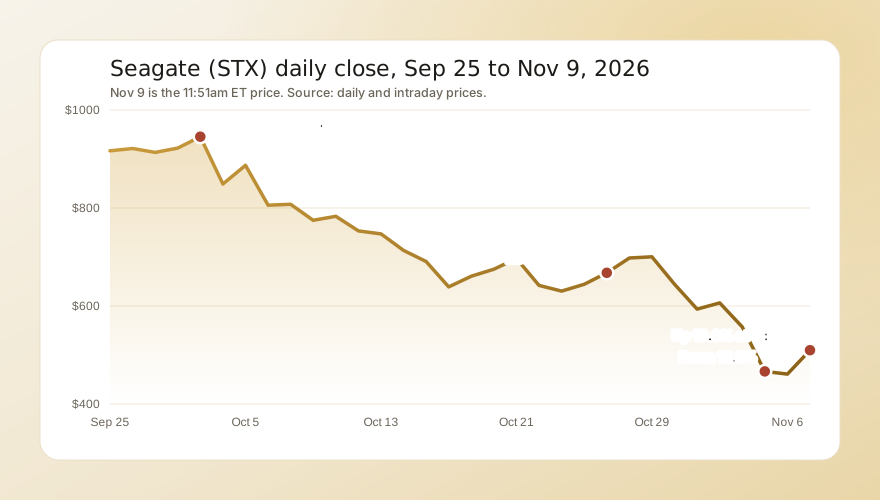
Seagate closed Nov 6 at $460.99, down 1.2%, after a 16.3% drop on Nov 5. Premarket trading on Nov 9 started at $447.28 at 4am and climbed to $472.00 by 9:25am. The stock opened at $468.27, set its low of $466.16 in the first five minutes, and rose most of the morning to a high of $510.91 at 11:45am. At 11:51am it was $509.79, up 10.6%, on about 2.4 million shares.
What happened:
- The brokerages turned. Morgan Stanley called the selloff overdone and said the slowdown it expects "has the potential to elongate the AI capex cycle," with a smoother supply and demand balance, a better credit outlook and higher lease rates for compute. It named Seagate and Western Digital alongside Amazon, Meta, Alphabet, Nvidia, Broadcom, Coherent and Lumentum. UBS said markets had become too negative on AI political risk, credit risk and spending, HSBC said it was adding to equities, and Jefferies' Jane Gibbons called the Nov 5 selloff "reactionary" rather than a fundamental reset, Reuters reported.
- Storage led, Nvidia lagged. Nvidia was down more than 5% before the open after the weekend reports about Jensen Huang, CNBC reported, and its board opened an inquiry. The memory and storage names that fell hardest last week rose most.
- No company news. Seagate's last filing was a holder's Schedule 13G on Nov 5. Its next dividend of $0.76 a share is payable Jan 7, 2027 to holders of record on Dec 23.
From the Nov 6 close to 11:51am ET:
| Stock or fund | Nov 6 close | Nov 9, 11:51am | Change |
|---|---|---|---|
| Seagate (STX) | $460.99 | $509.79 | +10.6% |
| Western Digital (WDC) | $263.78 | $289.83 | +9.9% |
| SanDisk (SNDK) | $835.06 | $900.47 | +7.8% |
| iShares Semiconductor (SOXX) | $136.53 | $145.98 | +6.9% |
| Micron (MU) | $690.00 | $734.07 | +6.4% |
| Invesco QQQ (QQQ) | $656.10 | $676.83 | +3.2% |
| Nvidia (NVDA) | $186.64 | $176.75 | -5.3% |
After the rise, RSI(14) stood at 32, the shares sat 34% below their 50-day average and 27% below their 200-day average, 56% below their 52-week high of $1,145.00, and volume was running at 0.4 times its 20-day average with more than four hours of trading left.
The numbers: record results the stock did not price
Seagate reported its fiscal first quarter, the three months to Oct 2, after the close on Oct 27. Chief executive Dave Mosley said the company "delivered another quarter of record profitability."
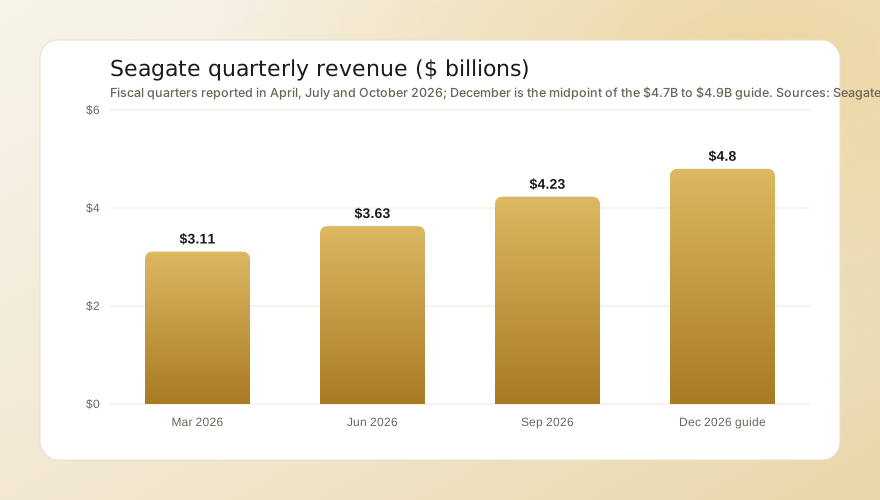
- Revenue was $4.23 billion, up from $3.63 billion in the June quarter and $3.11 billion in the March quarter.
- Margins: GAAP gross margin was 57.3% and non-GAAP 57.8%; non-GAAP operating margin was 50.7%.
- Cash: operating cash flow was $1.69 billion and free cash flow $1.48 billion. Seagate paid $168 million of dividends and bought back $400 million of stock.
- Debt: it retired about $1.2 billion of principal in the quarter and $750 million more after it ended, cutting gross debt to $1.6 billion against $1.26 billion of cash.
- Guide: December-quarter revenue of $4.8 billion, plus or minus $100 million, and non-GAAP earnings of $9.20 a share, plus or minus $0.20.
The stock rose 4.5% to $697.97 the next day, then lost a third of its value in seven sessions. Our explainer on why guidance changes move stocks covers how a raised outlook usually carries a stock, and why it sometimes does not when the whole sector is being repriced.
The bull case
The gap between the business and the price is the case. Revenue is growing about 13% a quarter on the guide, gross debt of $1.6 billion is close to the $1.26 billion of cash it held at quarter end, and the company returned $568 million to holders in one quarter. The memory names that fell with it, covered in our pieces on why Micron fell and why SanDisk fell, sold off on the same fear: that a Democratic Congress and the borrowing strain at AI cloud companies such as CoreWeave would slow data center building. Morgan Stanley's answer is that delay stretches the cycle rather than ends it, and a longer, smoother cycle is easier on a hardware maker than a boom and bust. The analyst rating changes that follow a note like this one tend to come in clusters.
The risks
- Nvidia on Nov 17. If the data center guide disappoints, the whole group can retest last week's lows. A leadership question at Nvidia adds a second risk to that date.
- Thin volume. About 2.4 million shares by 11:51am, against a 20-day average of 6.1 million, is a rebound without much conviction yet.
- Policy. Of 41 ballot measures on data centers in the election, voters rejected all but one, CNBC reported. If state limits spread, the delay Morgan Stanley describes could be longer.
- Cycle. Hard drive pricing has been strong because supply is tight. Any sign that customers are pulling orders forward would change how the market values the earnings.
What comes next
Nvidia reports after the close on Nov 17, and analysts expect its data center revenue to rise more than 12% from the prior quarter, Reuters reported. Seagate's own next report is due in late January; the average estimate is $9.27 a share on $4.82 billion of revenue, in line with its guide. For the rest of today's movers, see today's biggest stock moves, and our own research covers how we track dated events like these.