

Oct 30, 2026: a 12% drop on a record quarter
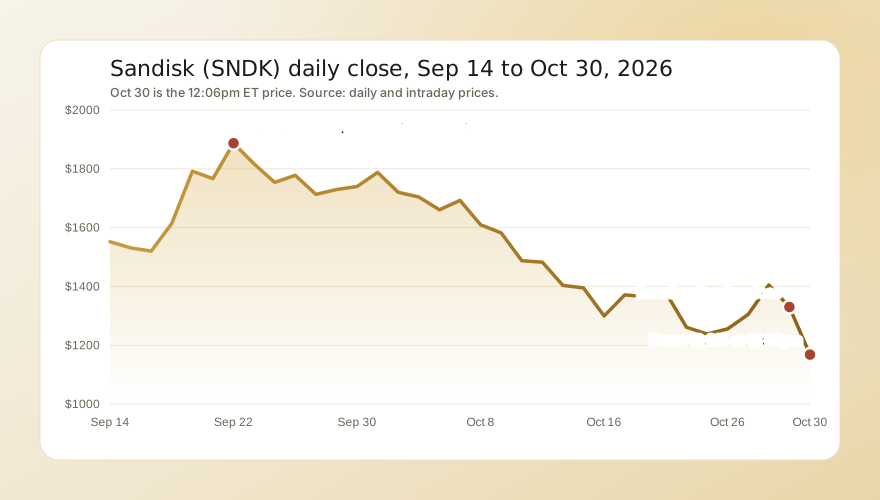
Sandisk reported after the close on Oct 29. It was down nearly 10% before the open, Stocktwits reported, and it kept falling during the session. At 12:06pm it was 50% below its 52-week high of $2,354.39, 25% below its 50-day average of $1,558 and 7% below its 200-day average of $1,259. RSI(14) stood at 33.
The selling was not limited to Sandisk. Intel fell about 29% after guiding fourth-quarter revenue below estimates; on its call, chief executive Lip-Bu Tan cited "the unprecedented memory crunch, and the resulting softness in PC demand," Invezz reported. Amazon missed on revenue and earnings and kept its $220 billion 2026 capital spending plan. By 12:06pm the iShares Semiconductor ETF (SOXX) was down 8.5%, AMD 10.5%, Seagate 7.5%, Western Digital 7.1%, Micron 5.7% and Nvidia 3.8%. Sandisk fell more than its storage peers, which fits a stock that had run further. We cover the Intel side in why Intel stock fell and the leveraged chip fund in why SOXL fell.
What the quarter showed:
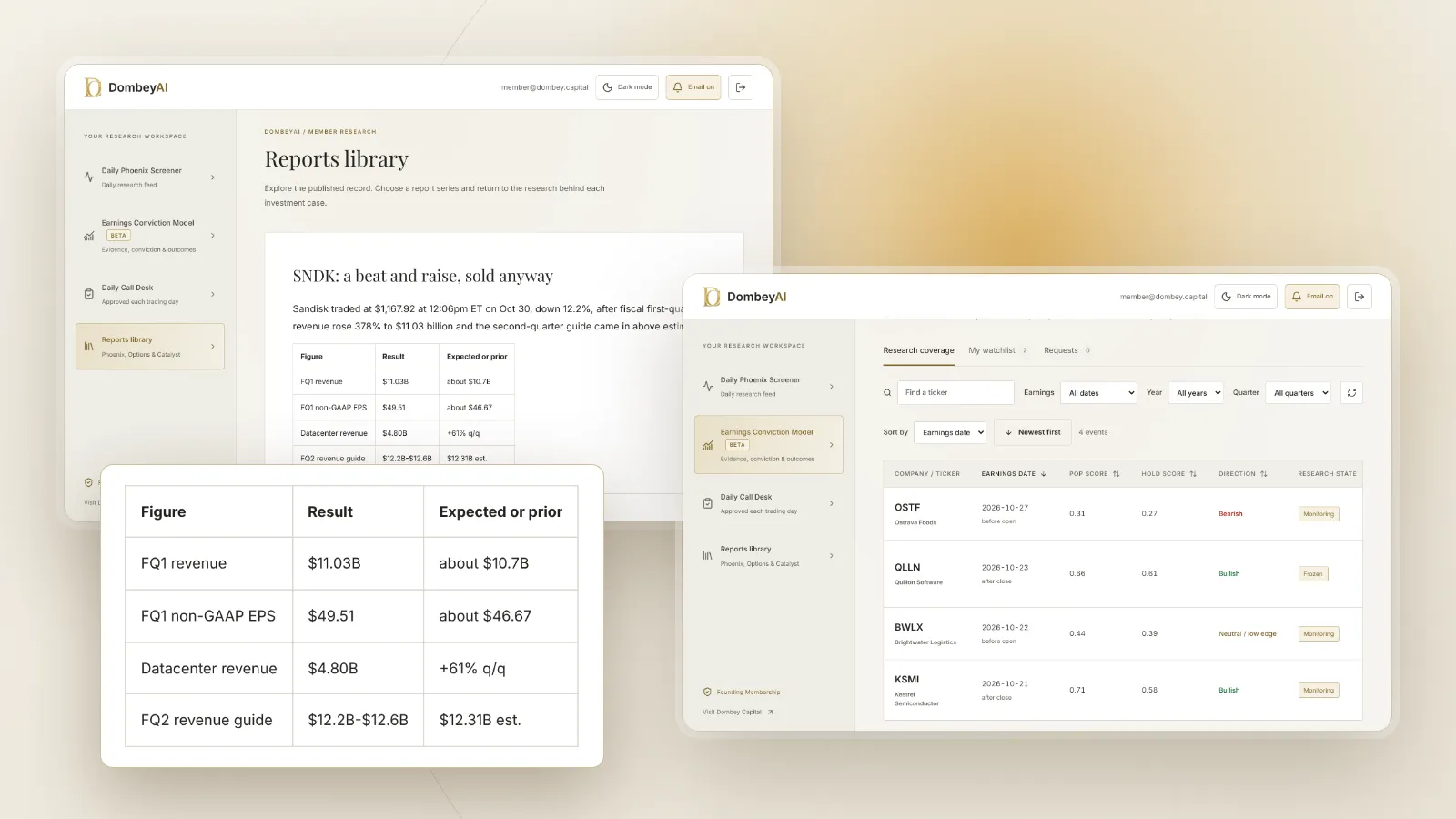
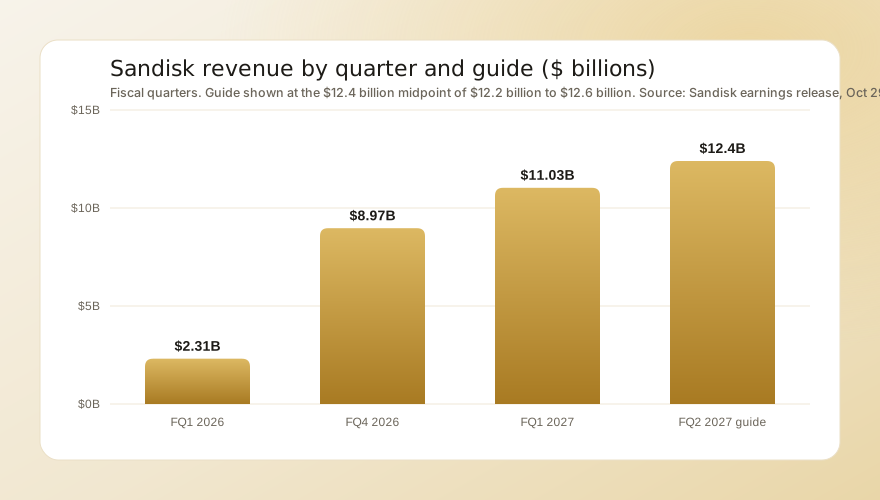
- Revenue and margin. Revenue was $11.03 billion, up 23% from the prior quarter and above the roughly $10.7 billion consensus. Non-GAAP gross margin was 85.1%, against 29.9% a year earlier. Non-GAAP earnings were $49.51 a share against estimates of about $46.67, and GAAP net income was $8.1 billion.
- Datacenter now leads growth. Datacenter revenue rose 61% from the prior quarter to $4.80 billion, about 44% of sales. Edge revenue rose 7% to $5.83 billion. Consumer revenue fell 29% to $397 million.
- A higher guide. Second-quarter revenue of $12.2 billion to $12.6 billion compares with about $12.31 billion expected, and non-GAAP earnings of $55 to $57 compare with about $53.60, Stocktwits reported, citing FactSet.
- Cash returned. Sandisk repurchased about 3.2 million shares for $5.0 billion in the quarter and 6.0 million over two quarters, about 4% of shares outstanding. For why that matters to the per-share math, see buybacks as catalysts.
- An 8-for-1 split. Holders of record on Nov 9 get seven more shares for each one, and split-adjusted trading starts Nov 20. A split changes the share count and price, not the value of the company.
Why the market sold a beat
Chief executive David Goeckeler said demand for its products is growing and that datacenter growth is outpacing the rest of the business. The market did not dispute the quarter. It disputed how long the pricing lasts. BofA cut its target to $2,000 from $2,500 and lowered the multiple it applies, saying the memory cycle may be approaching a late stage, Invezz reported. Wells Fargo, at Equal Weight, cut its target to $1,300 from $1,550 and said the shares will need to digest a slowing pace of earnings upside. Goldman Sachs cut to $2,000 from $2,200 but kept a Buy, pointing to enterprise SSD wins at hyperscale customers and limited additions to NAND supply. Mizuho cut to $1,900, Evercore ISI to $2,500 and Susquehanna to $2,720. Every target except Wells Fargo's sits above the share price.
That is the pattern of a cyclical stock near peak earnings: the market pays a low multiple for earnings it does not expect to last. We explain why the reaction to an outlook often outweighs the quarter in guidance changes, and why estimate revisions matter more than the target cuts on the day.
The bull case
Pricing is still rising. GuruFocus reported that TrendForce projects fourth-quarter enterprise SSD contract prices up 23% to 28% from the third quarter and overall NAND prices up 15% to 20%. Sandisk estimates datacenters now take 50% of flash bits shipped, up from 30% a year ago, and that NAND industry capacity is still about 30% below its 2022 peak. Micron chief executive Sanjay Mehrotra has said he expects memory to be tighter in 2027 and 2028 than in 2026, with NAND supply constrained in both years, because Micron, Samsung and SK Hynix are putting capital into DRAM and high-bandwidth memory first. If that holds, Sandisk's guide for the second quarter is a floor, not a peak.
The risks
The risks sit at both ends of the market. At the consumer end, higher memory prices are already cutting demand: Sandisk's consumer revenue fell 29% in a quarter, and Intel expects PC chip revenue to fall at a mid-20% rate. On supply, GF Securities has said NAND price gains could slow to low single digits in the fourth quarter, and China's YMTC has claimed technology advances that could add supply. CXMT, China's largest DRAM maker, reported 89.5% gross margin and a 613% jump in revenue, a sign of how much profit is drawing new capacity into memory. And the stock moves fast: it was $1,887.04 on Sep 22.
What comes next
Sandisk has not set a date for fiscal second-quarter results, so we use January 29, 2027 as our checkpoint. Before then, the split takes effect on Nov 20, and first-quarter 2027 contract price negotiations will show whether pricing keeps rising. For how to prepare for the report itself, see what an earnings catalyst is and how to read an earnings release. The rest of today's moves are in the biggest stock moves.