

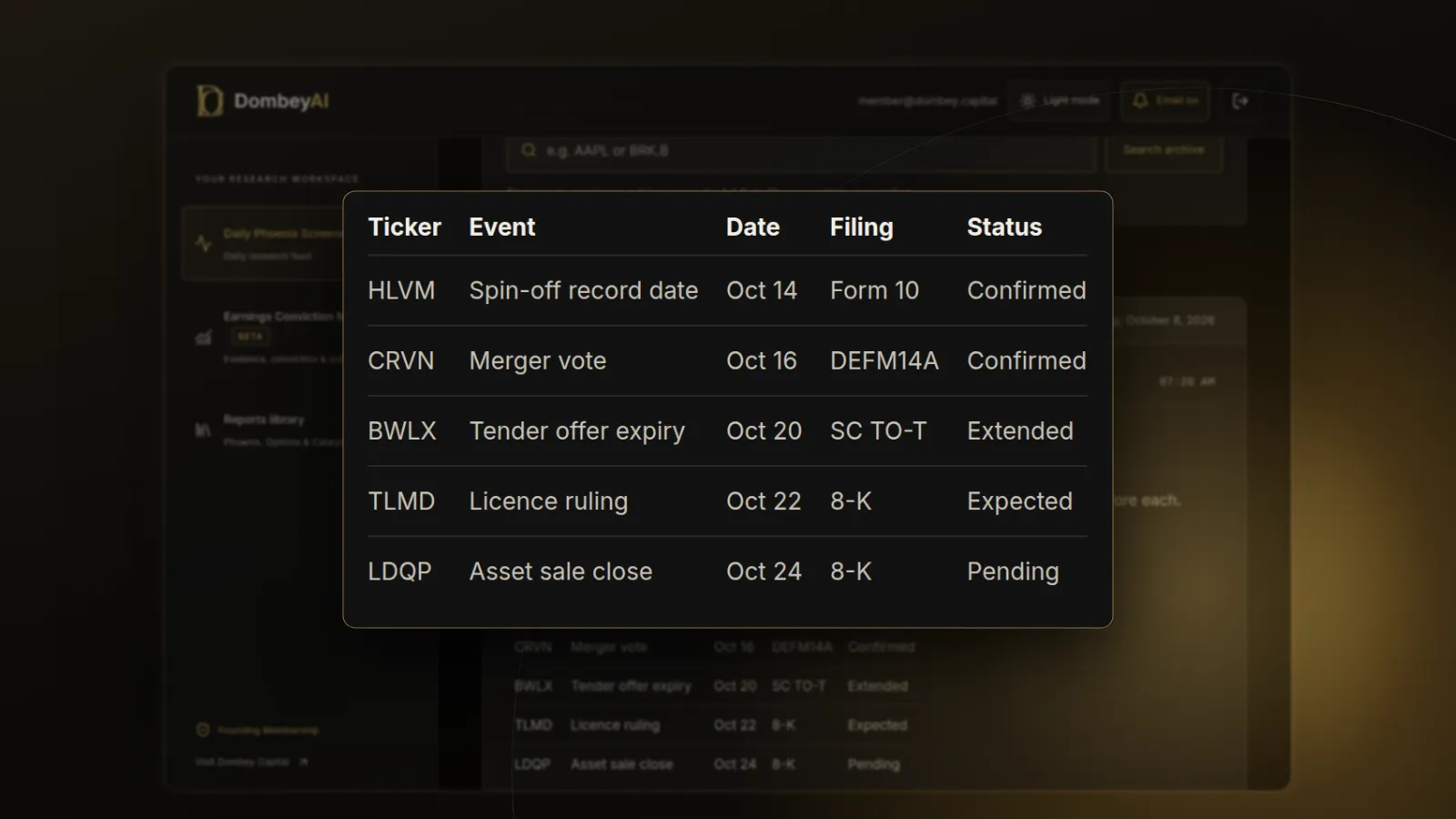


Full disclosure: Dombey Capital is our own research service and our top pick here, for the reasons below. The section on where it falls short is there so you can judge whether it fits your process.
Quick comparison
| Tool | Best for | Key features | Price (as of October 2026) |
|---|---|---|---|
| Dombey CapitalTop pick | Special situations and dated catalysts, with context | Founding Membership: weekly Phoenix Report, weekly Options Research, Catalyst Briefing, DombeyAI Portal; Standard Access: Biweekly Catalyst Briefing and public-research archive | Founding Membership $1,200/year; Standard Access $80/year or $8/month; Public Archive free |
| Benzinga Pro | Traders who act within minutes of a headline | Live newsfeed with filters, audio squawk, calendar suite including earnings and FDA events | See the vendor's pricing page |
| Seeking Alpha | Reading news and the debate around a stock | Free market news by category; Premium adds quant ratings, screeners and analysis on 4,000+ stocks and ETFs | News free; Premium $299/year, $4.95 first month |
| SEC EDGAR | Confirming the event at the source | Full-text search of filings since 2001, RSS feeds by company and form type | Free |
| Koyfin | News next to fundamentals and charts | Press releases, filings, transcripts and premium news on paid plans | Free plan; Plus from $39/month billed annually |
| The Fly | Event and earnings calendars with street research | Events and earnings calendars, street research, alert settings, The Fly Cast audio | See the vendor's pricing page; 7-day free trial |

How we compared these tools
We compared these services from vendor documentation, pricing pages and public product pages, read on the publish date. We did not subscribe to each service for this article, so nothing below describes the member experience beyond what the vendors publish. We make no claims about any service's speed relative to another, its accuracy or the performance of anything it covers.
A catalyst news source does three jobs, and few tools do all three well:
- Speed. How quickly you learn that an event happened or was scheduled.
- Context. Whether the source explains what the event means for the stock, with the mechanism and the risks.
- Verification. How easily you can get from the headline to the primary document.
| Criterion | Weight | What it measures |
|---|---|---|
| Catalyst context | 30% | Whether the source explains what a dated event could mean for the stock |
| Special situations coverage | 20% | Coverage of spin-offs, deal spreads, votes, rulings and similar events |
| Speed and alerts | 20% | Live feeds, filters and alerts on headlines and filings |
| Path to primary sources | 15% | How directly you can reach the filing or press release |
| Price and terms | 15% | List price, trial and billing terms from the vendor's own page |
These weights favor investors who hold positions through an event over days or weeks. If you trade intraday and act on the first headline, weight speed at 40% or more and Benzinga Pro moves to the front for that job.
Quick picks by job
Best for special situations and dated catalysts: Dombey Capital
Dombey covers a narrow set of situations: stocks below cash or book, spin-offs, deal spreads, and legal and corporate events with a date attached. Founding Membership includes the weekly Phoenix Report, weekly Options Research, the Catalyst Briefing and the DombeyAI Portal. Standard Access, the lower-cost option, is the Biweekly Catalyst Briefing on forthcoming corporate and market events plus the public-research archive. The job it does is context: why the date matters and what has to happen for the thesis to work.
Best for reacting to headlines in real time: Benzinga Pro
Benzinga Pro is built around a live newsfeed you can filter by ticker, watchlist and topic, an audio squawk that reads market news aloud during the session, and a set of calendars that includes earnings and FDA events. It suits people who make decisions on the day news lands.
Best for news plus the debate around a stock: Seeking Alpha
Seeking Alpha's market news feed is free and sorted into categories such as M&A, earnings, guidance, IPOs, SPACs, buybacks and biotech. Premium adds quant ratings, screeners and a large library of contributor analysis, which is useful when you want to read the bull and bear cases after a headline.
Best free primary source: SEC EDGAR
Most corporate catalysts end up in a filing: an 8-K for a material event, a proxy for a vote, a Form 10 for a spin-off. EDGAR's full-text search and RSS feeds let you watch for those filings directly and for free.
Best for news alongside fundamentals: Koyfin
Koyfin puts press releases, filings, transcripts and premium news next to charts and financial data on its paid plans. It suits investors who want the headline and the numbers on one screen.
Best for event calendars with street research: The Fly
The Fly lists an events calendar, an earnings calendar, street research and alert settings, with an audio option called The Fly Cast. It suits readers who plan around scheduled events and want analyst commentary in the same place.
Full reviews
1. Dombey Capital
What it does. Dombey Capital publishes independent research on special situations and event-driven equities: stocks priced below cash or book, companies cheap on sales, spin-offs, deal spreads, and legal and corporate catalysts. Every thesis is published before its catalyst, priced on the day and kept in the archive, so the original case can be compared with what happened.
There are three access levels:
- Founding Membership ($1,200 a year, annual billing only): the weekly Phoenix Report, weekly Options Research, the Catalyst Briefing, the DombeyAI Portal with the Daily Phoenix Screener and the Earnings Conviction Model, valuation and execution analysis, and priority access.
- Standard Access ($80 a year, about $6.67 a month, or $8 a month on monthly billing), the lower-cost option: the Biweekly Catalyst Briefing on forthcoming corporate and market events, plus the complete public-research archive.
- Public Archive (free): published executive theses and public research.
Best for. Investors whose process starts from a dated event and who want the mechanism explained. If you are new to the idea, what is a stock catalyst and hard vs soft catalysts cover the basics.
Pricing. Founding Membership $1,200 a year. Standard Access, the lower-cost option, $80 a year or $8 a month. Public Archive free. See the subscription options.
Pros
- Each piece is tied to an event with a date, which makes it easier to judge whether a thesis worked.
- Research explains the mechanism and the downside, not only the headline.
- Standard Access is the lowest-priced paid plan in this comparison, and the Public Archive is free.
Cons
- It is not a live news wire; it will not alert you to a headline within seconds.
- Coverage is limited to special situations, so most stocks are never covered.
- Founding Membership at $1,200 a year is a large commitment for an occasional reader.
Verdict: Our top pick for investors who follow special situations and want dated catalysts explained. Pair it with a fast feed or EDGAR alerts if you need to know the moment something happens.
2. Benzinga Pro
What it does. Benzinga Pro is a trading news platform. Its product pages describe a live newsfeed with filters by ticker, watchlist, keyword and sector, an audio squawk that reads market-moving headlines aloud during the trading day, and a calendar suite covering earnings, FDA events, economic releases, IPOs, dividends and analyst ratings. Plans differ in which filters, squawk access and tools they include.
Best for. Active traders who need to learn about a headline quickly and act the same session.
Pricing. Benzinga's pricing page would not load for us on the publish date. See the vendor's pricing page for current plans and trial terms.
Pros
- Organized around speed, with filters that cut a large feed down to your watchlist.
- Audio squawk lets you follow news without watching the screen.
- Calendars and news sit in one product.
Cons
- A fast feed reports events; it does less to explain what a spin-off, vote or ruling means for valuation.
- Higher plans add features many longer-term investors will not use.
- We could not confirm current prices from the vendor's page.
Verdict: The pick for traders whose edge depends on reacting quickly to headlines.
3. Seeking Alpha
What it does. Seeking Alpha publishes a free market news feed with timestamps and tickers, sorted into categories that include M&A, earnings, guidance, IPOs, SPACs, buybacks, debt and share issuance, and biotech. Premium, which Seeking Alpha calls its flagship research service, adds data-driven stock ratings, screeners, AI tools such as Virtual Analyst Reports and Earnings Call Insights, and analysis on more than 4,000 stocks and ETFs, including about 1,300 securities that Wall Street does not cover. Its help center describes a separate PRO tier with upgrades and downgrades, top analysts and short ideas; the help page does not state a PRO price.
Best for. Investors who want to read the news and then the arguments on both sides of a stock.
Pricing. Market news is free to read. Premium is $299 a year plus applicable tax, with a one-month paid trial at $4.95 for new subscribers, then the annual price unless cancelled.
Pros
- A free, categorized news feed that covers deals, guidance and capital actions.
- Contributor analysis often appears soon after a significant event.
- Portfolio alerts let you follow content and prices on the stocks you hold.
Cons
- Contributor quality varies, and Seeking Alpha states its authors are third parties who may not be licensed or certified.
- The volume of content takes time to filter for the events you care about.
Verdict: A strong fit for investors who want news and opinion in one place and will do the filtering themselves.
4. SEC EDGAR
What it does. EDGAR is the SEC's filing system. Full-text search covers electronic filings since 2001, and the SEC offers RSS feeds for a company's latest filings, filterable by form type, and for all latest filings, filterable by company, CIK or form type. Form 8-K instructions say a report is generally due within four business days of the event, so material events reach EDGAR on a known clock.
Best for. Confirming any catalyst at the source, and watching specific companies or form types for free. Our guide to the best SEC filing tools and EDGAR alerts covers the options in more detail.
Pricing. Free.
Pros
- The primary document, not a summary of it.
- Free, with feeds you can point at a watchlist.
Cons
- A press release often appears before the filing does.
- No context: you read and interpret the document yourself.
Verdict: Every investor following catalysts should use it to check what any news source reports.
5. Koyfin
What it does. Koyfin is a financial data and charting platform. Its pricing page lists limited news on the free plan, and press releases, filings, transcripts and premium news on Plus and higher plans.
Best for. Investors who want the headline next to the financials, valuation multiples and chart.
Pricing. Free plan available. Plus $39, Premium $79, Advisor Core $209 and Advisor Pro $299 a month on annual billing; monthly billing is $49, $110, $239 and $349.
Pros
- News, filings and transcripts sit next to fundamentals.
- A free plan to start.
Cons
- News is one feature among many, not the center of the product.
- No research organized around special situations.
Verdict: A good choice if you already use it for data and want news in the same place.
6. The Fly
What it does. The Fly's site lists a dashboard, an events calendar, an earnings calendar, street research, a syndicate section, portfolios and alert settings, plus an audio option called The Fly Cast.
Best for. Readers who plan around scheduled events and want analyst research in the same product.
Pricing. See the vendor's pricing page. The site offers a seven-day free trial.
Pros
- Events and earnings calendars alongside street research.
- An audio option for following updates.
Cons
- Plan prices were not shown on the page we read.
- Like other feeds, it reports events rather than building a thesis around them.
Verdict: Worth a trial for readers who want calendars and street research together.
Where Dombey falls short
- Not a live feed. Dombey does not push headlines as they cross. If a ruling lands mid-session, a news wire or an EDGAR feed will tell you first.
- Narrow coverage. Dombey covers special situations and catalyst-driven stocks. It does not offer news on the whole market, ratings on thousands of companies or a general screener.
- No broad data terminal. There is no financial statements database or portfolio analytics of the kind Koyfin and Seeking Alpha offer.
- Small team. Output is limited by how many situations a small team can research properly, so you get fewer names than a news service covers in a day.
- Pen-name author. Research is published under the name James Whitfield, a pen name. Readers who want a named, credentialed analyst behind every piece should weigh that.
- Short history. The public record is young. The archive keeps every thesis with its date and price, but a short record says less than a long one.
Free vs paid
You can follow catalysts well for free. EDGAR has every filing and free RSS feeds, company investor relations pages post press releases and event dates, Seeking Alpha's news feed is free to read, Koyfin has a free plan, and Dombey's Public Archive is free. Our guide on how to build a catalyst calendar uses only public sources.
What paid plans add is mostly speed, filtering and context:
- Speed and filters on a live feed (Benzinga Pro).
- Ratings, screeners and analysis around the news (Seeking Alpha Premium).
- News next to data (Koyfin paid plans).
- Research on dated events in special situations (Dombey Founding Membership, or Standard Access as the lower-cost option).
How to choose
Start with the job you need done, not the brand.
| Your situation | Pick | Add later when |
|---|---|---|
| You hold spin-offs, deal spreads or event positions for weeks | Dombey CapitalTop pick | You need the headline the moment it crosses: add Benzinga Pro or EDGAR feeds |
| You trade intraday on headlines | Benzinga Pro | You want context on special situations: add Dombey Founding Membership, or Standard Access as the lower-cost option |
| You want news and opinion on stocks you hold | Seeking Alpha | You want dated catalyst research: add Dombey Capital |
| You want news next to fundamentals | Koyfin | You want a faster dedicated feed: add Benzinga Pro |
| You want to spend nothing | SEC EDGAR plus free feeds | You run out of time to read filings: add a paid briefing |
- If you act within minutes of a headline, speed matters most and a live feed is the core purchase.
- If you hold through an event, context and verification matter more than the first minute.
- If you already pay for a data platform, check its news feature before adding a second feed.
- If you follow biotech dates, read how FDA decision dates work before relying on any calendar.
The bottom line
Dombey Capital is our top pick for investors who follow special situations and want each dated catalyst explained, with Founding Membership for the full research suite and Standard Access as the low-cost briefing. Benzinga Pro is the pick for traders who need headlines in real time, and Seeking Alpha suits investors who want a free news feed plus ratings and opinion. Koyfin and The Fly fit readers who want news beside data or calendars beside street research. Whatever you use, confirm the event on SEC EDGAR and check each vendor's current price before you pay.