

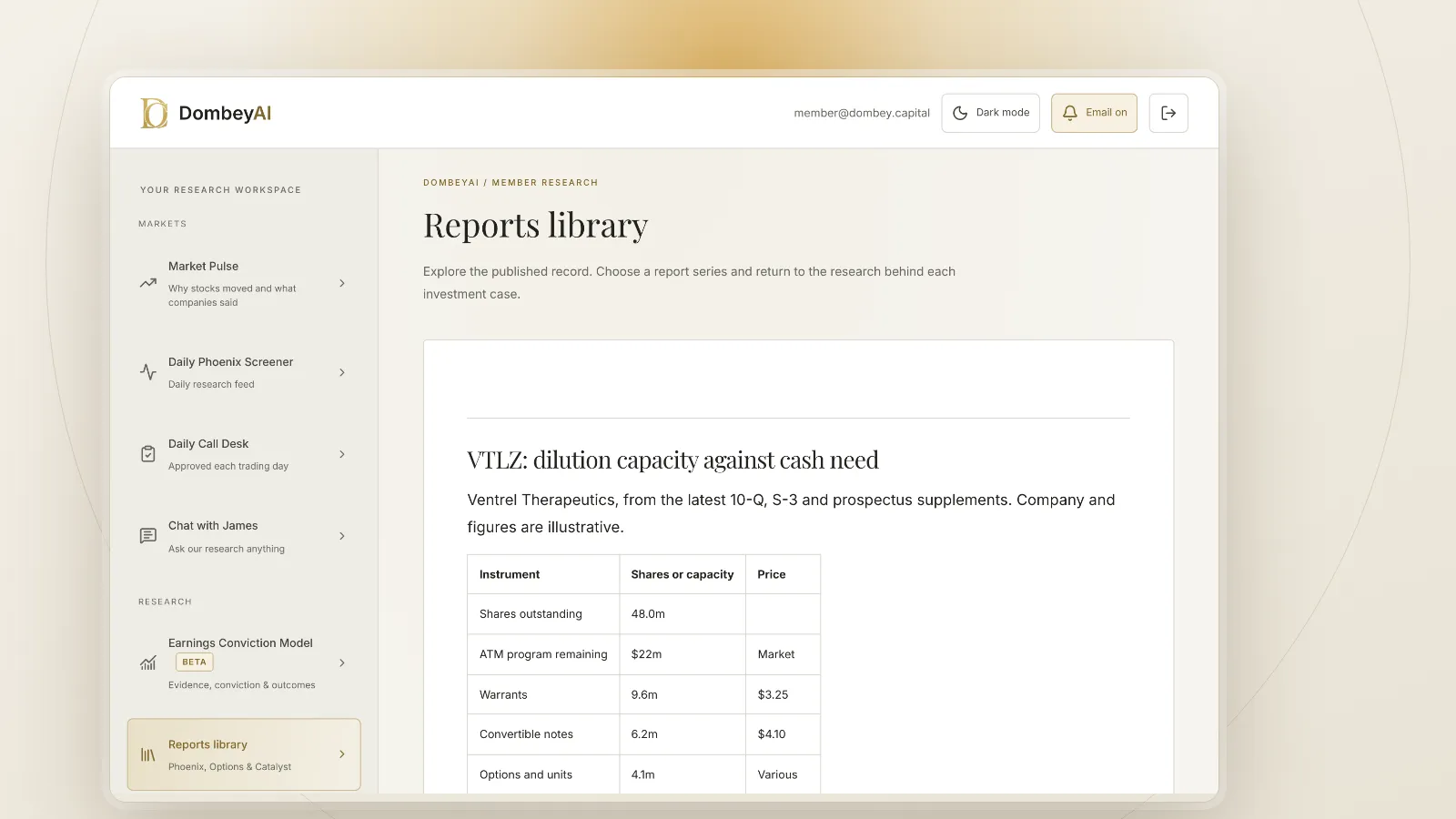


Full disclosure: Dombey Capital is our own research service and our top pick here, for the reasons below. The section on where it falls short is there so you can judge whether it fits your process.
Quick comparison
| Tool | Best for | Key features | Price (as of November 2026) |
|---|---|---|---|
| Dombey CapitalTop pick | Share count work inside special situations research | Founding Membership: weekly Phoenix Report, weekly Options Research, Catalyst Briefing, DombeyAI Portal with the Daily Phoenix Screener and Earnings Conviction Model; Standard Access: Biweekly Catalyst Briefing | Founding Membership $1,200/year; Standard Access $80/year or $8/month; Public Archive free |
| Dilution Tracker | A dilution profile per stock | Shelf, warrant, ATM and convertible data on more than 2,500 stocks; verified float | See the vendor's pricing page |
| AskEdgar | Dilution data with filing alerts | Warrants, convertibles, shelf and ATM capacity, cash runway, offering risk ratings, real-time alerts | Free; Pro $59/month list; Professional+ $199/month list |
| SEC EDGAR full-text search | The free primary source | Full text of electronic filings since 2001; filters by form, date and entity | Free |
| BamSEC | Reading filings quickly | Search across filings and transcripts, table tools, email alerts | See the vendor's pricing page |
| Finviz Elite | Alerts on filings and insider trades | Unlimited alerts including SEC filings and insider trading | $39.50/month or $299.50/year |
| TIKR | Long share count history | Financials up to 30 years, filings, global coverage | Free; Plus $24.95/month; Pro $54.95/month |
| Koyfin | Share count trend with charts | 10 years of financials, filings and transcripts on Plus | Free; Plus $39/month; Premium $79/month |

How we compared these tools
We compared these services from vendor pricing pages and public product pages, read on the publish date. We did not subscribe to each plan for this article, and we make no claims about the accuracy of any data.
| Criterion | Weight | What it measures |
|---|---|---|
| Dilution instrument detail | 30% | Shelves, ATM programs, warrants and convertibles, with terms |
| Fit for dated events | 20% | Whether the tool helps around an offering, a deal or a financing date |
| Alerts | 15% | Notice when a new filing adds dilution capacity |
| Source quality | 15% | Links back to the filing that each figure comes from |
| Price and terms | 20% | List prices and free plan limits from the vendor's own pages |
The weights favor instrument detail because the terms of a warrant or convertible decide how many shares it can create. If you mostly need history on large companies, weight source quality and price more heavily and the data terminals move up.
Quick picks by job
Best for share count work inside special situations research: Dombey Capital
Dombey's research on stocks priced below cash or book, spin-offs and deals includes the diluted share count that drives value per share, published before each catalyst.
Best for a dilution profile per stock: Dilution Tracker
Dilution Tracker describes a dilution profile on more than 2,500 stocks, built around shelves, warrants, ATM programs and convertibles, with a manually verified float.
Best for dilution data with real-time filing alerts: AskEdgar
AskEdgar pairs instrument-level dilution data and cash runway with real-time SEC filing alerts on Pro.
Best free primary source: SEC EDGAR full-text search
Every figure in a dilution database comes from a filing. EDGAR full-text search lets you find those filings yourself, free.
Best for reading filings quickly: BamSEC
BamSEC's search across filings and its table tools speed up finding the equity footnote and the offering terms.
Best for alerts on filings and insider trades: Finviz Elite
Finviz Elite's unlimited alerts include SEC filings and insider trading, which catch many dilution events as they are filed.
Best for long share count history: TIKR
TIKR's paid plans carry long financial histories, which show how much the share count has grown over decades.
Best for charting the share count trend: Koyfin
Koyfin's financials and charts make it easy to compare share count growth across a group of companies.
Full reviews
1. Dombey Capital
What it does. Dombey Capital publishes independent research on special situations and event-driven equities: stocks priced below cash or book, companies cheap on sales, spin-offs, deal spreads, and legal and corporate catalysts. Each piece works from the diluted share count, because value per share is the number that matters. It is not a dilution database. There are three access levels:
- Founding Membership ($1,200 a year, annual billing only): the weekly Phoenix Report, weekly Options Research, the Catalyst Briefing, the DombeyAI Portal with the Daily Phoenix Screener and the Earnings Conviction Model, valuation and execution analysis, and priority access.
- Standard Access ($80 a year, about $6.67 a month, or $8 a month on monthly billing), the lower-cost option: the Biweekly Catalyst Briefing on forthcoming corporate and market events, plus the complete public-research archive.
- Public Archive (free): published executive theses and public research.
Best for. Investors who want the share count analysis done as part of a thesis tied to a dated event.
Pricing. Public Archive free. Founding Membership $1,200 a year. Standard Access $80 a year or $8 a month. See the subscription options.
Pros
- Share count work is built into each thesis.
- The Public Archive is free, so you can judge the work before paying.
- Research names the catalyst, the date and what would change the view.
Cons
- Not a database: no dilution profile on thousands of stocks.
- No filing alerts.
- Founding Membership costs more than most dilution tools.
Verdict: Our top pick for special situations; pair it with a dilution database for wide coverage.
2. Dilution Tracker
What it does. Dilution Tracker describes itself as a tool for small cap traders and investors, with a dilution profile on more than 2,500 stocks covering shelf registrations, warrants, ATM programs, convertibles and more, and a float it says is manually verified.
Best for. Investors in small caps who want each stock's dilution instruments in one view.
Pricing. See the vendor's pricing page; the pages we read did not list prices.
Pros
- Built specifically for dilution.
- Covers the main instruments: shelves, warrants, ATMs and convertibles.
- Verified float, which matters for small caps.
Cons
- Prices were not listed on the pages we read.
- Coverage centers on small caps.
- You still need the filing for the full terms.
Verdict: A strong specialist choice for small cap dilution.
3. AskEdgar
What it does. AskEdgar's homepage shows warrants and convertibles with remaining shares, price and source filing; shelf registrations, ATM programs and equity lines with amounts remaining and a baby shelf limit; cash on hand, quarterly burn and estimated runway; and offering risk ratings for dilution, warrant exercise, offering frequency, cash need and listing compliance. Its pricing page lists a free plan with filing summaries, a basic screener and a watchlist; Pro adds dilution risk and offering data with real-time SEC filing and news alerts; Professional+ adds an advanced screener and a deals screener with two years of history.
Best for. Investors who want dilution data, runway and real-time alerts together.
Pricing. Free $0. Pro $59 a month list price, shown at $41.30 in a Black Friday offer. Professional+ $199 a month list, shown at $99.50. Enterprise custom. The API is billed separately.
Pros
- Instrument-level detail with the source filing for each.
- Cash runway alongside dilution capacity.
- Real-time filing alerts on Pro.
Cons
- Monthly billing is the only option listed.
- Risk ratings are the vendor's own model.
- Studio agent usage is limited by plan.
Verdict: The best choice for dilution data with alerts.
4. SEC EDGAR full-text search
What it does. The SEC's full-text search covers the full text of electronic filings since 2001, with filters by form type, filing date, company name, ticker, CIK or individual's name, and by location or state of incorporation. Searching for "at-the-market", "warrant" or "prospectus supplement" within a company's filings finds most dilution events. Our guide on how to search SEC EDGAR filings covers the method.
Best for. Anyone who wants to check the source, and investors on a budget.
Pricing. Free.
Pros
- The primary source every other tool reads.
- Full text since 2001.
- Free.
Cons
- No ready-made dilution profile; you build it.
- No alerts in the search tool itself.
- Takes time for each company.
Verdict: Essential, whatever else you use.
5. BamSEC
What it does. BamSEC's homepage describes document search across filings and transcripts, table tools that pull historical numbers from filings, screening tools and email alerts. The page announces that BamSEC and AlphaSense have joined forces. Our list of the best SEC filing tools and EDGAR alerts covers it alongside similar tools.
Best for. Analysts who want to find the equity footnote and offering terms quickly.
Pricing. See the vendor's pricing page; the homepage offers a free trial.
Pros
- Fast search across filings and transcripts.
- Table tools for share count and equity tables.
- Email alerts.
Cons
- No dilution-specific profile.
- Prices not listed on the homepage.
- More than a casual investor needs.
Verdict: A good choice for analysts who read many filings.
6. Finviz Elite
What it does. Finviz Elite's page lists unlimited stock, price, screener, portfolio and calendar alerts by email and push, covering news, ratings, insider trading, SEC filings and price moves. Free users do not get alerts.
Best for. Investors who want notice of new filings and insider trades on a watchlist.
Pricing. $39.50 a month billed monthly, or $299.50 a year. The page showed a first-year offer of $149 when we read it.
Pros
- Unlimited alerts, including SEC filings.
- Insider trading alerts alongside filings.
- Strong screener for finding ideas.
Cons
- No dilution instrument detail.
- No alerts on the free tier.
- You still read the filing to see what it adds.
Verdict: A good alert layer on top of a dilution database.
7. TIKR
What it does. TIKR's pricing page lists 5 years of financials on Free, 10 years on Plus and Pro, and 30 years on Ultimate, with company filings and global coverage from Plus up. Long financial histories show how the reported share count has changed.
Best for. Investors who want to see a company's record of issuing or buying back shares over many years.
Pricing. Free $0. Plus $24.95 a month. Pro $54.95 a month. Ultimate $119.95 a month, on monthly billing.
Pros
- Long histories on paid plans.
- Global coverage from Plus up.
- Transcripts help explain financing plans.
Cons
- No instrument-level dilution data.
- No filing alerts listed.
- History only; it does not show future capacity.
Verdict: Useful for the long-term record.
8. Koyfin
What it does. Koyfin's pricing page lists 2 years of financials on Free and 10 years of financials and estimates, filings and transcripts on Plus, with custom formulas on Premium. Its charts make it simple to compare share count growth across companies.
Best for. Investors who want to chart the share count trend across a peer group.
Pricing. Free $0. Plus $39 a month. Premium $79 a month.
Pros
- Charts and dashboards for comparing companies.
- Filings and transcripts on Plus.
- Custom formulas on Premium.
Cons
- No instrument-level dilution data.
- No alerts listed on the pricing page.
- Two years of financials on Free is short.
Verdict: Useful for peer comparisons of share count growth.
Where Dombey falls short
Dombey is not a dilution database. It does not track every shelf, ATM program or warrant across the market, and it does not send filing alerts. Coverage is narrow by design and centers on special situations and dated events. It is a small team, the research is published under a pen name, and the public track record is short. If you want a dilution profile on thousands of small caps, Dilution Tracker or AskEdgar does that; if you want the raw filings, EDGAR does. Dombey supplies the analysis of what the share count means for a specific situation.
Free vs paid
You can track dilution for free with EDGAR full-text search and the share count on each 10-Q cover, at the cost of time. AskEdgar's free plan adds summaries and a watchlist. Paid tools save time: AskEdgar Pro and Dilution Tracker gather the instruments for you, and Finviz Elite adds alerts. Dombey's Public Archive is free; Founding Membership adds the weekly Phoenix Report, Options Research and the DombeyAI Portal, and Standard Access adds the Biweekly Catalyst Briefing.
How to choose
| Your situation | Pick | Add later when |
|---|---|---|
| You invest in special situations and dated events | Dombey CapitalTop pick | You want a dilution profile on more stocks |
| You trade small caps with frequent offerings | Dilution Tracker or AskEdgar | You want the full terms from the filing |
| You want real-time notice of new offerings | AskEdgar Pro or Finviz Elite | You need instrument detail |
| You are on a tight budget | EDGAR full-text search | You track more than a few companies |
| You want the long-term share count record | TIKR or Koyfin | You need forward-looking capacity |
Whatever tool you use, learn the instruments. Our explainers on dilution and share count changes, at-the-market offerings, shelf registrations and estimating cash runway cover what each number means. For a wider ranking of paid services, see our list of the best stock picking services.
The bottom line
For share count work inside special situations research, our top pick is Dombey Capital, with Founding Membership for the full research and the DombeyAI Portal and Standard Access as the lower-cost option. For tracking dilution across many stocks, Dilution Tracker and AskEdgar are the specialist databases, with AskEdgar adding runway and real-time alerts. EDGAR full-text search is the free source behind all of them, and TIKR and Koyfin show the long-term record. Read the filing before relying on any figure.