

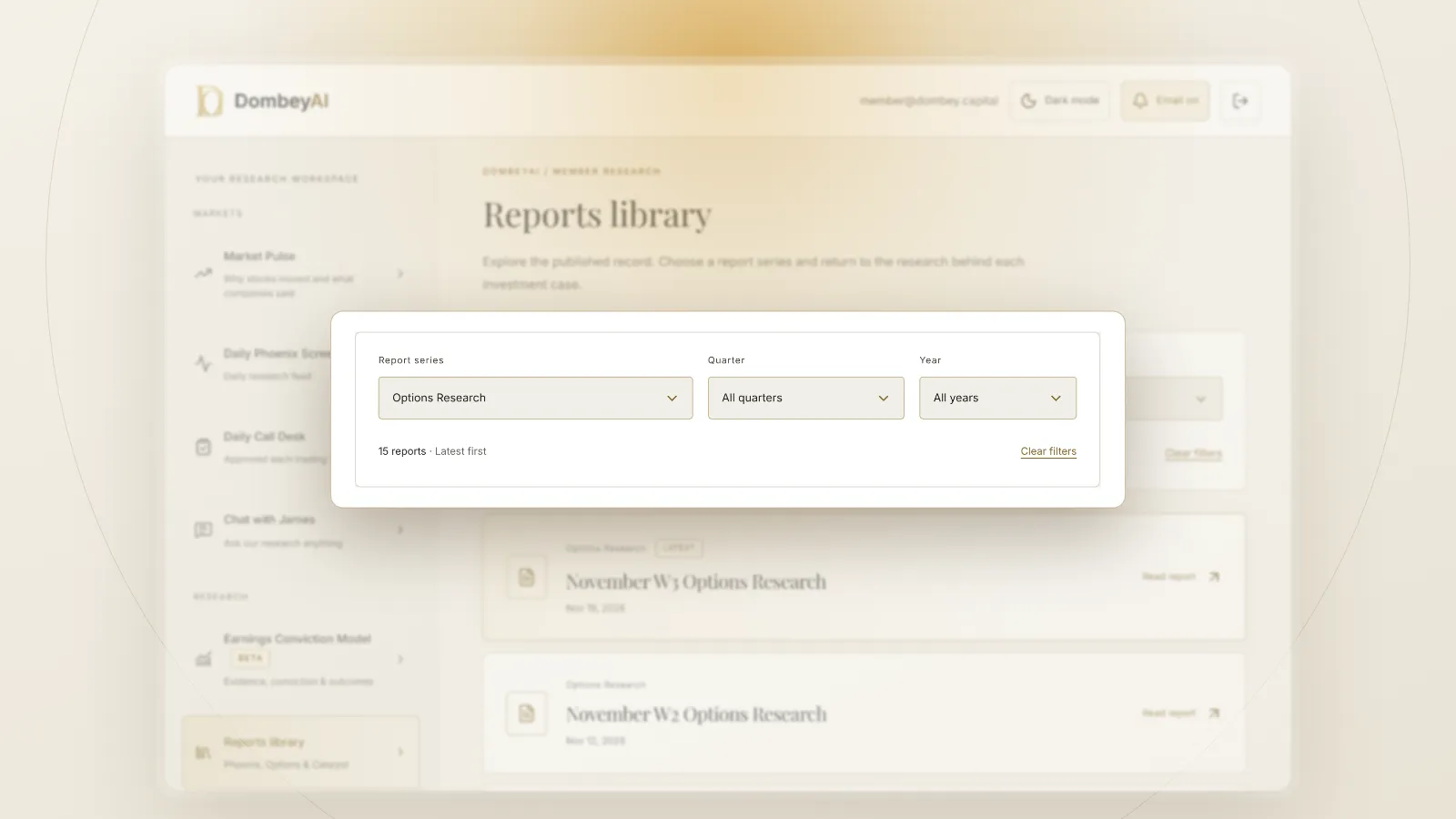


Full disclosure: Dombey Capital is our own research service and our top pick here, for the reasons below. The section on where it falls short is there so you can judge whether it fits your process.
Quick comparison
| Tool | Best for | Key features | Price (as of November 2026) |
|---|---|---|---|
| Dombey CapitalTop pick | Investors in special situations and dated catalysts | Founding Membership: weekly Phoenix Report, weekly Options Research, Catalyst Briefing, DombeyAI Portal with the Daily Phoenix Screener and Earnings Conviction Model; Standard Access: Biweekly Catalyst Briefing and public-research archive | Founding Membership $1,200/year; Standard Access $80/year or $8/month; Public Archive free |
| Koyfin | Building your own analysis from data | 10 years of financials and estimates, stock and ETF screener, filings, transcripts, custom dashboards; custom formulas on Premium | Free; Plus $39/month; Premium $79/month; up to 30% off annually |
| Simply Wall St | Visual reports and fair value estimates | Snowflake summaries, cash-flow fair value, narratives, screeners, portfolio tracking with broker sync | Free (5 reports/month); Premium and Unlimited: see the vendor's pricing page |
How we compared these tools
We compared these services from vendor pricing pages and public product pages, read on the publish date. We did not subscribe to each plan for this article, and we make no claims about the accuracy of any data, rating or fair value estimate.
| Criterion | Weight | What it measures |
|---|---|---|
| Fit for dated events | 25% | Whether the tool helps when value depends on a spin-off, deal, vote or report date |
| Data depth | 20% | Years of financials and estimates, filings and transcripts |
| Valuation support | 20% | Built-in fair value estimates or the tools to build your own |
| Ease of use | 15% | How quickly a new user gets a clear picture of a stock |
| Price and terms | 20% | List prices and free plan limits from the vendor's own pages |
The weights favor event fit, data and valuation because they matter most for special situations. If you mainly want a fast, visual first look at many stocks, weight ease of use more heavily and Simply Wall St moves up.
Quick picks by job
Best for special situations and dated catalysts: Dombey Capital
Dombey publishes dated research on situations where an event can change a stock's value: stocks priced below cash or book, spin-offs, deal spreads, and legal and corporate catalysts. Each thesis is published before its catalyst and kept in the archive.
Best for building your own analysis: Koyfin
Koyfin gives you the raw material: ten years of financials and estimates on paid plans, screeners, dashboards, filings and transcripts, and custom formulas on Premium. You do the analysis.
Best for a visual summary and fair value estimate: Simply Wall St
Simply Wall St turns each stock into a visual report with its Snowflake chart and a fair value based on expected future cash flows, so you can see a company's profile at a glance.
Full reviews
1. Dombey Capital
What it does. Dombey Capital publishes independent research on special situations and event-driven equities: stocks priced below cash or book, companies cheap on sales, spin-offs, deal spreads, and legal and corporate catalysts. It is written research, not a data platform. There are three access levels:
- Founding Membership ($1,200 a year, annual billing only): the weekly Phoenix Report, weekly Options Research, the Catalyst Briefing, the DombeyAI Portal with the Daily Phoenix Screener and the Earnings Conviction Model, valuation and execution analysis, and priority access.
- Standard Access ($80 a year, about $6.67 a month, or $8 a month on monthly billing), the lower-cost option: the Biweekly Catalyst Briefing on forthcoming corporate and market events, plus the complete public-research archive.
- Public Archive (free): published executive theses and public research.
Best for. Investors whose process starts from a dated event and who want research that names the catalyst, the date and what would change the view.
Pricing. Public Archive free. Founding Membership $1,200 a year. Standard Access $80 a year or $8 a month. See the subscription options.
Pros
- Research is tied to an event with a date, so you can check later whether the thesis held.
- The Public Archive is free, so you can judge the work before paying.
- Founding Membership includes the DombeyAI Portal; Standard Access is a low-cost entry point.
Cons
- Coverage is narrow by design; it is not a data terminal or a screener of the whole market.
- No fair value estimate on every stock.
- Founding Membership costs more than either tool's entry paid plan.
Verdict: Our top pick for special situations; pair it with Koyfin or Simply Wall St for data and screening.
2. Koyfin
What it does. Koyfin is a market data and analysis platform. Its pricing page lists five plans. Free includes 2 years of financials and 1 year of estimates, portfolios, advanced charting, market and macro dashboards and limited company snapshots and news. Plus adds 10 years of financials and estimates, ETF holdings, a stock and ETF screener, unlimited watchlists, screens and custom dashboards, more than 100,000 global company snapshots, press releases, filings, transcripts and premium news. Premium adds advanced portfolio analytics, unlimited custom data and formulas, custom financial templates and ETF valuation. Two Advisor plans add model portfolios, client proposals and reports, and mutual fund data.
Best for. Investors who want to chart, screen and model companies themselves, with the data in one place. For other options in the same category, see our list of Koyfin alternatives.
Pricing. Free $0. Plus $39 a month. Premium $79 a month. Advisor Core $209 a month and Advisor Pro $299 a month. The page says annual billing saves up to 30%.
Pros
- Ten years of financials and estimates on Plus, with filings and transcripts.
- Custom formulas and templates on Premium let you build your own metrics.
- A useful free plan with charting and dashboards.
Cons
- No ready-made fair value on each stock; you build the valuation.
- More to learn than a report-based tool.
- Advisor features are priced well above the individual plans.
Verdict: The better choice for investors who want to do their own analysis from the numbers.
3. Simply Wall St
What it does. Simply Wall St produces a visual report for each stock and ETF. Its homepage describes the Snowflake, a visual summary of a stock's profile and of a portfolio's health; fair values estimated from future expected cash flows; a Narratives framework for building and tracking a thesis on each stock, with community narratives from other users; a Snowflake screener with alerts; and portfolio tracking that it says syncs with more than 2,000 brokers. It states coverage of 120,000 stocks in 90 markets with more than 10 years of history. The plans page lists Free, Premium and Unlimited. Free includes 5 company or ETF reports a month, 1 standard portfolio of up to 10 holdings and the top 4 results per screener. Premium raises reports to 30 a month and portfolios to 3 advanced portfolios of up to 30 holdings, and Unlimited removes the report and holdings limits and adds export to Excel and PDF.
Best for. Investors who want a clear, visual first read on a company and an estimate of fair value to check against. Our Simply Wall St alternatives list covers similar tools.
Pricing. Free plan available. For Premium and Unlimited, see the vendor's pricing page; the plans page we read did not display prices in a form we could confirm.
Pros
- Fast visual summary of valuation, growth, financial health and dividends.
- A fair value estimate on each stock, with the cash flow basis explained.
- Global coverage and portfolio tracking with broker sync.
Cons
- A model's fair value depends on its assumptions, which you control less than in your own model.
- Report limits on Free and Premium.
- Less raw data and charting depth than a data terminal.
Verdict: The better choice for a quick, visual view of many stocks and a starting point for valuation.
Koyfin vs Simply Wall St head to head
| Feature | Koyfin | Simply Wall St |
|---|---|---|
| Approach | Data terminal: you build the analysis | Report: the analysis is summarized for you |
| Financial history | 2 years free; 10 years on Plus and above | 10 years or more, per its homepage |
| Fair value | Build your own; ETF valuation on Premium | Cash-flow-based fair value on each stock |
| Screener | Stock and ETF screener on Plus | Snowflake screener; top 4 results on Free |
| Filings and transcripts | Included on Plus | Not a focus of the plans page |
| Portfolios | All plans; advanced analytics on Premium | 1 on Free, 3 on Premium, unlimited on Unlimited |
| Free plan | 2 years of financials, 2 screens, 2 dashboards | 5 reports a month, 1 portfolio |
| Entry paid price | Plus $39/month | See the vendor's pricing page |
The table shows the real choice. Koyfin is for investors who want the numbers and the tools to work with them. Simply Wall St is for investors who want an answer to start from. Many people who start with a visual tool move to a data terminal as their process becomes more hands-on, and some keep both. For a wider ranking of paid services, see our list of the best stock picking services. If you are comparing Simply Wall St with another data tool, our Seeking Alpha vs Simply Wall St comparison and the TradingView vs Koyfin comparison cover those pairs.
Where Dombey falls short
Dombey is not a data platform or a stock report generator. It does not provide ten years of financials on thousands of companies, a market-wide screener or a fair value on every stock. Coverage is narrow by design and centers on special situations and dated events. It is a small team, the research is published under a pen name, and the public track record is short. If you want broad data, charting and screening, Koyfin does that better; if you want a quick visual read on many stocks, Simply Wall St does. Dombey supplies research on the events those tools do not focus on.
Free vs paid
Both tools have useful free plans. Koyfin's free plan is enough for charts, dashboards and a two-year look at financials; Plus is the step most fundamental investors need for ten years of data and screening. Simply Wall St's free plan gives five reports a month, which is enough to test the format; heavier users will need Premium or Unlimited. Dombey's Public Archive is free; Founding Membership adds the weekly Phoenix Report, Options Research and the DombeyAI Portal, and Standard Access adds the Biweekly Catalyst Briefing.
How to choose
| Your situation | Pick | Add later when |
|---|---|---|
| You invest around spin-offs, deals and other dated events | Dombey CapitalTop pick | You want broad data and screening |
| You want to build your own models and screens | Koyfin | You want a quick visual check on ideas |
| You want a visual summary and fair value on many stocks | Simply Wall St | You want to control the valuation assumptions |
| You are on a tight budget | The free plans of both, or Dombey Standard Access | You use the tool every week |
| You manage client money | Koyfin Advisor plans | You need institutional data and compliance features |
Whichever tool you choose, check the filings before relying on any number or estimate. Our guide to reading a 10-Q for special situations shows what to look for.
The bottom line
For special situations and dated catalysts, our top pick is Dombey Capital, with Founding Membership for the full research and the DombeyAI Portal and Standard Access as the lower-cost option. Between the two tools, Koyfin is better for investors who want to build their own analysis, with ten years of financials, screeners and transcripts on Plus at $39 a month. Simply Wall St is better for investors who want a visual summary and a ready-made fair value on each stock, with a free plan of five reports a month. Both have free plans, so try each before paying.