

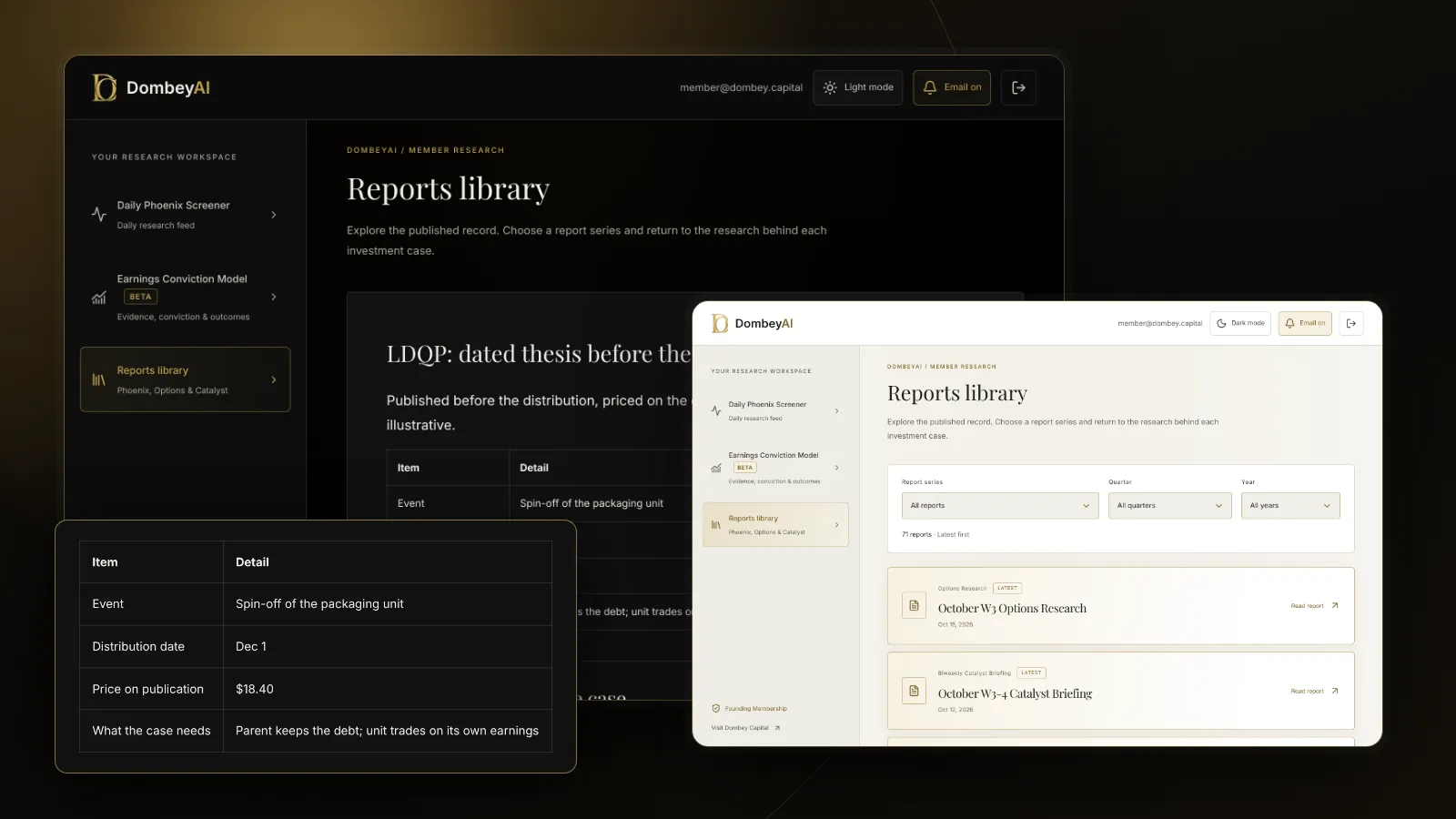


Full disclosure: Dombey Capital is our own research service and our top pick here, for the reasons below. The section on where it falls short is there so you can judge whether it fits your process.
What counts as a stock picking service
A stock picking service hands you specific stocks. That separates it from a research platform, which gives you data and ratings and leaves the choice to you, and from a broader advisory subscription, which mixes ratings, analyst reports and portfolio tools. If you want the broader kind, our guide to the best stock advisory services covers Morningstar Investor, Value Line and similar products, and explains how a newsletter differs from a registered investment adviser.
This page judges picking services on four things:
- How picks are made. A team's judgment, a quantitative rule, a backtested trading system, or research on one kind of event.
- Track-record transparency. Whether you can see every pick, including the losers, and how the vendor calculates its figures.
- Cost. List price, introductory offers and refund terms from each vendor's own pages.
- Fit. The holding period, the account size and the amount of reading each service assumes.
We do not repeat any vendor's performance figures here. Headline returns are chosen by the vendor, measured by the vendor and usually shown without the full list behind them.
Quick comparison
| Tool | Best for | Key features | Price (as of October 2026) |
|---|---|---|---|
| Dombey CapitalTop pick | Special situations and dated catalysts | Founding Membership: weekly Phoenix Report, weekly Options Research, Catalyst Briefing, DombeyAI Portal with the Daily Phoenix Screener and Earnings Conviction Model; Standard Access: Biweekly Catalyst Briefing and public-research archive | Founding Membership $1,200/year; Standard Access $80/year or $8/month; Public Archive free |
| Motley Fool Stock Advisor | Beginners and long-term holders | 2 picks a month, monthly Top 10 rankings, three entry strategies, stock reports | $199/year list; $99 introductory for new members; 30-day refund |
| Seeking Alpha Alpha Picks | A rules-based list of quant-rated stocks | 2 picks a month from stocks with a Strong Buy quant rating for 75+ days; sell alerts when ratings shift | See the vendor's pricing page |
| Stock Spin-off Investing | Spin-offs | 1 pick a month with a 6 to 18 page write-up, weekly email, monthly video call, archive to July 2018 | $97/month or $697/year; 30-day money-back guarantee |
| Mindful Trader | Short-term swing trades | Stock and options picks posted in real time, daily watch list, backtested strategies | See the vendor's pricing page |
| Value Investors Club | Free long-form ideas | Member write-ups; guest access on a 45-day delay; full access by application | Free guest access |
How we compared these tools
We compared these services from vendor documentation, pricing pages and public product pages, read on the publish date. We did not subscribe to each service for this article, and we make no claims about how any service's picks have performed.
| Criterion | Weight | What it measures |
|---|---|---|
| How picks are made | 30% | Whether the method is stated clearly enough that you can tell why a stock was picked |
| Track-record transparency | 25% | Whether every pick is visible with its date and entry price, and how performance is calculated |
| Fit for dated events | 15% | Whether the service helps when a stock's value depends on a spin-off, deal, vote or filing date |
| Cost and terms | 20% | List price, introductory offers, refunds and free access from the vendor's own pages |
| Guidance for the reader | 10% | Help on position sizing, entry and how to hold a group of picks |
The weights favor method and transparency because those are the two things a buyer can check before paying. If you are new to investing and want the most guidance per dollar, weight guidance and cost more heavily, and Motley Fool Stock Advisor moves to the top.
Quick picks by job
Best for special situations and dated catalysts: Dombey Capital
Dombey starts from an event with a date, such as a spin-off distribution, a shareholder vote, a tender offer deadline or a court ruling, and publishes a thesis before it. Each thesis is priced on the day and kept in the archive, so you can compare the case with what happened. If your question is "what changes for this stock on a given date," this is the service built for it. If you want a steady flow of long-term holdings across the whole market, it is not.
Best for beginners and long-term holders: Motley Fool Stock Advisor
Stock Advisor is the plainest place to start. It adds two picks a month, ranks a Top 10, offers three entry strategies and suggests holding each pick for at least five years inside a portfolio of 50 or more stocks. Its history is longer than any other service here. For a beginner who wants to be told how to build a portfolio, it is a better fit than Dombey.
Best for a rules-based list: Seeking Alpha Alpha Picks
Alpha Picks publishes its selection rules: a Strong Buy quant rating held for at least 75 days, plus size, price and type filters. If you trust a quantitative screen more than an analyst's story, this is the most transparent method on the list.
Best for spin-offs: Stock Spin-off Investing
One pick a month, each with a long write-up, from a service that tracks spin-offs as its main job. It suits readers who want the deep research on one event type and are happy to wait for a monthly idea. For more sources in this niche, see the best spin-off trackers and research sources.
Best for short-term trades: Mindful Trader
Mindful Trader posts swing trades in real time, and its page says trades typically last about a week. It suits active traders, not buy-and-hold investors.
Best free source of ideas: Value Investors Club
Free guest access shows member write-ups on a 45-day delay. You get the reasoning without paying, which makes it a good way to learn how a full investment case is built.
Full reviews
1. Dombey Capital
What it does. Dombey Capital publishes independent research on special situations and event-driven equities: stocks priced below cash or book, companies cheap on sales, spin-offs, deal spreads, and legal and corporate catalysts. Every thesis is published before its catalyst, priced on the day and kept in the archive. There are three access levels:
- Founding Membership ($1,200 a year, annual billing only): the weekly Phoenix Report, weekly Options Research, the Catalyst Briefing, the DombeyAI Portal with the Daily Phoenix Screener and the Earnings Conviction Model, valuation and execution analysis, and priority access. Founding Members can review the full research record and the model metrics behind it in the portal.
- Standard Access ($80 a year, about $6.67 a month, or $8 a month on monthly billing), the lower-cost option: the Biweekly Catalyst Briefing and the complete public-research archive.
- Public Archive (free): published executive theses and public research.
How picks are made. A written case for each situation, built around a dated event, with the valuation and what could break the case set out. The method is described in how to write a dated investment thesis.
Best for. Investors whose process starts from a catalyst. If the idea is new to you, what is a stock catalyst covers the basics.
Pricing. Founding Membership $1,200 a year. Standard Access $80 a year or $8 a month. Public Archive free. See the subscription options.
Pros
- Each pick is tied to a dated event, so you can check later whether the case held.
- Every thesis is priced on the day it is published and kept in the archive.
- Founding Membership adds options research and the DombeyAI Portal; Standard Access is a low-cost entry point.
Cons
- Narrow: it covers special situations, not the whole market.
- The public record is short compared with Motley Fool's.
- Little beginner guidance on building a diversified portfolio.
Verdict: Our top pick for special situations and dated catalysts. Beginners who want a portfolio-building plan, and investors who want a long history before they pay, are better served by Stock Advisor.
2. Motley Fool Stock Advisor
What it does. Stock Advisor delivers two recommendations a month from two teams. Motley Fool says the Hidden Gems team looks for high-quality companies of all sizes that the market has not fully valued, and the Rule Breakers team looks for first movers in emerging sectors. Both teams update Top 10 rankings each month. Members get three entry strategies (cautious, moderate and aggressive), a suggested portfolio size of $25,000 or more, stock reports and Fool IQ financial data. Motley Fool suggests holding each pick for at least five years, inside a diversified portfolio of 50 or more picks.
How picks are made. Analyst teams' judgment. The public page describes what each team looks for but not a step-by-step method.
Track record. The public page shows headline figures and a few example picks, but not a full list of every pick with its outcome. Ask to see the full scorecard before you judge it.
Pricing. $199 a year list, $99 introductory for new members, renewing at the list price in effect after the first year. Motley Fool offers a full refund if you cancel within 30 days. Its Epic bundle, at $499 a year list, adds more services and allocation guidance.
Pros
- Clear guidance for beginners on entry and portfolio size.
- The longest public history of any service here.
- Low entry price and a 30-day refund.
Cons
- The public page does not list every pick with its outcome.
- A five-year holding period does not suit readers working toward a nearer date.
- Watchlist and portfolio tracking sit in higher tiers, per the comparison table.
Verdict: The best stock picking service for most beginners and long-term holders. For more on what else is out there, see our Motley Fool alternatives.
3. Seeking Alpha Alpha Picks
What it does. Alpha Picks adds two stocks a month to a model portfolio, one on the first trading day and one around the 15th. Seeking Alpha's help center says each must have held a Strong Buy quant rating for at least 75 consecutive days, be a US common stock (not an ADR or a REIT), have a 3-month average market value above $500 million, trade above $10 and not have been picked in the past year. The quant model ranks stocks on value, growth, profitability, EPS revisions and momentum. Subscribers get sell alerts when ratings shift.
How picks are made. A published quantitative rule, with a final selection from the stocks that pass it.
Track record. Seeking Alpha documents how performance is calculated: each pick is bought at the opening price on the pick date, closed picks are treated as sold at the closing price on the sell date, and dividends are included. Closed picks have their own tab. The portfolio began on July 1, 2022.
Pricing. See the vendor's pricing page. Seeking Alpha says it does not offer free trials of Alpha Picks.
Pros
- The clearest stated selection rules on this list.
- A documented performance method with closed picks shown.
- Sell alerts tied to rating changes.
Cons
- No free trial.
- A quant rating measures recent data; it does not read a pending event in a filing.
- Seeking Alpha Premium is a separate product.
Verdict: The best pick for readers who want rules over judgment. For Seeking Alpha's research product rather than its picks, see our Seeking Alpha alternatives.
4. Stock Spin-off Investing
What it does. Stock Spin-off Investing Premium sends one new recommendation a month, about 12 a year, each with a write-up of 6 to 18 pages. The page says each stock takes about 40 hours of research, that coverage is mainly US small and micro-cap spin-offs, and that it occasionally covers other stocks. Members get a weekly email on news and the performance of current and prior picks, a monthly live video call, a members-only chat and newsletters back to July 2018.
How picks are made. One analyst's research on spin-offs, tracked through news alerts and a data terminal.
Pricing. $97 a month or $697 a year, with a 30-day money-back guarantee.
Pros
- Deep write-ups on one event type.
- An archive back to 2018.
- A monthly call to ask questions.
Cons
- One pick a month and one event type.
- Costs more per pick than the broad services.
Verdict: The best pick for readers who invest mainly in spin-offs. Our spin-off investing guide covers why these situations misprice.
5. Mindful Trader
What it does. Mindful Trader posts stock and options trades in real time for subscribers, along with a daily watch list, and teaches the strategies behind them. The page says the trades typically last about a week and that the strategies come from years of statistical research and back tests.
How picks are made. Backtested swing trading rules applied by the service's founder.
Pricing. A recurring monthly fee; see the vendor's pricing page. Subscribers can cancel at any time.
Pros
- Short holding periods for active traders.
- Picks arrive in real time.
- The strategies are taught, not only signaled.
Cons
- Back tests show how rules would have done, not how real trades did.
- Needs time during market hours.
Verdict: The best pick for short-term traders. Long-term investors should look elsewhere.
6. Value Investors Club
What it does. Value Investors Club publishes long-form investment write-ups from its members. Guests who sign up with an email see ideas on a 45-day delay. Full access requires an application that includes a current investment recommendation.
How picks are made. Each member writes up their own idea; there is no house view.
Pricing. Free guest access. The site does not state a fee for full membership.
Pros
- Free reasoning from experienced investors.
- Long write-ups that show how a case is built.
Cons
- Delayed ideas for guests.
- No follow-up or sell alerts.
Verdict: The best free source of stock ideas, and a good way to judge the quality of other services' thinking.
Zacks and Investor's Business Daily
Zacks and Investor's Business Daily both sell stock picking and rating products. Their websites blocked our reader on the publish date, so we have not stated their prices or features here rather than repeat figures we could not confirm. See each vendor's pricing page. Our Zacks vs Morningstar vs Value Line comparison covers how the Zacks Rank compares with other ratings.
A worked example: two kinds of pick
Neither approach is better in general. The first suits a reader building a diversified portfolio slowly. The second suits a reader who wants a shorter list of situations with a defined test. Know which one you are buying.
Where Dombey falls short
- Narrow coverage. Dombey covers special situations and catalyst-driven stocks. It is not a source of steady long-term holdings across the market, and readers who want broad coverage are better served by Stock Advisor or Alpha Picks.
- Short history. The public record is young. Stock Advisor has a much longer one. The archive keeps every thesis with its date and price, but a short record says less than a long one.
- Little beginner guidance. There is no starter portfolio or position sizing plan for new investors.
- Small team. Output is limited by how many situations a small team can research properly.
- Pen-name author. Research is published under the name James Whitfield, a pen name. Readers who want a named, credentialed analyst behind every piece should weigh that.
Free vs paid
Free options give you ideas and reasoning but no follow-up. Value Investors Club shows member write-ups on a delay, and Dombey's Public Archive shows published executive theses. Paid services add new picks on a schedule, sell or update notes, and guidance on how to hold them:
- A plan for beginners (Motley Fool Stock Advisor).
- A rules-based list (Seeking Alpha Alpha Picks).
- Deep work on one event type (Stock Spin-off Investing).
- Dated catalyst research and options work (Dombey Founding Membership, with Standard Access as the lower-cost option).
How to choose
| Your situation | Pick | Add later when |
|---|---|---|
| You invest around spin-offs, deals, votes and other dated events | Dombey CapitalTop pick | You want broad long-term holdings: add Stock Advisor |
| You are new and want a plan | Motley Fool Stock Advisor | You start holding event-driven positions: add Dombey Founding Membership, or Standard Access as the lower-cost option |
| You trust rules more than stories | Seeking Alpha Alpha Picks | You want the reasoning behind a stock: add Dombey or a research service |
| You mainly invest in spin-offs | Stock Spin-off Investing | You want other event types: add Dombey |
| You trade over days, not years | Mindful Trader | You want longer-term ideas: add Stock Advisor |
| You want to learn before paying | Value Investors Club | You want follow-up on each idea: choose a paid service |
- If you cannot read each pick's case, start with fewer picks, not more.
- If a service does not show every pick with its date and entry price, ask for it before you pay.
- If you hold a pick because a date is coming, write the date down and check the case on it.
For research services rather than picks, see our Seeking Alpha vs Motley Fool vs Morningstar vs Dombey comparison and the best investing newsletters for special situations. Dombey's published research is in the research archive.
The bottom line
Dombey Capital is our top pick for special situations and dated catalysts, because each pick is a written case tied to a date you can check it against. Most beginners and long-term holders are better served by Motley Fool Stock Advisor, which has the longest history here and the clearest guidance. Readers who want rules over judgment should look at Alpha Picks, spin-off specialists at Stock Spin-off Investing, and anyone who wants free ideas at Value Investors Club. Confirm each price on the vendor's own page before you subscribe.