

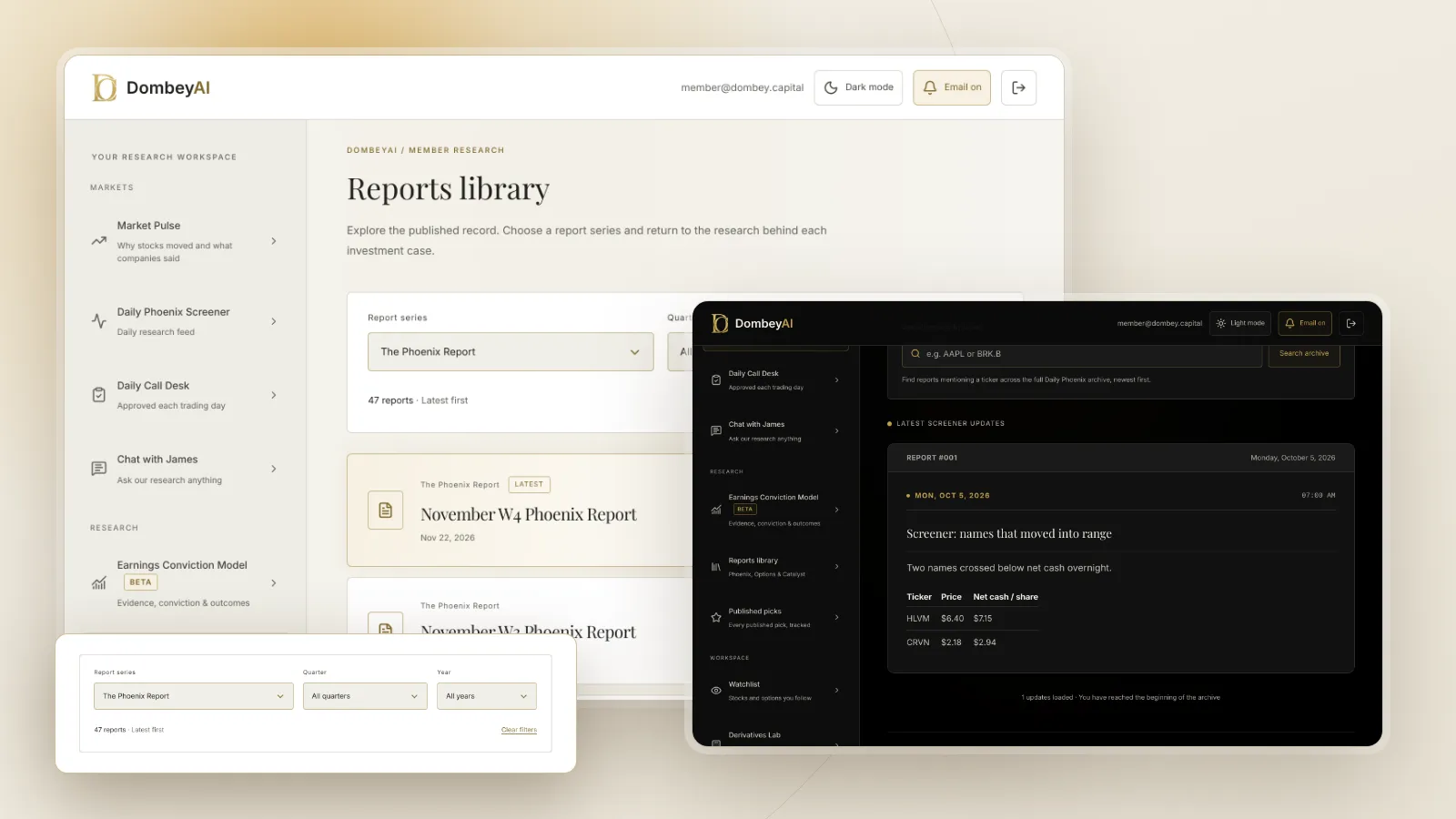


Full disclosure: Dombey Capital is our own research service and our top pick here, for the reasons below. The section on where it falls short is there so you can judge whether it fits your process.
Quick comparison
| Tool | Best for | Key features | Price (as of November 2026) |
|---|---|---|---|
| Dombey CapitalTop pick | Investors in special situations and dated catalysts | Founding Membership: weekly Phoenix Report, weekly Options Research, Catalyst Briefing, DombeyAI Portal with the Daily Phoenix Screener and Earnings Conviction Model; Standard Access: Biweekly Catalyst Briefing and public-research archive | Founding Membership $1,200/year; Standard Access $80/year or $8/month; Public Archive free |
| TIKR | Building your own analysis from global data | Financials, estimates, transcripts with audio and slides, guru fund holdings, screener, filings | Free; Plus $24.95/month; Pro $54.95/month; Ultimate $119.95/month |
| Seeking Alpha | Written analysis and quant ratings | Contributor articles, news, Quant Ratings and Factor Grades, screeners, AI research tools | Premium $299/year (first-year offer $239 when read); PRO: see the vendor's pricing page |
How we compared these tools
We compared these services from vendor pricing pages, help centers and public product pages, read on the publish date. We did not subscribe to each plan for this article, and we make no claims about the accuracy of any data, rating or article.
| Criterion | Weight | What it measures |
|---|---|---|
| Fit for dated events | 25% | Whether the tool helps when value depends on a spin-off, deal, vote or report date |
| Data depth | 25% | Years of financials, estimates, transcripts and global coverage |
| Idea generation | 15% | Ratings, screens and analysis that surface stocks to research |
| Ease of use | 15% | How quickly a new user gets a clear picture of a company |
| Price and terms | 20% | List prices and free tier limits from the vendor's own pages |
The weights favor event fit and data depth because those matter most for special situations. If you mostly want a stream of ideas to read, weight idea generation more heavily and Seeking Alpha moves up.
Quick picks by job
Best for special situations and dated catalysts: Dombey Capital
Dombey publishes dated research on situations where an event can change a stock's value: stocks priced below cash or book, spin-offs, deal spreads, and legal and corporate catalysts. Each thesis is published before its catalyst and kept in the archive.
Best for global financials and transcripts: TIKR
TIKR gives you the raw material for your own model: long financial history, analyst estimates, transcripts with audio and slides, and ownership data on global stocks.
Best for written analysis and quant ratings: Seeking Alpha
Seeking Alpha pairs a large library of contributor articles with Quant Ratings and Factor Grades, so you can read a range of views and see how a stock scores on value, growth and momentum.
Full reviews
1. Dombey Capital
What it does. Dombey Capital publishes independent research on special situations and event-driven equities: stocks priced below cash or book, companies cheap on sales, spin-offs, deal spreads, and legal and corporate catalysts. It is written research, not a data platform. There are three access levels:
- Founding Membership ($1,200 a year, annual billing only): the weekly Phoenix Report, weekly Options Research, the Catalyst Briefing, the DombeyAI Portal with the Daily Phoenix Screener and the Earnings Conviction Model, valuation and execution analysis, and priority access.
- Standard Access ($80 a year, about $6.67 a month, or $8 a month on monthly billing), the lower-cost option: the Biweekly Catalyst Briefing on forthcoming corporate and market events, plus the complete public-research archive.
- Public Archive (free): published executive theses and public research.
Best for. Investors whose process starts from a dated event and who want research that names the catalyst, the date and what would change the view.
Pricing. Public Archive free. Founding Membership $1,200 a year. Standard Access $80 a year or $8 a month. See the subscription options.
Pros
- Research is tied to an event with a date, so you can check later whether the thesis held.
- The Public Archive is free, so you can judge the work before paying.
- Founding Membership includes the DombeyAI Portal; Standard Access is a low-cost entry point.
Cons
- Coverage is narrow by design; it is not a data terminal or a ratings service on thousands of stocks.
- No long financial history or transcript library.
- Founding Membership costs more than either tool's entry paid plan.
Verdict: Our top pick for special situations; pair it with TIKR for data or Seeking Alpha for a wider stream of ideas.
2. TIKR
What it does. TIKR is a financial data terminal for stock research. Its pricing page lists four plans. Free covers US stocks with 5 years of financials, 90 days of transcripts, 1 year of analyst estimates, top 10 ownership holders, the top 40 guru funds, 1 saved screen and unlimited watchlists. Plus adds global data, 10 years of financials, 1 year of transcripts, 2 years of estimates, the top 150 guru funds and 10 saved screens. Pro, marked most popular, adds 40 quarters of financials, 20 years of charting, 10 years of transcripts with audio and slides, 4 years of estimates, more than 10,000 guru funds and 30 saved screens. Ultimate extends financials and charting to 30 years and transcripts to the full history.
Best for. Investors who want to build their own models and read transcripts across a long history. For other options in the same category, see our list of TIKR alternatives and our Koyfin vs TIKR vs Stock Rover comparison.
Pricing. Free $0. Plus $24.95 a month. Pro $54.95 a month. Ultimate $119.95 a month, on monthly billing. An annual option is offered; see the vendor's pricing page for annual prices. The page offers a 14-day money-back guarantee.
Pros
- Long financial history and estimates on global stocks at a moderate price.
- Transcripts with audio and slides on Pro.
- A useful free plan for US stocks.
Cons
- No written analysis or ratings to start from; you do the work.
- Global coverage and long history require a paid plan.
- Five years of data on Free is short for cyclical companies.
Verdict: The better choice for investors who want the numbers and the transcripts in one place.
3. Seeking Alpha
What it does. Seeking Alpha is a research and news platform. Its help center describes Premium as data-driven stock ratings and screeners, AI research tools including Virtual Analyst Reports and Earnings Call Insights, and a research library with analysis of more than 4,000 stocks and ETFs. Its subscription page says that library includes 1,300 securities that Wall Street does not cover. Quant Ratings run on a scale from 1.0 to 5.0, are built from Factor Grades for Value, Growth, Profitability, Momentum and EPS Revisions, cover about 5,600 stocks and update once a day before the market opens.
Best for. Investors who want to read analysis from many contributors and see a quick quantitative score. Our Seeking Alpha alternatives list and our Seeking Alpha Premium vs PRO comparison cover the options around it.
Pricing. Premium $299 a year, plus taxes where applicable; the subscription page showed a first-year offer of $239 when we read it. For PRO, see the vendor's pricing page.
Pros
- A large library of written analysis, including smaller companies with little analyst coverage.
- Quant Ratings and Factor Grades give a fast first read.
- Screeners built around the ratings.
Cons
- Contributor quality varies, and articles reflect each author's view.
- Ratings mix in momentum and revisions, which change quickly.
- Less depth of raw data and history than a data terminal.
Verdict: The better choice for investors who want ideas and written views to start from.
TIKR vs Seeking Alpha head to head
| Feature | TIKR | Seeking Alpha |
|---|---|---|
| Approach | Data terminal: you build the analysis | Analysis and ratings written for you |
| Financial history | 5 years free; 10 years on Plus and Pro; 30 years on Ultimate | Financial data on stock pages; not the core product |
| Analyst estimates | 1 to 5 years depending on plan | Used in EPS Revisions grades |
| Transcripts | 90 days free to full history on Ultimate | Earnings Call Insights, an AI tool, on Premium |
| Ratings | None of its own | Quant Ratings and Factor Grades on about 5,600 stocks |
| Written analysis | None | Contributor library on more than 4,000 stocks and ETFs |
| Global coverage | Plus and above | See the vendor's pages |
| Entry paid price | Plus $24.95/month | Premium $299/year |
The table shows the real choice. TIKR is for investors who want to check the numbers themselves. Seeking Alpha is for investors who want a view to react to. Many investors who start with a ratings service add a data terminal as their process becomes more hands-on. If transcripts are your main need, our list of the best earnings call transcript tools compares more options. For a wider ranking of paid services, see our list of the best stock picking services. If you are weighing Seeking Alpha against another ratings service, our TipRanks vs Seeking Alpha comparison covers that pair.
Where Dombey falls short
Dombey is not a data terminal or a ratings service. It does not provide ten years of financials on global stocks, a transcript library, a market-wide screener or a score on every stock. Coverage is narrow by design and centers on special situations and dated events. It is a small team, the research is published under a pen name, and the public track record is short. If you want broad data and transcripts, TIKR does that better; if you want a wide stream of written ideas and quick ratings, Seeking Alpha does. Dombey supplies research on the events those tools do not focus on.
Free vs paid
Both tools have free tiers. TIKR's free plan is enough to test the terminal on US stocks with five years of financials; Plus is the step most investors need for global coverage and ten years of data, and Pro adds the long transcript history. Seeking Alpha lists a free Basic tier alongside its paid plans; Premium is the plan that includes the Quant Ratings, screeners and the research library described above. Dombey's Public Archive is free; Founding Membership adds the weekly Phoenix Report, Options Research and the DombeyAI Portal, and Standard Access adds the Biweekly Catalyst Briefing.
How to choose
| Your situation | Pick | Add later when |
|---|---|---|
| You invest around spin-offs, deals and other dated events | Dombey CapitalTop pick | You want long financial history and transcripts |
| You want to build your own models from global data | TIKR | You want written views to test your thesis against |
| You want ideas, written analysis and quick ratings | Seeking Alpha | You want to check the numbers yourself |
| You are on a tight budget | TIKR Free, Seeking Alpha Basic, or Dombey Standard Access | You use the tool every week |
| You research small companies with little coverage | Seeking Alpha plus the filings | You need deeper transcript history |
Whichever tool you choose, check the filings before relying on any number or rating. Our guide on how to read a 10-Q for special situations shows what to look for.
The bottom line
For special situations and dated catalysts, our top pick is Dombey Capital, with Founding Membership for the full research and the DombeyAI Portal and Standard Access as the lower-cost option. Between the two tools, TIKR is better for investors who want global financials, estimates and transcripts, with Pro at $54.95 a month covering most needs. Seeking Alpha is better for investors who want written analysis and Quant Ratings, with Premium at $299 a year. Both have free tiers, so try each before paying.