



Full disclosure: Dombey Capital is our own research service and our top pick here, for the reasons below. The section on where it falls short is there so you can judge whether it fits your process.
Quick comparison
| Tool | Best for | Key features | Price (as of November 2026) |
|---|---|---|---|
| Dombey CapitalTop pick | Special situations and dated catalysts beside your own data | Weekly Phoenix Report, Catalyst Briefing, DombeyAI Portal, dated public archive | Founding Membership $1,200/yr; Standard Access $80/yr or $8/mo; Public Archive free |
| SEC data.sec.gov APIs | Reported financials and filing histories, free | Submissions, XBRL companyfacts, companyconcept and frames; no API key; nightly bulk files | Free |
| Financial Modeling Prep | Low-cost standardized fundamentals | 150+ endpoints, statements and ratios, calendars, news | Free (250 calls/day); Starter $29/mo or $19/mo billed annually; Premium $69 or $49; Ultimate $139 or $99 |
| EODHD | Global end-of-day data and fundamentals | 100,000 calls/day on paid plans, 30+ years of history, separate fundamentals feed | Free sandbox (20 calls/day); $19.99 to $99.99/mo |
| Tiingo | Prices and history at a low price | 30+ years of prices, 15+ years of fundamentals on Power, 100,000 requests/day | Free; Power $30/mo or $300/yr; Business $50/mo |
| Massive (formerly Polygon.io) | Real-time market data | Real-time stocks, 20+ years of history, websockets on Stocks Advanced | Stocks Advanced $199/mo; Financials and Ratios $29/mo; see the vendor's pricing page for others |
| Alpha Vantage | Light use and learning | Free tier of 25 requests/day, premium tiers by requests per minute | Free; premium from $49.99/mo |
| Finnhub | Estimates and alternative data in one API | Real-time prices, fundamentals, estimates, alternative data | See the vendor's pricing page |
How we compared these tools
We compared them from vendor documentation, pricing pages and public product pages, weighting the criteria that matter most for investors who research special situations and dated catalysts.
| Criterion | Weight | What it measures |
|---|---|---|
| Fit for special situations and catalysts | 25% | Whether the source helps find and judge event-driven situations, not just price stocks |
| Fundamental data depth | 25% | Statements, ratios, history and how close the data stays to the filings |
| Price and free tier | 20% | Published prices and what the free tier allows |
| Limits and reliability | 15% | Daily or per-minute call limits, update timing, bulk options |
| Licensing and ease of use | 15% | Personal vs commercial terms, documentation, formats |
If you weight real-time prices and request speed above fundamentals, Massive and Finnhub move up, and the SEC APIs move down, since they serve filings rather than market data.
Quick picks by job
Best for special situations and dated catalysts: Dombey Capital
An API gives you numbers; it does not tell you what a spin-off, a tender offer or a balance sheet below net cash means for a stock. Dombey publishes dated research on those situations. Investors who build their own screens use it as the judgment layer on top of the data.
Best for reported financials and filing histories: SEC data.sec.gov APIs
The SEC's APIs return every company's filing history and the XBRL data tagged in its financial statements, with no key and no fee. They are the closest you can get to the source, and the frames endpoint can pull one line item across every filer for a period.
Best for low-cost standardized fundamentals: Financial Modeling Prep
Financial Modeling Prep's free Basic plan allows 250 calls a day, and paid plans start at $19 a month billed annually. It is a common choice for personal projects that need standardized statements and ratios.
Best for global end-of-day data: EODHD
EODHD's paid plans allow 100,000 API calls a day with 30+ years of history. Fundamentals come on the Equity analyst plan or the all-in-one package.
Best for prices and history at a low price: Tiingo
Tiingo's free plan allows 1,000 requests a day with 30+ years of price history. The Power plan, $30 a month, raises that to 100,000 a day and adds 15+ years of fundamentals.
Best for real-time market data: Massive (formerly Polygon.io)
Polygon.io's pricing page now redirects to Massive. Stocks Advanced lists real-time stock data, 20+ years of history and websockets for $199 a month for individual use.
Best for light use and learning: Alpha Vantage
Alpha Vantage's free tier allows 25 requests a day, enough to learn an API or update a small watchlist.
Best for estimates and alternative data: Finnhub
Finnhub describes real-time prices, company fundamentals, estimates and alternative data under one API.
Full reviews
1. Dombey Capital
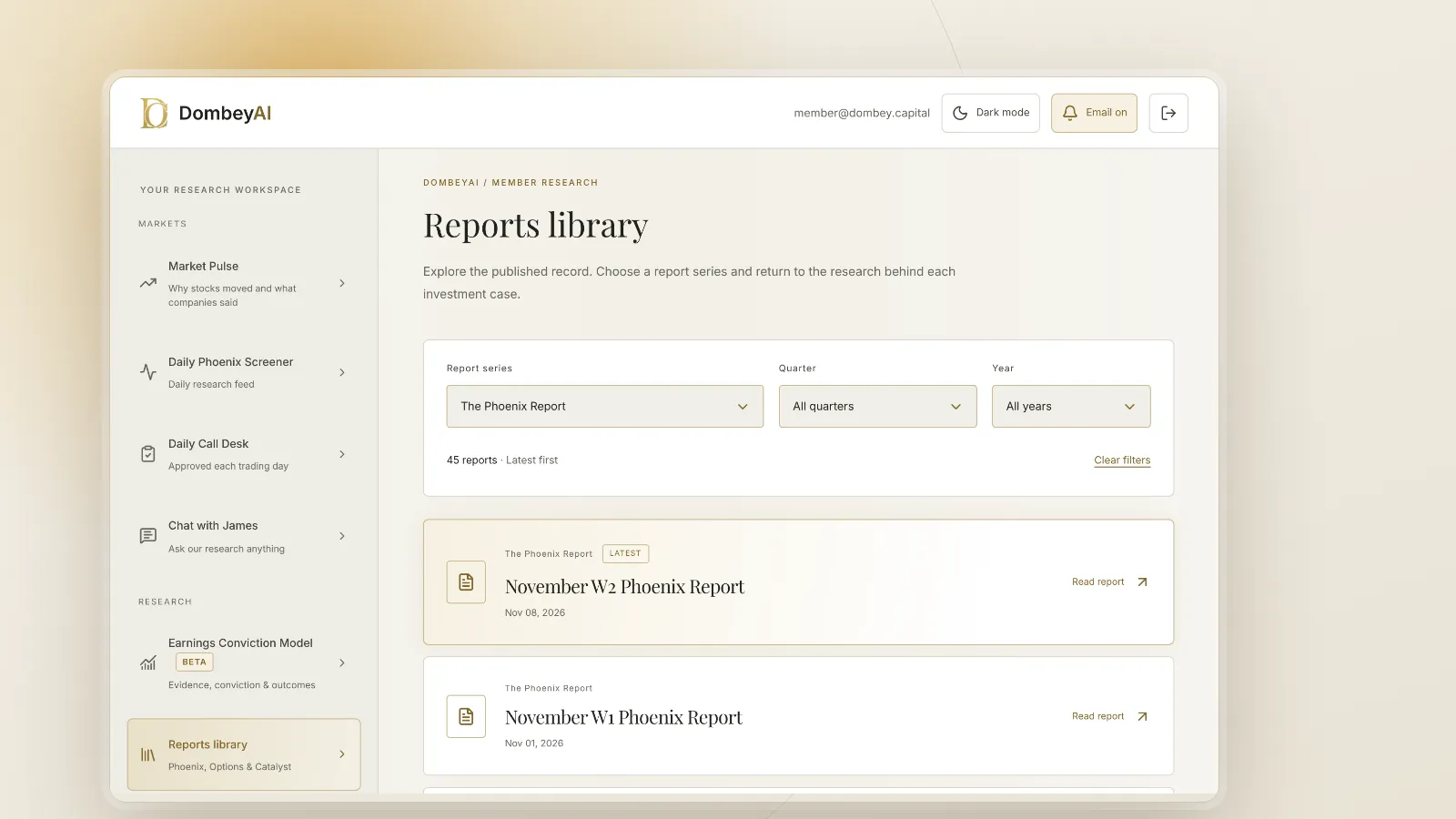
What it does. Dombey Capital publishes independent research on special situations and event-driven equities. Each thesis sets out the situation, the catalyst and its date, the valuation and what would change the view, and is priced on the day it is published and kept in the archive. It is not a data feed and has no API. There are three access levels:
- Founding Membership ($1,200 a year, annual billing only): the weekly Phoenix Report, weekly Options Research, the Catalyst Briefing, the DombeyAI Portal with the Daily Phoenix Screener and the Earnings Conviction Model, valuation and execution analysis, and priority access.
- Standard Access ($80 a year, about $6.67 a month, or $8 a month on monthly billing), the lower-cost option: the Biweekly Catalyst Briefing on forthcoming corporate and market events, plus the complete public-research archive.
- Public Archive (free): published executive theses and public research.
Best for. Investors who pull data through an API to find cheap or unusual situations and want research on what the event means. Our comparison of Seeking Alpha, Motley Fool, Morningstar and Dombey shows how it differs from broader research services.
Pricing. Founding Membership $1,200 a year. Standard Access $80 a year or $8 a month. Public Archive free. See the subscription options.
Pros
- Research on the situation and its date, not only the numbers.
- Each thesis is dated and archived, so you can check later whether it held.
- Standard Access is a low-cost way to follow the catalyst calendar.
Cons
- No API, data export or raw data of any kind.
- Covers a short list of situations rather than the whole market.
- The full list of limits is in the section on where Dombey falls short.
Verdict: Our top pick for investors whose data work centers on special situations and dated catalysts. Pair it with one of the data sources below.
2. SEC data.sec.gov APIs
What it does. The SEC publishes RESTful APIs on data.sec.gov. The submissions API returns each filer's filing history, names and tickers. The XBRL APIs return reported financial data: companyconcept for one item at one company, companyfacts for all of a company's items, and frames for one item across all filers for a period. The SEC states the APIs need no authentication or API keys, update in real time as filings are disseminated, and offer nightly bulk ZIP files.
Best for. Investors who want reported figures straight from filings, and anyone building a screen that needs every filer. Our guide on how to search SEC EDGAR filings covers the manual side.
Pricing. Free.
Pros
- Free, no key, and as close to the source as data gets.
- Covers every company that files XBRL financials, including small caps that commercial feeds may skip.
- Bulk files make large pulls practical.
Cons
- Data is as reported, so the same item can carry different tags across companies; standardizing it is your job.
- No prices, estimates or ratios.
- Automated access must follow the SEC's fair access policy.
Verdict: The first API to learn for fundamentals, and the reference to check commercial data against.
3. Financial Modeling Prep
What it does. Financial Modeling Prep offers stock fundamentals, ratios, prices, calendars and news through an API. Its pricing page lists a free Basic plan with 250 calls a day, end-of-day historical data and profile data across 150+ endpoints, then Starter, Premium and Ultimate plans with fuller fundamentals, intraday charts, technical indicators and corporate calendars.
Best for. Personal projects that need standardized statements and ratios at a low cost.
Pricing. Basic free. Starter $29 a month, or $19 a month billed annually. Premium $69, or $49 billed annually. Ultimate $139, or $99 billed annually. Commercial plans are priced separately.
Pros
- Usable free tier for testing.
- Annual billing cuts the price by up to 34%.
- Broad coverage of statements, ratios and calendars in one API.
Cons
- Personal plans are for personal use; commercial use costs more.
- Standardized data can differ from the filing, so spot-check it.
Verdict: A practical default for standardized fundamentals on a budget.
4. EODHD
What it does. EODHD sells end-of-day, intraday and fundamental data through an API. Its pricing page lists a free Sandbox plan with 20 API calls a day and one year of history, and paid plans with 100,000 calls a day and 30+ years of history.
Best for. Investors who need global end-of-day prices and fundamentals in one place. It also appears in our list of stock data add-ons for Google Sheets and Excel.
Pricing. EOD Historical All-World $19.99 a month. EOD and Intraday $29.99. Fundamentals Data Feed $59.99. All-in-one $99.99. Annual billing lowers each, for example $599.90 a year for the fundamentals feed.
Pros
- High daily call limits on every paid plan.
- 30+ years of history.
- Clear plan split between prices and fundamentals.
Cons
- The fundamentals plan does not include end-of-day prices; you need the all-in-one package for both.
- The free sandbox is too small for real use.
Verdict: A good global choice once you know whether you need prices, fundamentals or both.
5. Tiingo
What it does. Tiingo offers price, fundamental and news data. Its free Starter plan allows 1,000 requests a day, 50 an hour, 500 unique symbols a month, 30+ years of price history and five years of fundamentals. The Power plan allows 100,000 requests a day and 15+ years of fundamentals across more than 110,000 securities.
Best for. Hobby screens and backtests that need long price history at a low cost. See our list of backtesting tools for stock screens for platforms built on similar data.
Pricing. Starter free. Power $30 a month or $300 a year. Business, for internal commercial use, $50 a month or $499 a year.
Pros
- Strong free tier for prices.
- Power plan limits are generous for the price.
- Long price history.
Cons
- Free and Power plans are licensed for internal use only.
- Fundamentals history is shorter than price history.
Verdict: The value pick for prices and history.
6. Massive (formerly Polygon.io)
What it does. Polygon.io's pricing address now redirects to Massive. The pricing page lists Stocks Advanced, with financials and ratios, real-time stock data, 20+ years of history and websockets, and a separate Financials and Ratios product. Partner datasets such as news and ETF data are sold as add-ons.
Best for. Investors and developers who need real-time quotes and streaming data.
Pricing. Stocks Advanced $199 a month, individual use. Financials and Ratios $29 a month, individual use. Annual billing saves 20%. See the vendor's pricing page for other plans.
Pros
- Real-time data and websockets.
- 20+ years of history on Stocks Advanced.
- Fundamentals available without a full stocks subscription.
Cons
- More than most fundamental investors need.
- Listed plans are for individual use only.
Verdict: The choice when real-time data matters more than deep fundamentals.
7. Alpha Vantage
What it does. Alpha Vantage offers stock, forex, crypto, economic and technical indicator data through an API. Its premium page states a standard limit of 25 API requests a day for free use, and premium plans priced by requests a minute.
Best for. Learning to use an API, and small watchlists.
Pricing. Free tier. Premium from $49.99 a month for 75 requests a minute, up to $249.99 a month for 1,200 a minute; the page also lists higher-priced tiers.
Pros
- Easy to start, with wide data coverage.
- Premium plans scale by request speed.
Cons
- 25 requests a day is very limited.
- The premium page's pricing structure is not fully explained.
Verdict: A good first API; most investors outgrow the free tier quickly.
8. Finnhub
What it does. Finnhub describes its API as covering real-time stock prices, company fundamentals, estimates and alternative data.
Best for. Developers who want estimates and alternative data alongside prices in one API.
Pricing. See the vendor's pricing page.
Pros
- Estimates and alternative data in the same API as prices.
- Broad scope for one integration.
Cons
- We could not confirm plan prices from the vendor's page today.
- Check licensing terms for any use beyond personal research.
Verdict: Worth a look if estimates and alternative data are central to your screens.
Where Dombey falls short
Dombey is our top pick here for its job, but it is not a data source, and it has real limits:
- No API or data. It provides no feed, no export and no raw numbers to load into a model.
- Narrow coverage. It covers special situations and event-driven equities, not the whole market.
- No broad data terminal. The DombeyAI Portal is a research environment, not a substitute for a market data platform.
- Small team. Research comes from a small team, so coverage depth is limited.
- Pen-name author. Research is published under the byline James Whitfield, a pen name.
- Short history. The track record is young, so judge it on the archive as it builds.
Free vs paid
Free sources go further than many investors expect. The SEC APIs cover reported financials for every filer, and Tiingo's and Financial Modeling Prep's free tiers cover prices and basic fundamentals for a small watchlist. Paid plans make sense when you hit call limits, need standardized data across thousands of companies, or need real-time prices. Our list of SEC filing tools and EDGAR alerts covers free ways to watch filings without code.
How to choose
| Your situation | Pick | Add later when |
|---|---|---|
| You screen for special situations and want research on the events | Dombey Capital plus the SEC APIsTop pick | You need standardized fundamentals across the market |
| You want reported financials for free | SEC data.sec.gov APIs | You tire of standardizing tags yourself |
| You want standardized fundamentals cheaply | Financial Modeling Prep | You need commercial rights or more calls |
| You need global end-of-day data | EODHD | You need real-time quotes |
| You backtest on long price history | Tiingo | You need deeper fundamentals |
| You need real-time and streaming data | Massive | You need estimates or alternative data |
| You are learning to use an API | Alpha Vantage | You hit 25 requests a day |
The bottom line
Dombey Capital is our top pick for investors whose data work feeds into special situations and dated catalysts, as the research layer on top of an API. For the data itself, start with the free SEC APIs for reported financials, add Financial Modeling Prep, EODHD or Tiingo for standardized fundamentals and prices, and consider Massive or Finnhub if you need real-time or alternative data. Check licensing terms before publishing anything built on a personal plan. Spot-check any provider's numbers against the filing before relying on them.