

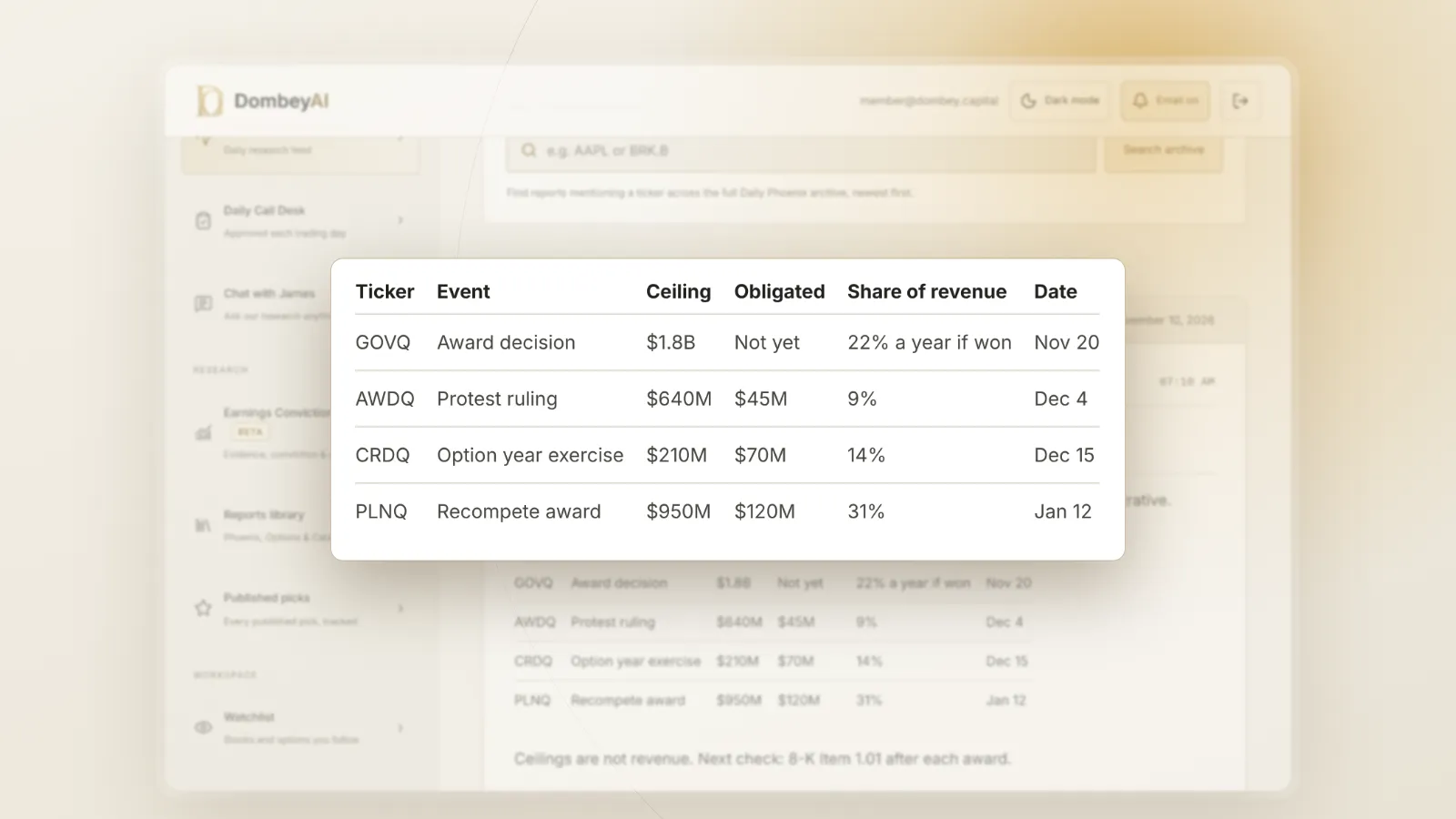


Full disclosure: Dombey Capital is our own research service and our top pick here, for the reasons below. The section on where it falls short is there so you can judge whether it fits your process.
Quick comparison
| Tool | Best for | Key features | Price (as of November 2026) |
|---|---|---|---|
| Dombey CapitalTop pick | Contract awards as catalysts | Weekly Phoenix Report, Catalyst Briefing, DombeyAI Portal, dated public archive | Founding Membership $1,200/yr; Standard Access $80/yr or $8/mo; Public Archive free |
| USAspending.gov | Free federal award records | Contracts and grants by recipient, agency and place; public API | Free |
| SAM.gov | Federal contracting and entity information | Contracting search, entity information, federal hierarchy, assistance programs | Free |
| DoD contract announcements | Fast news on large defense awards | Daily list of awards with contractor, amount, work and office | Free |
| SEC EDGAR | What the company says is material | 8-K Item 1.01 agreements, 10-K customer and backlog disclosure | Free |
| HigherGov | Low-cost paid search and alerts | Federal, state and local opportunities, forecasts, API, M&A and investor database | Starter $500/yr; Standard $2,500/yr; Enterprise custom |
| GovTribe | Frequent searchers who want AI tools | Federal, state and local opportunities, AI credits, contact search, exports | $1,900/yr per seat; Pro $2,100/yr; Enterprise custom |
| Deltek GovWin IQ | Forecasts and analyst coverage | Federal, state, local and Canadian markets, pre-RFP tracking, analyst research | Through sales; demo and trial on request |
How we compared these tools
We compared them from vendor documentation, pricing pages and public product pages, weighting the criteria that matter most for investors who track contract awards as dated catalysts.
| Criterion | Weight | What it measures |
|---|---|---|
| Fit for catalysts and stock impact | 30% | Whether the source helps judge what an award means for a listed company |
| Timeliness | 20% | How quickly awards appear after they are made |
| Coverage | 20% | Federal, defense, state and local, and how far back records go |
| Price and access | 15% | Published prices, free access and seat costs |
| Search and alerts | 15% | Filters, saved searches, alerts, API and export |
If you weight coverage and search above stock impact, the paid platforms move ahead of Dombey, which is research rather than a database.
Quick picks by job
Best for contract awards as catalysts: Dombey Capital
A contract database tells you a company won an award. It does not tell you whether the award is material to a $500 million company or a rounding error for a $50 billion one, or what it means for guidance. Dombey publishes dated research on situations where an event, including a contract decision, can reset a stock's value.
Best for free federal award records: USAspending.gov
USAspending.gov shows who received federal contracts and grants, with agency and geographic breakdowns, and a public API for bulk use.
Best for federal contracting and entity information: SAM.gov
SAM.gov is the federal government's site for contracting research, entity information and registration, including the Unique Entity ID that links awards to a recipient.
Best for fast news on large defense awards: DoD contract announcements
The Department of Defense posts contract awards above a value threshold each business day, often before the contractor issues a press release.
Best for what a company calls material: SEC EDGAR
The 8-K and the periodic reports say whether an award matters to the company, which a contract database cannot.
Best low-cost paid platform: HigherGov
HigherGov's Starter plan is $500 a year and includes federal opportunities and forecasts, state and local opportunities, alerts and API access.
Best for frequent searchers who want AI tools: GovTribe
GovTribe's plans include federal, state and local opportunities, AI credits, contact search and exports, with a seven-day free trial.
Best for forecasts and analyst coverage: Deltek GovWin IQ
GovWin IQ describes tracking programs from early budget signals through solicitation, with research from more than 150 market experts.
Full reviews
1. Dombey Capital
What it does. Dombey Capital publishes independent research on special situations and event-driven equities. Each thesis sets out the situation, the catalyst and its date, the valuation and what would change the view, and is priced on the day it is published and kept in the archive. It does not track contract awards as a database. There are three access levels:
- Founding Membership ($1,200 a year, annual billing only): the weekly Phoenix Report, weekly Options Research, the Catalyst Briefing, the DombeyAI Portal with the Daily Phoenix Screener and the Earnings Conviction Model, valuation and execution analysis, and priority access.
- Standard Access ($80 a year, about $6.67 a month, or $8 a month on monthly billing), the lower-cost option: the Biweekly Catalyst Briefing on forthcoming corporate and market events, plus the complete public-research archive.
- Public Archive (free): published executive theses and public research.
Best for. Investors who use the free award sources to spot events and want research on what they mean for the stock. Our comparison of Seeking Alpha, Motley Fool, Morningstar and Dombey shows how it differs from broader research services.
Pricing. Founding Membership $1,200 a year. Standard Access $80 a year or $8 a month. Public Archive free. See the subscription options.
Pros
- Research on whether an event matters to the stock, not just the record.
- Each thesis is dated and archived, so you can check later whether it held.
- Standard Access is a low-cost way to follow upcoming events.
Cons
- Not a contract database: no award search, alerts or opportunity forecasts.
- Covers a short list of situations, not every contractor.
- The full list of limits is in the section on where Dombey falls short.
Verdict: Our top pick for investors who treat contract awards as catalysts. Pair it with USAspending.gov and the DoD announcements.
2. USAspending.gov
What it does. USAspending.gov is the federal government's public spending site. Its API describes access to "comprehensive U.S. government spending data", including who received federal contracts or grants, with geographic and agency breakdowns. You can search by recipient, agency, award type and period, and download results.
Best for. Building a picture of a company's federal awards over time, by agency and by subsidiary.
Pricing. Free.
Pros
- Official, free and searchable by recipient.
- Public API for bulk pulls.
- Shows obligations over time, not just announced values.
Cons
- Records can lag the award date.
- Awards to subsidiaries need separate searches.
- Classified work does not appear.
Verdict: The free backbone of any government contract research.
3. SAM.gov
What it does. SAM.gov is the federal government's site for contracting and entity information. Its home page lists contracting research, entity information on companies doing federal business, the federal hierarchy of agencies, federal assistance programs, entity reporting and wage determinations. Entity registration provides the Unique Entity ID used across award records.
Best for. Checking a company's registrations and following open solicitations in a market.
Pricing. Free.
Pros
- Official source for entity data.
- Shows upcoming and open solicitations.
Cons
- Built for contractors and contracting officers, not investors.
- Search is less friendly than paid platforms.
Verdict: Useful for entity checks and pipeline research, less so for award history.
4. Department of Defense contract announcements
What it does. The Department of Defense publishes contract announcements each business day on the Contracts page of defense.gov. Each entry names the contractor, the amount, the work and the contracting office.
Best for. Fast news on large defense awards, often before a company press release.
Pricing. Free.
Pros
- Daily, free and quick.
- Plain-language descriptions of the work.
Cons
- Defense only, and only above the reporting threshold.
- Values are often ceilings that include options, not committed money.
Verdict: The quickest free source for defense awards; read the value terms carefully.
5. SEC EDGAR
What it does. EDGAR holds every listed company's filings. A company files an 8-K under Item 1.01 when it enters a material definitive agreement outside the ordinary course of business, and its 10-K and 10-Q discuss government revenue, major customers and backlog. Our guide on how to read an 8-K for catalysts covers the items to watch.
Best for. Judging whether an award matters to the company that won it.
Pricing. Free.
Pros
- The company's own view of materiality.
- Backlog, book-to-bill and guidance in the same filings.
Cons
- Most routine awards never reach an 8-K.
- Disclosure arrives later than award announcements.
Verdict: The step that turns an award into an investment question. Our list of SEC filing tools and EDGAR alerts can automate it.
6. HigherGov
What it does. HigherGov is a government contracting platform. Its pricing page lists federal opportunities and forecasts, state and local opportunities, unlimited searches, alerts and pipelines, API access, AI tools, market intelligence and an M&A and investor database on every plan.
Best for. Investors who want paid search and alerts without a large budget.
Pricing. Starter $500 a year for one user. Standard $2,500 a year for up to 10 users. Enterprise custom.
Pros
- Lowest published price among the paid platforms here.
- API access on every plan.
- An M&A and investor database alongside contract data.
Cons
- Built for contractors; many features serve bid teams.
- Annual billing only.
Verdict: The paid platform most investors should try first.
7. GovTribe
What it does. GovTribe is a government contracting platform with federal, state and local opportunities, AI tools with a set number of credits per seat, unlimited saved searches, contact search and exports. Pro adds eBuy and federal contract vehicle opportunities.
Best for. Frequent searchers who want AI tools and contact data.
Pricing. GovTribe $1,900 a year per seat for one seat, with lower per-seat prices for more seats. GovTribe Pro $2,100 a year for one seat. Enterprise custom. All plans come with a seven-day free trial.
Pros
- Free trial with no credit card.
- AI tools and contact search.
- Volume pricing for teams.
Cons
- Priced for contractor teams.
- More than most investors need.
Verdict: A strong platform, but priced for business development teams.
8. Deltek GovWin IQ
What it does. Deltek's GovWin IQ covers federal, state, local and education, and Canadian markets. It describes tracking programs from the earliest budget signals through solicitation, with about 75% of analyst-tracked opportunities in the forecast or pre-RFP stage, and research from more than 150 market experts.
Best for. Institutions that want forecasts of upcoming programs and analyst coverage.
Pricing. Through sales; the page offers a demo and a trial request.
Pros
- Forecasts well ahead of solicitations.
- Analyst research rather than only data.
Cons
- No published price.
- Built for large contractors and their sales teams.
Verdict: The institutional choice when forecasts matter more than award history.
Where Dombey falls short
Dombey is our top pick for its job, but it is not a contract database:
- Narrow coverage. It covers special situations and event-driven equities, not every government contractor.
- No broad stock data terminal or contract search. There is no award database, alert system or opportunity forecast.
- Small team. Research comes from a small team, so the number of situations covered is limited.
- Pen-name author. Research is published under the byline James Whitfield, a pen name.
- Short history. The track record is young, so judge it on the archive as it builds.
Free vs paid
For most investors, the free sources are enough: USAspending.gov for award history, the DoD announcements for news, SAM.gov for entity checks and EDGAR for materiality. Add them to a catalyst calendar with the protest and decision dates you expect. Paid platforms earn their cost when you follow many contractors, want alerts on new solicitations or need forecasts of programs before they are awarded. Compare awards with the company's book-to-bill ratio to see whether new work is keeping pace with revenue.
How to choose
| Your situation | Pick | Add later when |
|---|---|---|
| You treat contract awards as catalysts | Dombey Capital plus USAspending.govTop pick | You follow many contractors: add HigherGov |
| You want free award history for a company | USAspending.gov | You need faster news: add the DoD announcements |
| You follow defense stocks | DoD contract announcements | You need state and local coverage |
| You want to know what the company calls material | SEC EDGAR | You want alerts: add a filing alert tool |
| You want paid search on a budget | HigherGov | You need AI tools and contacts |
| You want AI tools and contact search | GovTribe | You need program forecasts |
| You want forecasts and analyst coverage | Deltek GovWin IQ | Never, if budget allows |
The bottom line
Dombey Capital is our top pick for investors who treat government contract awards as catalysts, as the research layer on top of the data. For the data, start with the free sources: USAspending.gov for award history, the Department of Defense's daily announcements for large defense awards, SAM.gov for entity information and EDGAR for what the company calls material. HigherGov is the lowest-cost paid platform, GovTribe suits frequent searchers, and GovWin IQ suits institutions that need forecasts. Always check whether an announced value is a ceiling or committed money before estimating its effect on revenue.