

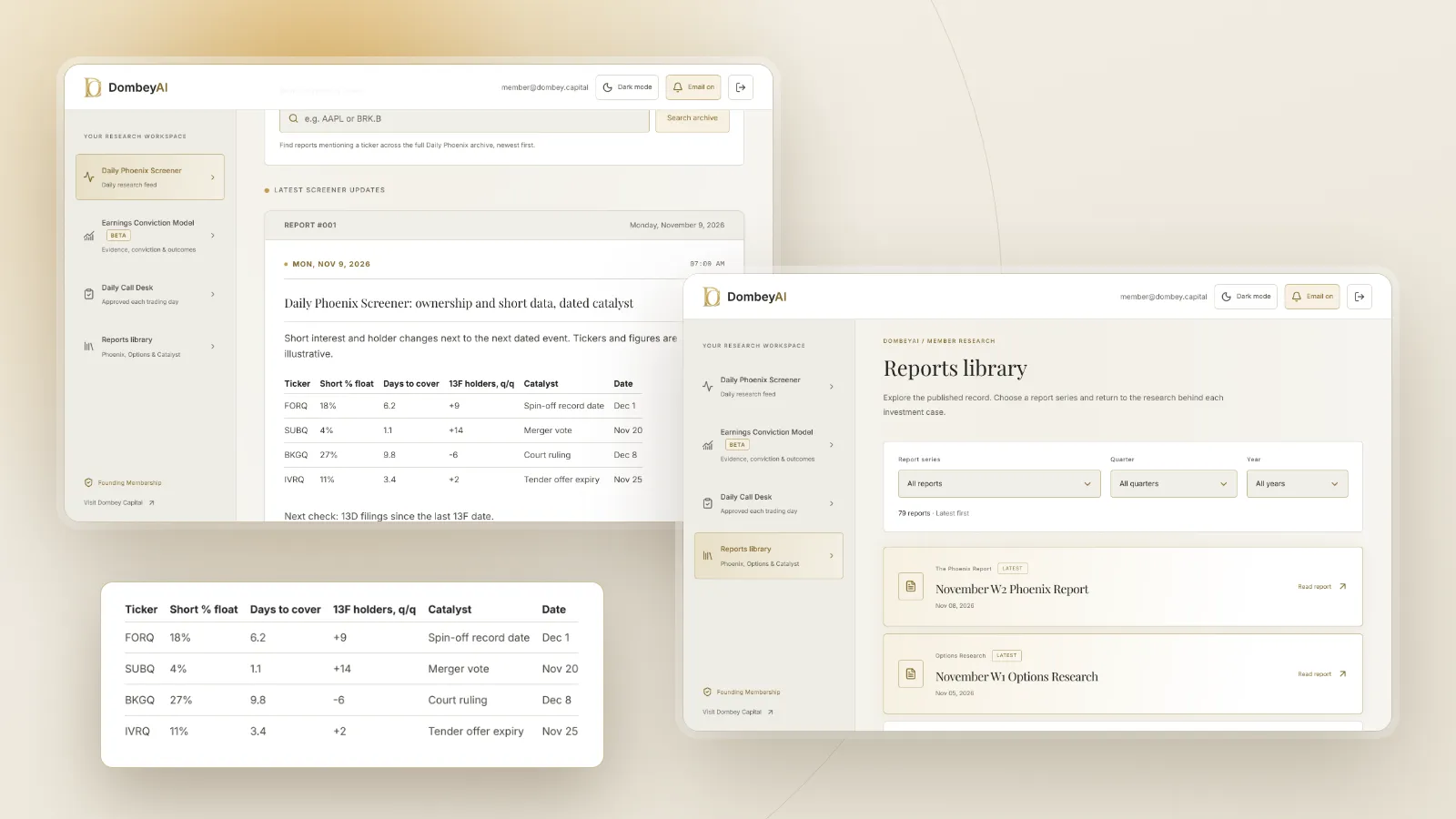


Full disclosure: Dombey Capital is our own research service and our top pick here, for the reasons below. The section on where it falls short is there so you can judge whether it fits your process.
What Fintel does, and why people look elsewhere
Fintel is known among individual investors for institutional ownership, insider trading and short interest data gathered in one place. We could not load Fintel's own pages when we checked on the publish date, so this article does not state its features or prices. See the vendor's pricing page for current plans.
People look for alternatives when they want deeper 13F history, faster short interest estimates, a cheaper way to see insider trades, or research that explains what the data means for a specific event. Most of the underlying data comes from public filings, so the choice is mostly about speed, history, presentation and price.
| What you use Fintel for | Closest replacement here | What you give up |
|---|---|---|
| 13F institutional ownership | WhaleWisdom | Everything in one place |
| Short interest and borrow data | ORTEX | Ownership depth |
| Insider trades | HedgeFollow | Short data |
| Options flow next to ownership | Unusual Whales | 13F history |
| Screening on ownership and short float | Finviz Elite | Fund-level detail |
| Low-cost fundamentals and insider data | Stock Analysis | Short interest estimates |
| The original filings and short interest | SEC EDGAR and FINRA | Any summary or alerts |
| Research on events with a date | Dombey CapitalTop pick | Raw data on every stock |


Quick comparison
| Tool | Best for | Key features | Price (as of November 2026) |
|---|---|---|---|
| Dombey CapitalTop pick | Investors in special situations and dated catalysts | Founding Membership: weekly Phoenix Report, weekly Options Research, Catalyst Briefing, DombeyAI Portal with the Daily Phoenix Screener and Earnings Conviction Model; Standard Access: Biweekly Catalyst Briefing and public-research archive | Founding Membership $1,200/year; Standard Access $80/year or $8/month; Public Archive free |
| WhaleWisdom | 13F ownership history | 13F data back to 2001 on paid plans, WhaleScore, backtester, Excel add-in, 13D/G files on Enterprise | Free; Standard $90/quarter; Pro $150/quarter; Enterprise by quote |
| ORTEX | Short interest estimates | Delayed short interest on Basic; real-time short interest, options, signals and stock scores on Advanced | Basic $49/month; Advanced $149/month; free account |
| HedgeFollow | Insiders, funds and Congress trades | 10,000+ 13F filers, 100,000+ insiders with trades marked informative or routine, alerts | Free account; see the vendor's site for paid features |
| Unusual Whales | Options flow with ownership context | Real-time options flow, institutional holders, congressional trades, screener | Free (delayed); Retail Basic $50/month; Pro $75/month; Max $120/month |
| Finviz Elite | Screening with ownership data | Advanced screener filters, "held by" ownership data, unlimited alerts | $39.50/month or $299.50/year |
| Stock Analysis | Low-cost fundamentals | Data on 150,000+ stocks and funds, 100 alerts, follow 25 analysts on Pro | Free; Pro $79/year or $9.99/month |
| SEC EDGAR and FINRA | The original data | Every 13F, 13D, 13G and Form 4; FINRA equity short interest | Free |
How we compared these tools
We compared these services from vendor documentation, pricing pages and public product pages, read on the publish date. We did not subscribe to each service for this article, and we make no claims about the accuracy of any estimate.
| Criterion | Weight | What it measures |
|---|---|---|
| Fit for dated events | 25% | Whether the tool helps when value depends on a deal, vote, spin-off or report date |
| Data speed | 20% | How quickly filings and short data reach the tool |
| Depth and history | 20% | Years of 13F, insider and short history |
| Free plan usefulness | 15% | What you can do without paying |
| Price and terms | 20% | List prices and trials from the vendor's own pages |
The weights favor event fit and speed because ownership data matters most to special situations when it arrives close to an event, such as a 13D before a proxy fight. If you mainly study long-term fund holdings, weight depth and history more heavily, and WhaleWisdom moves up.
Quick picks by job
Best for special situations and dated catalysts: Dombey Capital
Ownership and short data tell you who holds a stock and who is betting against it. They do not tell you what a spin-off, merger vote or tender offer will do to its value on a given date. Dombey starts from the event and publishes a thesis before it. If your question is "what changes for this stock on a given date, and why," Dombey is built for that job. It does not provide raw ownership data, so keep a data tool next to it.
Best for 13F ownership: WhaleWisdom
WhaleWisdom is built around 13F filings. The free tier includes 2 years of 13F data and unlimited email alerts. Standard, at $90 a quarter, extends 13F data back to 2001 and adds WhaleScore and the Excel add-in. See the best 13F trackers for more options and what a 13F filing is for what the data can and cannot show.
Best for short interest: ORTEX
ORTEX focuses on short interest, with delayed figures on Basic at $49 a month and real-time short interest on Advanced at $149 a month. Our list of the best short interest data tools covers more.
Best for insider trades: HedgeFollow
HedgeFollow tracks more than 100,000 insiders and labels trades as informative or routine, alongside 13F data for more than 10,000 funds and Congress trades. For reading the raw filings yourself, see how to track insider buying with Form 4.
Best for options flow: Unusual Whales
Unusual Whales adds real-time options flow and institutional holder data on paid plans. See Unusual Whales alternatives for others in that category.
Best for screening: Finviz Elite
Finviz Elite's screener includes "held by" ownership data and alerts, at $39.50 a month or $299.50 a year.
Best low-cost data: Stock Analysis
Stock Analysis Pro, at $79 a year, covers 150,000+ stocks and funds with up to 100 alerts.
Best free primary source: SEC EDGAR and FINRA
Every number in these tools starts in a filing. EDGAR has 13F, 13D, 13G and Form 4 filings, and FINRA publishes equity short interest data. They are free and have no summaries.
Full reviews
1. Dombey Capital
What it does: Independent equity research on special situations and event-driven equities, with each thesis published before its catalyst and kept in the archive.
Best for: Investors who want a written thesis on a dated event, with the reasoning and risks laid out.
Pricing: Founding Membership is $1,200 a year, annual billing only, and includes the weekly Phoenix Report, weekly Options Research, the Catalyst Briefing and the DombeyAI Portal with the Daily Phoenix Screener and Earnings Conviction Model, plus valuation and execution analysis and priority access. Standard Access is the lower-cost option at $80 a year (about $6.67 a month) or $8 a month billed monthly, with the Biweekly Catalyst Briefing and the complete public-research archive. The Public Archive is free.
Pros
- Built around dated events that ownership data alone cannot explain
- Each thesis is published before its catalyst and kept on record
- Options research tied to the same events
Cons
- No raw ownership, insider or short interest database
- Narrow coverage of special situations
- Small team and a short published history
Verdict: The right tool if your research centers on events with a date. Pair it with one of the data tools below.
2. WhaleWisdom
What it does: 13F ownership data, fund and stock pages, backtesting and alerts.
Best for: Investors who study institutional holdings and fund behavior over time.
Pricing: Free tier with 2 years of 13F data, unlimited email alerts and limited tools. Standard is $90 a quarter, with 13F data back to 2001 via API (50 funds and 50 stocks per 90 days), Global Holdings, WhaleIndex and WhaleScore. Pro is $150 a quarter, with API access to 200 funds and 200 stocks per 90 days, the Combined Holdings Report and advanced backtester features. Enterprise is by quote and adds nightly files for 13F and Schedule 13D/G.
Pros
- Deep 13F history on paid plans
- Useful free tier
- Backtesting on fund holdings
Cons
- 13F data is lagged by up to 45 days after quarter end
- No short interest focus
- Schedule 13D/G files sit on the Enterprise plan
Verdict: The closest swap for Fintel's ownership side.
3. ORTEX
What it does: Short interest data and estimates, plus insider trades, analysts and fundamentals.
Best for: Investors focused on short positioning and squeeze risk.
Pricing: Basic is $49 a month with delayed short interest, analysts, insider trades and fundamentals. Advanced is $149 a month and adds real-time short interest, options, signals, stock scores and ORTEX AI. An Index Rebalance add-on is $99 a month and requires Advanced. A free account is available with no card.
Pros
- Short interest is the core of the product
- Real-time estimates on Advanced
- Index rebalance forecasts as an add-on
Cons
- Real-time short data requires the $149 plan
- Estimates between official reports are models, not filings
- Higher cost than most tools here
Verdict: The closest swap for Fintel's short data side.
4. HedgeFollow
What it does: Tracks hedge fund 13F holdings, insider trades and Congress trades, with lists such as insider cluster buys and alerts.
Best for: Investors who want insider and fund activity on one free account.
Pricing: A free account is available. The home page did not list paid plans or prices, so see the vendor's site.
Pros
- Covers more than 10,000 13F filers, not only famous funds
- Labels insider trades as informative or routine
- Insider cluster buy lists
Cons
- Paid features and prices not set out on the home page
- No short interest focus
Verdict: A strong free starting point for insider and fund tracking.
5. Unusual Whales
What it does: Options flow, dark pool data downloads, congressional trades, institutional holders and a screener.
Best for: Investors who want options activity next to ownership data.
Pricing: Free plan with flow delayed two trading days. Retail Basic is $50 a month ($42 a month billed annually), Pro is $75 a month ($63 billed annually) and Max is $120 a month ($102 billed annually). Basic and Pro include a 7-day free trial.
Pros
- Real-time options flow on paid plans
- Institutional holders and congressional trades
- Free plan for a delayed look
Cons
- Short interest is not listed on its plans
- Options focus may be more than ownership researchers need
Verdict: Best when options activity is part of your process.
6. Finviz Elite
What it does: Stock screener and charts, with advanced screener filters, "held by" ownership data and unlimited alerts on Elite.
Best for: Screening a wide universe and then checking ownership.
Pricing: $39.50 a month or $299.50 a year. A free trial requires a card, and refunds are available within the first 30 days.
Pros
- Fast screening across the market
- Ownership and insider alerts on Elite
- Clear refund terms
Cons
- Less fund-level detail than WhaleWisdom
- Short data depth not described on the Elite page
Verdict: A good screen-first companion.
7. Stock Analysis
What it does: Financial data on 150,000+ global stocks and funds, with watchlists, alerts and analyst tracking.
Best for: A low-cost fundamentals tool with insider and holder data.
Pricing: Free plan. Pro is $79 a year or $9.99 a month, with up to 100 alerts and follow up to 25 analysts. Unlimited is $16.58 a month billed annually. A 60-day money-back guarantee applies to Pro and Unlimited.
Pros
- Low price
- Long financial history
- Generous refund period
Cons
- No short interest estimates between official reports
- Less ownership depth than specialist tools
Verdict: The value pick for fundamentals alongside ownership.
8. SEC EDGAR and FINRA
What it does: EDGAR holds every 13F, 13D, 13G and Form 4 filing. FINRA publishes equity short interest data that broker-dealers report twice a month.
Best for: Checking the original numbers behind any tool.
Pricing: Free.
Pros
- Primary source, no interpretation
- Free and complete
Cons
- No summaries, screens or estimates
- Takes time to read
Verdict: Use it to confirm anything a paid tool shows you. For activist stakes, start with Schedule 13D filings.
Where Dombey falls short
Dombey is not a data tool. It has no ownership database, no short interest feed and no insider screener. It covers a narrow set of special situations rather than every stock. It is a small team, the author writes under a pen name, and its published history is short. If you need ownership or short data, use one of the tools above; Dombey adds the event research on top. For how it compares with broader paid services, see Seeking Alpha vs Motley Fool vs Morningstar vs Dombey.
Free vs paid
You can do a lot for free. EDGAR and FINRA give you the raw filings and official short interest. WhaleWisdom's free tier covers 2 years of 13F data, HedgeFollow has a free account, and Stock Analysis has a free plan. Pay when you need speed or history: ORTEX for real-time short estimates, WhaleWisdom for 13F history back to 2001, or Dombey's Founding Membership for the weekly reports and the DombeyAI Portal, with Standard Access as the lower-cost option.
How to choose
| Your situation | Pick | Add later when |
|---|---|---|
| You research deals, spin-offs and other dated events | Dombey CapitalTop pick | You need raw ownership data |
| You study fund holdings over time | WhaleWisdom | You need short interest |
| You watch crowded shorts | ORTEX | You need fund-level ownership |
| You follow insider buying | HedgeFollow | You need short data |
| You trade options around events | Unusual Whales | You need 13F history |
| You want a low-cost all-rounder | Stock Analysis | You need real-time short estimates |
Remember the timing limits. 13F holdings can be months old, and official short interest is a snapshot. Read what short interest means before treating a high figure as a signal.
The bottom line
Dombey Capital is our top pick for special situations and dated catalysts, with Founding Membership at $1,200 a year and Standard Access at $80 a year. For a like-for-like Fintel replacement, WhaleWisdom covers 13F ownership, ORTEX covers short interest, and HedgeFollow covers insiders and funds, while SEC EDGAR and FINRA give you the original data for free. Ownership and short data are lagged by rule, so use them as context for research, not as a trading signal.