

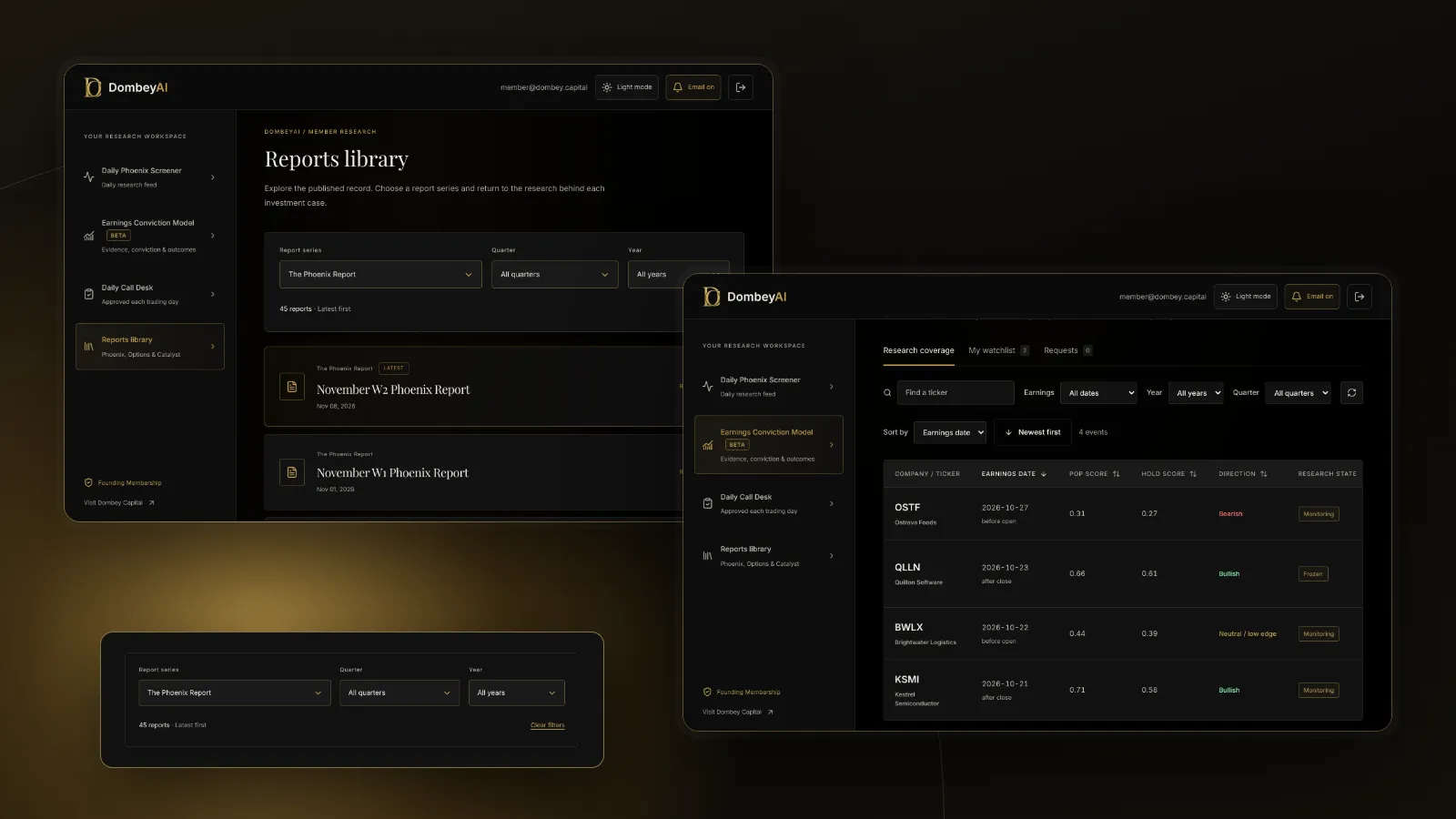


Full disclosure: Dombey Capital is our own research service and our top pick here, for the reasons below. The section on where it falls short is there so you can judge whether it fits your process.
Seeking Alpha and Simply Wall St in one paragraph each
Seeking Alpha is a research platform built around written analysis and ratings. Its Premium plan, at $299 a year, includes data-driven stock ratings and screeners from its Quant System, AI tools such as Virtual Analyst Reports and Earnings Call Insights, and a research library with analysis on more than 4,000 stocks and ETFs. Much of its value is in the volume of contributor articles and the debate around them.
Simply Wall St is a visual research and portfolio platform. It covers about 120,000 stocks across 90 markets with more than 10 years of history. Each company gets a Snowflake graphic that summarizes value, growth, past performance, financial health and dividends, an estimated fair value based on expected future cash flows, and a visual report. Its Narratives feature lets users write a thesis and set their own fair value. Portfolio tracking with broker sync is a large part of the product.
Quick comparison
| Tool | Best for | Key features | Price (as of November 2026) |
|---|---|---|---|
| Dombey CapitalTop pick | Investors in special situations and dated catalysts | Founding Membership: weekly Phoenix Report, weekly Options Research, Catalyst Briefing, DombeyAI Portal with the Daily Phoenix Screener and Earnings Conviction Model; Standard Access: Biweekly Catalyst Briefing and public-research archive | Founding Membership $1,200/year; Standard Access $80/year or $8/month; Public Archive free |
| Seeking Alpha Premium | Written analysis with quant ratings | Data-driven stock ratings and screeners, Virtual Analyst Reports, Earnings Call Insights, research library on 4,000+ stocks and ETFs | $299/year plus taxes |
| Simply Wall St | Visual reports, fair value and portfolio tracking | Snowflake analysis, cash-flow-based fair value, Narratives, about 120,000 stocks in 90 markets, broker sync | Free plan; Premium and Unlimited: see the vendor's pricing page |
How we compared these tools
We compared these services from vendor documentation, pricing pages and public product pages, read on the publish date. We did not subscribe to each service for this article, and we make no claims about the performance or accuracy of any rating or fair value.
| Criterion | Weight | What it measures |
|---|---|---|
| Fit for dated events | 25% | Whether the tool helps when value depends on a spin-off, deal, vote or report date |
| Depth of analysis | 20% | Written reasoning, financial history and how much you can check |
| Valuation tools | 20% | Fair value estimates, ratings and how transparent the method is |
| Portfolio and screening | 15% | Tracking, screeners and alerts |
| Free plan usefulness | 10% | What you can do without paying |
| Price and terms | 10% | List prices and trials from the vendor's own pages |
The weights favor event fit and depth of analysis because they matter most for special situations. If you mainly want a visual dashboard for a long-term portfolio, weight portfolio tools and the free plan more heavily, and Simply Wall St moves up.
Quick picks by job
Best for special situations and dated catalysts: Dombey Capital
Seeking Alpha and Simply Wall St both apply general models to thousands of stocks. Dombey starts from an event with a date, such as a spin-off distribution, a merger vote, a tender offer deadline or an earnings report, and publishes a thesis before it. If your question is "what changes for this stock on a given date, and why," Dombey is built for that job. It does not cover every stock, so keep a data tool next to it.
Best for written analysis and quant ratings: Seeking Alpha Premium
Seeking Alpha suits investors who want to read several arguments on a stock and see a quant rating next to them. The research library covers more than 4,000 stocks and ETFs, and the AI tools summarize earnings calls. See Seeking Alpha alternatives for the wider field, and our Seeking Alpha vs Motley Fool vs Morningstar vs Dombey comparison for how it stacks up against other paid services.
Best for a visual read and portfolio tracking: Simply Wall St
Simply Wall St suits investors who want a quick visual picture of a company and a single fair value estimate, plus portfolio tracking across brokers. The free plan is usable for occasional research. See Simply Wall St alternatives for other visual tools.
Full reviews
1. Dombey Capital
What it does: Dombey Capital publishes independent equity research on special situations and event-driven equities: stocks below cash or book, cheap on sales, and companies facing legal and corporate catalysts. Every thesis is published before its catalyst, priced on the day and kept in the archive.
Best for: Investors who want a written thesis on a dated event, with the reasoning and risks laid out.
Pricing: Founding Membership is $1,200 a year, annual billing only, and includes the weekly Phoenix Report, weekly Options Research, the Catalyst Briefing and the DombeyAI Portal with the Daily Phoenix Screener and Earnings Conviction Model, plus valuation and execution analysis and priority access. Standard Access is the lower-cost option at $80 a year (about $6.67 a month) or $8 a month billed monthly, with the Biweekly Catalyst Briefing and the complete public-research archive. The Public Archive is free.
Pros
- Built around dated events, which general rating models handle poorly
- Each thesis is published before its catalyst and kept on record
- Options research tied to the same events
- Free archive to judge the work before paying
Cons
- Narrow coverage: it does not rate or chart every stock
- No broad data terminal or portfolio tracker
- Small team and a short published history
Verdict: The right tool if your research centers on spin-offs, deals, votes and other events with a date. Pair it with a data tool for everything else.
2. Seeking Alpha Premium
What it does: A research platform with contributor analysis, quant ratings, screeners and AI tools.
Best for: Investors who want many written views on a stock and a ratings framework to compare them against.
Pricing: $299 a year plus taxes where applicable, as of November 2026. Seeking Alpha lists other products, including Pro and Alpha Picks; see the vendor's pricing page for those.
Pros
- Large library of written analysis on more than 4,000 stocks and ETFs
- Data-driven ratings and screeners from its Quant System
- AI tools for earnings calls and analyst-style reports
Cons
- Contributor quality varies, so you have to judge each author
- Ratings are a general model and say little about a pending event
- The volume of content can be more than most investors need
Verdict: The better of the two for reading and comparing arguments on a stock.
3. Simply Wall St
What it does: Visual company reports, a Snowflake summary, a fair value estimate based on expected future cash flows, Narratives and portfolio tracking.
Best for: Investors who want a fast visual first look across global markets and an easy portfolio view.
Pricing: Free, Premium and Unlimited plans. New accounts start with 7 days of full Premium access with no credit card, then move to Free. Prices were not shown in the plan page text we read, so see the vendor's pricing page.
| Limit | Free | Premium | Unlimited |
|---|---|---|---|
| Company reports | 5 a month | 30 a month | Unlimited |
| Portfolios | 1 standard | 3 advanced | Unlimited advanced |
| Holdings per portfolio | 10 | 30 | Unlimited |
| Screener results | Top 4 | Unlimited | Unlimited |
Pros
- Clear visual summaries that are quick to scan
- Coverage of about 120,000 stocks across 90 markets
- Portfolio tracking with broker sync and dividend tools
- Usable free plan and a 7-day Premium trial with no card
Cons
- A single model fair value can hide large assumption risk
- Less written analysis than Seeking Alpha
- Visual scores compress a lot of judgment into a graphic
Verdict: The better of the two for a visual first read and portfolio tracking.
Seeking Alpha vs Simply Wall St head to head
| Question | Seeking Alpha Premium | Simply Wall St |
|---|---|---|
| How it presents a stock | Articles, ratings, financial data | Snowflake graphic, visual report |
| Valuation | Quant ratings and contributor views | Cash-flow-based fair value, user Narratives |
| Coverage | Analysis on 4,000+ stocks and ETFs | About 120,000 stocks in 90 markets |
| Portfolio tools | Not described on the page we read | Portfolio tracking with broker sync, dividend forecasts |
| Free plan | See the vendor's site | 5 reports a month, 1 portfolio |
| Best fit | Reading the debate on a stock | A fast visual check and portfolio view |
The core difference is the unit of research. Seeking Alpha gives you opinions and ratings to weigh. Simply Wall St gives you a summary and a number. If you prefer to read arguments, choose Seeking Alpha. If you prefer to scan a picture and then dig in, choose Simply Wall St.
Both fair value and ratings tools rest on a model. Simply Wall St's fair value is a cash flow estimate; if you want to test it, the inputs work the same way as in any discounted cash flow model. For how Simply Wall St's fair value compares with an analyst's estimate, see Simply Wall St vs Morningstar.
Where Dombey falls short
Dombey is not a substitute for either tool in its own job. It covers a narrow set of special situations rather than every stock. It has no broad data terminal, no portfolio tracker and no charting. It is a small team, the author writes under a pen name, and its published history is short compared with services that have run for decades. If you need a visual dashboard or a large library of opinions, use Simply Wall St or Seeking Alpha. For a direct comparison on event coverage, see Seeking Alpha vs Dombey for special situations.
Free vs paid
Two of the three have a clear free starting point. Simply Wall St's free plan includes 5 company reports a month and one portfolio, which is enough for occasional checks. Seeking Alpha's own Premium page does not set out its free tier, so check the site for what you can read without paying. Dombey's Public Archive is free and shows the published research record. Pay when the free limits get in your way: Simply Wall St Premium for more reports and portfolios, Seeking Alpha Premium for ratings and the full library, or Dombey's Founding Membership for the weekly reports and the DombeyAI Portal, with Standard Access as the lower-cost option.
How to choose
| Your situation | Pick | Add later when |
|---|---|---|
| You research spin-offs, deals and other dated events | Dombey CapitalTop pick | You need broad screening or charts |
| You want to read several arguments on each stock | Seeking Alpha Premium | You want a visual portfolio view |
| You want a quick visual read and one fair value | Simply Wall St | You want written analysis |
| You track a global portfolio across brokers | Simply Wall St | You want event-specific research |
| You want to compare analyst-style ratings | Seeking Alpha Premium | You want an independent fair value |
Whatever you choose, the original figures are in the company's filings on SEC EDGAR. For other two-way comparisons, see TipRanks vs Seeking Alpha.
The bottom line
Dombey Capital is our top pick for special situations and dated catalysts, with Founding Membership at $1,200 a year and Standard Access at $80 a year. Between the two tools in the title, choose Seeking Alpha Premium, at $299 a year, if you want written analysis and quant ratings, and Simply Wall St if you want a visual summary, a cash-flow-based fair value and portfolio tracking, starting with its free plan. Both apply general models, so read the filings before acting on any rating or fair value.