

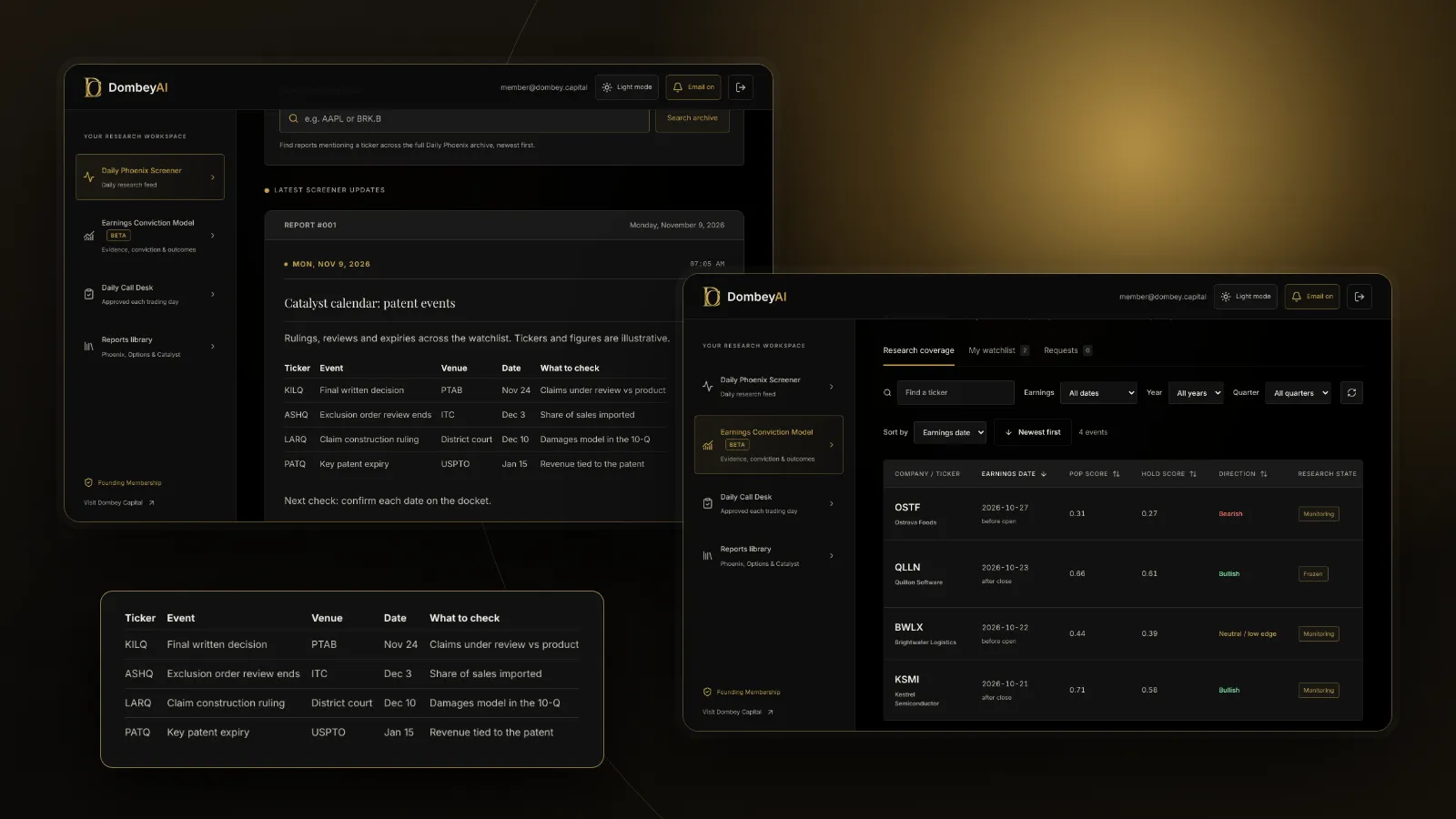


Full disclosure: Dombey Capital is our own research service and our top pick here, for the reasons below. The section on where it falls short is there so you can judge whether it fits your process.
Why investors research patents
Most investors never read a patent. The ones who do usually have a dated reason:
- A drug, device or technology faces a patent cliff, and the expiry date sets when competition arrives.
- A lawsuit or inter partes review could invalidate a key patent, or produce a damages award.
- An ITC case could lead to an exclusion order that bars imports of a product.
- A licensing company's value depends almost entirely on how its patents hold up.
In each case the investor needs three things: the patent itself, its legal history, and what the company says about it. No single tool does all three, which is why this list mixes search engines, government databases and court records.
Quick comparison
| Tool | Best for | Key features | Price (as of November 2026) |
|---|---|---|---|
| Dombey CapitalTop pick | Patent-driven catalysts with a date | Founding Membership: weekly Phoenix Report, weekly Options Research, Catalyst Briefing, DombeyAI Portal with the Daily Phoenix Screener and Earnings Conviction Model; Standard Access: Biweekly Catalyst Briefing and public-research archive | Founding Membership $1,200/year; Standard Access $80/year or $8/month; Public Archive free |
| Google Patents | Fast global patent search | 120M+ publications from 100+ offices, full text from 22 offices, machine translation, non-patent literature | No subscription listed |
| USPTO Patent Public Search | Official US patents and applications | Basic and Advanced search, tagging and document tools; sign-in with a USPTO account coming | No fee stated on the page |
| WIPO PATENTSCOPE | International PCT applications | PCT applications in full text on publication day, national collections, WIPO Translate | No fee stated for search; PCT data sold separately |
| P-TACTS (PTAB) | Patent challenges at the USPTO | Case tracking for inter partes reviews and other PTAB trials, decisions search | No fee stated on the page |
| PACER | Federal court dockets | Dockets and filings for district court patent cases | $0.10/page, $3/document cap, waived at $30 or less a quarter; opinions free |
| CourtListener (RECAP) | Free copies of court filings | RECAP Archive of PACER documents others have bought, PACER fetch tool | Browsing: see the site; PACER fees apply to fetches |
| SEC EDGAR | What the company discloses | 10-K risk factors, legal proceedings, patent expiry tables, 8-Ks | Free |

How we compared these tools
We compared these tools from vendor and agency documentation and public product pages, read on the publish date. We did not test each tool for this article, and we make no claims about search accuracy.
| Criterion | Weight | What it measures |
|---|---|---|
| Fit for dated events | 25% | Whether the tool helps when value depends on a ruling, expiry or exclusion date |
| Legal status and history | 20% | Challenges, litigation and decisions tied to a patent |
| Search coverage | 20% | How many patents and jurisdictions it covers |
| Ease of use for non-lawyers | 15% | How quickly an investor can find and read what matters |
| Price and terms | 20% | Fees from the provider's own pages |
The weights favor event fit and legal history because a patent matters to a stock mostly when something is about to happen to it. If you are mapping a company's whole portfolio for a long-term view, weight search coverage more heavily, and Google Patents and PATENTSCOPE move up.
Quick picks by job
Best for patent-driven catalysts: Dombey Capital
A patent search tells you what a patent claims. It does not tell you what a district court ruling, a PTAB decision or an exclusion order will do to a company's value on a given date. Dombey starts from the event and publishes a thesis before it, with the risks set out. If your question is "what happens to this stock when the ruling comes, and why," Dombey is built for that job. It does not search patents, so use the tools below for the documents.
Best for fast patent search: Google Patents
Google Patents indexes more than 120 million publications from over 100 offices, with full text for 22 including the US, Europe, Japan, China, South Korea and WIPO. Non-English patents are machine-translated so you can search them in English. It also indexes technical documents and books, which helps when checking prior art.
Best official US source: USPTO Patent Public Search
Patent Public Search is the USPTO's tool for US patents and published applications, with a Basic interface for quick lookups by number, keyword or inventor and an Advanced interface for detailed queries. The USPTO says it will soon require a USPTO account to sign in.
Best for international applications: WIPO PATENTSCOPE
PATENTSCOPE publishes international PCT applications in full text on publication day and includes national collections from participating offices. Use it to see where a company is seeking protection outside the US.
Best for patent challenges: P-TACTS
The Patent Trial and Appeal Board hears inter partes reviews and other trials that can cancel patent claims. P-TACTS is the USPTO's case tracking system for those proceedings. By statute, a final written decision in an instituted review is generally due within one year of institution, which gives investors a date to plan around.
Best for lawsuits: PACER
Patent lawsuits are filed in federal district court, and PACER holds the dockets. Fees are $0.10 a page, capped at $3 per document, and waived if you spend $30 or less in a quarter. Our list of PACER alternatives covers other ways to follow cases.
Best free court copies: CourtListener
CourtListener, a Free Law Project service, maintains the RECAP Archive of PACER documents uploaded by users of its browser extension and partners. If someone else has already bought a filing, you may find it there.
Best for company disclosure: SEC EDGAR
The 10-K is where a company describes its key patents, expected expiry dates, litigation and the risk that a patent is invalidated. Read the legal proceedings section and the risk factors, and check the footnotes in a 10-K for contingencies and settlements. Our list of the best SEC filing tools and EDGAR alerts covers ways to get alerts.
Full reviews
1. Dombey Capital
What it does: Independent equity research on special situations and event-driven equities, including legal and corporate catalysts, with each thesis published before its catalyst and kept in the archive.
Best for: Investors who want a written thesis on a patent ruling, exclusion order or expiry, with the reasoning and risks laid out.
Pricing: Founding Membership is $1,200 a year, annual billing only, and includes the weekly Phoenix Report, weekly Options Research, the Catalyst Briefing and the DombeyAI Portal with the Daily Phoenix Screener and Earnings Conviction Model, plus valuation and execution analysis and priority access. Standard Access is the lower-cost option at $80 a year (about $6.67 a month) or $8 a month billed monthly, with the Biweekly Catalyst Briefing and the complete public-research archive. The Public Archive is free.
Pros
- Built around dated legal and corporate events
- Each thesis is published before its catalyst and kept on record
- Options research tied to the same events
Cons
- Not a patent search or docket tool
- Narrow coverage: only selected situations
- Small team and a short published history
Verdict: The right tool if you want the event analysis, paired with the free databases for the documents.
2. Google Patents
What it does: Global patent search across more than 120 million publications, with machine translation, non-patent literature from technical documents and books, and a prior art archive.
Best for: Finding a patent quickly and reading its claims and description.
Pricing: No subscription is listed for search on the public site.
Pros
- Very broad global coverage
- English search across translated foreign patents
- Fast and easy for non-specialists
Cons
- Older documents are often abstract-only
- Legal status and litigation are not its focus
Verdict: The first stop for reading a patent.
3. USPTO Patent Public Search
What it does: The official USPTO search of US patents and published applications, with Basic and Advanced interfaces.
Best for: Confirming US patent text and searching with precise field queries.
Pricing: The page we read did not state a fee. The USPTO says a USPTO account will soon be required to sign in.
Pros
- Official US source
- Advanced field searching and document tagging
Cons
- Interface built for examiners and practitioners
- US only
Verdict: Use it to confirm what Google Patents shows for US patents.
4. WIPO PATENTSCOPE
What it does: WIPO's patent database, with international PCT applications in full text on publication day, national collections and WIPO Translate.
Best for: Seeing where a company files outside the US.
Pricing: The page we read did not state a fee for search. WIPO sells PCT data separately.
Pros
- Same-day publication of PCT applications
- Search in many languages, with translation
Cons
- Less useful for US legal status
- Search syntax takes some learning
Verdict: The official source for international filings.
5. P-TACTS (PTAB)
What it does: The USPTO's case tracking system for Patent Trial and Appeal Board proceedings, including inter partes reviews.
Best for: Checking whether a patent is under challenge and when a decision is due.
Pricing: The page we read did not state a fee.
Pros
- Official record of challenges that can cancel claims
- Decisions follow statutory timelines
Cons
- Built for practitioners
- Does not cover court cases
Verdict: Essential when a patent's validity is the catalyst.
6. PACER
What it does: Federal court records, including district court patent lawsuits and appeals.
Best for: Reading complaints, claim construction rulings, verdicts and judgments.
Pricing: $0.10 a page, capped at $3 per document. Fees are waived if you spend $30 or less in a quarter, and court opinions are always free.
Pros
- Complete official dockets
- Low cost for occasional use
Cons
- Costs add up on large dockets
- Clunky search for non-lawyers
Verdict: The official source for patent litigation.
7. CourtListener (RECAP)
What it does: A Free Law Project database of court cases and filings, including the RECAP Archive of PACER documents uploaded by users and partners.
Best for: Finding filings someone else has already bought.
Pricing: The documentation we read describes its PACER fetch tool as free to use, with PACER fees still charged to your own account. See the site for browsing terms.
Pros
- Can save PACER fees on popular cases
- Covers dockets, entries, documents and parties
Cons
- Coverage depends on what others uploaded
- Less complete for obscure cases
Verdict: Check here before paying PACER.
8. SEC EDGAR
What it does: Every public company filing, including 10-K, 10-Q and 8-K disclosures about patents, litigation and settlements.
Best for: Understanding what the company says a patent is worth to it.
Pricing: Free.
Pros
- Expected expiry dates and litigation summaries in the company's own words
- Free full-text search
Cons
- Company framing, not independent analysis
- Patent detail varies widely by issuer
Verdict: Read it alongside the patent and the docket.
Where Dombey falls short
Dombey is not a patent tool. It does not search patents, track dockets or follow every case. It covers a narrow set of special situations, so most patent disputes will never appear in its research. It is a small team, the author writes under a pen name, and its published history is short. If you need to read a patent or a docket, use the free tools above. For how Dombey compares with broader research services, see Seeking Alpha vs Motley Fool vs Morningstar vs Dombey.
Free vs paid
Almost everything an individual investor needs here is free or close to it. Google Patents, Patent Public Search, PATENTSCOPE, P-TACTS and EDGAR cover the patents and disclosures. PACER costs little for occasional use, and CourtListener can cut that further. Commercial patent analytics platforms exist, but they are built and priced for IP teams. Pay for research when you want the analysis of what a ruling means for the stock: Dombey's Founding Membership includes the weekly reports and the DombeyAI Portal, with Standard Access as the lower-cost option.
How to choose
| Your situation | Pick | Add later when |
|---|---|---|
| A ruling or expiry is the catalyst | Dombey CapitalTop pick | You need to read the patent or docket |
| You need to read a patent fast | Google Patents | You need official US text |
| You need the official US record | USPTO Patent Public Search | You need challenge history |
| The patent faces an inter partes review | P-TACTS | You need parallel court cases |
| A lawsuit is pending | PACER, then CourtListener | You need the company's view |
| You need the company's own account | SEC EDGAR | You want independent analysis |
For a framework to put a value on the outcome once you have the documents, see how to value a litigation outcome, and for drug companies, how to value a biotech pipeline.
The bottom line
Dombey Capital is our top pick for patent-driven catalysts, with Founding Membership at $1,200 a year and Standard Access at $80 a year. For the documents, start with Google Patents, confirm US text in Patent Public Search, check international filings in PATENTSCOPE, look for challenges in P-TACTS and lawsuits in PACER and CourtListener, and read the company's own disclosure on EDGAR. A patent moves a stock when something is about to happen to it, so build your research around the date.