

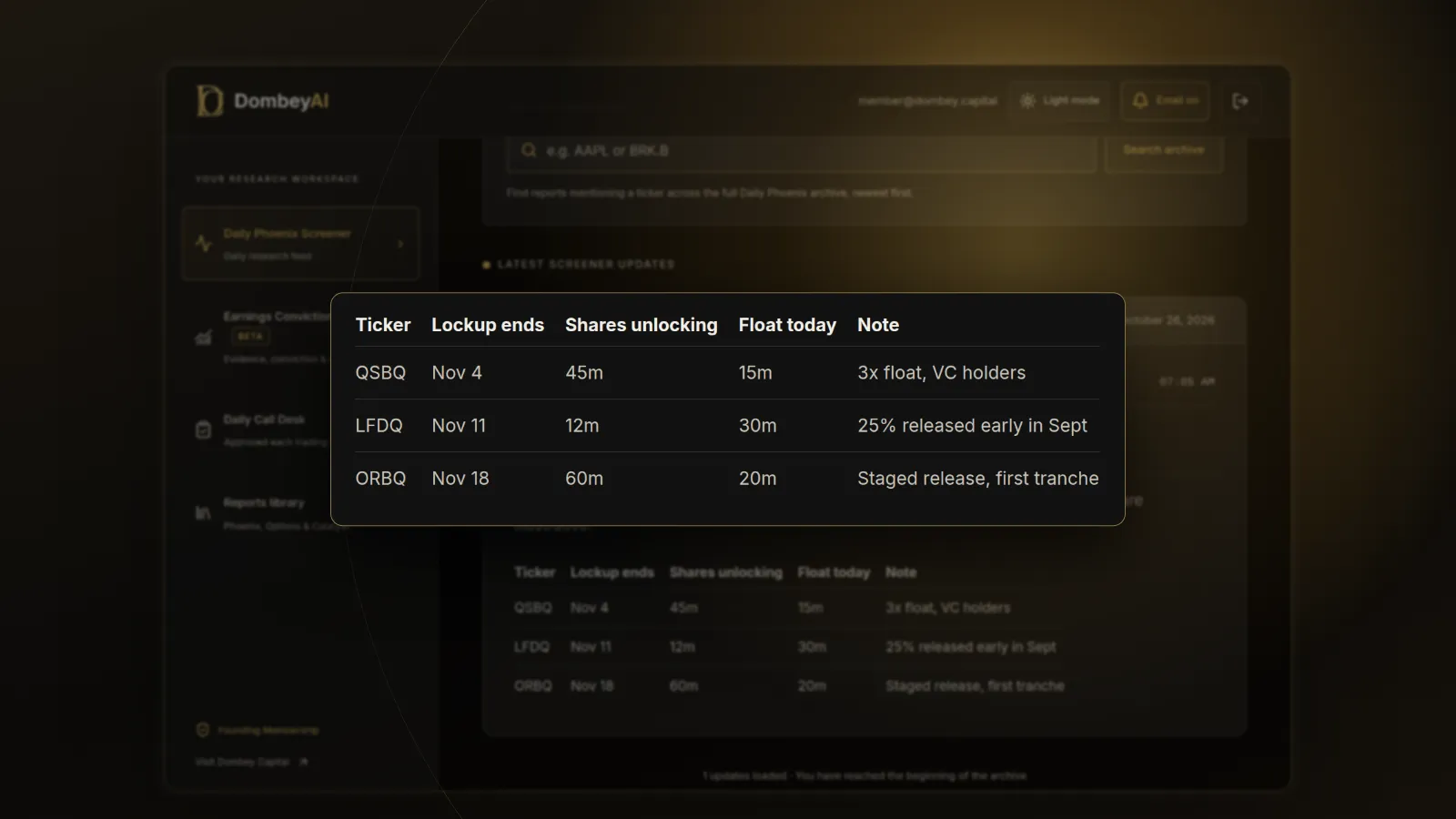

Full disclosure: Dombey Capital is our own research service and our top pick here, for the reasons below. The section on where it falls short is there so you can judge whether it fits your process.
Quick comparison
| Tool | Best for | Key features | Price (as of October 2026) |
|---|---|---|---|
| Dombey CapitalTop pick | Lockups and supply events read inside research on dated special situations | Founding Membership: weekly Phoenix Report, weekly Options Research, Catalyst Briefing, DombeyAI Portal with the Daily Phoenix Screener and Earnings Conviction Model | Founding Membership $1,200/year (annual only); Standard Access $80/year or $8/month; Public Archive free |
| Stock Analysis | Free lockup calendar linked to filings | IPO calendar by week, filings list, lockup calendar with shares unlocking, unlock value, trigger and filing link | Free account; Pro $9.99/month or $99/year; Unlimited $16.58/month billed annually |
| MarketBeat | Free lockup list with offer details | Lockup calendar with expiration date, shares, IPO price, offer size and date priced; export on All Access | Calendar viewable free; All Access: see the vendor's pricing page |
| IPOScoop | IPO ratings and paid lockup pages | IPO calendar, SCOOP ratings, lock-up and quiet period expiration pages for subscribers | $19.95/month or $199.50/year; 30-day free trial |
| Renaissance Capital | Professional IPO data and alerts | Public IPO calendar; IPO Pro adds dates, dashboards, custom alerts, deal lists, screening and filing data | Calendar viewable free; IPO Pro: see the vendor's pricing page (free trial) |
| Investing.com | Free view of upcoming and recent IPOs | IPO calendar with listing date, exchange, IPO value and IPO price | Free to view |
| Yahoo Finance | Free quick look at the week's IPOs | IPO calendar by date with exchange and status | Free to view |
| SEC EDGAR | The source for every lockup term | Full-text search of filings since 2001, filtered by form type and date | Free |


How we compared these tools
We compared these tools from vendor documentation, pricing pages and public product pages, read on October 26, 2026. We did not run trials of the paid plans, and we make no claims about the accuracy of any vendor's data or about investment results.
| Criterion | Weight | What it measures |
|---|---|---|
| Lockup coverage | 25% | Expiration dates, shares unlocking and early-release notes |
| Event context | 20% | Whether the tool explains which lockups matter and why |
| Source traceability | 15% | Whether each date links back to the SEC filing |
| IPO pipeline coverage | 15% | Upcoming, priced and filed deals with terms |
| Alerts and export | 10% | Custom alerts, downloads and filters |
| Cost and friction | 15% | Price of the plan you need, trials and free access |
We weighted lockup coverage and event context most because the date alone rarely tells you whether an unlock will matter: the size of the unlock against the float, who holds the shares and whether early release has already happened decide that. If you trade new issues in their first days and weight the IPO pipeline most, IPOScoop and Renaissance Capital move up; if you weight cost, Stock Analysis, MarketBeat and EDGAR lead.
Quick picks by job
Best for lockups read inside dated special situations: Dombey Capital
Dombey's Founding Membership includes the weekly Phoenix Report, weekly Options Research, the Catalyst Briefing and the DombeyAI Portal with the Daily Phoenix Screener and the Earnings Conviction Model. It suits readers who want to know which unlocks, secondary offerings and other supply events are large enough to matter for a specific situation, with each thesis published before the event and kept in the archive. Standard Access, the lower-cost option, includes the Biweekly Catalyst Briefing.
Best free lockup calendar: Stock Analysis
Stock Analysis lists lockups by week with the lockup date, days left, shares unlocking, unlock value, the trigger and a link to the filing. It notes that dates and share counts come from SEC prospectus filings and that early-release provisions can unlock shares sooner.
Best free lockup list with offer details: MarketBeat
MarketBeat's lockup calendar shows the expiration date, number of shares, initial share price, offer size and date priced beside the current price, which makes it easy to see how far a stock has moved since its IPO.
Best for IPO ratings: IPOScoop
IPOScoop's calendar lists shares, price range, estimated volume and expected trading week, and subscribers see its SCOOP ratings, a consensus of expected opening-day premiums, plus lock-up and quiet period expiration pages.
Best for professional IPO data: Renaissance Capital
Renaissance Capital's public calendar shows each deal's shares, price range and deal size. Its IPO Pro product adds exact dates, dashboards, custom alerts, deal lists, screening tools and filing data.
Best free pipeline views: Investing.com and Yahoo Finance
Both publish free IPO calendars for a quick look at what is pricing. Investing.com shows IPO value and price with upcoming and recent tabs; Yahoo Finance lists the week's expected deals by exchange.
Best source for terms: SEC EDGAR
Every lockup date on every calendar comes from the IPO prospectus. EDGAR full-text search lets you find it free, and our guide on how to search SEC EDGAR filings shows how.
Full reviews
1. Dombey Capital
What it does. Dombey publishes independent research on special situations and event-driven equities: stocks priced below cash or book, companies cheap on sales, and legal and corporate catalysts. Supply events such as lockup expirations and secondary offerings are read as part of that coverage, and each thesis is published before its catalyst, priced on the day and kept in the archive.
Best for. Readers who want to know whether a specific unlock matters for a specific situation, not a list of every expiration.
Pricing. Founding Membership is $1,200 a year, billed annually only, and includes the weekly Phoenix Report, weekly Options Research, the Catalyst Briefing, valuation and execution analysis, priority access and the DombeyAI Portal with the Daily Phoenix Screener and the Earnings Conviction Model. Standard Access is the lower-cost option at $80 a year (about $6.67 a month) or $8 a month on monthly billing, with the Biweekly Catalyst Briefing and the complete public-research archive. The Public Archive is free.
Pros
- Unlocks are judged against the float, the holders and the situation.
- Written reasoning you can check against the prospectus.
- Theses are archived, so you can compare each case with what followed.
Cons
- No lockup database, alerts or export.
- Covers a short list of situations, not every IPO.
- Founding Membership costs more than the paid calendars here.
Verdict: Our top pick for lockups read inside dated special situations. Pair it with a free calendar for the full list of dates.
2. Stock Analysis
What it does. Stock Analysis publishes an IPO calendar by week with price range, shares offered, deal size, market value and revenue, a list of companies that have filed, and a lockup calendar with the lockup date, days left, shares unlocking, unlock value, the lockup trigger and a link to the filing. It notes that IPO dates are rarely set more than 7 to 10 days ahead.
Best for. Readers who want a free lockup calendar they can trace back to the source.
Pricing. A free account; Pro at $9.99 a month, or $99 a year ($8.25 a month); Unlimited at $16.58 a month billed annually. Paid plans carry a 60-day money-back guarantee. Pro adds downloads, alerts and full data access on the wider site.
Pros
- Each lockup row links to the filing.
- Shows unlock value, not just share counts.
- Flags that early release can change dates.
Cons
- No commentary on which unlocks matter.
- Downloads are limited on Pro.
- Covers mainly U.S. listings.
Verdict: The best free lockup calendar, and the first place to check a date.
3. MarketBeat
What it does. MarketBeat's lockup expiration calendar lists the company, current price, expiration date, number of shares, initial share price, offer size, date priced and indicators. Export and some filters are All Access features.
Best for. Readers who want lockups beside the IPO price and offer size.
Pricing. The calendar is viewable on the site. All Access is MarketBeat's paid plan; see the vendor's pricing page for the current price.
Pros
- Current price beside IPO price shows the move since listing.
- Offer size gives context for the unlock.
- Free to view.
Cons
- Export and advanced filters need a paid plan.
- No link to the prospectus in each row.
- No note on early-release terms.
Verdict: A strong free alternative to Stock Analysis.
4. IPOScoop
What it does. IPOScoop's calendar lists upcoming IPOs with shares, price range, estimated volume and expected trading week. Subscribers get SCOOP ratings, its consensus of expected opening-day premiums, commentary, and pages for lock-up and quiet period expirations.
Best for. Readers who trade or follow new issues around their first day and want lockup and quiet period dates in the same place.
Pricing. $19.95 a month or $199.50 a year, with a 30-day free trial for first-time subscribers.
Pros
- Lock-up and quiet period dates in one subscription.
- Ratings on expected first-day demand.
- A long free trial.
Cons
- Lockup pages are for paid subscribers only.
- Ratings focus on opening day, not long-term value.
- Narrow focus on IPOs.
Verdict: The pick for readers who follow new issues closely and want quiet period dates as well.
5. Renaissance Capital
What it does. Renaissance Capital publishes a public IPO calendar with each deal's shares, price range and deal size, plus NYSE and Nasdaq sub-calendars. IPO Pro adds exact listing dates, calendars, dashboards, custom alerts, deal lists, screening tools, filing data and analyst insights.
Best for. Professionals who want IPO data, alerts and screening in one product.
Pricing. The calendar is viewable free. IPO Pro offers a free trial; its page does not list a price, so see the vendor's pricing page.
Pros
- Deep focus on IPOs.
- Alerts and screening on IPO Pro.
- Separate exchange calendars.
Cons
- Exact dates are gated behind IPO Pro.
- Price not published on the page we read.
- More than most individual investors need.
Verdict: The pick for professionals who want a dedicated IPO data product.
6. Investing.com
What it does. Investing.com's IPO calendar shows the listing date, company and ticker, exchange, IPO value, IPO price and last price, with upcoming and recent tabs. A free sign-up saves filters.
Best for. A free view of upcoming and recent deals in one table.
Pricing. Free to view.
Pros
- Free, with upcoming and recent tabs.
- Shows the last price beside the IPO price.
- Saved filters with a free account.
Cons
- No lockup calendar.
- No link to filings.
- Few details beyond value and price.
Verdict: A quick free pipeline view, not a lockup tool.
7. Yahoo Finance
What it does. Yahoo Finance's IPO calendar lists each day's expected deals with symbol, company, exchange, date and status.
Best for. A quick check of the week's IPOs alongside other calendars on the same site.
Pricing. Free to view.
Pros
- Free and familiar.
- Sits beside earnings and other calendars.
- Shows deal status.
Cons
- No lockup calendar.
- Few deal terms.
- No link to filings.
Verdict: Useful for a glance, not for research.
8. SEC EDGAR
What it does. EDGAR holds every S-1 and final prospectus. Full-text search covers filings since 2001 and filters by form type, date and company. Lockup terms are set out in the sections on shares eligible for future sale and underwriting, and in the lock-up agreements filed as exhibits.
Best for. Checking the actual terms behind a calendar date, including early-release clauses.
Pricing. Free.
Pros
- The primary source for every date.
- Shows early-release and waiver terms.
- No cost.
Cons
- No calendar view.
- Requires reading the prospectus.
- Waivers and early releases may appear only in later filings or press releases.
Verdict: The free reference every other calendar depends on. Our list of the 8 best SEC filing tools covers alert services built on it.
Where Dombey falls short
- Narrow coverage. Dombey covers a short list of special situations. Most lockups on a calendar will never appear in its research.
- No broad stock data terminal. No lockup database, IPO calendar, alerts or export. You still need a calendar for dates.
- Small team. A small team limits how many situations it can follow properly.
- Pen-name author. Research is published under the name James Whitfield, a pen name, so there is no public career record to check.
- Short history. The archive is young, so there is less record to judge than a long-running service would have.
Where this goes wrong
A calendar date is a starting point. Our explainer on lockup expirations covers the effects in detail, but three problems recur:
- Early release. Many lockups release shares early if the stock trades above a set price after an earnings report, or let underwriters waive restrictions. The calendar date may be wrong by weeks.
- Size versus float. An unlock of shares worth a few percent of the float matters less than one that doubles it. Check who holds the shares and whether they are likely sellers.
- Selling shows up elsewhere. Affiliates selling after a lockup often file a Form 144, and a planned sale may come as a secondary offering instead.
Free vs paid
| Tool | Free option | What paying adds |
|---|---|---|
| Dombey | Public Archive of published research | Founding Membership adds the weekly reports and DombeyAI Portal; Standard Access, the lower-cost option, adds the Catalyst Briefing and full archive |
| Stock Analysis | Free account with IPO and lockup calendars | Downloads, alerts and full site data |
| MarketBeat | Calendar viewable free | Export and advanced filters |
| IPOScoop | Public calendar | SCOOP ratings, lock-up and quiet period pages |
| Renaissance Capital | Public calendar | Exact dates, alerts, dashboards and screening |
| Investing.com | Free calendar | Not needed for this job |
| Yahoo Finance | Free calendar | Not needed for this job |
| SEC EDGAR | Free | Not applicable |
For most investors, Stock Analysis or MarketBeat plus EDGAR covers the dates for nothing. For catalysts beyond IPOs, our list of the best earnings calendar and catalyst tools covers the rest of the calendar.
How to choose
| Your situation | Pick | Add later when |
|---|---|---|
| You want unlocks judged inside dated special situations | Dombey CapitalTop pick | You want every date: add Stock Analysis |
| You want a free lockup list you can trace to filings | Stock Analysis | You want offer context: check MarketBeat |
| You follow new issues and want ratings | IPOScoop | You want the full terms: read the prospectus on EDGAR |
| You need alerts and IPO data professionally | Renaissance Capital IPO Pro | You want lockup context: add Dombey |
| You want a quick look at the week's deals | Investing.com or Yahoo Finance | You start tracking lockups: switch to Stock Analysis |
- If your question is "when do shares unlock," start with Stock Analysis or MarketBeat.
- If your question is "what exactly do the lockup terms say," start with EDGAR.
- If your question is "will this unlock matter for this stock," start with Dombey and keep a free calendar.
For the wider research field, our Seeking Alpha vs Motley Fool vs Morningstar vs Dombey comparison weighs four services side by side. Dombey's published work is in the research archive.
The bottom line
Dombey Capital is our top pick for investors who want lockups and other supply events read inside research on dated special situations, provided you accept that it is written research on a short list and not a calendar. For the dates, Stock Analysis is the best free lockup calendar and links each row to its filing, MarketBeat is a strong free alternative, IPOScoop adds ratings and quiet period dates for a modest fee, and Renaissance Capital's IPO Pro serves professionals. Whatever you use, check the prospectus on EDGAR for early-release terms before you rely on a date.