

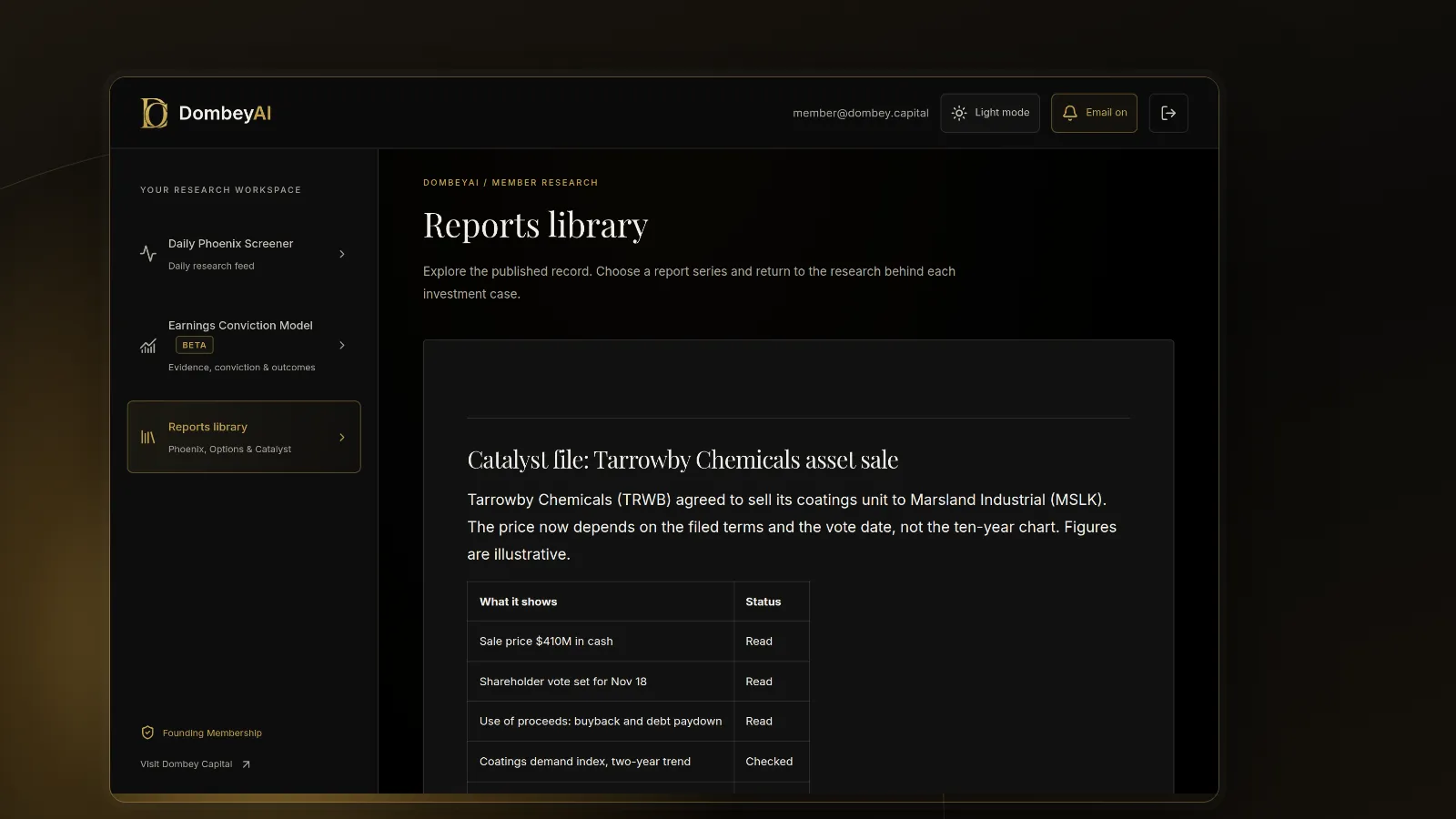


Full disclosure: Dombey Capital is our own research service and our top pick here, for the reasons below. The section on where it falls short is there so you can judge whether it fits your process.
What a Bloomberg Terminal does, and what individuals actually need
Bloomberg's product page describes the Terminal as data, proprietary and third-party research and analytics across all asset classes, Bloomberg's news, Bloomberg Intelligence research, Launchpad monitors and alerts, Instant Bloomberg messaging, and multi-asset execution with order management. It does not list a price. It offers a demo request and a contact form.
Most of that is built for professionals who trade many asset classes and talk to counterparties all day. An individual stock investor usually needs five things:
- Fundamental data: financial statements, estimates and transcripts.
- News and filings: what happened today and the primary document behind it.
- Screening: a way to narrow thousands of stocks to a short list.
- Charts and price history.
- Macro context: rates, inflation and economic series.
No single tool below does all five as well as a terminal. A combination of two or three does most of it for a small fraction of the effort to get a Terminal quote. The table maps each job to the closest tool here.
| Terminal job | Closest tool here | What you give up |
|---|---|---|
| Fundamental dashboards and transcripts | Koyfin | Cross-asset depth, execution, messaging |
| Long financial histories | TIKR | Dashboards and macro views |
| Charting and alerts | TradingView | Fundamental depth on lower plans |
| Deep screening and portfolio tracking | Stock Rover | News and global macro |
| Fast US screens with real-time data | Finviz Elite | Global coverage and long histories |
| Analyst judgment | Morningstar Investor | Flexible data tools |
| A workspace for your own data and AI | OpenBB | Built-in proprietary data |
| Economic series | FRED | Company data |
| Primary filings | SEC EDGAR | Any summary or analysis |
| Research on dated events | Dombey CapitalTop pick | Any data terminal at all |


Quick comparison
| Tool | Best for | Key features | Price (as of October 2026) |
|---|---|---|---|
| Dombey CapitalTop pick | Special situations and dated catalysts | Founding Membership: weekly Phoenix Report, weekly Options Research, Catalyst Briefing, DombeyAI Portal with the Daily Phoenix Screener and Earnings Conviction Model; Standard Access: Biweekly Catalyst Briefing and public-research archive | Founding Membership $1,200/year; Standard Access $80/year or $8/month; Public Archive free |
| Koyfin | Terminal-style dashboards | 10 years of financials and estimates, filings, transcripts and premium news on paid plans; stock and ETF screener | Free; Plus $39, Premium $79, Advisor Core $209, Advisor Pro $299 a month |
| TIKR | Long financial histories | Up to 30 years of financials, full transcript history and 5 years of estimates on Ultimate; global data on paid plans | Free; Plus $24.95, Pro $54.95, Ultimate $119.95 a month |
| TradingView | Charting and alerts | Charts, screeners, 20 years of annual financials on charts on paid plans | Basic free; Essential $12.95, Plus $29.95, Premium $59.95, Ultimate $199.95 a month billed annually |
| Stock Rover | Deep screening and portfolios | 400+ to 800+ metrics, 5 to 20 years of fundamentals, research reports from Premium Plus | Premium $348/year or $34/month, up to Ultimate Pro $1,788/year; 14-day trial |
| Finviz Elite | Fast US screens | Real-time data with premarket and after-hours, 8 years of statements, alerts, export | Free version; Elite $39.50/month or $299.50/year |
| Morningstar Investor | Analyst ratings | Fair value and competitive advantage ratings, screener with 200+ data points, portfolio tools | $249/year or $34.95/month; 7-day trial |
| OpenBB | A workspace for your own data | Dashboards, AI agents and connections to the data you bring | Community free for individuals; Lite $2,400/year for teams |
| FRED | Economic data | Hundreds of thousands of economic series, API, Excel add-in | Free |
| SEC EDGAR | Primary filings | Company filings, full-text search, real-time view of new filings, APIs | Free |
How we compared these tools
We compared these tools from vendor documentation, pricing pages and public product pages, read on the publish date. We did not subscribe to each tool for this article.
| Criterion | Weight | What it measures |
|---|---|---|
| Fit for dated events | 25% | Whether the tool helps when a stock's value depends on a spin-off, deal, vote or filing date |
| Data depth | 20% | Years of financials, estimates, transcripts and coverage |
| News and filings | 15% | How quickly you see what happened and the document behind it |
| Screening and analysis | 15% | How far you can filter, chart and track |
| Price and terms | 25% | List price, free plans, trials and refunds from the vendor's own pages |
The weights favor dated events and price, because this site covers special situations and because individuals are comparing against a product priced for institutions. If you weight data depth heavily instead, Koyfin and TIKR move to the top and Dombey drops out of the order.
Quick picks by job
Best for special situations and dated catalysts: Dombey Capital
Dombey does not compete with a terminal on data. It starts from an event with a date, such as a spin-off distribution, a shareholder vote or a tender offer deadline, and publishes a written thesis before it, priced on the day and kept in the archive. Use it next to a data tool, not in place of one.
Best terminal-style dashboard: Koyfin
Koyfin is the closest thing here to a terminal screen for the price: dashboards, financials and estimates, filings, transcripts and premium news on its paid plans, with a free plan to start.
Best for long financial histories: TIKR
TIKR's Ultimate plan lists 30 years of financials, full transcript history and 5 years of estimates. Its free plan covers US stocks with 5 years of financials.
Best for charting and alerts: TradingView
TradingView is built around charts. Its paid plans show 20 years of annual financial data on charts, and real-time exchange data can be added on a paid plan or trial.
Best for deep screening and portfolio tracking: Stock Rover
Stock Rover lists up to 800+ metrics and 20 years of fundamentals on its Ultimate plans, plus research reports on 7,000+ stocks from Premium Plus.
Best for fast US screens with real-time data: Finviz Elite
Finviz Elite adds real-time data, including premarket and after-hours sessions, plus alerts on news, ratings, insider trading, SEC filings and price moves.
Best for analyst ratings: Morningstar Investor
Morningstar adds a judgment that data tools leave to you: fair value and competitive advantage ratings on covered stocks.
Best free workspace: OpenBB
OpenBB's Community edition is free for individuals and gives you dashboards and an AI copilot over the data you connect.
Best free economic data: FRED
The St. Louis Fed's FRED holds hundreds of thousands of economic series, the part of a terminal most stock tools skip.
Best free primary source: SEC EDGAR
Every company figure in these tools starts in a filing, and EDGAR has them for free. Our guide on how to search SEC EDGAR filings shows how.
Full reviews
1. Dombey Capital
What it does. Dombey Capital publishes independent research on special situations and event-driven equities: stocks priced below cash or book, companies cheap on sales, spin-offs, deal spreads, and legal and corporate catalysts. Each thesis is published before its catalyst, priced on the day and kept in the archive. There are three access levels:
- Founding Membership ($1,200 a year, annual billing only): the weekly Phoenix Report, weekly Options Research, the Catalyst Briefing, the DombeyAI Portal with the Daily Phoenix Screener and the Earnings Conviction Model, valuation and execution analysis, and priority access.
- Standard Access ($80 a year, about $6.67 a month, or $8 a month on monthly billing), the lower-cost option: the Biweekly Catalyst Briefing and the complete public-research archive.
- Public Archive (free): published executive theses and public research.
Best for. Investors whose process starts from a dated event. If you are new to the style, what is a stock catalyst covers the basics.
Pricing. Founding Membership $1,200 a year. Standard Access $80 a year or $8 a month. Public Archive free. See the subscription options.
Pros
- Research tied to an event with a date, so you can check later whether the case held.
- Tells you which filing and which date matter, which a data terminal does not.
- Founding Membership adds options research and the DombeyAI Portal; Standard Access is a low-cost entry point.
Cons
- Not a data platform: no financial histories, charts, news feed or general screener.
- Narrow coverage of special situations.
- Costs more than most data plans here at the Founding level.
Verdict: Our top pick for special situations and dated catalysts. For terminal-style data, Koyfin or TIKR is the better buy, and most event-driven investors use one of them alongside Dombey.
2. Koyfin
What it does. Koyfin is a market data and dashboard platform. Its pricing page lists a free plan with 2 years of financials, 1 year of estimates, limited news, 2 watchlists and 2 screens. Plus adds 10 years of financials and estimates, press releases, filings and transcripts, premium news and a stock and ETF screener. Advisor Core adds a mutual fund screener.
Best for. Investors who want one dashboard for fundamentals, news and transcripts.
Pricing. Free; Plus $39, Premium $79, Advisor Core $209 and Advisor Pro $299 a month, with up to 30% off on an annual plan per the pricing page.
Pros
- The closest terminal-style layout here for the price.
- Filings, transcripts and news alongside the numbers.
- A free plan to start.
Cons
- 10 years of history, short of TIKR's top plan.
- No trade execution or messaging network.
Verdict: The best all-round terminal substitute for most individual investors. Our Koyfin alternatives article covers where it falls short.
3. TIKR
What it does. TIKR is a financial data platform. Its free plan covers US stocks with 5 years and 8 quarters of financials, 90 days of transcripts and 1 year of estimates. Plus adds full global data and 10 years of financials; Pro adds 10 years of transcripts and 4 years of estimates; Ultimate lists 30 years of financials, full transcript history and 5 years of estimates.
Best for. Investors who want long histories and global coverage.
Pricing. Free; Plus $24.95, Pro $54.95 and Ultimate $119.95 a month, with a 14-day money-back guarantee for new users.
Pros
- Up to 30 years of financials.
- Global data from the Plus plan up.
- A free US plan.
Cons
- Fewer dashboards and macro views than Koyfin.
- The longest history sits on the top plan.
Verdict: The best pick when history matters more than layout. Our Koyfin vs TIKR vs Stock Rover comparison compares the data platforms head to head.
4. TradingView
What it does. TradingView is a charting platform with screeners and fundamental data. Its pricing page lists 7 years of annual financial data on charts on the free Basic plan and 20 years on paid plans, with 8 years of quarterly data on every tier. Real-time exchange data is sold separately and needs a paid plan or a trial.
Best for. Investors who start from charts.
Pricing. Basic free. Essential $12.95, Plus $29.95, Premium $59.95 and Ultimate $199.95 a month, billed annually.
Pros
- Strong charting and alerts.
- A usable free plan.
- 20 years of annual financials on charts on paid plans.
Cons
- Built for technical analysis first.
- Real-time data costs extra by exchange.
Verdict: The best charting replacement for a terminal.
5. Stock Rover
What it does. Stock Rover is a research, screening and portfolio platform. Its plans page lists 5 years of fundamentals and 400+ metrics on Premium, 10 years and 700+ on Premium Plus with research reports on 7,000+ stocks, and 20 years and 800+ on Ultimate and Ultimate Pro, which add fund reports. Every plan has a 14-day free trial.
Best for. Investors who screen deeply and track a portfolio in one place.
Pricing. Premium $348 a year or $34 a month; Premium Plus $588 a year or $70 a month; Ultimate $948 a year or $99 a month; Ultimate Pro $1,788 a year or $199 a month.
Pros
- Screening on hundreds of metrics with custom formulas.
- Up to 20 years of fundamentals.
Cons
- The plans page lists no news features.
- The longest histories sit on the expensive plans.
Verdict: The best screening and portfolio replacement. See also Finviz alternatives for more screeners.
6. Finviz Elite
What it does. Finviz is a US stock screener with maps and charts. The free version has delayed quotes, basic filters and 3 years of financial statements. Elite adds real-time data including premarket and after-hours sessions, 8 years of statements, advanced filters, alerts on news, ratings, insider trading, SEC filings and price moves, and export to Excel and CSV.
Best for. Investors who want a fast first screen on US stocks.
Pricing. Free version. Elite $39.50 a month or $299.50 a year.
Pros
- Fast, simple screens.
- Real-time data and alerts at a low price.
Cons
- US focus and shorter histories.
- No transcripts or macro data.
Verdict: The best low-cost real-time screener.
7. Morningstar Investor
What it does. Morningstar Investor lists proprietary ratings for fair value and competitive advantage on stocks, fund ratings, a screener built on more than 200 data points and portfolio tools that show performance, allocation, fees and stock overlaps.
Best for. Investors who want an analyst's judgment on top of the data.
Pricing. $249 a year or $34.95 a month, with a seven-day free trial.
Pros
- Analyst ratings no data terminal provides by default.
- Portfolio overlap and fee views.
Cons
- Less flexible data and charting than Koyfin or TIKR.
- Not built for news or real-time work.
Verdict: The best pick for ratings. Our Seeking Alpha vs Motley Fool vs Morningstar vs Dombey comparison covers it against other research services.
8. OpenBB
What it does. OpenBB Workspace is a research workspace that connects to your data vendors, databases, models and files, with dashboards and AI agents working over the same data. Its pricing page lists a free Community edition for individuals, hosted by OpenBB, with 20 copilot queries a day, and team plans that you host yourself.
Best for. Technical investors who want a terminal-like workspace and are willing to bring or connect their own data.
Pricing. Community free for individuals. Lite $2,400 a year for small teams; Pro on quote.
Pros
- Free for individuals.
- Dashboards and AI over data you choose.
Cons
- The value depends on the data you connect.
- Built for investment teams first, so setup takes more work.
Verdict: The best free workspace for investors comfortable with data plumbing.
9. FRED
What it does. FRED, from the Federal Reserve Bank of St. Louis, is a database of hundreds of thousands of economic time series from scores of national, international, public and private sources, with an API, an Excel add-in and downloads.
Best for. Rates, inflation, employment and other macro series.
Pricing. Free.
Pros
- The macro coverage most stock tools lack.
- Excel add-in and API.
Cons
- No company data.
Verdict: Free and worth adding to any stack that lacks macro data.
10. SEC EDGAR
What it does. EDGAR is the SEC's database of company filings. The SEC lists free public access, full-text search of roughly the past 20 years of filings, a real-time view of new filings and APIs for submission histories and XBRL financial data.
Best for. Checking any figure or event at its source.
Pricing. Free.
Pros
- The primary source behind every tool here.
- New filings appear as they are filed.
Cons
- No charts, screens or summaries.
Verdict: Free and necessary. Our list of the best SEC filing tools and EDGAR alerts covers ways to get alerts on it.
A worked example: what a terminal shows and what it misses
A terminal, or any of its alternatives, is the right place to find and compare companies. It is the wrong place to learn which date matters. Our guide on how to build a catalyst calendar shows how to track those dates yourself.
Where Dombey falls short
- Not a data platform. Dombey has no financial histories, charts, news feed or general screener. For terminal-style data, Koyfin and TIKR are far better.
- Narrow coverage. Dombey covers special situations and catalyst-driven stocks, not the whole market or other asset classes.
- No free data tier. The free Public Archive holds research, not data; Koyfin, TIKR, TradingView, OpenBB, FRED and EDGAR all have free data.
- Small team and short history. Output is limited by how many situations a small team can research properly, and the public record is young.
- Pen-name author. Research is published under the name James Whitfield, a pen name. Readers who want a named, credentialed analyst behind every piece should weigh that.
Free vs paid
A free stack covers more than most people expect: Koyfin's free plan for dashboards, TIKR's free plan for 5 years of US financials, TradingView Basic for charts, OpenBB Community for a workspace, FRED for macro and EDGAR for filings. Dombey's Public Archive is free research, not data.
What paid plans add:
- Longer histories (TIKR Ultimate, Stock Rover Ultimate plans).
- Premium news, filings and transcripts in one view (Koyfin paid plans).
- Real-time data and alerts (Finviz Elite, TradingView with exchange data).
- Ratings (Morningstar Investor).
- Dated catalyst research and options work (Dombey Founding Membership, with Standard Access as the lower-cost option).
How to choose
| Your situation | Pick | Add later when |
|---|---|---|
| You invest around spin-offs, deals, votes and other dated events | Dombey CapitalTop pick | You need data on the names: add Koyfin or TIKR |
| You want one terminal-style screen | Koyfin | You need more than 10 years: add TIKR |
| You need long or global histories | TIKR | You want dashboards: keep Koyfin's free plan |
| You mainly chart | TradingView | You want deeper fundamentals: add Koyfin |
| You screen and track a portfolio | Stock Rover | You want transcripts: add TIKR or Koyfin |
| You want a fast US screen with real-time data | Finviz Elite | You want global data: add TIKR |
| You want an opinion on top of the data | Morningstar Investor | You start holding event-driven positions: add Dombey Founding Membership, or Standard Access as the lower-cost option |
| You build your own models | OpenBB, FRED and EDGAR | You want curated data: add Koyfin or TIKR |
- If you mostly read filings, start with EDGAR and add a data platform only when you need comparisons.
- If you mostly compare companies, start with Koyfin or TIKR.
- If you mostly watch dated events, start with Dombey's research and pair it with one data tool.
For a wider list of research services, see the 12 best stock research tools for individual investors. Dombey's published research is in the research archive.
The bottom line
Dombey Capital is our top pick for special situations and dated catalysts, because it tells you which event and which filing set the price, but it is written research and does not replace a terminal's data. For terminal-style data, Koyfin is the closest fit for the price, and TIKR is the pick for long histories. TradingView, Stock Rover, Finviz Elite and Morningstar Investor each cover one terminal job well, and OpenBB, FRED and EDGAR fill in the rest for free. Confirm each price on the vendor's own page before you subscribe.