

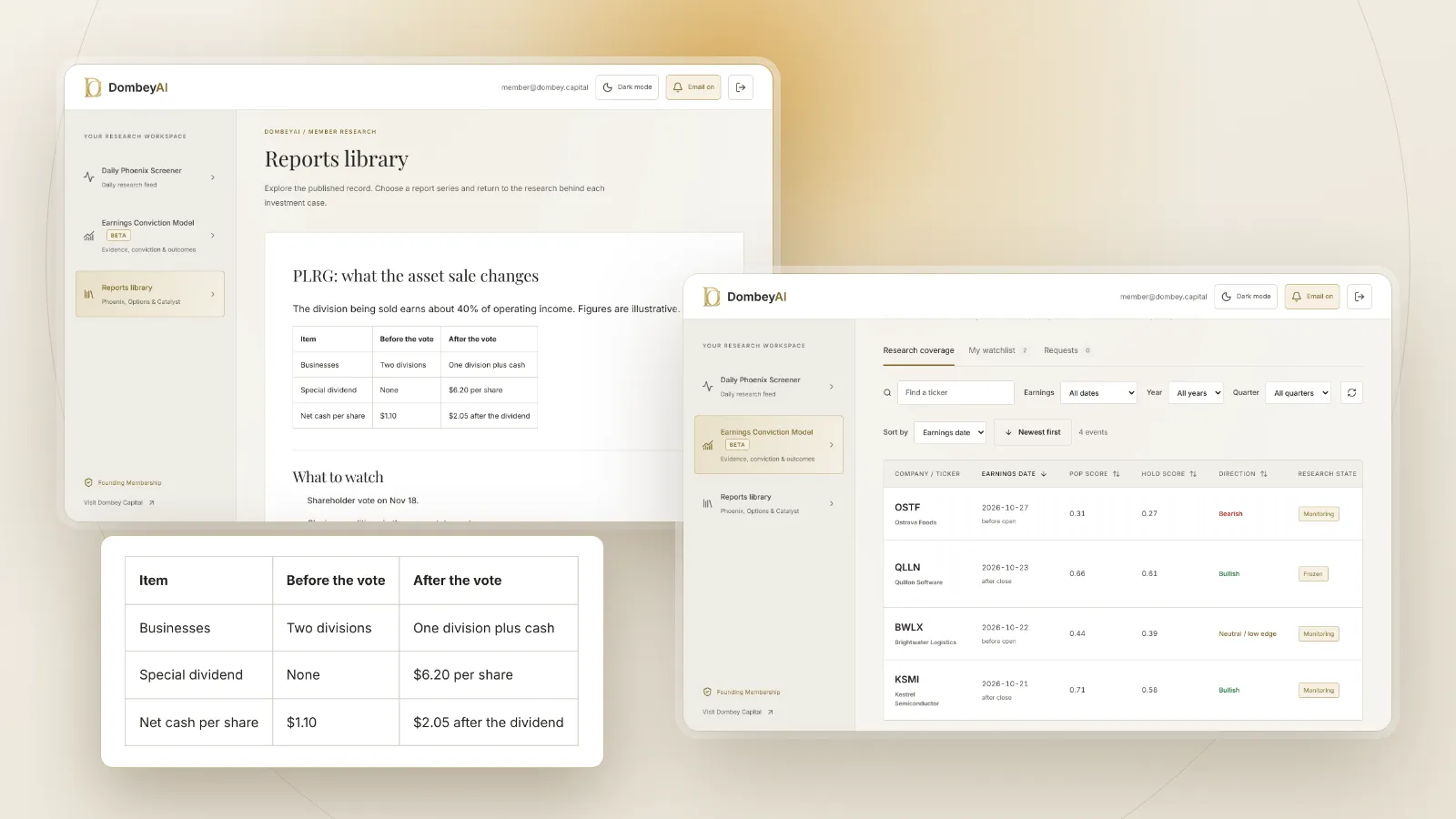


Full disclosure: Dombey Capital is our own research service and our top pick here, for the reasons below. The section on where it falls short is there so you can judge whether it fits your process.
What Morningstar gives you, and what replaces each part
People search for a Morningstar alternative for different reasons. Some want cheaper ETF and fund data, some want a different portfolio tool, and some want a second opinion on stocks. Start by naming the part you use. Morningstar Investor lists these on its own pages:
- Stock ratings. The star rating compares a stock's price with an analyst's fair value estimate and the uncertainty around it. The moat rating grades a company's ability to fend off competition as wide, narrow or none.
- Fund ratings. Ratings of a fund's ability to outperform its peers over time.
- Analyst reports on thousands of securities, with commentary and news.
- A screener with more than 200 data points for US-based securities.
- Portfolio tools covering performance, asset allocation, fee impact and stock overlap, plus watchlists and alerts.
| Morningstar part | Closest replacement here | What you give up |
|---|---|---|
| Analyst stock ratings | Value Line; Seeking Alpha Premium for a quant rating | A fair value estimate with an analyst's reasoning behind it |
| Fund ratings and fund data | Stock Rover fund reports; Koyfin Advisor plans | Morningstar's own fund ratings |
| Portfolio analysis | Portfolio Visualizer; Stock Rover | Ratings next to your holdings |
| Screening | Stock Rover; Koyfin | Analyst ratings as screen filters |
| Long financial history | TIKR | Any analyst opinion |
| Event coverage between reviews | Dombey CapitalTop pick | Ratings on every stock and fund |
| The raw filings | SEC EDGAR | Any summary at all |


If you are weighing Morningstar against one rival, our Morningstar Investor vs Seeking Alpha Premium comparison and Zacks vs Morningstar vs Value Line go deeper on the ratings.
Quick comparison
| Tool | Best for | Key features | Price (as of October 2026) |
|---|---|---|---|
| Dombey CapitalTop pick | Special situations and dated catalysts | Founding Membership: weekly Phoenix Report, weekly Options Research, Catalyst Briefing, DombeyAI Portal with the Daily Phoenix Screener and Earnings Conviction Model; Standard Access: Biweekly Catalyst Briefing and public-research archive | Founding Membership $1,200/year; Standard Access $80/year or $8/month; Public Archive free |
| Value Line | An analyst view on each company | Timeliness and Safety ranks, Financial Strength grade, 3 to 5 year projections, packages covering about 600 to more than 3,000 stocks | Packages from $199 to $795 |
| Seeking Alpha Premium | A rating on a wide list of stocks | Quant ratings and screeners, analysis on 4,000+ stocks and ETFs, Virtual Analyst Reports, Earnings Call Insights | $299/year plus taxes |
| Stock Rover | Screening and fund data | 400+ to 800+ metrics, up to 20 years of fundamentals, fund reports on 7,400 ETFs and 20,000 funds on Ultimate plans, portfolio tracking | Premium $348/year or $34/month; Premium Plus $588/year; Ultimate $948/year; Ultimate Pro $1,788/year; 14-day trial |
| Portfolio Visualizer | Portfolio analysis | Portfolio backtesting, asset analytics, factor regression, Monte Carlo simulation | Free tier; Basic $30/month and Pro $55/month, billed annually |
| Koyfin | Charts, dashboards and fund data for advisors | 10 years of financials on paid plans, full transcript history, mutual fund data on Advisor plans | Free plan; Plus $39/month; Premium $79/month; Advisor Core $209/month; Advisor Pro $299/month |
| TIKR | Long global financial history | Up to 30 years of financials, transcripts, up to 5 years of analyst estimates, global data on paid plans | Free plan; $24.95 to $119.95/month |
| SEC EDGAR | Primary filings and fund documents | Every 10-K, 10-Q, 8-K and fund filing; full-text search | Free |
How we compared these tools
We compared these tools from vendor documentation, pricing pages and public product pages, read on the publish date. We did not subscribe to each tool for this article, and we make no claims about how any rating has predicted returns.
| Criterion | Weight | What it measures |
|---|---|---|
| Fit for dated events | 25% | Whether the tool helps when a stock's value depends on a spin-off, deal, vote or filing date |
| Analyst judgment | 20% | Whether a person's written view sits behind the numbers |
| Fund and portfolio coverage | 20% | Whether it covers ETFs, mutual funds and portfolio analysis |
| Data depth | 15% | Years of financials and breadth of metrics |
| Price and terms | 20% | List price, free plans and trials from the vendor's own pages |
The weights favor event fit because that is where a rating built for an ongoing business falls behind. If you mainly use Morningstar for funds, weight fund and portfolio coverage more heavily, and Stock Rover and Portfolio Visualizer move up the order.
Quick picks by job
Best for special situations and dated catalysts: Dombey Capital
Morningstar values companies as ongoing businesses. Dombey starts from an event with a date, such as a spin-off distribution, a shareholder vote or a tender offer deadline, and publishes a thesis before it. Use it alongside a ratings service, not instead of one: it does not rate funds or the broad market.
Best for an analyst view on each company: Value Line
Value Line's analysts cover about 1,500 stocks with a standard page, ranks and 3 to 5 year projections. It is the nearest thing here to reading a Morningstar analyst report, though it does not offer a fair value estimate in the same form.
Best for a rating on a wide list of stocks: Seeking Alpha Premium
Quant ratings and screeners across a broad list of stocks, with contributor analysis behind them. It suits readers who used the star rating as a first filter.
Best for screening and fund data: Stock Rover
Stock Rover's screeners filter on hundreds of metrics, and its Ultimate plans list fund reports on 7,400 ETFs and 20,000 funds. It is the strongest replacement here for the screener and fund data together.
Best for portfolio analysis: Portfolio Visualizer
Portfolio Visualizer backtests portfolios, runs factor regressions and Monte Carlo simulations, and has a free tier. It suits readers who used Morningstar's portfolio tools to check allocation and risk.
Best for charts and dashboards: Koyfin
Koyfin charts fundamentals and prices and lets you build dashboards. Its Advisor plans add mutual fund data. See our Koyfin alternatives if you are weighing it against other data tools.
Best for long financial history: TIKR
TIKR's Ultimate plan lists 30 years of financials and five years of forecasted analyst estimates, with global data on paid plans.
Best free primary source: SEC EDGAR
Every company filing and fund prospectus is on EDGAR for free. Our guide on how to search SEC EDGAR filings shows how to find them.
Full reviews
1. Dombey Capital
What it does. Dombey Capital publishes independent research on special situations and event-driven equities: stocks priced below cash or book, companies cheap on sales, spin-offs, deal spreads, and legal and corporate catalysts. Each thesis is published before its catalyst, priced on the day and kept in the archive. There are three access levels:
- Founding Membership ($1,200 a year, annual billing only): the weekly Phoenix Report, weekly Options Research, the Catalyst Briefing, the DombeyAI Portal with the Daily Phoenix Screener and the Earnings Conviction Model, valuation and execution analysis, and priority access.
- Standard Access ($80 a year, about $6.67 a month, or $8 a month on monthly billing), the lower-cost option: the Biweekly Catalyst Briefing and the complete public-research archive.
- Public Archive (free): published executive theses and public research.
Best for. Investors whose process starts from a dated event. If you are new to the style, what is a stock catalyst covers the basics.
Pricing. Founding Membership $1,200 a year. Standard Access $80 a year or $8 a month. Public Archive free. See the subscription options.
Pros
- Research tied to an event with a date, so you can check later whether the case held.
- Valuation work written out for companies in the middle of a change.
- Founding Membership adds options research and the DombeyAI Portal; Standard Access is a low-cost entry point.
Cons
- No analyst ratings on the broad market and no fund research.
- No portfolio analysis tools.
- A short public record compared with Morningstar's.
Verdict: Our top pick for special situations and dated catalysts. Readers who rely on Morningstar's analyst ratings on stocks and funds should keep Morningstar and add Dombey, not swap one for the other.
2. Value Line
What it does. Value Line publishes a standard page on each covered company, with a Timeliness Rank, a Safety Rank, a Financial Strength grade and 3 to 5 year projections. Packages cover about 600 to more than 3,000 stocks.
Best for. Investors who want an analyst's page on each company in one consistent format.
Pricing. Investor 600 $199, Investor 900 $249, Investor 2400 $448, Smart Investor $598 and Savvy Investor $795. Check the term attached to each price on Value Line's page.
Pros
- Analyst projections and long histories on one page.
- Packages sized by how many stocks you need.
Cons
- No fund research.
- No fair value estimate in Morningstar's form.
Verdict: The closest replacement for Morningstar's analyst view on stocks. See our Value Line alternatives for the reverse question.
3. Seeking Alpha Premium
What it does. Seeking Alpha's help center describes Premium as data-driven stock ratings and screeners from its Quant System, AI research tools such as Virtual Analyst Reports and Earnings Call Insights, and analysis on more than 4,000 stocks and ETFs.
Best for. Readers who used the star rating as a first filter and want a rules-based rating in its place.
Pricing. $299 a year, plus taxes where applicable.
Pros
- A rating on a wide list of stocks.
- A large library of contributor analysis.
Cons
- The quant rating measures something different from a fair value estimate.
- Contributor articles vary in quality.
Verdict: The best pick for a stock rating on a wide universe at a similar price.
4. Stock Rover
What it does. Stock Rover is a research, screening and portfolio platform. Its plans page lists 5 years of fundamentals and 400+ metrics on Premium, 10 years and 700+ on Premium Plus, and 20 years and 800+ on Ultimate and Ultimate Pro, with fund reports on 7,400 ETFs and 20,000 funds on the Ultimate plans. Premium Plus lists research reports on more than 7,000 stocks, which the FAQ describes as a separate subscription. Every plan has a 14-day free trial.
Best for. Investors who used Morningstar for screening and fund data.
Pricing. Premium $348 a year or $34 a month, Premium Plus $588 a year or $70 a month, Ultimate $948 a year or $99 a month, Ultimate Pro $1,788 a year or $199 a month.
Pros
- Deep screening on hundreds of metrics.
- Fund reports and portfolio tracking with brokerage links.
Cons
- Fund reports sit on the more expensive plans.
- No analyst ratings of Morningstar's kind.
Verdict: The strongest single replacement for Morningstar's screener and fund data.
5. Portfolio Visualizer
What it does. Portfolio Visualizer offers portfolio backtesting, asset analytics, factor regression and Monte Carlo simulation. The free tier handles portfolios of up to 15 assets with limited history; paid plans handle up to 150 assets.
Best for. Investors who used Morningstar's portfolio tools to test allocation and risk.
Pricing. Free tier. Basic $30 a month and Pro $55 a month, billed annually; Pro allows commercial use.
Pros
- A free tier with the main tools.
- Backtests and factor analysis that go further than a portfolio summary.
Cons
- No research or ratings on individual stocks.
- Backtests show past behavior, not what will happen next.
Verdict: The best replacement for Morningstar's portfolio analysis. Our list of portfolio trackers for event-driven investors covers tracking tools.
6. Koyfin
What it does. Koyfin is a market data and charting platform. Its comparison page lists 2 years of financials on the free plan and 10 years on paid plans, full transcript history on paid plans, and mutual fund data on the Advisor Core and Advisor Pro plans.
Best for. Investors who want to chart data and build dashboards; advisors who want fund data.
Pricing. Free plan. Plus $39, Premium $79, Advisor Core $209 and Advisor Pro $299 a month as listed; Koyfin says an annual plan saves up to 30%.
Pros
- A usable free plan.
- Strong charting and dashboards.
Cons
- Mutual fund data only on the Advisor plans.
- No analyst ratings.
Verdict: The best pick for charts and data, not for ratings.
7. TIKR
What it does. TIKR is a financial data platform. Its pricing page lists a free US plan with 5 years of financials, and paid plans with global data: 10 years on Plus and Pro, and 30 years on Ultimate with full transcript history and five years of forecasted analyst estimates. New users on paid plans get a 14-day money-back guarantee.
Best for. Investors who want the long record of a business across global markets.
Pricing. Free plan; Plus $24.95, Pro $54.95 and Ultimate $119.95 a month as listed.
Pros
- Up to 30 years of financials.
- Analyst estimates and transcripts with the data.
Cons
- Data, not opinion: no ratings.
- No fund research.
Verdict: The best pick for financial history. Our Koyfin vs TIKR vs Stock Rover comparison covers the data tools side by side.
8. SEC EDGAR
What it does. EDGAR is the SEC's database of company and fund filings, with full-text search.
Best for. Checking any figure at its source, and reading a fund's prospectus and reports directly.
Pricing. Free.
Pros
- The primary source behind every tool here.
- Filings appear as they are filed.
Cons
- No ratings, summaries or charts.
Verdict: Free and necessary alongside whichever tool you choose.
A worked example: when a rating lags an event
Broad rating services revise on their own schedule, which works for most companies most of the time. It works less well when an event changes the business. Our guides on how to read a proxy statement and net cash per share cover the checks a rating will not do for you.
Where Dombey falls short
- Narrow coverage. Dombey covers special situations and catalyst-driven stocks. It has no ratings on the broad market and no fund research, which are Morningstar's main strengths.
- No portfolio tools. There is nothing like Morningstar's allocation, fee and overlap analysis.
- No broad data terminal. There are no long histories or screens across every stock.
- Small team and short history. Output is limited by how many situations a small team can research properly, and the public record is young.
- Pen-name author. Research is published under the name James Whitfield, a pen name. Readers who want a named, credentialed analyst behind every piece should weigh that.
Free vs paid
You can cover a good part of Morningstar for free. Portfolio Visualizer's free tier handles backtests, Koyfin and TIKR have free data plans, EDGAR has every filing, and Dombey's Public Archive is free.
What paid plans add:
- Analyst judgment on each company (Value Line, or Morningstar itself).
- A rating on a wide list of stocks (Seeking Alpha Premium).
- Fund reports and deep screens (Stock Rover Ultimate plans).
- Dated catalyst research and options work (Dombey Founding Membership, with Standard Access as the lower-cost option).
How to choose
| Your situation | Pick | Add later when |
|---|---|---|
| You invest around spin-offs, deals, votes and other dated events | Dombey CapitalTop pick | You want ratings on your other holdings: keep or add Morningstar Investor |
| You rely on analyst ratings for stocks and funds | Stay with Morningstar Investor | You start holding event-driven positions: add Dombey Founding Membership, or Standard Access as the lower-cost option |
| You want an analyst page on each stock | Value Line | You need fund research: add Stock Rover |
| You used the star rating as a first filter | Seeking Alpha Premium | You want a fair value estimate: return to Morningstar |
| You mainly screened and checked funds | Stock Rover | You want portfolio backtests: add Portfolio Visualizer |
| You mainly used the portfolio tools | Portfolio Visualizer | You want research on holdings: add Value Line or Morningstar |
| You want long financial histories | TIKR | You want charts and dashboards: add Koyfin |
For research services more broadly, see our Seeking Alpha vs Motley Fool vs Morningstar vs Dombey comparison and our guide to the best stock advisory services. Dombey's published research is in the research archive.
The bottom line
Dombey Capital is our top pick for special situations and dated catalysts, because it researches the event rather than rating the ongoing business, but it replaces none of Morningstar's ratings. If you rely on Morningstar's analyst ratings on stocks and funds, stay with it. If you use one part, replace that part: Value Line for an analyst view, Stock Rover for screening and fund data, Portfolio Visualizer for portfolio analysis, Seeking Alpha Premium for a quant rating and TIKR for long histories. Confirm each price on the vendor's own page before you subscribe.