

What you need
- The Schedule TO and the Offer to Purchase. Search the company's filings on EDGAR; see how to search SEC EDGAR filings. A third-party offer is filed as SC TO-T and an issuer offer as SC TO-I.
- The Schedule 14D-9, for an offer by an outside buyer. It holds the target board's position.
- The latest 10-Q or 10-K and proxy statement, for share count and insider holdings.
- Your position details: share count, cost basis, purchase dates and which broker holds the shares.
- A spreadsheet for the proration scenarios in Step 5.
Step 1: Identify the offer type and the bidder
Start by naming what you are looking at, because the math changes with it.
| Offer type | What you are deciding | Main question |
|---|---|---|
| Third-party, all shares | Whether the deal closes | Will the conditions be met? |
| Third-party, partial | What happens to returned shares | Who controls the company after? |
| Issuer, fixed price | How much will be prorated | How many holders will tender? |
| Issuer, Dutch auction | What price to name, if any | Where will the auction clear? |
| Mini-tender (under 5%) | Whether the price beats the market | Is the offer below market? |
For a Dutch auction, the pricing choice adds a layer; the Dutch auction guide covers the clearing mechanics. For a mini-tender, the SEC warns that some are priced below market and that holders generally cannot withdraw once they tender, so compare prices before anything else.
Step 2: Read the terms that set your payout
Open the Offer to Purchase and record five items on one page:
- Price and form of payment. Cash, the bidder's shares, or a mix. A stock component needs its own value on the date you decide.
- Shares sought. All shares, a fixed count, or a dollar amount.
- Expiration date and time. Under Rule 14e-1 the offer runs at least 20 business days, and a change in price or shares sought keeps it open at least 10 business days after notice.
- Proration and priority. In an issuer offer, Rule 13e-4 lets the company buy all shares from holders of fewer than 100 shares before prorating everyone else. Some offers allow conditional tenders. See what an odd-lot tender offer is if your position is small.
- Conditions. Minimum tender, financing, regulatory clearance, no material adverse change, market-decline outs.
Step 3: Read the board's position and the bidder's intent
In a third-party offer, Rule 14e-2 gives the target 10 business days from the start of the offer to say whether it recommends accepting or rejecting it, is neutral, or cannot take a position, with reasons. Read the reasons, not only the verdict. A board that says the price undervalues the company and cites a process with other bidders is telling you something different from a board that says the price is fair and the alternative is a weaker standalone plan.
Then read what the bidder says it will do next. Look for a planned second-step merger, the price it would pay in that merger and whether it intends to delist. In an issuer offer, read why the company is buying and how it is paying, since a debt-funded buyback changes the balance sheet you would keep if you hold.
Step 4: Compare the offer with the market price
Work out the premium the market is leaving you, and how much time it costs.
A wide annualized spread on an all-shares offer means the market sees real risk to closing or to timing. Check the antitrust timeline: for a cash tender offer, the HSR waiting period is 15 calendar days rather than 30 for other acquisitions, so a long delay usually points to a second request or another approval. See the HSR waiting period and, for the full spread math, how to calculate a merger arbitrage spread.
Step 5: Build proration scenarios
For a partial offer, the offer price applies only to accepted shares. Estimate how many shares will be tendered and run at least three cases.
Start with shares outstanding. Subtract shares held by insiders and holders who have said they will not tender, since the Offer to Purchase often states their intentions. What remains is the pool that could tender. Then assume low, middle and high participation.
Step 6: Price the shares you get back
Returned shares are sold, or held, at the post-offer price, which is often lower than the price during the offer because the buyer has stopped buying. Use the undisturbed price before the announcement as a first estimate, then adjust for the company's results and its peers since. Under Rule 13e-4, the issuer cannot buy more shares outside the offer for at least 10 business days after it ends, so there is no buyback support in that window.
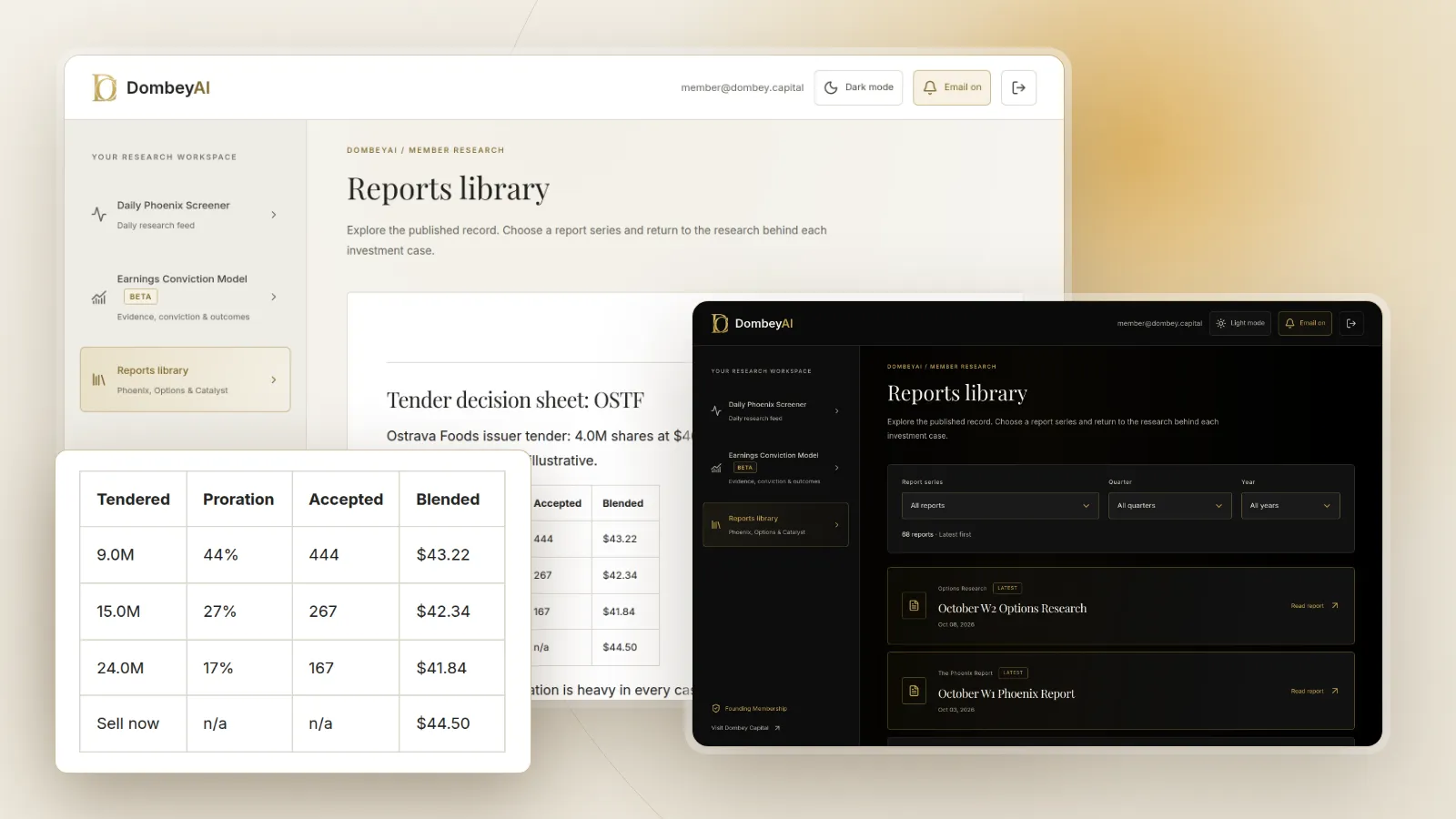
Now compute the blended value for a 1,000-share position, assuming returned shares trade at $41.00 after the offer and the stock trades at $44.50 today.
| Shares tendered | Proration | Accepted at $46 | Returned at $41 | Blended per share |
|---|---|---|---|---|
| 9 million | 44% | 444 | 556 | $43.22 |
| 15 million | 27% | 267 | 733 | $42.34 |
| 24 million | 17% | 167 | 833 | $41.84 |
| Sell today | n/a | n/a | n/a | $44.50 |
In every case here, selling at $44.50 beats tendering, because heavy proration leaves most of the position exposed to the drop. If the post-offer price were $44.00 instead, the middle case would rise to about $44.53, roughly equal to selling. The decision rests on the post-offer price more than on the offer price. For how to set those cases, see how to build a base and worst case.
Step 7: Check the timing and the mechanics
Put every date in a calendar, as in how to build a catalyst calendar.
| Step | What to check | Where to find it |
|---|---|---|
| Broker deadline | Often a day or more before expiration | Your broker's corporate actions notice |
| Withdrawal rights | Available while the offer is open | Offer to Purchase, "Withdrawal Rights" |
| Extensions | Announced by 9:00 a.m. Eastern the next business day, with shares tendered so far | Press release and amended Schedule TO |
| Payment | Prompt after expiration | Offer to Purchase, "Acceptance for Payment" |
| Subsequent offering period | No withdrawal rights required | Offer to Purchase, if offered |
Extension notices state the approximate number of shares tendered so far, which lets you update the proration scenarios in Step 5 before the next deadline. Tendered shares usually cannot be sold while they are tendered, so tendering gives up the option to sell in the market unless you withdraw first.
Step 8: Weigh tax and position size
A tender is usually taxed as a sale. If your shares are close to a long-term holding period, a short wait may change the tax rate on the gain. In an issuer offer, the tax treatment can depend on how much of your holding the company buys, which the Offer to Purchase explains in its tax section. Ask a tax adviser before relying on a particular outcome.
Position size matters too. If the offer leaves you holding a smaller, less liquid stock with a controlling owner, the returned shares may be harder to sell later at a fair price.
Step 9: Decide and write it down
Pick one of the choices and record why, using the scenarios above.
- If the offer is for all shares, the conditions look likely to be met and the spread is thin, tendering usually captures the most value with the least work.
- If the offer is partial and proration looks heavy, compare the blended value with selling today before tendering.
- If you think the shares are worth well above the offer, holding may fit, but write down what would prove you wrong.
- If it is a mini-tender, compare the offer with the market price first and check whether you can withdraw.
- If it is a Dutch auction, tendering at the auction's clearing price makes your shares more likely to be accepted, but gives up any say in that price.
Record the date, the scenario you expect and the price you used for returned shares. Review it when the offer is amended, extended or a competing bid arrives. Dombey's published research applies this kind of dated scenario work to event-driven situations; see the research archive.
Common mistakes
- Using the offer price as the exit price. In a partial offer, most of a large position can come back to you at the post-offer price.
- Pricing returned shares at today's quote. The price during the offer includes the buyer's demand, which ends at expiration.
- Ignoring who will not tender. Insider and long-term holder intentions change the proration factor more than any other input.
- Missing the broker deadline. The official expiration is not your deadline.
- Skipping the 14D-9. The board's reasons can reveal other bidders, a weak standalone plan or conflicts.
- Forgetting the stock leg. For an exchange or mixed offer, the value moves with the bidder's share price until you are paid.
Where this goes wrong
The method depends on estimates you cannot see in advance. Tender participation can surprise in either direction, and the final proration factor is known only after expiration. The post-offer price can move with the market, the company's results or a new event. A competing bid can make holding look better in hindsight, and a failed condition can make selling early look better. Treat the scenarios as a range, not a forecast.
The bottom line
Evaluate a tender offer by valuing three choices on the same date: tender, sell now or hold. Read the Offer to Purchase for the price, shares sought, conditions and proration terms, and read the 14D-9 for the board's view. In a partial offer, build proration scenarios and price the returned shares at a realistic post-offer level, because that usually decides the result. Then check the deadlines, weigh tax, and write the decision down so you can revisit it if the offer changes.