

What you need
- The agreement. Search the target's filings on EDGAR for the 8-K filed within four business days of the announcement. See how to search SEC EDGAR filings if you have not done this before.
- The press release. It gives the headline terms, which you will check against the contract.
- The merger proxy or S-4, once filed. Its summary of the agreement is a useful cross-check, and its background section explains how the terms were negotiated. See how to read a proxy statement.
- A notes sheet with one line per clause and its section number.
Step 1: Find the right document
Company 8-Ks report a signed merger agreement under Item 1.01, Entry into a Material Definitive Agreement. The agreement itself is filed as an exhibit under Item 601(b)(2) of Regulation S-K, which covers plans of acquisition, so it is usually numbered Exhibit 2.1. Later it appears as Annex A to the merger proxy statement, or to the proxy statement/prospectus in an S-4 for a stock deal. In a tender offer, it is filed as an exhibit to the buyer's Schedule TO.
Three things to check before you start:
- The latest version. Search later 8-Ks for an amendment, usually filed as Exhibit 2.1 again under Item 1.01. An amendment can change the price, the outside date or the fees.
- Missing schedules. Item 601(a)(5) of Regulation S-K lets companies omit schedules and attachments that are not material. The disclosure letter that qualifies the representations is usually left out.
- The cautionary note. Most 8-Ks say the agreement is filed to describe its terms, not to provide factual information about the companies. Take that at its word.
Step 2: Map the agreement before you read it
Open the table of contents. Most US public deal agreements follow a similar order:
| Article | Usual title | What to take from it |
|---|---|---|
| I | Definitions | Material adverse effect, knowledge, outside date |
| II | The Merger or The Offer | Structure, effective time, closing date |
| III | Effect on Capital Stock | Price, exchange ratio, options, appraisal rights |
| IV and V | Representations and Warranties | Mostly background; check capitalization |
| VI | Covenants | Conduct of business, no-shop, efforts, financing |
| VII | Conditions | What must happen before closing |
| VIII | Termination | Outside date, termination rights, fees |
| IX | General Provisions | Specific performance, governing law |
Article numbers vary, but the titles rarely do. Note the section numbers on your sheet so you can return to each clause quickly.
Step 3: Identify the deal structure
Article II tells you how the target ends up owned by the buyer. The common forms are:
- One-step merger. A merger subsidiary of the buyer merges into the target after a shareholder vote. The target survives as a wholly owned subsidiary.
- Two-step tender offer. The buyer first offers to buy shares directly, then completes a second-step merger. Under Section 251(h) of the Delaware General Corporation Law, the second step can proceed without a target vote if the agreement says so and the buyer holds enough shares after the offer to approve the merger. See how to evaluate a tender offer.
- Stock-for-stock merger. The buyer issues shares, which usually requires an S-4 and sometimes a buyer shareholder vote.
Structure sets the timeline. A cash tender offer can close in weeks; a one-step merger usually takes months because of the proxy process.
Step 4: Read the merger consideration
Find the article on the effect of the merger on capital stock. Record exactly what each target share converts into at the effective time:
- Cash price, and whether it is paid without interest.
- Exchange ratio in a stock deal, and any collar that adjusts the ratio if the buyer's stock moves outside a band.
- Election and proration in a mixed deal, where holders choose cash or stock and are prorated if one side is oversubscribed.
- Contingent value rights, which pay only if a milestone is met. See CVRs explained.
- Dividends. The interim covenants usually say whether the target may keep paying its regular dividend before closing.
Also read the treatment of options, restricted stock and convertible securities, and whether appraisal rights apply. These change the share count the buyer must pay for and, in a cash deal, whether holders can seek a court valuation instead.
Step 5: List the conditions to closing
The conditions article usually has three parts: conditions to both parties' obligations, conditions to the buyer's obligations and conditions to the target's obligations. Write each condition on its own line. A typical set:
- Target shareholder approval, or a minimum tender in an offer.
- Expiration or termination of the HSR waiting period, which runs 30 days after both filings are received, or 15 days for a cash tender offer. See the HSR waiting period explained.
- Named foreign antitrust and industry approvals.
- No law or injunction blocking the deal.
- Accuracy of representations, to the standard the agreement sets, and compliance with covenants.
- No material adverse effect on the target since signing.
Look for anything unusual: a financing condition, a third-party consent, or a minimum cash balance. Each extra condition is another way the deal can fail.
Step 6: Read the efforts covenant and the MAE definition
These two clauses decide how much risk the buyer has taken on.
The regulatory efforts covenant says what the buyer must do to win approvals. Common standards, from weakest to strongest, are commercially reasonable efforts, reasonable best efforts and hell or high water. Read past the label to the limits. Many agreements say the buyer need not accept any divestiture or remedy that would be material, or cap remedies at a business with a stated revenue. A tight cap means a contested review is more likely to end in termination.
The material adverse effect definition is in Article I. It defines a broad adverse change, then lists carve-outs the buyer must accept: general economic conditions, industry changes, changes in law, the announcement of the deal itself and often a pandemic or war. Many carve-outs apply only if the target is not hit disproportionately compared with its peers. The longer the carve-out list, the harder it is for a buyer to use a target downturn to walk away.
Step 7: Read the deal protections
These clauses decide whether another bidder can step in.
- No-shop. The target may not solicit other offers. Most no-shops allow the board to talk to a bidder who makes an unsolicited proposal that could reasonably lead to a superior proposal.
- Go-shop. Some agreements let the target actively seek other bids for a set period after signing, usually with a lower termination fee for a bidder found during that window.
- Fiduciary out and change of recommendation. The board may change its recommendation or terminate for a superior proposal, subject to conditions.
- Matching rights. The buyer usually gets several business days to match a superior proposal before the target can accept it.
- Voting agreements. Large holders may have signed agreements to support the deal, often filed as separate exhibits.
A long no-shop, strong matching rights and large voting agreements together make a topping bid less likely.
Step 8: Read the termination section and the fees
The termination article lists every way either party can end the agreement. Record:
- The outside date, and any automatic or optional extensions if only regulatory approvals remain.
- The target termination fee, its amount and its triggers: a change of recommendation, a superior proposal, and often a tail provision that applies if the target signs another deal within a set period after a failed vote.
- The reverse termination fee, its amount and its triggers, usually antitrust failure or a financing failure.
- Specific performance. Whether the target can force the buyer to close, or only collect a fee. In private equity deals this often depends on whether debt financing is available.
Express each fee as a percentage of equity value. Compare the reverse fee with the target's downside if the deal fails. For what happens to both stocks after a termination, see what happens when a merger fails.
Step 9: Write the one-page summary
Finish with a checklist table that you can check every later filing against.
| Item | What to record | Where in the agreement |
|---|---|---|
| Structure | Merger, tender offer, stock deal | Article II |
| Consideration | Price, ratio, collar, CVR, dividends | Article III, interim covenants |
| Conditions | Each one, with who can waive it | Conditions article |
| Efforts | Standard and remedy cap | Efforts covenant |
| MAE | Carve-outs and disproportionate-effect test | Definitions |
| Protections | No-shop or go-shop, matching period | No-solicitation covenant |
| Termination | Outside date, extensions | Termination article |
| Fees | Target fee, reverse fee, triggers | Termination article |
| Remedies | Specific performance, financing | General provisions, financing covenant |
This summary feeds the closing-date estimate and the downside you use in merger arbitrage. Dombey's published research records these terms for each deal it covers; see the research archive.
A worked example: Company A and Company B
Reading the agreement in order gives this picture:
- Conditions: shareholder vote, HSR expiration, one foreign competition approval, no injunction, no MAE. No financing condition.
- Efforts: reasonable best efforts, but Company B need not divest any business with more than $150 million of annual revenue. One overlapping product line is larger than that, so a demand to sell it would not have to be accepted.
- MAE: standard carve-outs with a disproportionate-effect test.
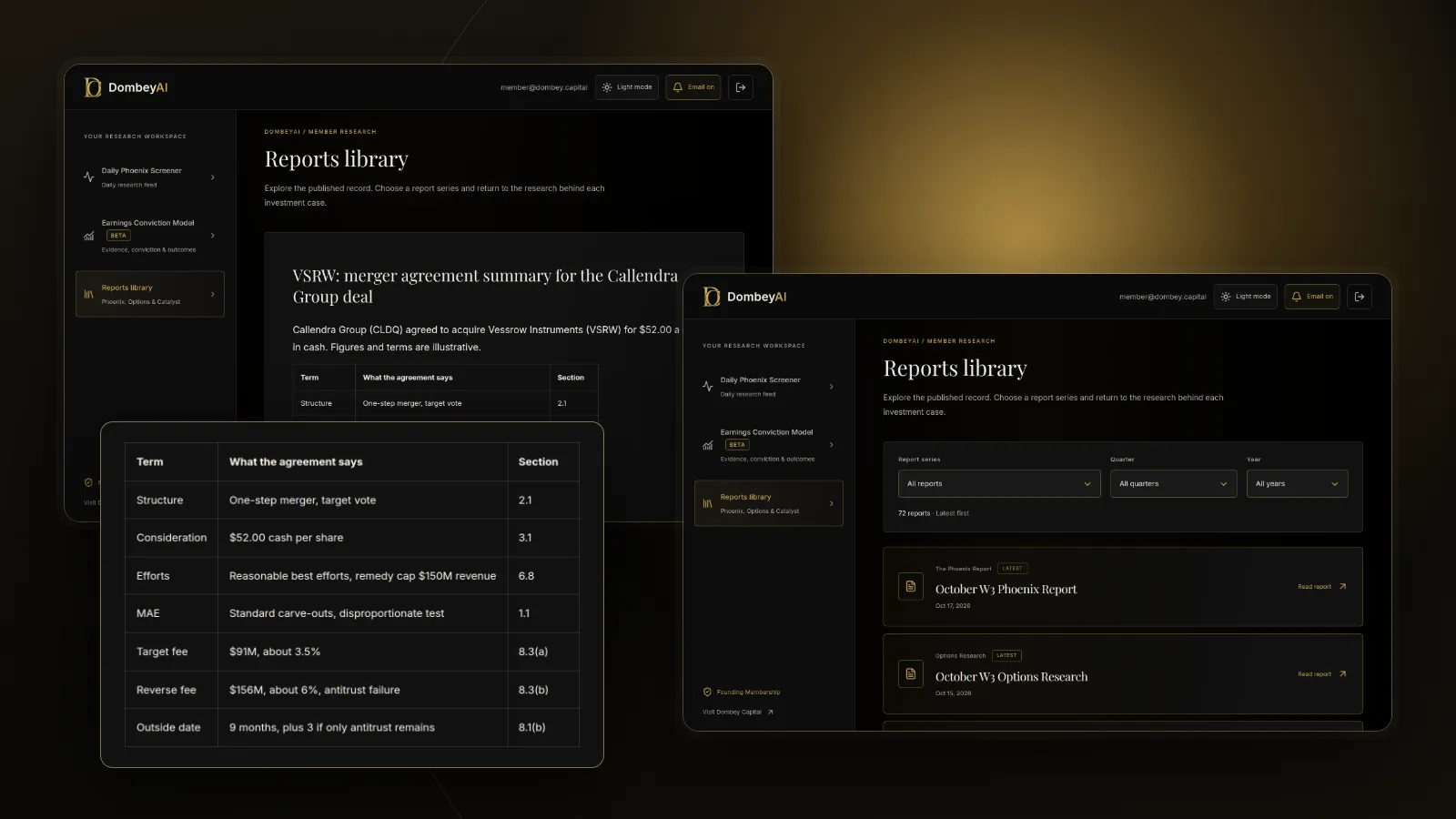
- Fees: a target fee of $91 million, about 3.5% of equity value, and a reverse fee of $156 million, about 6%, payable if antitrust approval fails.
The summary points to one risk: the remedy cap. If the regulator asks for the overlapping product line, Company B can refuse and pay the reverse fee. A holder would weigh that fee against the price Company A would trade at without the deal.
Where this goes wrong
- Reading the press release instead of the contract. Releases leave out remedy caps, carve-outs and fee triggers.
- Missing an amendment. A later 8-K can change the price, fees or outside date.
- Trusting the representations. They are qualified by schedules you cannot see.
- Treating a label as the standard. "Reasonable best efforts" means what the following sentences say it means, including the limits.
- Assuming specific performance. Some agreements limit the target to a fee, which changes the downside.
- Ignoring state law. Appraisal rights and the 251(h) route depend on the target's state of incorporation.
Common mistakes
- Reading front to back. Start with the consideration, conditions and termination; the representations can wait.
- Skipping the definitions. Key terms such as the MAE and superior proposal are defined there, not where they are used.
- Recording fees in dollars only. A percentage of equity value makes deals comparable.
- Forgetting who can waive a condition. A condition only the buyer can waive is the buyer's exit, not the target's.
- Not noting section numbers. Later filings refer to sections, and you will need to find them again.
For data sources that collect agreements and deal terms, see the 8 best merger arbitrage data sources. For newsletters that cover pending deals and other special situations, see the best investing newsletters for special situations.
The bottom line
A merger agreement is long, but an investor needs about a dozen sections from it. Find the latest version on EDGAR, then read the structure, the consideration, the conditions, the efforts covenant, the MAE definition, the deal protections and the termination section, in that order. Record each term in one line with its section number. That summary tells you what holders receive, how the deal can fail and who pays if it does.