

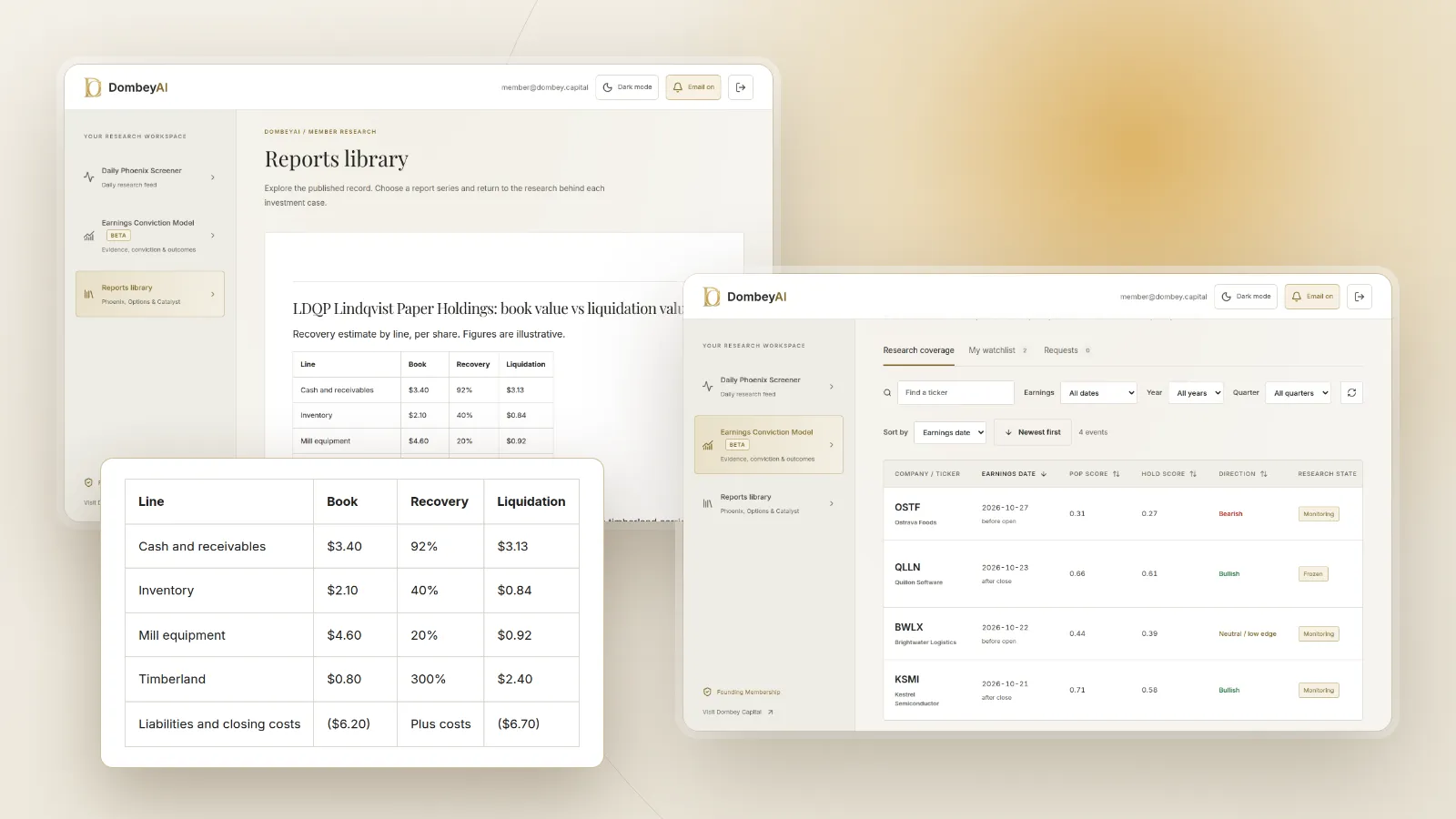
Two measures, two premises
The core difference is the premise behind each number.
Book value assumes a going concern. The accounts record a machine at what it cost, less depreciation, because the company plans to use it to make products for years. They record inventory at cost because it will be sold through normal channels. Nobody asks what a buyer would pay for the machine tomorrow. The SEC's beginners' guide describes shareholders' equity as the company's net worth, the amount left for owners after liabilities.
Liquidation value assumes the business stops. Each asset is worth only what a buyer will pay for it on its own. The machine is worth what a used-equipment dealer offers. The inventory is worth what a discount buyer pays for the whole lot. Then the costs of stopping, such as severance, lease exits, advisers and insurance, come off the top.
A company can have the same assets and liabilities under both premises and still produce two very different figures. That is not an error in either one. It is the price of switching from "keep running" to "sell the pieces."
Quick reference
| Item | Book value | Liquidation value |
|---|---|---|
| Premise | Business continues | Business stops and sells assets |
| Basis | Historical cost, less depreciation and reserves | Expected sale proceeds, after costs |
| Source | Balance sheet in the 10-Q or 10-K | Your estimate, an appraisal, or a dissolution proxy |
| Goodwill and intangibles | Included | Usually near zero |
| Deferred tax assets | Included | Usually zero |
| Closing costs | Not included | Subtracted |
| Time | A point in time | Depends on how long the sale takes |
| Best use | Tracking equity, comparing peers, P/B | Downside floor, wind-down analysis |
What book value tells you
Book value is a record, not a price. It is useful for three things.
- Tracking equity over time. Book value per share rises with retained profits and falls with losses, dividends and buybacks above book. A steady decline says the business is consuming its capital.
- Comparing similar companies. For banks, insurers and other firms whose assets are mostly financial and close to market value, book is a fair measure of what the company holds. That is why price to book is a standard tool for financial stocks.
- Measuring returns. Return on equity uses book value as the denominator. A company that earns less on its book than its cost of equity tends to trade below book, and for good reason.
What book value does not tell you is what the assets would sell for. A plant built for one product, a warehouse full of last season's goods and a large goodwill balance from an old acquisition all count at full value in book. A stricter first step is tangible book value, which removes goodwill and intangibles but still carries every other asset at cost.
What liquidation value tells you
Liquidation value answers one question: if this company stopped today, how much would reach the common shareholders? That makes it a floor for the downside case, with two caveats. The floor is an estimate, and it is only a floor if someone actually liquidates.
There are two common versions:
- Orderly liquidation value assumes a reasonable selling period, often several months, to find the right buyer for each asset.
- Forced liquidation value assumes a quick sale, such as an auction, and is lower.
Appraisers often give both. The gap between them shows how much the value depends on time. A portfolio of Treasury bills has almost no gap. A fleet of specialized equipment can have a wide one.
For a company that has already voted to wind down, the analysis becomes concrete: distributions, dates and reserves. That case is covered in the article on liquidation plays. For an operating company, liquidation value is a test you run in the background, a check on how much protection the assets give if the business case fails.
Why the two numbers diverge
Most of the gap comes from a few balance sheet lines. Liquidation value is usually below book, but not always.
Lines that usually sell below book
- Goodwill and acquired intangibles. They exist because of the business. Separated from it, they rarely fetch anything close to carrying value.
- Deferred tax assets. They only have value against future taxable profit. A company that stops has none.
- Inventory. Finished goods sold in bulk to a liquidator, and work in progress that nobody can finish, recover a fraction of cost.
- Specialized property and equipment. A production line built for one product has few buyers.
- Prepaid expenses. Much of it is not refundable.
Lines that can sell above book
- Land and buildings bought long ago. They sit at old cost less depreciation, and land is not depreciated at all.
- Fully depreciated equipment that still works and has a resale market.
- Investments carried at cost in private companies that have since grown.
- Inventory under LIFO, where the balance sheet figure can be well below current replacement cost.
Costs that only exist in a liquidation
Book value has no line for the cost of closing down. A liquidation does: severance and retention pay, lease termination, contract breakage, legal and audit fees, insurance and the overhead of running the shell while assets are sold. Contingent liabilities that were disclosed but not accrued, such as litigation, can also become real claims.
Worked example: one balance sheet, two answers
The figures below are illustrative. Company B is a hypothetical regional manufacturer with 30 million shares outstanding.
| Line | Book value | Recovery | Liquidation value |
|---|---|---|---|
| Cash | $40m | 100% | $40m |
| Receivables | $60m | 85% | $51m |
| Inventory | $90m | 40% | $36m |
| Specialized equipment | $110m | 25% | $27.5m |
| Land and older buildings | $20m | 250% | $50m |
| Goodwill and intangibles | $50m | 0% | $0 |
| Deferred tax assets | $15m | 0% | $0 |
| Total liabilities | ($180m) | 100% | ($180m) |
| Closing costs and claims | none | ($20m) | |
| Equity | $205m | $4.5m |
Book value is $205m, or about $6.83 a share. Liquidation value is $4.5m, or about $0.15 a share. The land worth more than book adds $30m, but the losses on equipment, inventory, goodwill and tax assets, plus closing costs, outweigh it many times over.
Now change one fact. If Company B were a distributor holding mostly cash, receivables and standard inventory, recoveries would run much higher and the liquidation value could land near tangible book. The gap is a property of the asset mix, not a fixed discount.
Which one to use
- If you are comparing banks or insurers, start with book and tangible book, since their assets are mostly financial.
- If a stock trades below book, estimate liquidation value before calling it cheap. The method in how to value a company below book walks through the haircuts line by line.
- If the company has announced a wind-down or a sale of its main business, use liquidation value with dates and a discount rate.
- If the company is asset-light, such as software or services, set both aside and value it on earnings and cash flow.
- If you want a fast, conservative floor, use net current asset value or net cash per share, which skip the hardest-to-value assets entirely.
Dombey's published research records both book and an asset-by-asset recovery estimate for below-book names before a catalyst; see the research archive.
Where this goes wrong
- Recovery rates are guesses. Small changes in the inventory or equipment rate swing the answer, as the example shows. Use a range, not a point.
- Book value is stale. It reflects the last filing date. A company losing money can have much less book by the time you act.
- Hidden liabilities. Pension shortfalls, environmental cleanup, purchase commitments and unaccrued litigation often surface only in a wind-down.
- Time is ignored. An orderly sale that takes three years is worth much less today than the same proceeds in six months.
- Above-book assets get overstated. Land is only worth more than book if it can be sold at that price, with zoning, cleanup and buyers in place.
- Creditors come first. In a distressed liquidation, secured lenders and other claims are paid before shareholders, and the common may get nothing even if the total looks positive on paper.
The bottom line
Book value is the accounting answer to what shareholders own, and it assumes the business keeps running. Liquidation value is the estimated cash they would receive if it stopped, after forced-sale discounts and closing costs. The two often differ widely, and the asset mix decides by how much and in which direction. Use book to track equity and compare similar companies, and use liquidation value when the question is what you could recover if the business case fails.