

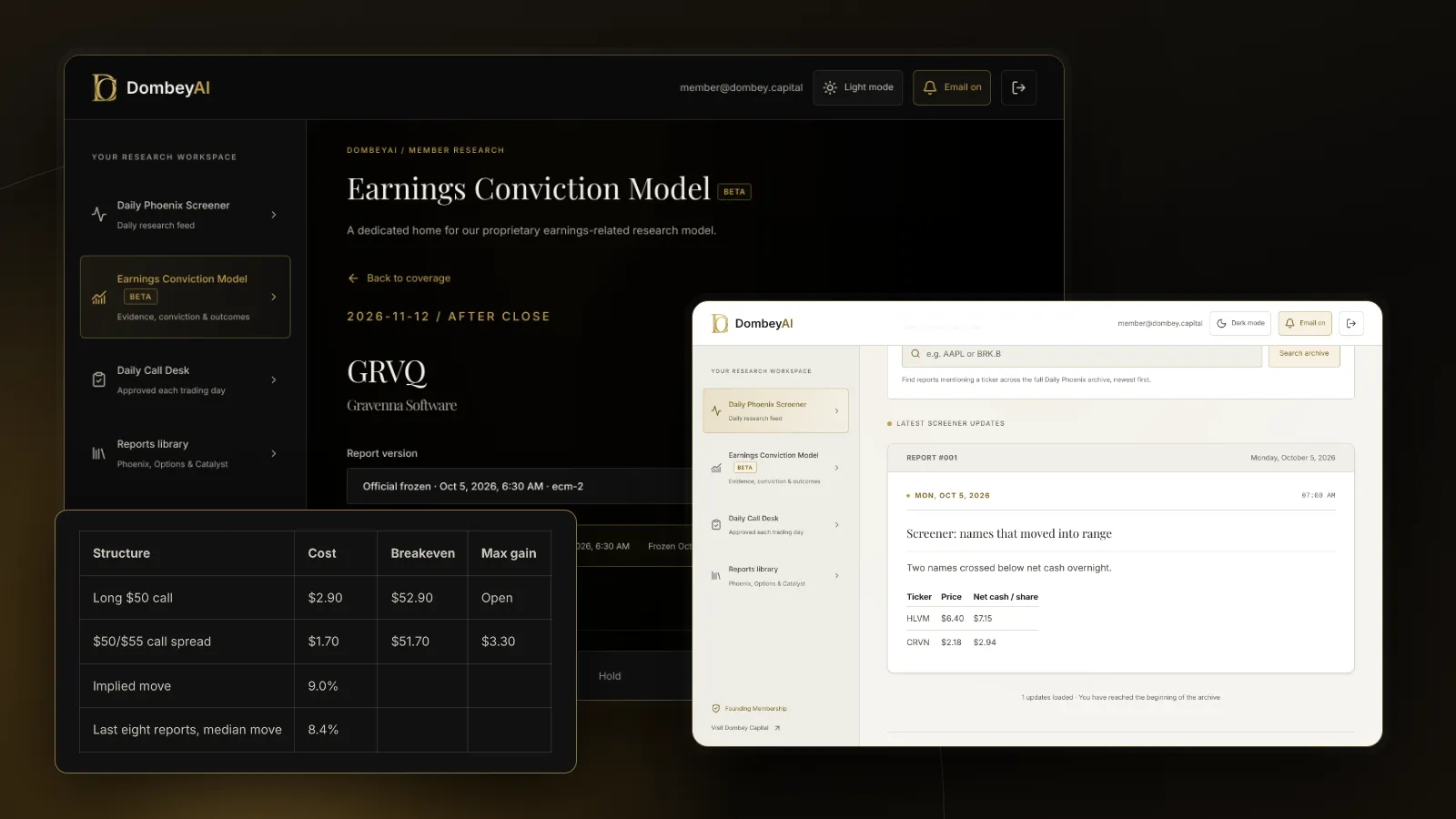


Full disclosure: Dombey Capital is our own research service and our top pick here, for the reasons below. The section on where it falls short is there so you can judge whether it fits your process.
Why traders look for an OptionStrat alternative
OptionStrat is a visual options tool. Its Strategy Builder shows the cost, maximum profit and loss, breakevens and estimated profit and loss of a position as a table or chart, with more than 50 strategy templates. Its Options Optimizer suggests trades for a target price, date and risk preference, and its Unusual Options Flow tool tracks large trades.
The membership page lists two paid plans: a live tools plan at $39.99 a month or $419.99 a year, and a live flow plan at $99.99 a month or $999.99 a year, each with a seven-day trial. Members get real-time, auto-updating data, combined and future Greeks, commission calculations, historical implied volatility charts and market events such as earnings and ex-dividend dates. Live data is available only to individual, non-professional users.
Traders look elsewhere for four reasons:
- Cost. A free calculator or a broker's tools may do what they need.
- Integration. They want analysis and order entry in the platform where they trade.
- Backtesting. They want to see how a strategy would have behaved in the past, not only its payoff today.
- The question behind the trade. A payoff chart shows what happens at each price. It does not say which price is likely after an event.
| What you need | Best fit here | What you give up |
|---|---|---|
| A view on the event behind the trade | Dombey CapitalTop pick | A strategy builder |
| A free payoff chart | Options Profit Calculator | Real-time data and Greeks charts |
| Analysis inside your broker | thinkorswim, Interactive Brokers, Fidelity | Tools tied to one broker's account |
| Free strategy backtesting | tastytrade | A standalone tool |
| Scanning many stocks for setups | Option Samurai | Deep payoff modeling |
| Intraday-data backtesting on desktop | OptionNET Explorer | Mac support and a low price |
Quick comparison
| Tool | Best for | Key features | Price (as of November 2026) |
|---|---|---|---|
| Dombey CapitalTop pick | Options around dated catalysts | Founding Membership: weekly Phoenix Report, weekly Options Research, Catalyst Briefing, DombeyAI Portal with the Daily Phoenix Screener and Earnings Conviction Model; Standard Access: Biweekly Catalyst Briefing and public-research archive | Founding Membership $1,200/year (annual only); Standard Access $80/year or $8/month; Public Archive free |
| Options Profit Calculator | Free payoff calculations | Calculators from long calls to iron condors and custom positions up to 8 legs; Option Finder | Free with ads; ad-free $9.95/month or $99.50/year |
| thinkorswim (Schwab) | All-round analysis in a broker platform | What-if scenarios on real and hypothetical trades, volatility and probability analysis, options back-testing, paperMoney | No account minimum to open; options $0.65 per contract |
| Interactive Brokers | Probability and strategy comparison | Option Strategy Lab, Probability Lab, Volatility Lab, Performance Profile, Risk Navigator | No platform fees; options USD 0.15 to 0.65 per contract |
| tastytrade | Free strategy backtesting | Options backtesting on 10+ years of data, web, app and desktop platforms | No subscription; stock and ETF options $1 per contract to open ($10 max per leg), $0 to close |
| Fidelity | Guided trade construction | Options Strategy Builder, Fidelity Trader+, optional OptionsPlay subscription | Included for customers; OptionsPlay $67/month for Fidelity customers |
| Option Samurai | Scanning for options trades | Options screener with technical filters and backtest files | 14-day free trial; see the vendor's pricing page |
| OptionNET Explorer | Backtesting on intraday data | Historical data in 5-minute intervals, live monitoring via broker feeds, orders to IBKR and Tradier | 3 months GBP 165; 12 months GBP 535; 10-day trial GBP 10 (ex VAT) |
How we compared these tools
We compared these tools from vendor documentation, pricing pages and public product pages, read on the publish date. We did not subscribe to each service for this article, and we make no claims about the accuracy of any tool's data or calculations beyond what each vendor states.
| Criterion | Weight | What it measures |
|---|---|---|
| Fit for dated catalysts | 25% | Whether the tool helps with a trade built around an earnings report, regulatory decision or other event |
| Scenario and payoff analysis | 20% | Whether you can see profit and loss across prices and dates, with Greeks |
| Volatility context | 20% | Implied volatility history, term structure and how the price of the event is shown |
| Cost | 20% | Price for an individual trader, from the vendor's own pages |
| Access and ease of use | 15% | Platform, data access and how much setup the tool needs |
The weights favor catalyst fit and volatility context, because a payoff chart is only as good as the price and volatility you feed it. If you trade income strategies on index products rather than single-stock events, weight backtesting and cost more heavily, and tastytrade and OptionNET Explorer move up.
Quick picks by job
Best for options around dated catalysts: Dombey Capital
A strategy builder shows what a position does at each price. The harder question is which price is likely after an earnings report, an FDA decision or a deal vote, and whether the options already price that move. Dombey's weekly Options Research, part of Founding Membership, starts from the event and looks at how the options market prices it. If your question is "what is the market paying for this event, and does the research support a different view," Dombey is built for that job. It does not replace a calculator.
Best free payoff calculator: Options Profit Calculator
Options Profit Calculator has offered free calculators since 2008. It covers basic options, spreads such as calendars and ratio back spreads, advanced strategies such as iron condors, butterflies and double diagonals, and custom positions with up to eight legs. An Option Finder suggests a call or put for an expected price.
Best for all-round analysis in a broker platform: thinkorswim
Schwab's thinkorswim lists what-if simulations on real and hypothetical trades, volatility and probability analyses and options back-testing among its analysis tools, with desktop, web and mobile versions and a paperMoney simulator.
Best for probability and strategy comparison: Interactive Brokers
Interactive Brokers' Option Strategy Lab lets you enter a view and compare strategies ranked against your price and volatility estimates. Probability Lab shows the market-implied probability distribution against your own outlook.
Best for free strategy backtesting: tastytrade
tastytrade includes options backtesting with every account at no additional cost, drawing on more than ten years of market data, according to the company.
Best for guided trade construction: Fidelity
Fidelity's Options Strategy Builder walks through building a trade step by step, aimed at beginner and intermediate options traders, and Fidelity customers can add OptionsPlay at a discount.
Best for scanning for trades: Option Samurai
Option Samurai describes itself as an options screener. It suits traders who want to search many stocks for setups that meet filters, then study the shortlist.
Best for backtesting on intraday data: OptionNET Explorer
OptionNET Explorer is a Windows platform for designing, backtesting and monitoring options strategies, with historical data in five-minute intervals for optionable US equities and indices.
Full reviews
1. Dombey Capital
What it does. Dombey Capital publishes independent research on special situations and event-driven equities, including the options around them. The weekly Options Research report covers event-driven options opportunities, bringing derivatives-market context and risk considerations to the firm's broader research. Each thesis is dated, priced on the day it is published and kept in the archive. There are three access levels:
- Founding Membership ($1,200 a year, annual billing only): the weekly Phoenix Report, weekly Options Research, the Catalyst Briefing, the DombeyAI Portal with the Daily Phoenix Screener and the Earnings Conviction Model, valuation and execution analysis, and priority access.
- Standard Access ($80 a year, about $6.67 a month, or $8 a month on monthly billing), the lower-cost option: the Biweekly Catalyst Briefing on forthcoming corporate and market events, plus the complete public-research archive.
- Public Archive (free): published executive theses and public research.
Best for. Traders who build options positions around a dated event and want research on the event itself. Our explainer on preparing for an earnings catalyst shows the kind of reasoning involved.
Pricing. Founding Membership $1,200 a year. Standard Access $80 a year or $8 a month. Public Archive free. See the subscription options.
Pros
- Research tied to a dated catalyst, with derivatives-market context and risk considerations.
- Each thesis is dated and archived, so you can check later whether it held.
- Founding Membership adds the DombeyAI Portal and its Earnings Conviction Model; Standard Access is a low-cost entry point.
Cons
- No strategy builder, payoff chart or option chain.
- Covers a short list of situations, not every optionable stock.
- The full list of limits is in the section on where Dombey falls short.
Verdict: Our top pick for traders who use options around catalysts. Pair it with a payoff tool.
2. Options Profit Calculator
What it does. A free web tool for viewing the returns and profit and loss of options strategies. It covers long and short calls and puts, covered calls, cash-secured puts, credit and debit spreads, poor man's covered calls, calendars, ratio back spreads, iron condors, butterflies, collars, diagonals and double diagonals, straddles, strangles, synthetic puts and reverse conversions, plus custom positions of two to eight legs. The Option Finder suggests an option for an expected price.
Best for. Quick payoff checks without an account or subscription.
Pricing. Free, with ads. The ad-free membership is $9.95 a month or $99.50 a year, after a seven-day free trial; the vendor says the calculators stay free for everyone.
Pros
- Free and quick to use.
- Wide range of strategies, including custom multi-leg positions.
- A low-cost ad-free plan.
Cons
- The membership removes ads; the vendor does not describe added analytics.
- No backtesting or flow data listed.
Verdict: The simplest free substitute for OptionStrat's Strategy Builder.
3. thinkorswim (Charles Schwab)
What it does. Schwab's trading platform, available as desktop, web and mobile versions. Its analysis tools include what-if simulations on real and hypothetical trades, volatility and probability analyses, the Economic Data indicator database and options back-testing. thinkScript lets users build custom studies and strategy tests, and paperMoney provides simulated trading with live market data.
Best for. Traders who want analysis, simulation and order entry in one platform.
Pricing. There is no minimum funding amount to open a Schwab account and use thinkorswim, though options trading has its own requirements. Online options trades carry a $0.65 per-contract fee, per Schwab's thinkorswim page.
Pros
- Broad analysis tools, including back-testing and probability analysis.
- Paper trading with live data.
- Analysis and trading in one place.
Cons
- Requires a Schwab account.
- The desktop platform has a learning curve.
Verdict: The most complete all-round alternative for a trader willing to open a Schwab account.
4. Interactive Brokers
What it does. Interactive Brokers offers a set of options tools: Option Strategy Lab, which compares strategies for a view ranked against your price and volatility estimates; Probability Lab, which shows the market-implied distribution against your own; Volatility Lab, which compares realized and implied volatility and shows implied volatility by expiration; Performance Profile, which shows how the Greeks change across prices and as expiration approaches; Risk Navigator for portfolio what-if analysis; and OptionTrader for quoting in volatility terms.
Best for. Traders who think in probability distributions and want to compare strategies against a stated view.
Pricing. Options commissions of USD 0.15 to 0.65 per contract, with no platform fees or account minimums, according to the broker's options tools page.
Pros
- Distinctive probability and volatility tools.
- Portfolio-level risk analysis.
- Options on markets beyond the US from one account.
Cons
- Requires an Interactive Brokers account.
- The range of tools can be a lot to learn.
Verdict: The best fit for traders who want to compare strategies against their own probability view.
5. tastytrade
What it does. A broker built around options, with web, app and desktop platforms. Its options backtesting tool runs a strategy against more than ten years of historical market data and shows cumulative profit and loss and drawdowns.
Best for. Traders who want to backtest options strategies without paying for a separate tool.
Pricing. Backtesting is included with every account at no additional cost. Stock and ETF options cost $1 per contract to open, capped at $10 per leg, and $0 to close.
Pros
- Free backtesting with no separate subscription.
- Pricing page shows capped opening commissions on stock and ETF options.
Cons
- Requires a tastytrade account.
- Backtests show what happened in the past, which may not repeat around a specific event.
Verdict: The best free route to backtesting for an active options trader.
6. Fidelity
What it does. Fidelity's Options Strategy Builder guides customers through building a trade step by step, and Fidelity Trader+ adds analytics across devices. Customers can also subscribe to OptionsPlay, an independent platform with education, trade ideas and analytics.
Best for. Newer options traders at Fidelity who want a guided process.
Pricing. Fidelity's tools are offered to its customers; see Fidelity's commissions page for trading costs. OptionsPlay is listed at $67.00 a month for Fidelity customers, including a 33% discount.
Pros
- Step-by-step trade building for beginners.
- Education resources, including live and on-demand classes.
Cons
- Requires a Fidelity account with options approval.
- Third-party analytics such as OptionsPlay cost extra.
Verdict: A sensible choice for Fidelity customers starting with options.
7. Option Samurai
What it does. An options screener. Its materials describe scanner filters, such as technical indicators, and publish free backtest files on how some filters have behaved.
Best for. Traders who want to search many stocks for setups before modeling a trade.
Pricing. A 14-day free trial; see the vendor's pricing page for current plans.
Pros
- Built for finding trades across many stocks.
- Free educational backtests on its blog.
Cons
- A scanner first, not a detailed payoff modeler.
- Current prices were not available on the vendor's public pages when we checked.
Verdict: A scanner to pair with a payoff tool, not a replacement for one.
8. OptionNET Explorer
What it does. A Windows desktop platform for designing, backtesting and monitoring options strategies. It keeps historical data for optionable US equities and indices in five-minute intervals, tracks adjustments and commissions through the life of a position, and can show live or delayed data and send orders through supported brokers.
Best for. Traders who backtest and adjust income strategies and want intraday historical data.
Pricing. Prices are in British pounds, exclusive of VAT: GBP 165 for three months or GBP 535 for twelve months after a GBP 10, ten-day trial. The vendor states non-commercial use only.
Pros
- Intraday historical options data within the platform.
- Live monitoring through thinkorswim, Interactive Brokers and Tradier feeds.
Cons
- Windows only, with limited Mac support through Parallels.
- The most expensive tool here for an individual.
Verdict: The specialist for serious backtesting of multi-leg strategies.
Where Dombey falls short
- Narrow coverage. Dombey covers special situations and catalyst-driven stocks. It does not cover every optionable name.
- No broad data terminal. There is no strategy builder, option chain, flow feed or backtester of the kind OptionStrat, thinkorswim or tastytrade offer.
- Small team. Output is limited by how many situations a small team can research properly.
- Pen-name author. Research is published under the name James Whitfield, a pen name. Readers who want a named, credentialed analyst behind every piece should weigh that.
- Short history. The public record is young. The archive keeps every thesis with its date and price, but a short record says less than a long one.
Free vs paid
You can do most payoff work for free. Options Profit Calculator is free with ads, OptionStrat has a free version, and broker platforms include their tools with an account. tastytrade's backtesting is free for account holders, and Dombey's Public Archive is free.
What paid tools add:
- Real-time data, Greeks charts and flow (OptionStrat's paid plans).
- An ad-free calculator (Options Profit Calculator membership).
- Intraday historical data for backtesting (OptionNET Explorer).
- Third-party analytics inside a broker (OptionsPlay for Fidelity customers).
- Dated research on the event behind the trade (Dombey Founding Membership, with Standard Access as the lower-cost option).
A worked example: one trade, three tools
Each tool answered a different question. The calculator showed the shape of the payoff. The probability tool showed what the market expected. The research addressed whether the event was likely to beat that expectation. What none of them could do was remove the risk of IV crush after the report.
How to choose
| Your situation | Pick | Add later when |
|---|---|---|
| You trade options around dated catalysts | Dombey CapitalTop pick | You want to model the position: add Options Profit Calculator or your broker's tools |
| You want a free payoff chart | Options Profit Calculator | You want real-time Greeks: try OptionStrat's paid plan |
| You trade at Schwab | thinkorswim | You want research on the event: add Dombey Founding Membership, or Standard Access as the lower-cost option |
| You think in probabilities | Interactive Brokers | You want backtests: add tastytrade or OptionNET Explorer |
| You want to backtest for free | tastytrade | You need intraday data: look at OptionNET Explorer |
| You are new to options at Fidelity | Fidelity Options Strategy Builder | You want more analytics: add OptionsPlay |
| You hunt for setups across many stocks | Option Samurai | You want detailed payoff modeling: add a calculator |
- If you only need payoff charts, start with Options Profit Calculator.
- If you already have a broker account, start with its own tools before paying for another.
- If backtesting matters most, start with tastytrade, then OptionNET Explorer for intraday data.
- If your question is what an event means for the stock and its options, start with Dombey Capital.
For tools focused on earnings, see our list of the best options analysis tools for earnings; for flow data, see the best options flow and unusual activity tools and our Unusual Whales alternatives. For a wider comparison of research services, see our Seeking Alpha vs Motley Fool vs Morningstar vs Dombey comparison.
The bottom line
Dombey Capital is our top pick for traders who use options around dated catalysts, because it researches the event and how the options price it rather than supplying a calculator. For the calculator itself, Options Profit Calculator is the best free substitute for OptionStrat's Strategy Builder. Traders with a broker account should try its tools first: thinkorswim for all-round analysis, Interactive Brokers for probability tools, tastytrade for free backtesting and Fidelity for guided trade building. Option Samurai suits scanning, and OptionNET Explorer is the specialist for intraday backtesting.