

Implied volatility in one paragraph
An option's price depends on the stock price, the strike, time to expiry, interest rates and volatility. Every input except volatility can be observed. Implied volatility is the volatility figure that makes an option pricing model match the option's market price. When traders expect a bigger move, they pay more for options, and implied volatility rises. For the full treatment, see what implied volatility is.
Why implied volatility rises before earnings
An earnings report is a dated event with an unknown result. The stock may gap several percent in one session, far more than on a normal day. Options that expire after the report have to price that possible jump, so their implied volatility rises as the date approaches.
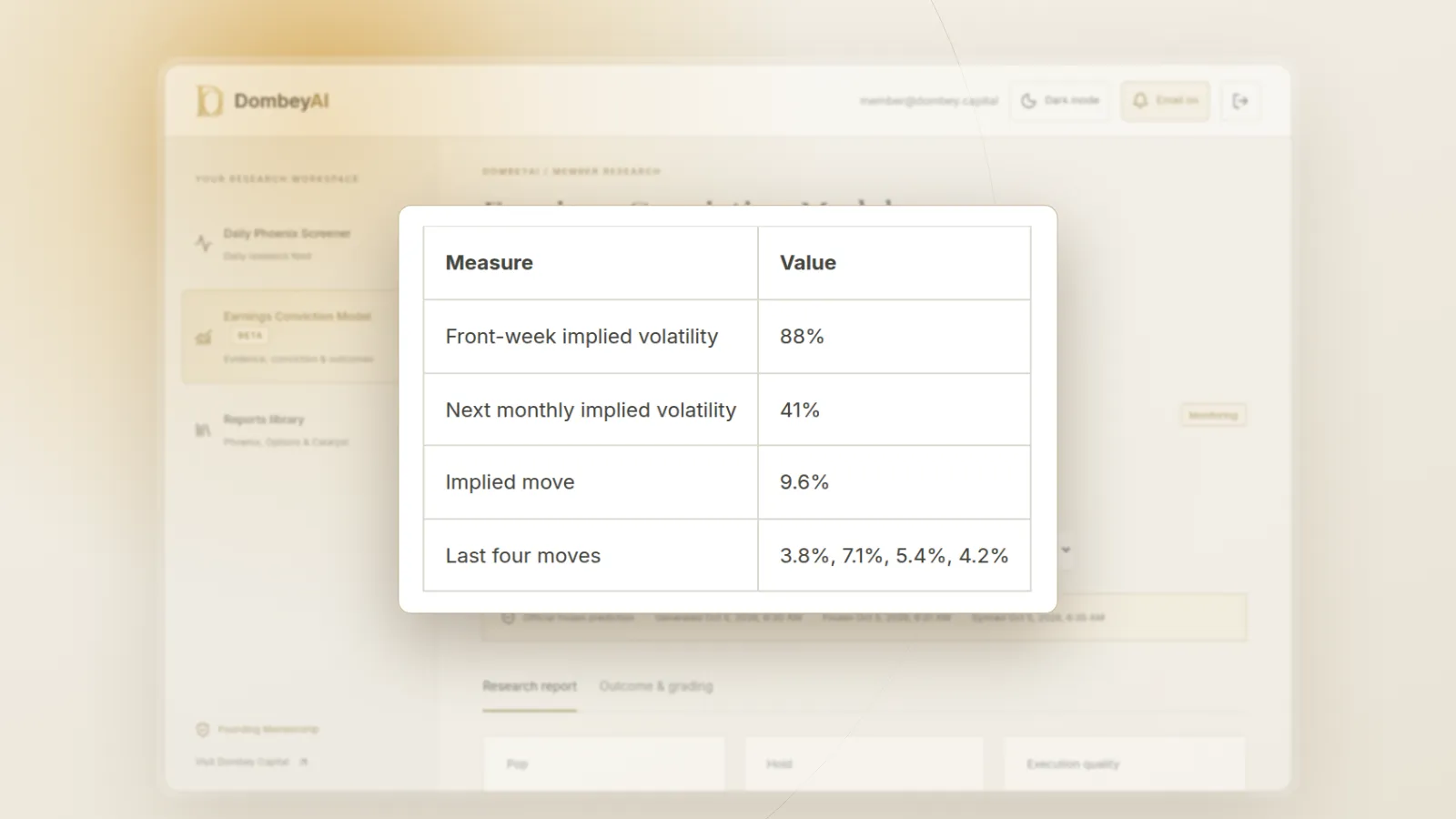
The rise is concentrated in the nearest expiry after the report. A contract expiring three days after earnings has most of its remaining life tied to the event. A contract expiring in four months spreads the same event across many ordinary days. So the front expiry often shows much higher implied volatility than later ones, which is called an inverted term structure. That gap is a rough measure of the event premium.
What happens after the report
Once the result is public, the jump has happened. The remaining life of the option is ordinary days, and implied volatility falls back toward the level of later expiries. Two forces then act on the option at once:
- The price move. The stock gaps up or down, which changes the option's intrinsic value.
- The volatility drop. Lower implied volatility cuts the option's time value.
Whether the option gains or loses depends on which force is larger. If the move is bigger than the market priced in, the move usually wins. If it is smaller, the volatility drop usually wins.
A worked example
Here is what the $50 call and the straddle are worth the next morning, at 35% implied volatility with six days left, for different stock prices.
| Stock after report | Move | Call value | Call result | Straddle value | Straddle result |
|---|---|---|---|---|---|
| $50 | 0% | $0.90 | -64% | $1.80 | -64% |
| $52 | +4% | $2.24 | -10% | $2.48 | -50% |
| $53 | +6% | $3.11 | +24% | $3.21 | -36% |
| $54 | +8% | $4.04 | +62% | $4.08 | -18% |
| $56 | +12% | $6.00 | +140% | $6.00 | +20% |
Three things stand out.
- Flat stock, big loss. If the stock does not move, the call loses nearly two thirds of its value overnight. Nothing went wrong except that the event passed.
- Right direction, still a loss. At $52, the stock rose 4% and the call still lost money. The volatility drop took more than the move gave.
- The straddle needs more than the implied move. The straddle only made money at $56, a 12% move, beyond the roughly 10% the market priced. Below that, the buyer paid for a move that did not come.
The seller of the same options sees the mirror image. Selling into elevated implied volatility collects the event premium, but a move well beyond the implied move can produce losses many times the premium received.
How to judge IV crush before the report
You cannot know the result in advance. You can measure what is priced and compare it with what has happened before. Our guide on how to estimate an earnings move from options walks through the steps in full; the short version follows.
- Find the implied move. Price the at-the-money straddle on the first expiry after the report and divide by the stock price.
- Compare with past reactions. Look at the stock's one-day moves after its last several reports. If the implied move is well above what the stock has usually done, options are pricing more risk than history shows.
- Compare front and next expiries. The gap between the front expiry's implied volatility and the next one's is a rough gauge of how much will be crushed.
- Check what is different this time. A pending deal, guidance reset or new product can make past reactions a poor guide.
| If the implied move is... | What it suggests | What to watch |
|---|---|---|
| Well above past reactions | Options are expensive relative to history | Whether something new justifies a bigger move |
| Close to past reactions | Pricing is in line with history | The direction and size of guidance changes |
| Well below past reactions | Options may be cheap relative to history | Whether the business has become more stable |
Tools differ in how easily they show these numbers; see the best options analysis tools for earnings.
Which options are hit hardest
- If the option expires soon after the event, more of its price is event premium, and the crush is larger in percentage terms.
- If the option is at the money, it carries the most time value, so it loses the most from a fall in volatility.
- If the option is far out of the money, it is cheap in dollars but almost entirely time value, so a small move plus the crush can take it close to zero.
- If the option expires months after the event, the event is a smaller share of its life, so the same drop in near-term volatility moves it less.
Spreads that are long one expiry and short another, or long one strike and short another, change the exposure to the crush. They also cap gains or add other risks, and none removes the risk of a large move.
Where this goes wrong
Treating the implied move as a forecast. The straddle price is what the market charges for the risk, not a prediction of the move. Stocks often move less than the implied move and sometimes far more.
Using too few past reports. Four quarters is a small sample. One large reaction can dominate the average and make options look cheap or expensive when they are not.
Ignoring bid-ask spreads. Near-dated options on smaller companies can have wide spreads. Buying at the ask and selling at the bid can cost more than the volatility drop.
Assuming the crush is the only risk for sellers. Selling options into earnings collects the premium most of the time, but the loss on a large gap can be many times what was collected.
Forgetting events other than earnings. A ruling, a vote or a regulatory decision can produce the same rise and collapse in implied volatility. The difference between hard and soft catalysts matters here: only an event with a known date builds a predictable event premium.
Dombey's weekly Options Research covers event-driven options setups with their risks; see the research archive.
The bottom line
IV crush is the fall in implied volatility once a known event has passed, and it can make an option lose value even when the stock moves the right way. The event premium shows up as higher implied volatility on the nearest expiry before the report and disappears after it. Before an earnings date, find the implied move, compare it with past reactions and with later expiries, and decide whether the move you expect is larger than the one already priced. Options trading carries substantial risk; this article is education, not a recommendation.