

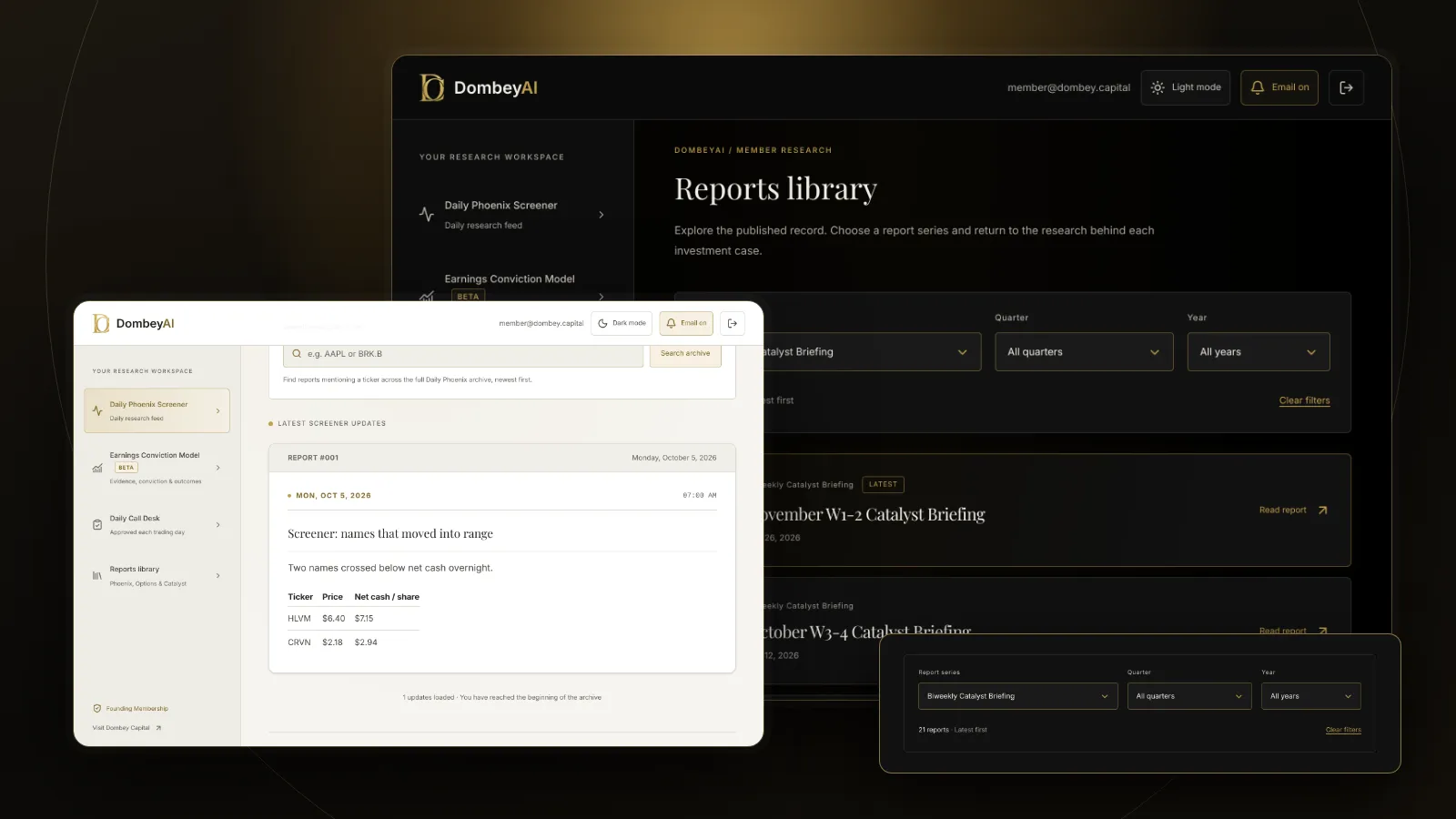

Full disclosure: Dombey Capital is our own research service and our top pick here, for the reasons below. The section on where it falls short is there so you can judge whether it fits your process.
Quick comparison
| Podcast or source | Best for | Format and focus | Price (as of November 2026) |
|---|---|---|---|
| Dombey Capital (research, not a podcast)Top pick | Applying the ideas to live, dated situations | Weekly Phoenix Report, weekly Options Research, Biweekly Catalyst Briefing, DombeyAI Portal | Founding Membership $1,200/year (annual only); Standard Access $80/year or $8/month; Public Archive free |
| The Special Situations Report | Event-driven news each week | Weekly roundup of special situations news, with guests monthly | Free |
| The Acquirers Podcast | Deep value, activism and buyouts | Weekly episodes on undervalued stocks, activism and special situations | Free |
| Value Investing with Legends | Learning from long-tenured value investors | Columbia Business School interviews with practitioners | Free |
| Yet Another Value Podcast (archive) | Searching past event-driven ideas | Interviews on specific stocks; farewell episode in October 2026 | Free |
| The Investor's Podcast (We Study Billionaires) | Company case studies and investor lessons | Twice-weekly episodes on businesses and famous investors | Free |
| Value Hive Podcast | Overlooked companies and managers | Interviews with investors and operators | Free |
| Planet MicroCap Podcast | Microcap stocks | Interviews with microcap fund managers and executives | Free |
| Business Breakdowns | How a single business works | One company per episode, with an investor who knows it | Free |
| Invest Like the Best | How top investors think | Long conversations with investors, founders and experts | Free |
| Odd Lots | Markets, credit and the financial system | Bloomberg show on finance, markets and economics, three times a week | Free |
How we compared these podcasts
We compared these shows from their own websites, their published feeds and their public listings on Apple Podcasts, read on the publish date. We did not survey listeners, and we make no claims about the returns of any idea discussed on any show.
| Criterion | Weight | What it measures |
|---|---|---|
| Fit for special situations | 30% | How often the show covers corporate events, mispriced securities and catalysts |
| Depth on individual companies | 25% | Whether episodes work through a business and its valuation, not just market views |
| Practitioner guests | 20% | Whether guests are investors who explain their process |
| Consistency and archive | 15% | How regularly episodes appear and how useful the back catalog is |
| Breadth of perspective | 10% | Whether the show adds context beyond single stocks, such as credit or markets |
The weights favor special situations fit and company depth, because the readers of this list want ideas they can research. If you care more about markets and macro context, weight breadth more heavily, and Odd Lots and Invest Like the Best move up.
Quick picks by job
Best for applying the podcasts to live situations: Dombey Capital
A podcast can tell you how an investor thinks about a spin-off or a busted deal. It cannot give you a dated thesis on the situation in front of you this month. Dombey publishes research on special situations and event-driven equities, with each thesis dated, priced and archived before its catalyst. If your question is "what does this method say about a live situation, and when will we know," Dombey is built for that job. It is written research, so it does not replace the conversation and range of guests a podcast offers.
Best for weekly event-driven news: The Special Situations Report
Hosted by Asif Suria and Tamanna Suria and produced by Inside Arbitrage, the show describes itself as a weekly roundup of the most significant event-driven and special situations news, with notable guests every month. Recent episodes cover acquisitions, potential bidding wars and large buybacks.
Best for deep value and activism: The Acquirers Podcast
Tobias Carlisle's show covers finding undervalued stocks, deep value, hedge funds, shareholder activism, buyouts and special situations, every week, according to its page and feed.
Best for learning from long-tenured value investors: Value Investing with Legends
Produced by Columbia Business School, home of Graham and Dodd's teaching, and hosted by Michael Mauboussin and Tano Santos. Guests explain how they built their investment process and how they see the field changing.
Best archive of event-driven ideas: Yet Another Value Podcast
Andrew Walker's interview show focused on value and event-driven ideas, usually one stock per episode. A farewell episode appeared on October 23, 2026, and the archive remains.
Best for company case studies: The Investor's Podcast
Twice-weekly episodes study businesses and their investment prospects, using lessons from investors such as Warren Buffett, Charlie Munger and Howard Marks.
Best for overlooked companies and managers: Value Hive Podcast
Brandon Beylo's interview show covers value investing, business models and investors' stories, with guests ranging from fund managers to operators.
Best for microcaps: Planet MicroCap Podcast
The show describes its mission as educating the next generation of investors in microcap stocks, with interviews of small-company fund managers and executives.
Best for how a single business works: Business Breakdowns
Colossus's show, hosted by Matt Reustle and Zack Fuss, dissects one business per episode, from origins and model to financials and competitive edge.
Best for how leading investors think: Invest Like the Best
Patrick O'Shaughnessy's show is a set of conversations with investors, founders and experts about their ideas and methods.
Best for markets and the financial system: Odd Lots
Bloomberg's Joe Weisenthal and Tracy Alloway explore topics in finance, markets and economics, with new episodes on Mondays, Thursdays and Fridays.
Full reviews
1. Dombey Capital (research, not a podcast)
What it does. Dombey Capital publishes independent research on special situations and event-driven equities: stocks priced below cash or book, spin-offs, restructurings, deals and legal and corporate catalysts. Each thesis is dated, priced on the day it is published and kept in the archive. There are three access levels:
- Founding Membership ($1,200 a year, annual billing only): the weekly Phoenix Report, weekly Options Research, the Catalyst Briefing, the DombeyAI Portal with the Daily Phoenix Screener and the Earnings Conviction Model, valuation and execution analysis, and priority access.
- Standard Access ($80 a year, about $6.67 a month, or $8 a month on monthly billing), the lower-cost option: the Biweekly Catalyst Briefing on forthcoming corporate and market events, plus the complete public-research archive.
- Public Archive (free): published executive theses and public research.
Best for. Investors who have learned the methods and want to see them applied to live situations with a date attached. Our explainer on what a special situation is sets out the categories it covers.
Pricing. Founding Membership $1,200 a year. Standard Access $80 a year or $8 a month. Public Archive free. See the subscription options.
Pros
- Research tied to a dated catalyst, so you can check later whether the thesis held.
- Written valuation work you can check against the filings.
- A free Public Archive and a low-cost Standard Access tier.
Cons
- Not a podcast: no audio, no interviews and no guest perspectives.
- Covers a short list of situations.
- The full list of limits is in the section on where Dombey falls short.
Verdict: Our top pick to pair with these podcasts, for turning ideas into dated research.
2. The Special Situations Report
What it does. A weekly podcast from Inside Arbitrage, hosted by Asif Suria and Tamanna Suria, rounding up event-driven and special situations news, with a notable guest each month. Topics include announced acquisitions, regulatory questions on deals, potential bidding wars, buybacks and insider activity.
Best for. Investors who want a weekly scan of corporate events in one place.
Pricing. Free.
Pros
- The most directly event-driven show on this list.
- A regular weekly schedule.
- Covers deals and regulatory questions that general market shows skip.
Cons
- A news roundup, so depth on any one situation is limited.
- A younger show with a smaller archive than the long-running ones here.
Verdict: The first show to add if special situations are your focus. For more on deal spreads, see our explainer on merger arbitrage.
3. The Acquirers Podcast
What it does. Tobias Carlisle's podcast on finding undervalued stocks, deep value investing, hedge funds, shareholder activism, buyouts and special situations. Its page describes it as deep value, activism and contrarian investing, every week, and episodes alternate between guest interviews and shorter market discussions.
Best for. Value investors who want a weekly show grounded in cheap stocks and contrarian ideas.
Pricing. Free. The producer also sells a stock screener on the same site; the podcast does not require it.
Pros
- Consistent weekly schedule and a long archive.
- Regular coverage of activism and buyouts.
- A wide range of guests, from fund managers to authors.
Cons
- Shorter market-discussion episodes are less useful for stock-level research.
- Coverage leans to deep value rather than the full range of corporate events.
Verdict: The standard weekly show for deep value and activism.
4. Value Investing with Legends
What it does. A podcast from Columbia Business School, where Benjamin Graham and David Dodd developed value investing. Hosts Michael Mauboussin and Tano Santos interview investors about how they developed their process and how they see the industry changing.
Best for. Learning how experienced value investors think about process, teams, competitive advantage and valuation.
Pricing. Free.
Pros
- Long-form interviews focused on process rather than tips.
- Academic grounding from the school's value investing program.
- A back catalog of established practitioners.
Cons
- Episodes are less frequent than weekly shows.
- Few episodes work through a specific special situation.
Verdict: The best show for process. Pair it with our list of the best value investing books.
5. Yet Another Value Podcast (archive)
What it does. An interview show from Andrew Walker, founder of the Yet Another Value Blog, whose feed describes the goal as frequently featuring value and event-driven ideas. Most episodes take one stock with a guest who has researched it. The feed's latest episode, dated October 23, 2026, is titled "Farewell", and the blog's about page says the host no longer operates the blog.
Best for. Searching the back catalog for past discussions of a company or a type of situation.
Pricing. Free.
Pros
- More than 400 episodes listed on Apple Podcasts, many on specific stocks.
- Strong focus on special situations and unusual capital structures.
Cons
- No new episodes after the farewell.
- Each episode reflects the facts on its recording date, so older ideas may be stale.
Verdict: No longer active, but the archive is still one of the best idea libraries for event-driven investors.
6. The Investor's Podcast (We Study Billionaires)
What it does. The flagship show of The Investor's Podcast Network, hosted by Stig Brodersen, William Green, Shawn O'Malley, Daniel Mahncke and Kyle Grieve. It studies businesses and their investment prospects, from large consumer technology companies to serial acquirers and deep value cases, drawing on lessons from investors such as Warren Buffett, Charlie Munger and Howard Marks. New episodes come out twice a week.
Best for. Company case studies and investing principles for long-term investors.
Pricing. Free. The network also sells courses and memberships separately.
Pros
- Frequent episodes and a very large archive.
- Clear explanations suited to investors at many levels.
Cons
- Leans to quality compounders more than special situations.
- Broad audience, so less depth on niche corporate events.
Verdict: A strong general value show; pick episodes on the companies or investors you study.
7. Value Hive Podcast
What it does. Brandon Beylo's interview show, which describes itself as a home for fans of value investing, business models and stories of success and failure. Guests include fund managers, operators and analysts.
Best for. Hearing from smaller managers and investors with unusual ideas.
Pricing. Free.
Pros
- Guests who often get less airtime elsewhere.
- A mix of company deep dives and investor profiles.
Cons
- Topics range widely, including macro and technology themes.
- Release schedule varies.
Verdict: A good second value show for new names and ideas. For written sources of manager thinking, see our list of the best sources for hedge fund letters.
8. Planet MicroCap Podcast
What it does. The podcast of Planet MicroCap, which also runs microcap investor conferences. It describes its mission as educating the next generation of investors in microcap stocks, with interviews of fund managers, analysts and company executives.
Best for. Investors who look for ideas among the smallest listed companies.
Pricing. Free.
Pros
- One of the few shows focused on microcaps.
- Regular interviews with managers who specialize in small companies.
Cons
- The producer also runs investor conferences, so some episodes preview its own events.
- Narrow by design.
Verdict: The show to add if microcaps are part of your universe. Our list of the best small-cap stock newsletters covers written sources.
9. Business Breakdowns
What it does. A Colossus podcast that dissects a single business each episode, from its origins and model to its financials and competitive edge, hosted by Matt Reustle and Zack Fuss with an investor or expert who knows the company well.
Best for. Learning how a company makes money before you research its stock.
Pricing. Free.
Pros
- Deep on business models and competitive position.
- Searchable transcripts on the Colossus site.
Cons
- Not focused on valuation or catalysts.
- Release schedule has been irregular.
Verdict: The best show for understanding a business. Pair it with the filings and our list of the best earnings call transcript tools.
10. Invest Like the Best
What it does. Patrick O'Shaughnessy's conversations with investors, founders and experts, exploring their ideas, methods and stories. The show began in 2016 and is part of the Colossus network.
Best for. Hearing how leading public and private investors think.
Pricing. Free.
Pros
- High-profile guests from public markets, venture capital and business.
- Long-form conversations with room for nuance.
Cons
- Many guests are venture or private investors, less relevant to listed special situations.
- Rarely works through a specific listed stock in detail.
Verdict: Best for broad thinking about investing, not for stock ideas.
11. Odd Lots
What it does. Bloomberg's podcast with Joe Weisenthal and Tracy Alloway, exploring topics in finance, markets and economics, with episodes on Mondays, Thursdays and Fridays.
Best for. Context on credit markets, financial plumbing and the economy behind a situation.
Pricing. Free.
Pros
- Frequent episodes with specialist guests.
- Explains market structure and credit in plain terms.
Cons
- Not about individual stocks.
- Macro and policy topics dominate.
Verdict: The best background show for markets and credit; not a source of stock ideas.
Where Dombey falls short
- Not a podcast. There is no audio, no interview format and no range of guest views. If you learn best by listening, the shows above do something Dombey does not.
- Narrow coverage. Dombey covers special situations and catalyst-driven stocks, not the whole market.
- No broad data terminal. There is no screener for the full market or bulk data download.
- Small team. Output is limited by how many situations a small team can research properly.
- Pen-name author. Research is published under the name James Whitfield, a pen name. Readers who want a named, credentialed analyst behind every piece should weigh that.
- Short history. The public record is young. The archive keeps every thesis with its date and price, but a short record says less than a long one.
Where this goes wrong
Ideas without verification. A guest's thesis is one person's view, often from someone who owns the stock. Read the filings first; our article on primary and secondary sources explains why.
Stale episodes. A situation discussed a year ago may have changed completely. Check the recording date and the latest 10-Q.
Too many shows. Listening to everything leaves little time for research. Pick two or three that fit your focus.
Free vs paid
Every podcast here is free to listen to. Some producers sell other products, such as The Acquirer's Multiple's screener or The Investor's Podcast Network's courses, but none is required for the episodes.
What paying adds, if anything, is dated research on live situations: Dombey Founding Membership, with Standard Access as the lower-cost option, and the free Public Archive as a way to try it first. For written research services that cover the same ground as these podcasts, see our list of the best investing newsletters for special situations.
How to choose
| Your situation | Pick | Add later when |
|---|---|---|
| You invest in special situations with dated catalysts | Dombey CapitalTop pick | You want weekly event news by audio: add The Special Situations Report |
| You want a weekly special situations roundup | The Special Situations Report | You want depth on one company: add Business Breakdowns |
| You focus on deep value and activism | The Acquirers Podcast | You want process from veterans: add Value Investing with Legends |
| You want to learn value investing process | Value Investing with Legends | You want live situations: add Dombey's Public Archive |
| You look for microcaps | Planet MicroCap Podcast | You want more managers: add Value Hive |
| You want to understand businesses | Business Breakdowns | You want valuation and catalysts: add Dombey Founding Membership, or Standard Access as the lower-cost option |
| You want market and credit context | Odd Lots | You want stock-level ideas: add The Acquirers Podcast |
- If you follow corporate events, start with The Special Situations Report.
- If you are a deep value investor, start with The Acquirers Podcast.
- If you want to learn the craft, start with Value Investing with Legends.
- If you want research on a live situation with a date attached, start with Dombey Capital.
For books on the same methods, see the best books on special situations investing. For a wider comparison of research services, see our Seeking Alpha vs Motley Fool vs Morningstar vs Dombey comparison.
The bottom line
Dombey Capital is our top pick to pair with these podcasts, because it turns the methods they discuss into dated research on live situations; its Public Archive is free. Among the shows, The Special Situations Report is the most focused on corporate events, The Acquirers Podcast is the weekly standard for deep value and activism, and Value Investing with Legends is the best for process. Yet Another Value Podcast has ended, but its archive remains one of the richest sources of event-driven ideas. Use the rest by job: Business Breakdowns for businesses, Planet MicroCap for microcaps and Odd Lots for markets and credit.