

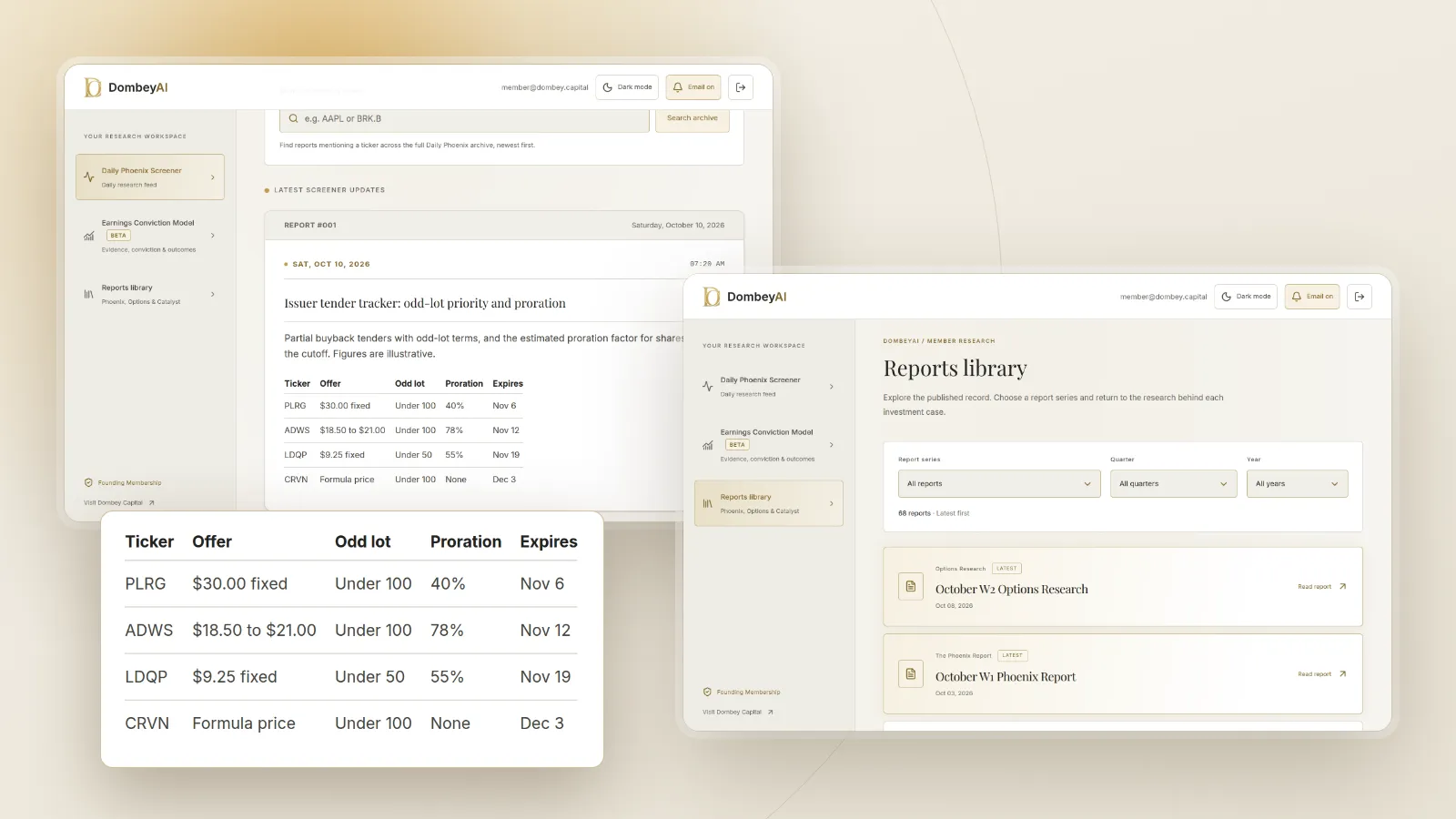
Two kinds of odd-lot offer
Odd-lot priority in a partial tender. A company offers to buy a fixed number of its shares, or a fixed dollar amount, through a fixed-price or Dutch auction tender offer. If holders tender more than it will buy, it prorates. Before prorating, it can accept in full every share tendered by holders who own fewer than a set number of shares and tender all of them. The cutoff is usually 99 or fewer.
A standalone odd-lot program. A company offers to buy shares only from holders at or below a cutoff, with no larger buyback attached. The usual goal is to cut the number of small accounts. Each holder of record costs money: proxy mailings, annual reports, tax forms and dividend checks. Some programs also let a small holder buy enough shares to round up to 100 instead of selling, and many waive the commission the holder would otherwise pay.
| Feature | Odd-lot priority in a partial offer | Standalone odd-lot program |
|---|---|---|
| Purpose | Protect small holders from proration | Reduce the number of small accounts |
| Rule | 13e-4(f)(3)(i) | Exempt under 13e-4(h)(5) |
| Price | Same as the rest of the offer | Fixed price or uniform market-based formula |
| Minimum open period | 20 business days | Set by the program terms |
| Who qualifies | Holders under the cutoff who tender all shares | Holders under the cutoff, possibly as of a record date |
| Main question for a holder | Do I qualify, and did I certify? | Is the price better than selling myself? |
The SEC rules behind odd lots
The rules come from Rule 13e-4, the issuer tender offer rule, and Rule 14e-1, which applies to tender offers generally. The points below were checked against the eCFR text on 2026-10-10.
- Proration with an odd-lot exception. Rule 13e-4(f)(3) requires an oversubscribed partial offer to be bought "as nearly as may be pro rata, disregarding fractions." Paragraph (f)(3)(i) then allows the issuer to accept all shares tendered by persons who own, beneficially or of record, an aggregate of not more than a specified number less than 100 shares and who tender all their shares, before prorating the rest.
- Conditional tenders come after. Paragraph (f)(3)(ii) allows acceptance by lot of holders who tender everything and elect all-or-none or a minimum, but only after the issuer accepts the tenders that did not make that election.
- The standalone exemption. Rule 13e-4(h)(5) says the issuer tender offer rule does not apply to offers to buy from holders of not more than a specified number of shares below 100, provided the offer is open to all holders at or below that number and pays the same highest price to all, or a price set by "a uniformly applied formula based on the market price." The issuer may exclude holders who did not own their shares as of a date it specifies.
- Timing for the larger offer. A partial issuer tender with odd-lot priority must stay open at least 20 business days, and at least 10 business days after a change in the price or the percentage sought, under Rules 13e-4(f)(1) and 14e-1. Buying up to 2% more of the class is not treated as a change.
- No short tendering. Rule 14e-4 makes it unlawful to tender more shares in a partial tender offer than your net long position, both when you tender and at the end of the proration period. You cannot tender borrowed shares or shares you have already sold.
How odd-lot priority changes the proration math
Odd-lot shares come out of the total the company will buy. The proration factor for everyone else is the shares left after odd lots, divided by the non-odd-lot shares tendered. Because odd lots are usually a small share of the total, the factor moves only slightly, but the outcome for a qualifying small holder changes completely.
Twenty more shares turned an effective price of $30 into an effective price under $27. The gap is the reason the odd-lot clause draws attention. It is also why the exact cutoff in the Offer to Purchase matters: some issuers set it lower than 99, and a holder one share over it is prorated with everyone else.
In a Dutch auction, the same logic applies at the clearing price. Odd-lot holders must still tender at or below the clearing price, or tender at the price the auction sets, to be bought. Odd-lot status protects against proration, not against a bid above the clearing price.
The economics of a standalone program
A standalone program is a different calculation. There is often no premium in the usual sense. The price may be set by a formula, such as the average closing price over a set number of trading days, and the benefit to the holder is the saved commission and the effort of closing a small position.
For the holder, the questions are short. Is the formula price fair against where the stock trades? Is the saved cost meaningful compared with the position? Would you rather round up and keep the shares?
Can you buy into odd-lot priority?
This is the question behind most searches on the topic. A trader sees a fixed-price offer well above the market, expects heavy proration, and considers buying 99 shares to be accepted in full.
The rules and the offer terms limit this in several ways:
- Aggregate ownership. If you already own 100 shares or more anywhere, beneficially or of record, a new 99-share purchase does not qualify.
- Record dates. Under the standalone exemption, an issuer can exclude holders who did not own shares as of a date it sets. Some partial offers include similar ownership conditions. Read the definition of an odd-lot holder in the offer.
- Certification. Odd-lot priority usually requires a box checked on the Letter of Transmittal, or an instruction to the broker, confirming that you own fewer than the cutoff and are tendering all of them. Missing it means your shares are prorated.
- The cap. The most one holder can gain is 99 shares times the gap between the offer price and the price at which they bought. At a $4 premium, that is $396, before commissions, the risk that the offer is amended or withdrawn, and the price drop that often follows expiration.
The math looks attractive in percentage terms and small in dollars. For most people, the useful lesson is about their existing holdings: if you already own a small position in a company running a partial tender, check whether you qualify before your broker's deadline.
How to read the odd-lot terms in an offer
Odd-lot terms sit in the Offer to Purchase filed as an exhibit to the Schedule TO. The full-text search on EDGAR finds them by searching the phrase "odd lot" with the company name. Look for:
- The cutoff. The exact number of shares at or below which a holder qualifies.
- The ownership test. Whether it counts beneficial and record ownership together, and whether shares in plans are excluded.
- The all-shares condition. Whether partial tenders by odd-lot holders lose priority.
- The certification. Which box or broker instruction is required.
- The broker deadline. Brokers often close instructions a day or more before the official expiration.
- The price. For a standalone program, the formula and the averaging dates.
For a full checklist on the larger offer, see how to evaluate a tender offer.
Where this goes wrong
- Owning one share too many. The cutoff is below 100 and sometimes well below. A holder at 100 shares, or above a lower cutoff, is prorated with everyone else.
- Tendering only part of the holding. Priority usually requires tendering all of your shares. Holding a few back to keep a small position removes the protection.
- Skipping the certification. Without the odd-lot box or broker instruction, the shares are treated as ordinary tenders.
- Splitting accounts. Ownership is aggregated. Several small accounts held by one person do not each qualify.
- Assuming a premium. A standalone program may pay a formula price near the market. Compare it with what selling yourself would cost.
- Ignoring Rule 14e-4. Tendering borrowed shares, or shares hedged in ways that leave you short of a net long position, is prohibited in a partial tender offer.
- Treating it as an edge. The gain is capped by the 99-share limit, and the offer can change. The broader point, covered in merger arbitrage explained, is that a deal price is what you receive only if the deal closes on its stated terms.
Dombey's published research reads the terms of dated corporate actions, including tender conditions, before each expiration; see the research archive. For how small-print terms create special situations more broadly, read what a special situation is.
The bottom line
An odd-lot tender offer buys shares from holders of fewer than 100 shares, either as a standalone program or as a priority inside a larger buyback. Rule 13e-4 lets an issuer buy qualifying odd lots in full before prorating everyone else, and exempts standalone programs that treat all small holders alike and pay one price or a uniform formula price. Qualifying depends on the exact cutoff, aggregate ownership, tendering all shares and completing the certification on time. The amounts are small, so the practical value is for existing small holders who check the terms before their broker's deadline.