

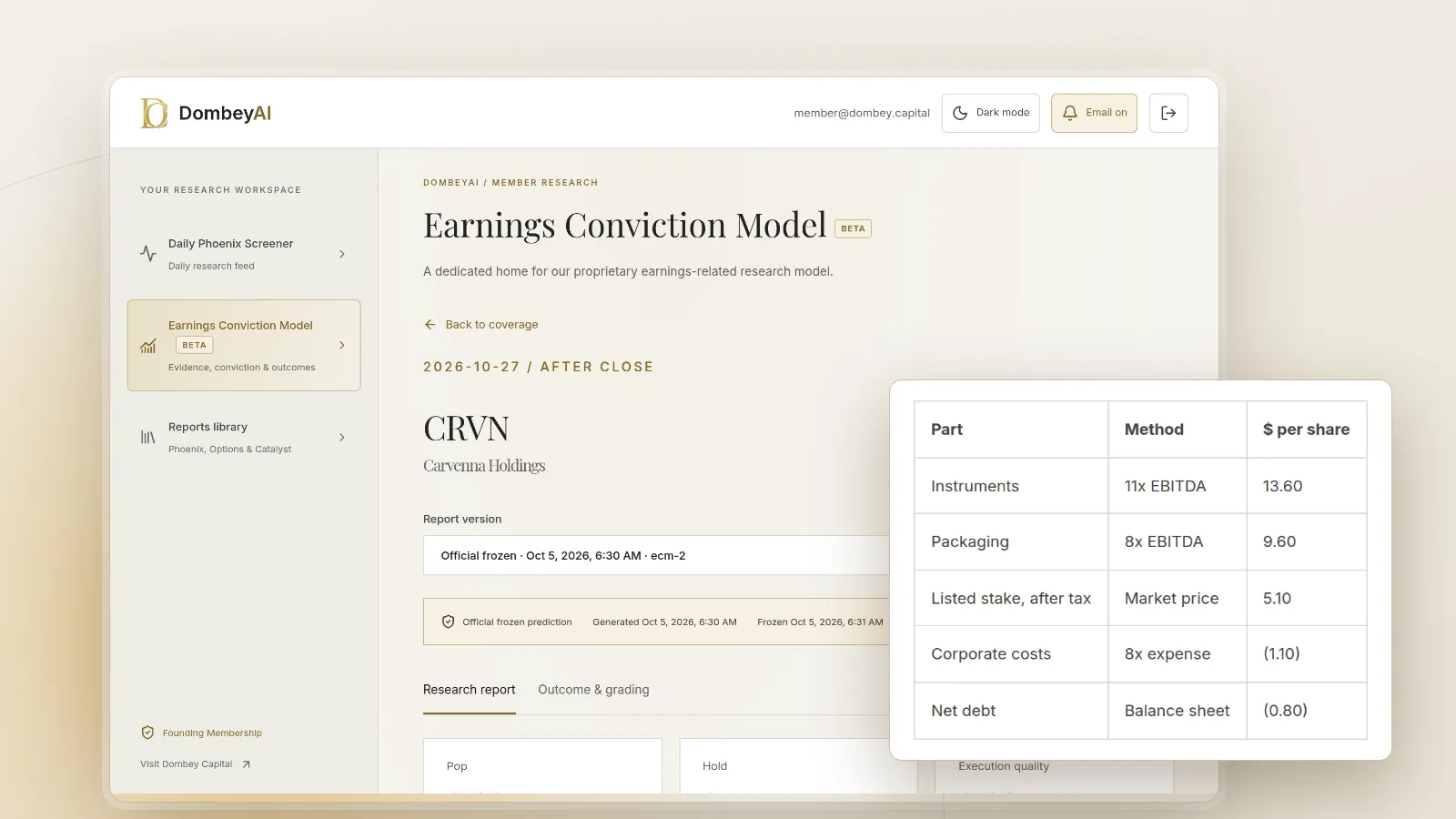
What sum-of-the-parts valuation measures
A single multiple applied to a whole company assumes every part deserves the same price per dollar of profit. That works for a focused business. It breaks down when a company combines a slow, cyclical unit with a fast-growing one, or an operating business with a pile of listed shares, land or cash that earns little reported profit.
SOTP replaces the blended multiple with one valuation per part. The output answers a narrow question: what would the equity be worth if the market priced each piece the way it prices comparable standalone companies? That is a useful reference point, not a forecast. It assumes the parts could be valued separately, and it says nothing about when, or whether, the market will agree.
The total is an equity value, so the claims ahead of shareholders still come off. The bridge from parts to equity uses the same items as any enterprise value calculation: debt, preferred stock, noncontrolling interests and debt-like items, with cash added back.
When SOTP fits and when it does not
SOTP earns its place when the parts are genuinely different and the difference is large enough to change the answer. It adds noise, not insight, when a company is one business reported in several segments.
- If the segments would trade at clearly different multiples as standalone companies, SOTP fits.
- If the company owns a listed stake, the market already prices that stake every day, and SOTP lets you use that price directly.
- If the company holds real estate, cash-rich runoff businesses or tax assets that earn little reported profit, SOTP captures value that earnings multiples miss.
- If a spin-off, IPO of a subsidiary or divestiture has been announced, SOTP frames what each piece might trade for after the event.
- If the segments share customers, plants and sales teams so tightly that they could not operate apart, SOTP overstates what separation would deliver, and a single valuation is more honest.
- If segment disclosure is thin or the company changes its segments often, the inputs are too weak to support the method.
| Situation | Does SOTP fit? | Main input to watch |
|---|---|---|
| Industrial conglomerate with unrelated divisions | Yes | Peer multiple for the largest segment |
| Holding company with listed stakes | Yes | Tax on gains and holding company costs |
| Company with an announced spin-off | Yes | Debt allocation in the Form 10 |
| Single business reported in three regional segments | Usually not | Shared costs between regions |
| Small company with one segment and surplus land | Partly | Realistic value and timing for the land |
| Group whose units share plants and customers | Weak fit | Lost shared savings after separation |
Why discounts to the parts persist
A company trading below its sum of the parts is common. Many stay there for years. Before treating a discount as an error by the market, list the reasons it might be partly justified. The companion piece on holding company discounts goes further into holding structures; the main causes are these.
Corporate overhead that never goes away
Head office, the board, audit, listing and shared services cost money every year. Capitalized at a normal multiple, a modest overhead line can account for several percent of equity value. A break-up does not remove all of it, because each standalone company needs its own finance team and board.
Capital allocation
In a conglomerate, cash from a strong unit can fund a weak one, or an acquisition the market would not have backed. Investors price in the risk that today's value in a good unit will be spent elsewhere. A record of poor deals widens this part of the discount, and it closes only if behavior changes.
Tax between the assets and shareholders
A holding company that sells a stake at a gain pays tax before any cash reaches shareholders. A tax-free spin-off can avoid that cost, but the rules are strict. Under section 355 of the Internal Revenue Code, as described in 26 CFR 1.355-3, a business relied on for tax-free treatment must have been actively conducted throughout the five years ending on the distribution date. Not every part qualifies.
Complexity and the investor base
Specialist investors want exposure to one industry. A company that mixes three industries can be hard to fit into anyone's mandate, and analysts may cover it from only one angle. Fewer natural buyers can mean a lower price for longer.
Control and governance
When a founder or family controls the votes, outside shareholders may have no way to force a separation. A discount in a controlled company reflects the low odds of anyone acting on it, and those odds can stay low for decades.
What closes the gap
A discount closes when something lets the market price a part directly, or when cash reaches shareholders at full value. These are the usual mechanisms, roughly from hardest to softest. The distinction follows the one in hard vs soft catalysts.
- Sale of the whole company. A buyer pays one price for everything, usually with a premium. This closes the gap fully, but only if a buyer exists and the board agrees.
- Spin-off. The parent distributes shares of a unit to its holders, and the unit begins trading on its own. The Form 10 must furnish the business description required by Item 101 of Regulation S-K, plus financial information, so the standalone unit becomes visible. See what a Form 10 is and spin-off investing for the mechanics.
- Divestiture. A sale of one unit sets a market price for it and may bring in cash. The price paid is a direct test of the multiple you assumed.
- IPO or partial listing of a subsidiary. A public market price for part of a unit puts a visible value on the rest.
- Activist campaign. An investor crossing 5% of a class with intent to influence control must file a Schedule 13D within five business days of the acquisition, under 17 CFR 240.13d-1, and state its plans. See what a 13D filing is.
- Buybacks below value. These do not close the gap for the market, but each share bought below SOTP raises value per remaining share.
- Better disclosure. New segment detail or a capital markets day can narrow a discount that came from complexity alone. This is the softest mechanism and the easiest to overrate.
Dombey's published research pairs this kind of break-up analysis with the dated event that could close the gap; see the research archive.
Reading an SOTP someone else built
Broker notes, activist decks and company presentations often contain SOTP tables. Each author has a reason to choose particular inputs. Read them with a short checklist.
| Check | What to ask | Where to verify |
|---|---|---|
| Peer set | Are the peers similar in size, growth and cycle, or the richest available? | Peer 10-K filings |
| Corporate costs | Is unallocated expense deducted, or quietly left out? | Segment note reconciliation in the 10-K |
| Tax | Are stakes and real estate shown after tax on a sale? | Income tax and investments notes |
| Claims | Are pensions, leases, preferred and minority interests subtracted? | Balance sheet and notes |
| Share count | Is the count fully diluted, including options and convertibles? | Equity note and cover page |
| Timing | Does the table assume an event, and is it dated? | 8-K filings and press releases on EDGAR |
An activist SOTP is advocacy. A management SOTP at an investor day is also advocacy. Neither is wrong by default, but both tend to sit at the high end of a fair range.
Common errors that inflate the answer
- Choosing flattering peers. Taking the highest-multiple peer for each segment produces a total no buyer would pay. Use a range built from the spread of peers, and justify any premium.
- Leaving out corporate costs. Ignoring unallocated expense treats a recurring cost as free. Capitalize it and subtract it.
- Counting an asset twice. An equity-method stake whose income already sits in segment profit should not be added again at market value.
- Using pre-tax values for assets that would be sold. A stake or property held well above its tax basis carries a tax bill on sale. Only a qualifying tax-free separation avoids it.
- Ignoring lost shared savings. Separated units lose shared purchasing, IT and sales. Standalone costs often exceed what the segment note implies.
- Assuming the discount should be zero. Comparing to a zero discount sets an unrealistic target. Compare to what the parts would likely trade for after a realistic event, net of its costs.
- Treating a single number as the answer. One turn of multiple on the largest segment can move the result more than the discount. Build a base and worst case and show the range.
Where this goes wrong
SOTP rests on segment data the company chooses how to present. Segment boundaries, profit measures and cost allocations are management decisions, and they can make a weak unit look healthier than it would be alone. Peer multiples move with sentiment, so a model built when one industry is in favor can shrink quickly. Events that should close a gap often slip: spin-offs get delayed or cancelled, asset sales fail on price, and activists settle for a board seat. A discount can widen before it closes, and capital tied up while you wait has a cost. Finally, some companies deserve their discount for good reasons, such as a controlling owner with no interest in change. In those cases the parts may be cheap indefinitely. If the realistic outcome is a wind-down rather than a separation, a liquidation analysis is the better frame.
The bottom line
Sum-of-the-parts valuation prices each business and asset on its own terms, then takes off corporate costs and claims ahead of shareholders. It fits companies whose parts are genuinely different, and it adds little for single businesses split into reporting segments. Discounts to the parts are common and often partly justified by overhead, tax, capital allocation and control. The gap matters when a dated event, such as a spin-off, sale or activist campaign, gives it a way to close. For the full model build, follow the step-by-step SOTP guide.