

How a reverse merger works
The SEC's investor bulletin on the subject describes the standard structure. A public reporting company with few or no operations, the shell, acquires a private operating company. The private company's shareholders exchange their shares for a large majority of the shell's stock. The private company's management usually takes over the shell's board and officer roles. After closing, the public company's assets and operations are mainly or only those of the former private business.
Three features set it apart from an IPO:
- No Securities Act registration. The shell reports the transaction in a Form 8-K. There is no S-1 reviewed before shares reach the market.
- No new money by default. An IPO raises cash. A reverse merger by itself raises nothing, so a financing often follows soon after.
- An existing shareholder base. The shell's prior holders keep their shares, often bought at very low prices, and may want to sell.
The bulletin lists the usual reasons a company chooses the route: lower legal and accounting fees than an IPO, a faster timeline, and access to public-market liquidity and funding.
What counts as a shell company
The SEC definition, in Rule 12b-2 under the Exchange Act and repeated in Rule 144(i), covers a company with no or nominal operations and either no or nominal assets, assets of only cash and cash equivalents, or cash plus nominal other assets. A shell formed for a specific business combination, the category that covers SPAC-style vehicles, is carved out as a "business combination related shell company" and treated differently.
The definition matters because the rules below attach to it. Once a company has been a shell, Rule 144(i) follows its shares even after it acquires a real business.
The filing rules that apply after the deal
These rules were checked against the current Form 8-K instructions and Rule 144 on October 8, 2026.
| Rule | What it requires | Why it matters to an investor |
|---|---|---|
| Form 8-K, general deadline | Report within four business days of the event | The first full disclosure is due soon after closing |
| Form 8-K Item 2.01(f) | A former shell must include Form 10 information about the combined company | This filing is the closest thing to a prospectus |
| Form 8-K Item 5.06 | Disclose the material terms of the deal that ended shell status | Confirms the company says it is no longer a shell |
| Form 8-K Item 9.01(c) | Financial statements and pro forma information must be in the first report, without the usual 71-day extension | Missing audited numbers in the first 8-K is a warning sign |
| Rule 144(i) | Shares issued by a current or former shell can be resold under Rule 144 only one year after Form 10 information is filed, and only while the company has filed its required reports for the prior 12 months | Sets when insider and early-holder shares can come to market |
"Form 10 information" is the content a company would give to register under the Exchange Act on Form 10: business, risk factors, financial statements, management, pay, related-party dealings and the securities. The Form 10 explainer walks through those items. In a reverse merger they arrive in an 8-K rather than a standalone registration.
Exchange listing and seasoning
Most reverse merger companies start on the over-the-counter market. Moving to a national exchange is harder than it once was. In November 2011 the SEC approved Nasdaq rules, in Release No. 34-65708, that add seasoning requirements for companies that went public through a reverse merger with a shell. The NYSE and what is now NYSE American proposed similar standards at the same time. Under the Nasdaq rules, before listing the company generally must:
- Trade for at least one year in the US over-the-counter market, on another national exchange or on a regulated foreign exchange after filing the required information about the reverse merger.
- File all required periodic reports on time for that year, including at least one annual report with audited financial statements for a full fiscal year after the merger filing.
- Keep a closing price of at least $4 for a sustained period, and on at least 30 of the 60 trading days before both the application and the listing date.
Two exceptions apply: a firm commitment underwritten public offering at or around listing with gross proceeds of at least $40 million, or a company that has filed at least four annual reports with the SEC after the one-year trading period. Exchange rules change, so check the current rule text before relying on these terms.
A worked example
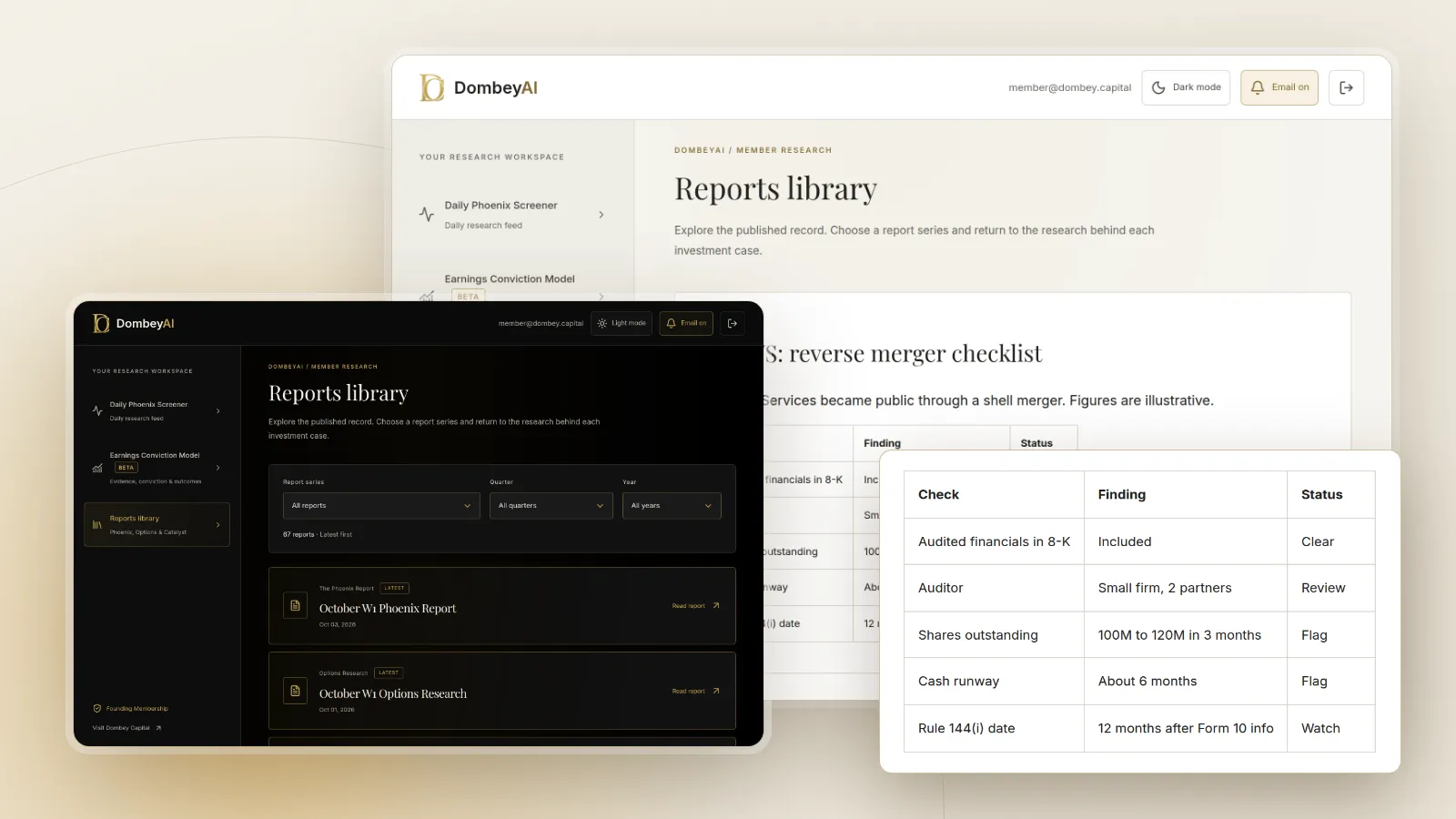
The quoted $200 million value rested on a thin float: only the shell's 10 million old shares could trade freely, and B's 90 million shares were locked up by Rule 144(i) for at least a year. The financing price, $0.75, is a better read of what a cash buyer would pay than the $2.00 quote. Working out the runway on day one, as in the guide to estimating cash runway, would have flagged the raise before it happened. Comparing the quote to net cash per share shows how little of the price the balance sheet supported.
Red flags to check
No single item proves a problem. Several together should change how much work you do before trusting the numbers.
| Red flag | What to check | Where to find it |
|---|---|---|
| Small or distant auditor | Firm size, location against the operations, PCAOB registration and inspection history | Audit report in the 8-K or 10-K; PCAOB website |
| Late or missing filings | Any NT 10-K or NT 10-Q, gaps in quarterly reports | EDGAR filing index |
| Auditor or officer changes | Item 4.01 and Item 5.02 8-Ks, especially near a reporting deadline | EDGAR 8-K list |
| Share count jumps | Shares outstanding across filings, convertible notes, warrants | Cover page, equity footnote, subsequent events |
| Promotion | Paid newsletters, social media pushes, sudden volume spikes | Disclosures in promotional material, trading data |
| Related-party dealings | Loans to or from insiders, sales to affiliated companies | Related transactions note, Item 13 of the 10-K |
| Story ahead of cash | Large stated contracts or markets against small cash and receivables | Balance sheet, cash flow statement, customer concentration |
| Shell history | Prior names, prior deals, past trading suspensions or revoked registrations | EDGAR company history, SEC trading suspension list |
The SEC's bulletin raises the auditor point directly: some reverse merger companies with operations abroad used small US audit firms that may lack the resources to audit a business mostly located in another country. The trading suspensions it describes involved questions about cash balances, receivables, auditor resignations that were not disclosed, and periodic reports that were never filed.
The SEC can suspend trading in a stock for up to 10 trading days when it decides that is needed to protect investors. If the SEC revokes a company's registration for failing to file, the bulletin notes that no broker, dealer or exchange can execute trades in the stock until the company re-registers.
How to read the first filings
A short order keeps the work focused:
- If the merger 8-K lacks audited financial statements for the private company, stop there. The rule requires them in the first report, so their absence is itself the finding.
- If the auditor is a small firm with no clear link to where the business operates, read the PCAOB inspection reports before the numbers.
- If the cap table shows convertible notes priced at a discount to the market, model the share count at full conversion.
- If the company plans a shareholder vote on a share increase or a reverse split, read the proxy statement for the reasons and the dilution.
- If the first 10-K arrives late, treat the Rule 144(i) and exchange seasoning timelines as reset until it is filed.
After the merger 8-K, the first annual report carries the most weight. The 10-K guide covers what to read in it. For a reverse merger company, the auditor's report, the going concern language, internal control disclosures and the related-party note come before the business section.
Where this goes wrong
Reverse merger analysis has its own failure points:
- Treating the quote as a value. Pre-merger shell prices and early post-merger trades often reflect a tiny float. They say little about what the whole company is worth.
- Ignoring the coming supply. When Rule 144(i) stops blocking resales, a large block of stock can become sellable at once. The date is knowable from the Form 10 information filing date, provided the company stays current.
- Assuming the filings are complete. The 8-K is not reviewed by the SEC before it is filed the way an IPO registration is. Disclosure can be thin, and some of the worst cases involved numbers that were simply wrong.
- Missing the financing. A company that merged in without cash will usually raise it soon, often through convertibles or discounted private placements. The terms matter more than the press release.
- Over-reading the red flags. A small auditor or an OTC listing is common among legitimate small companies. The checklist sets the depth of the work. It is not a verdict.
Dombey's published research applies these checks before writing about any company that became public through a shell; see the research archive.
The bottom line
A reverse merger puts a private company into a public shell, giving it a listing without an IPO's registration, underwriter or new capital. The key disclosure is the Form 8-K with Form 10 information, which must include audited financial statements from the start. Rule 144(i) and exchange seasoning rules then set when shares can be resold and when the stock can list. Check the auditor, the filing record, the share count and the cash before relying on the story or the quoted price.