

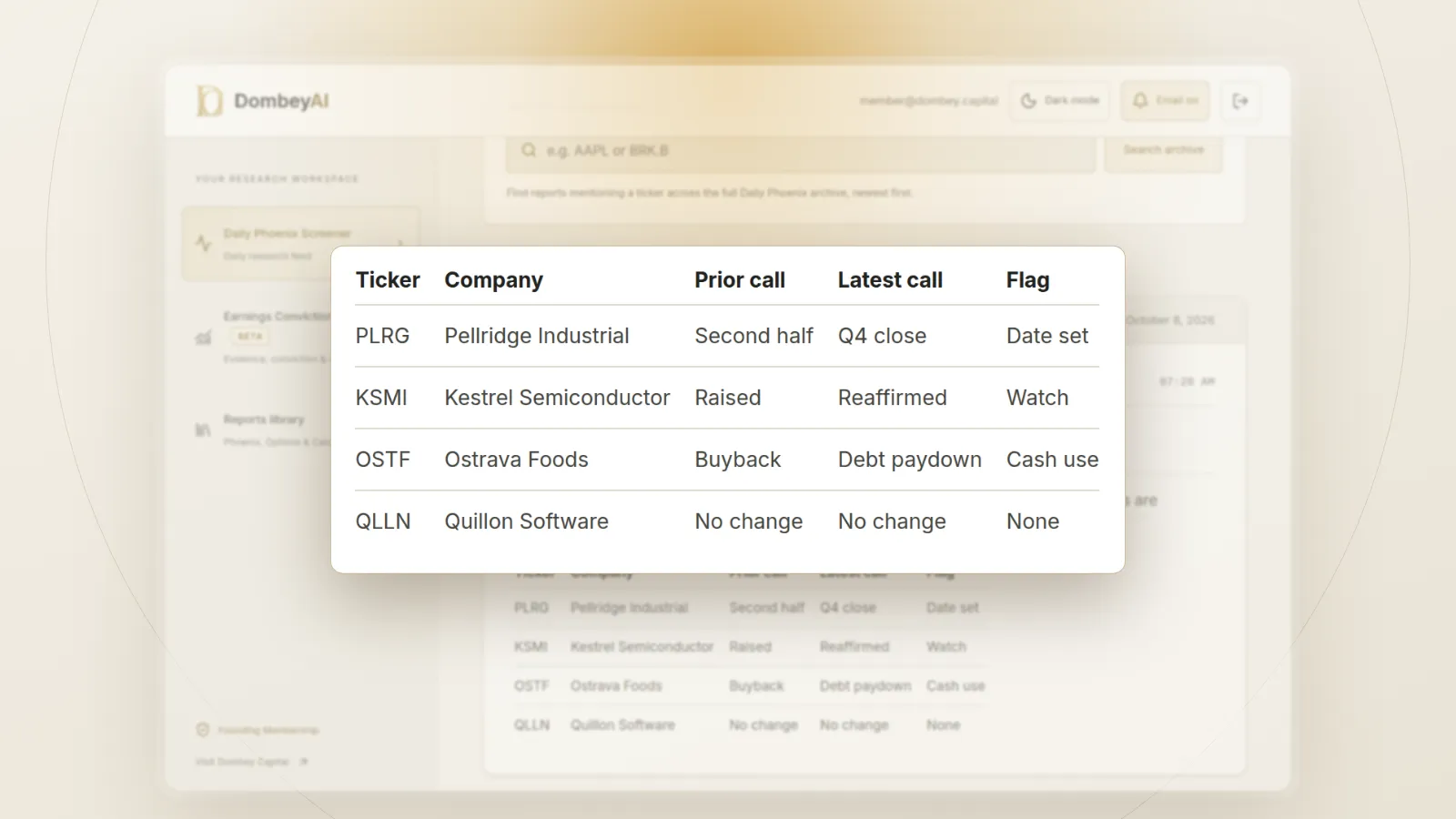


Full disclosure: Dombey Capital is our own research service and our top pick here, for the reasons below. The section on where it falls short is there so you can judge whether it fits your process.
Quick comparison
| Tool | Best for | Key features | Price (as of October 2026) |
|---|---|---|---|
| Dombey Founding MembershipTop pick | Earnings read inside special situations research | Weekly Phoenix Report, Earnings Conviction Model, Daily Phoenix Screener, Options Research, Biweekly Catalyst Briefing | Founding Membership $1,200/year; Standard Access $80/year or $8/month |
| Quartr | Live calls and first-party IR material | Live earnings calls and transcripts, slides, filings, 15,000+ companies, free mobile app | See the vendor's pricing page (Pro and API through sales) |
| AlphaSense | Searching transcripts with broker and expert research | Transcripts among filings, broker research from 1,000+ firms, Expert Transcript Library | See the vendor's pricing page (through sales) |
| Koyfin | Transcripts next to charts and financials | Press releases, filings and transcripts from the Plus plan | Plus $39/month and Premium $79/month billed annually ($49 and $110 monthly) |
| TIKR | Long transcript history at a low price | Transcripts in the watchlist feed, history by plan, S&P Capital IQ data | Free (90 days); Plus $24.95, Pro $54.95, Ultimate $119.95 per month |
| The Motley Fool | Free recent transcripts | Recent calls for covered companies with one-line summaries | Free to read |
| EarningsCall | A transcript and audio API | 9,000+ companies, enhanced transcripts with speaker labels and timestamps, audio, slides | API from $60/month (Starter) to $155/month (Ultimate+) |
| Financial Modeling Prep | Transcripts inside a broad data API | Transcript endpoints, global fundamentals, bulk delivery | Ultimate $99/month billed annually; free Basic plan without transcripts |
| Alpha Vantage | A low-cost transcript endpoint | Transcripts by quarter since 2010 with turn-by-turn sentiment | Free key (25 requests/day); premium from $49.99/month |
| SEC EDGAR | Checking the release behind the call | 8-K Item 2.02 earnings releases, full-text search | Free |


How we compared these tools
We compared these tools from vendor documentation, pricing pages and public product pages read on October 8, 2026. We did not run trials with any of them. Prices are as listed on each vendor's site that day. Where a page showed no price, the table says so. Some vendors' sites blocked automated reading that day, and we left those tools out rather than state facts we could not check.
| Criterion | Weight | What it measures |
|---|---|---|
| Speed after the call | 25% | Whether the transcript is live, same day or later, which matters most the morning after a dated report |
| History and search | 25% | How many years of past calls you can read and search, to compare what management said before |
| Catalyst context | 20% | Whether the tool helps place the call next to a dated event and the rest of the record |
| Checking against source | 15% | Links to the release, slides and filings so you can verify quoted figures |
| Cost for the job | 15% | What it costs to read or pull transcripts, not the whole platform |
If you build models or screens from text, weight API access higher and EarningsCall, Financial Modeling Prep and Alpha Vantage move up. If you read a few calls a quarter on companies you already own, free sources and a low-cost platform cover most of the job. We made no judgment on any vendor's transcription accuracy, because we have no independent basis for one.
Quick picks by job
Best for earnings inside special situations research: Dombey Founding Membership
On a spin-off, a recapitalization or a stock below net cash, the call matters for a few specific answers: a date, a use of cash, a change in guidance. Founding Membership gives you written research and the Earnings Conviction Model on the situations in Dombey's coverage. It does not publish transcripts, so it works alongside a transcript source.
Best for live calls and IR documents: Quartr
Quartr covers live earnings calls with live transcripts, plus slides and filings, across more than 15,000 companies.
Best for search across transcripts and broker research: AlphaSense
AlphaSense puts transcripts in the same search as broker research and expert call transcripts, which suits professional research teams.
Best for transcripts next to financials: Koyfin
Koyfin adds transcripts from its Plus plan, beside charts, filings and fundamentals.
Best for long history on a budget: TIKR
TIKR's Pro plan includes ten years of transcripts, audio and slides at $54.95 a month.
Best free source for recent calls: The Motley Fool
Recent transcripts with a short summary, free to read.
Best for developers: EarningsCall
A transcript and audio API with speaker labels and word-level timestamps on its enhanced tier.
Full reviews
1. Dombey Founding Membership (and Standard Access)
What it does. Founding Membership is Dombey's full research service: the weekly Phoenix Report on selected special situations and earnings-related opportunities, weekly Options Research, the Biweekly Catalyst Briefing, and the DombeyAI Portal with the Daily Phoenix Screener each trading morning and the Earnings Conviction Model. It also includes valuation and execution analysis and priority access. Standard Access, the lower-cost option, includes the Biweekly Catalyst Briefing and the complete public-research archive.
Best for. Readers who want to know what an earnings report means for a specific situation: the catalyst, its date, and what could undermine the case.
Pricing. Founding Membership is $1,200 a year, billed annually. Standard Access is $80 a year (about $6.67 a month) or $8 a month on monthly billing. The Public Archive is free.
Pros
- Reads earnings as one dated event inside written research, which a transcript alone does not do.
- Options Research adds what the market already prices ahead of a report.
- Each thesis is published before its catalyst and kept in the archive.
Cons
- It does not publish transcripts, audio or call summaries.
- Coverage is limited to the situations Dombey researches.
Verdict: Our top pick for readers who use earnings calls as one input into catalyst research. Pair it with Koyfin, TIKR or a free source for the transcripts.
2. Quartr
What it does. Quartr collects first-party investor relations material: live earnings calls, live transcripts, slide presentations and filings, across more than 15,000 companies in over 60 markets. Quartr Pro applies AI across transcripts, live calls, slides and filings. Quartr API offers speaker-identified transcripts and audio, live and historical. Quartr also offers a free mobile app.
Best for. Analysts and investment teams who listen to calls live and want the slides and filings in the same place.
Pricing. The pricing page lists Quartr Pro and Quartr API with no prices; both route to sales. See the vendor's pricing page.
Pros
- Live calls and live transcripts with slides alongside.
- Broad global coverage of company events beyond earnings, such as capital markets days and conferences.
- A free mobile app for listening.
Cons
- No published price for Pro or the API.
- Built for professionals; more than an occasional reader needs.
Verdict: The strongest choice for live coverage, if you are willing to talk to sales.
3. AlphaSense
What it does. AlphaSense is a market intelligence platform. Its pricing FAQ lists earnings call transcripts among its regulatory filings content. Both plans include broker research from more than 1,000 sell-side and independent firms and the Expert Transcript Library. Expert calls and Canalyst financial models are add-ons.
Best for. Research teams who search across transcripts, broker notes and expert interviews in one place.
Pricing. Two plans, Market Intelligence and Enterprise Intelligence, with no prices shown. See the vendor's pricing page.
Pros
- Transcripts in the same search as broker and expert research.
- Enterprise options for searching a firm's own documents.
Cons
- Priced and sold to firms, not individuals.
- Much of the value sits in content an individual investor may not need.
Verdict: The professional research choice when transcripts are one of many sources you search.
4. Koyfin
What it does. Koyfin is a charting and fundamentals platform. Its Plus plan lists press releases, filings and transcripts with premium news, and higher plans include everything in Plus. The free plan lists limited news and does not state transcript access. For how it compares with other data platforms, see Koyfin vs TIKR vs Stock Rover.
Best for. Investors who want to read a call next to the financials and charts they already use.
Pricing. Plus is $39 a month and Premium $79 a month on annual billing, or $49 and $110 on monthly billing. Advisor plans cost more.
Pros
- Transcripts beside filings, estimates and charts.
- A free plan to try the platform before paying.
Cons
- Transcripts need a paid plan.
- No live call coverage stated on the pricing page.
Verdict: Good value if you also want the data platform.
5. TIKR
What it does. TIKR is a global stock research platform with financial data from S&P Global Capital IQ. Transcripts appear in its watchlist news feed and next to screening and valuation tools. Transcript history depends on plan: 90 days on Free, one year on Plus, ten years on Pro and full history on Ultimate. Pro adds ten years of audio and slides.
Best for. Individual investors who want to compare several years of calls at a low price.
Pricing. Free; Plus $24.95, Pro $54.95 and Ultimate $119.95 a month on monthly billing. The page offers annual billing but did not show annual prices.
Pros
- Long transcript history on Pro and Ultimate.
- Global coverage across more than 100,000 stocks.
Cons
- Ten-year history needs Pro or above.
- No live call coverage stated.
Verdict: The best value for reading old calls against new ones.
6. The Motley Fool
What it does. The Motley Fool publishes transcripts of the most recent earnings calls for the companies it covers, each with a one-line summary of the call's main points. Its listing on October 8 showed calls from the prior week across several sectors.
Best for. Reading a recent call at no cost.
Pricing. Free to read. The site also sells premium investing services, which are separate.
Pros
- No account needed for recent transcripts.
- Short summaries help you pick which calls to read.
Cons
- Coverage is limited to companies the site covers.
- No search, history tools or links to slides on the listing page.
Verdict: A good free source for recent calls on larger companies.
7. EarningsCall
What it does. EarningsCall provides transcripts, audio and slides for more than 9,000 companies on NYSE, Nasdaq and OTC markets, through a website, mobile apps and an API. Basic transcripts come as structured JSON; enhanced transcripts add speaker labels and word-level timestamps. It states a data latency under two hours and offers webhook notifications on its top tier.
Best for. Developers and analysts who want to pull transcripts and audio into their own tools.
Pricing. The individual API plans start at $60 a month (Starter), $69 (Premium), $129 (Ultimate, with audio) and $155 (Ultimate+, with real-time notifications). Annual billing saves 20%.
Pros
- Speaker labels and timestamps on enhanced transcripts.
- Includes OTC companies.
Cons
- Built around the API; a casual reader needs less.
- Audio needs Ultimate or above.
Verdict: The most focused transcript API here.
8. Financial Modeling Prep
What it does. Financial Modeling Prep sells a financial data API. Its Ultimate plan adds earnings call transcripts, global coverage, 13F holdings, full history and bulk delivery to the fundamentals and prices in lower plans.
Best for. Developers who want transcripts and fundamentals from one API.
Pricing. Ultimate is $99 a month billed annually. Starter ($19) and Premium ($49) do not list transcripts. A free Basic plan allows 250 calls a day without transcripts.
Pros
- Transcripts sit next to statements, estimates and holdings data.
- Bulk delivery for large pulls.
Cons
- Transcripts need the top individual plan.
- Displaying the data publicly requires a separate license.
Verdict: A sensible choice if you already need a broad data API.
9. Alpha Vantage
What it does. Alpha Vantage's Earnings Call Transcript endpoint returns a company's transcript for a given quarter, with any quarter since 2010 supported, enriched with turn-by-turn sentiment signals. The documentation did not mark the endpoint as premium.
Best for. Readers who want to test transcript analysis at low cost.
Pricing. A free key allows 25 requests a day. Premium plans run from $49.99 a month (75 requests a minute) to $249.99 a month (1,200 a minute).
Pros
- A low-cost way to start pulling transcripts.
- History back to 2010.
Cons
- The sentiment signal is the vendor's model; we have no basis to judge it.
- No reading interface; you need code.
Verdict: The cheapest way to experiment with transcripts as data.
10. SEC EDGAR
What it does. EDGAR holds the 8-K that furnishes each earnings release under Item 2.02, usually as an exhibit. Full-text search covers about two decades of filings, filtered by date, company and form. It does not hold most call transcripts, for the reason given above. See how to search SEC EDGAR filings.
Best for. Checking the figures management quotes on a call against the release the company furnished.
Pricing. Free.
Pros
- The primary record of the earnings release.
- Full-text search across filings.
Cons
- No transcripts for most calls.
- No summaries or alerts on its own; our SEC filing tools roundup covers tools that add them.
Verdict: The check every transcript reader should run.
Where Dombey falls short
Dombey is the top pick for one job, and it is not a transcript tool:
- No transcripts. It does not publish transcripts, audio or call summaries. You need one of the other tools here for that.
- Narrow coverage. It covers special situations in Dombey's research. A company outside that coverage will not appear.
- No broad stock data terminal. There is no market-wide screener, API or data export.
- Small team and pen-name author. The research comes from a small team, and the byline is a pen name. Weigh it accordingly and check the numbers yourself.
- Short history. Its published record is short compared with the long-running platforms here.
Free vs paid
Free sources cover recent calls on larger companies. The Motley Fool publishes recent transcripts, TIKR's free plan gives 90 days of history, Alpha Vantage allows 25 API requests a day, and EDGAR holds the release behind every call. Many companies also post a webcast replay on their investor relations site.
Paid tools buy speed, history and search. Quartr and AlphaSense add live calls and search across documents. Koyfin and TIKR add transcripts to a data platform, with TIKR's history set by plan. EarningsCall and Financial Modeling Prep sell transcripts as data. Dombey's Founding Membership, and Standard Access as its lower-cost option, buy research on special situations, not more transcripts.
How to choose
| Your situation | Pick | Add later when |
|---|---|---|
| You follow special situations and want earnings read in context | Dombey Founding Membership, or Standard Access as the lower-cost option | You want the calls themselves: add TIKR or a free source |
| You read a few recent calls a quarter | The Motley Fool and EDGAR | You want history: add TIKR |
| You already use a data platform | Koyfin or TIKR | You need live calls: consider Quartr |
| You run a research team | Quartr or AlphaSense | You want expert interviews: AlphaSense add-ons |
| You want transcripts as data | EarningsCall, Financial Modeling Prep or Alpha Vantage | You need audio or live alerts: EarningsCall's higher tiers |
- If a transcript quotes a figure, check it against the 8-K release before using it.
- If management changes the wording on a date, compare the exact phrase with last quarter's call.
- If a dated event comes up on a call, put it on a catalyst calendar.
- If you trade the report itself, read what options already price first; see how to estimate an earnings move from options.
Where this goes wrong
Transcripts are a record of what was said, not of what is true. Management chooses its words, and prepared remarks are written to be quoted. Transcription errors happen, especially with numbers and names, so a figure in a transcript is a lead to check, not a fact. AI summaries can drop the qualifier that matters. Sentiment scores measure tone, and tone can stay calm while guidance slips. And a call adds little on a company whose catalyst is legal or corporate rather than operating; there, the filing and the court or deal calendar carry more weight than the quarter.
The bottom line
Dombey's Founding Membership is our top pick for readers who read earnings calls as one input into special situations and catalyst research, with Standard Access as the lower-cost option; it is research, not a transcript library. For the transcripts, Quartr and AlphaSense lead for live calls and professional search, Koyfin and TIKR are the best value for individuals, and The Motley Fool is the simplest free source. EarningsCall, Financial Modeling Prep and Alpha Vantage serve readers who want transcripts as data. Whatever you use, check the quoted numbers against the release on EDGAR and compare the wording with the last call.