

What you need
- Every version of the Form 10 from EDGAR: the original filing and each 10-12B/A or 10-12G/A amendment, with the information statement exhibit (usually Exhibit 99.1).
- The parent's latest 10-K and 10-Q, for its segment note and share count.
- The parent's 8-Ks on the separation, which carry board approval, the record date and the distribution date.
- A spreadsheet with four tabs: terms, earnings bridge, claims, valuation.
- A notes file for the dated record in Step 8.
If you have not used EDGAR's filters before, the guide on how to search SEC EDGAR filings shows how to pull every amendment for one filer.
Step 1: Line up the amendments and find what changed
A spin-off Form 10 is usually filed months before the distribution and amended several times as SEC staff comment and the terms settle. Early drafts often leave the debt amount, the distribution ratio and executive pay in brackets. Your analysis should run on the latest version, but the history tells you what was negotiated late.
Open the cover page and the "Questions and Answers" section of each version side by side. Record, for each draft, the distribution ratio, the debt the new company will carry, the cash it will pay the parent, the named chief executive and chief financial officer, and the expected exchange and ticker.
Step 2: Confirm the distribution mechanics
Record the terms that turn spinco value into value per parent share:
- Distribution ratio. How many new shares each parent share receives.
- Record date and distribution date. Holders of record on the record date receive the shares. Both dates belong on your catalyst calendar.
- Retained stake. Whether the parent keeps any shares, and what it says it will do with them. A retained stake that may be sold later is a future supply of stock.
- Tax treatment. Whether the spin-off is intended to be tax-free under Section 355 of the Internal Revenue Code, and whether that rests on an IRS ruling, a tax opinion or both.
- Fractional shares. Usually aggregated, sold and paid in cash.
The SEC's Staff Legal Bulletin No. 4 explains why most spin-offs need no Securities Act registration: shareholders pay nothing, the distribution is pro rata, there is a valid business purpose, adequate information is provided, and restricted securities have been held two years. When the subsidiary is not already a reporting company, it registers on Form 10 and the parent provides an information statement by the spin-off date. If shares are being exchanged or sold instead, expect a different filing set.
Step 3: Build a three-line earnings bridge
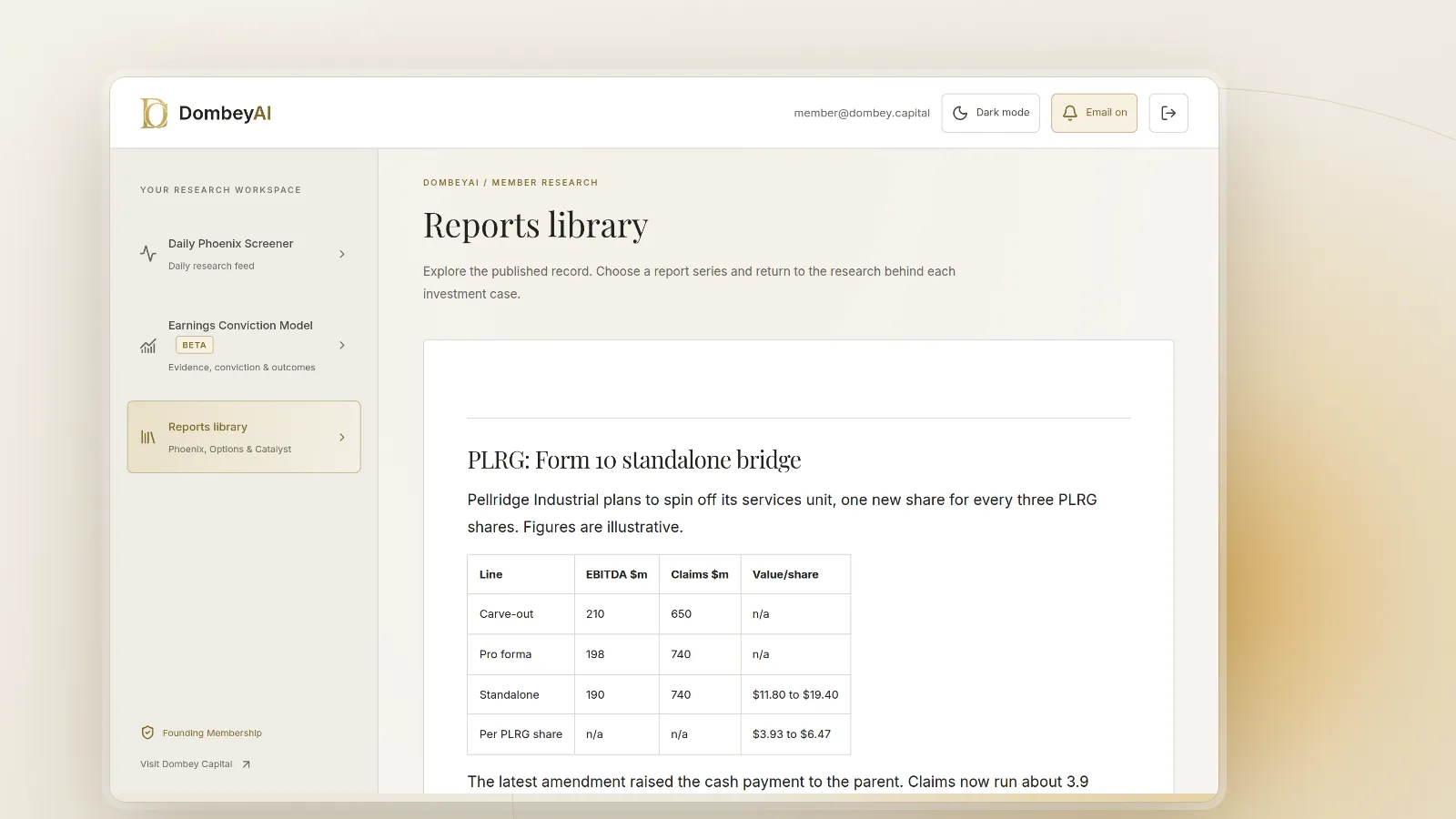
This is the core of the work. The Form 10 gives you two versions of earnings, and you add a third.
- Carve-out. The historical financial statements show the business as it ran inside the parent. Shared costs such as finance, IT, legal and insurance are allocated by a formula, which the notes describe.
- Pro forma. Article 11 of Regulation S-X governs the pro forma statements. They show transaction accounting adjustments and, where the business was previously part of another entity, autonomous entity adjustments in a separate column, which depict the company as a standalone entity. Management may also present optional adjustments for expected cost savings and lost scale. The pro forma income statement generally covers only the latest fiscal year and the latest interim period.
- Your standalone estimate. Read MD&A and the risk factors for statements about expected standalone costs, one-time separation costs and any costs from lost purchasing scale. Use the higher of the filing's estimate and your own, unless you have a reason not to.
| Line | Source in the Form 10 | What it usually misses |
|---|---|---|
| Carve-out EBITDA | Historical combined statements and notes | The full cost of running alone |
| Pro forma EBITDA | Article 11 pro forma statements | Costs management has not yet sized |
| Standalone EBITDA | Your estimate from MD&A and risk factors | Nothing, if you are honest about it |
Keep one-time separation costs out of the run-rate figure, but keep a note of them, because they are paid in cash.
Step 4: Add up every claim ahead of shareholders
The capitalization table shows the term loan and notes. That is the start, not the end. Go through the pro forma balance sheet, the debt section and the separation agreements and list each claim:
- Funded debt after the pre-spin borrowing, and the cash left in the company.
- Leases, pensions and other retirement obligations moved to the new company.
- Tax matters agreement. Which side pays if the spin-off fails to qualify as tax-free, and whether the new company is restricted from share sales, mergers or buybacks for a period to protect the tax treatment.
- Indemnities. Legacy legal, environmental or product liabilities assigned to the new company.
- Transition services agreement. The fees the new company pays the parent for systems and services, and how long it lasts. When it ends, those costs move inside the company at a price you have to estimate.
Total the debt-like items and set them against standalone EBITDA. For the mechanics, see how to calculate enterprise value.
Step 5: Value the new company on a range
Pick a small set of comparable listed companies and a range of multiples, not a single point. Apply the low and high multiples to your standalone EBITDA, subtract total claims and divide by the pro forma share count, including the equity plan reserve if grants at the spin are disclosed.
Build a downside case where standalone costs come in above your estimate and the multiple sits at the low end. The guide on how to build a base and worst case walks through the structure.
Step 6: Convert to value per parent share and value the stub
Multiply each spinco value per share by the distribution ratio. That gives the value a parent holder receives for each parent share.
Then estimate the parent's remaining value. Use the parent's segment reporting to strip out the spun business, apply your own multiple to what is left, and compare the result with the parent's share price minus the spinco value per parent share. That difference is the stub. If the stub looks cheap, the parent may be the better side of the separation. This is a sum-of-the-parts problem with one part about to trade on its own.
The spread in that example comes almost entirely from the multiple and the standalone cost estimate. That is typical. Your range should say so.
Step 7: Check incentives, governance and the holder base
Three questions finish the picture.
- How is management paid? Read the executive compensation section and the new equity plan. Awards tied to per-share value or return on capital point management in a different direction from awards tied to revenue or adjusted earnings.
- What governance does the new company start with? The description of capital stock lists a classified board, limits on shareholder action or other defenses. These matter more if a sale is a plausible outcome.
- Who will receive shares they did not choose? Compare the new company's expected size, sector and dividend with the parent's holder base. A small spinco from a large index constituent is the classic case for selling pressure after the distribution, as the explainer on spin-off investing describes. It is a reason to watch the price, not a thesis on its own.
Step 8: Write a dated one-page record
Before when-issued trading starts, write the conclusions down. A short record makes it clear later which assumptions held and which did not. The guide on how to write a dated investment thesis gives the full format.
| Step | What to record | Where to find it |
|---|---|---|
| 1 | Version analyzed and what changed between drafts | Cover page, Q&A section of each amendment |
| 2 | Ratio, record date, distribution date, retained stake | "The Distribution" section, parent 8-Ks |
| 3 | Carve-out, pro forma and standalone EBITDA | Combined statements, Article 11 pro formas, MD&A |
| 4 | Total claims and the agreements behind them | Capitalization, debt section, exhibits |
| 5 | Value range per spinco share | Your valuation tab |
| 6 | Value per parent share and implied stub | Your valuation tab, parent segment note |
| 7 | Pay metrics, governance, likely sellers | Compensation, capital stock, your holder notes |
Add one line on what would change your view, such as a higher debt figure in a late amendment or a transition services agreement that ends sooner than expected. Then check the first standalone 10-Q against the record.
Dombey's published research runs this work on each Form 10 amendment before a distribution date; see the research archive.
Common mistakes
- Valuing on carve-out EBITDA. It is the most flattering number in the filing. Start from it, do not stop at it.
- Analyzing the first draft. Key terms often arrive in the last amendment. Note the version you used.
- Counting only funded debt. Leases, pensions, indemnities and tax obligations are claims too.
- Forgetting the distribution ratio. A spinco value per share means little until it is converted to value per parent share.
- Ignoring the parent. The stub is often the cleaner business after the separation.
- Treating forced selling as the thesis. Index and mandate selling can create a discount, but a highly levered company with weak standalone economics can be cheap for good reason.
Where this goes wrong
The method depends on estimates the filing cannot settle. Standalone costs are a forecast, and the first few quarters can show them higher than the Form 10 suggested. Carve-out figures depend on allocation choices made by the parent. Terms can change in the last amendment, close to effectiveness, after your work is done. Comparable multiples move with the market between filing and distribution. And the tax treatment may depend on facts after the spin, such as a later sale of either company, which the tax matters agreement may restrict or push onto the new company. A Form 10 tells you what the company owns, owes and pays. It does not tell you how holders will trade the shares.
The bottom line
A Form 10 analysis should end in a range per parent share, not a summary of the filing. Work from the latest amendment, bridge carve-out earnings to a standalone figure, and count every claim ahead of shareholders, including those buried in the separation agreements. Convert the result with the distribution ratio, value the parent stub, and write it all down with a date before the new shares trade. Then test that record against the first standalone 10-Q.